Welcome to SOUTHEAST KENTUCKY BEHAVIORAL HEALTH
When Your Partner Makes You Feel Guilty for Filing for Divorce: When Blame Replaces Accountability

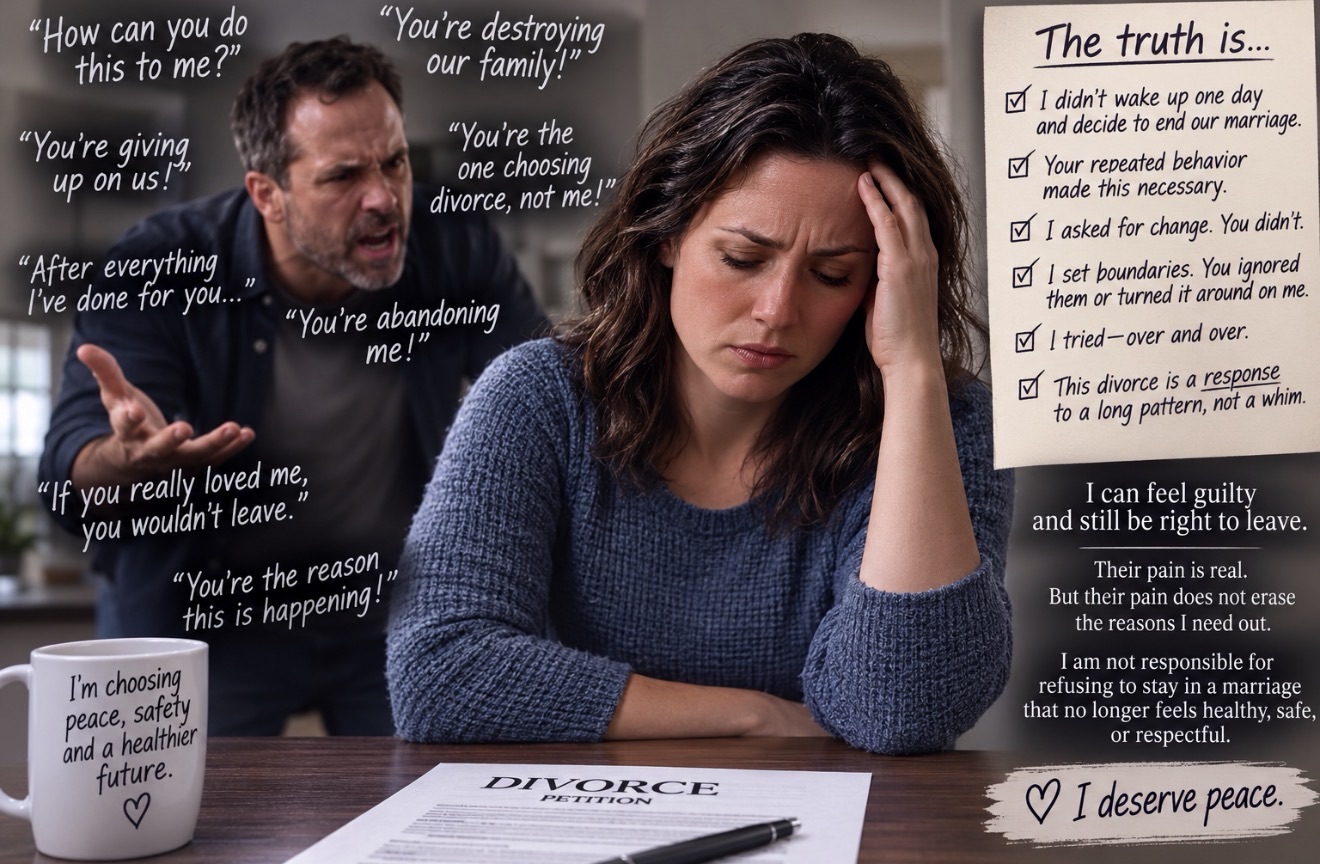
Deciding to file for divorce can be one of the most emotionally complicated decisions a person ever makes. Even when the relationship has become unhealthy, chronically conflictual, emotionally exhausting, or destructive, leaving can produce grief, doubt, fear, and guilt. Research has specifically identified guilt toward a former spouse as a meaningful part of the divorce experience, associated with factors such as regret, compassion, perceived responsibility for the separation, and psychological functioning (Baum et al., 2012). (PubMed⁠)

But there is an important difference between feeling guilty because you care about another person’s pain and being made to feel guilty so that you will reconsider a decision made necessary by an ongoing pattern of harmful behavior.

Sometimes the partner who desperately wants to save the marriage focuses almost entirely on the divorce itself:

“How can you do this to me?”

“You’re destroying our family.”

“You’re giving up on us.”

“After everything I’ve done for you, you’re just walking away.”

“You’re the one choosing divorce, not me.”

Technically, one spouse may be the person who signs and files the paperwork. Psychologically and relationally, however, that does not necessarily mean that person single-handedly created the conditions that ended the marriage.

Sometimes filing for divorce is not the beginning of the problem.

It is the response to a problem that has existed for a very long time.

The Difference Between Filing for Divorce and Causing the Marriage to Fail

When someone says, “You’re the one who filed,” the statement may be factually accurate while leaving out most of the story.

The more important questions may be:

What happened before the filing?

What conversations took place?

What promises were repeatedly made and broken?

Were boundaries repeatedly violated?

Was there chronic dishonesty?

Was there infidelity?

Were there repeated episodes of yelling, humiliation, intimidation, manipulation, neglect, controlling behavior, substance-related chaos, financial irresponsibility, or emotional abandonment?

Did one spouse repeatedly communicate that something needed to change?

Were opportunities for counseling, reconciliation, or behavioral change offered?

And, perhaps most importantly:

Did the person who is now devastated by the divorce take the problems seriously before divorce became a reality?

A divorce petition does not tell the entire story of a marriage.

Imagine someone living in a house where the roof has leaked for years. They repeatedly point to the water damage and say, “We have to repair this.” Their partner minimizes the problem, promises to fix it later, becomes defensive whenever it is mentioned, or blames them for complaining.

Eventually the damage becomes unbearable, and the person moves out.

It would be strange to say:

“You destroyed our home because you moved.”

Moving did not create the leaking roof.

It was a response to living underneath it.

Relationships can work similarly.

“You’re Leaving Me” Can Distract From “Why Are You Leaving?”

A spouse facing divorce understandably experiences powerful emotions. They may feel abandoned, frightened, angry, embarrassed, rejected, or devastated. Those feelings deserve compassion.

But emotions and accountability are two different things.

A person can genuinely be heartbroken that you are leaving while simultaneously refusing to acknowledge the behavior that contributed to your decision.

That distinction matters.

Instead of asking:

“What did I do that brought our marriage to this point?”

they may ask:

“How could you do this to me?”

Instead of saying:

“I understand why you no longer trust me.”

they may say:

“You never gave me another chance.”

Instead of acknowledging:

“My behavior hurt you repeatedly.”

they may say:

“You’re throwing away everything we’ve built.”

The focus subtly shifts.

The conversation stops being about the pattern of behavior that damaged the relationship and becomes a trial concerning the person who finally decided they could no longer live with that pattern.

This type of blame reversal is particularly concerning when it occurs alongside manipulation, intimidation, gaslighting, coercive control, or other forms of emotional abuse. The National Domestic Violence Hotline identifies blaming a partner for one’s own unhealthy or abusive behavior as a warning sign of emotional abuse. It also identifies manipulation, humiliation, intimidation, excessive jealousy, monitoring, isolation, and gaslighting among behaviors that can constitute emotional abuse. (The Hotline⁠)

Not every spouse who says something unfair during a painful divorce is abusive. Divorce brings intense emotions, and people sometimes speak defensively out of grief. What matters is whether there is a persistent pattern of avoiding responsibility while pressuring the other person to assume it.

Guilt Can Become a Powerful Form of Control

Guilt itself is not unhealthy.

Healthy guilt can tell us that we violated our values or harmed another person. It can motivate us to apologize, repair damage, and behave differently.

Manipulated guilt operates differently.

It communicates:

“Your decision to protect yourself is proof that you are hurting me.”

Research examining abusive relationship dynamics has found that shame and guilt can sometimes be deliberately elicited as mechanisms of coercive control. A qualitative study by Culos-Reed and colleagues examined what the researchers called “shame-to-guilt” behaviors—manipulative strategies through which abusive partners trigger shame and guilt in their partners. The researchers identified tactics involving emotional manipulation, threats, parenting, health concerns, religious values, and other emotionally significant areas. (PubMed⁠)

This does not mean that every expression of sadness or guilt during divorce is manipulation.

A spouse is allowed to say:

“I don’t want this divorce.”

They are allowed to cry.

They are allowed to grieve.

They are allowed to wish you would reconsider.

They are even allowed to believe that divorce is the wrong decision.

What becomes problematic is when their emotional pain is repeatedly turned into evidence that you are morally obligated to remain in the relationship regardless of what the relationship has been doing to you.

Compassion does not require continued participation in an unhealthy relationship.

When Accountability Gets Replaced by Blame

Accountability sounds different from guilt-based pressure.

Accountability says:

“I hurt you.”

“I understand that my behavior had consequences.”

“I should have listened when you told me things needed to change.”

“I wish I had handled things differently.”

“I don’t want the marriage to end, but I understand that my actions contributed to where we are.”

“I’m going to work on myself whether you return or not.”

Blame sounds more like:

“Look what you’re doing to me.”

“You’re ruining everyone’s lives.”

“You’re selfish.”

“You’re breaking up the family.”

“If you really loved me, you wouldn’t leave.”

“You’re abandoning me when I need you most.”

The difference is significant.

Accountability examines one’s own behavior. Blame attempts to transfer responsibility for its consequences.

The National Domestic Violence Hotline makes a similar distinction when discussing apologies in abusive relationships. An apology that essentially says, “I’m sorry, but you made me do it,” shifts responsibility rather than accepting it. Genuine accountability requires recognizing one’s choices and taking meaningful steps to change future behavior. (The Hotline⁠)

“But They Say They’ll Change Now”

This can be one of the most emotionally difficult parts of leaving.

Perhaps you spent months—or years—asking for changes.

You asked for communication.

You asked for honesty.

You asked them to stop yelling.

You asked them to seek treatment.

You asked for counseling.

You asked for affection.

You asked them to respect boundaries.

You explained how badly you were hurting.

Nothing produced sustained change.

Then you filed for divorce.

Suddenly there are tears, apologies, promises, therapy appointments, flowers, long messages, declarations of love, and statements such as:

“I finally understand.”

The natural question becomes:

Why did it take losing me for my pain to matter?

That question does not have a simple answer.

Sometimes the threat of losing a marriage genuinely awakens someone to the seriousness of their behavior. People can change, and genuine transformation is possible.

But urgency is not the same thing as transformation.

Promises made when consequences finally arrive should be evaluated according to sustained behavior over time, not simply according to their emotional intensity.

Accountability is demonstrated rather than announced.

The Trap of Remembering Only the Good

Guilt often becomes stronger when separation begins because distance can change how we remember a relationship.

You remember vacations.

Christmas mornings.

Inside jokes.

Their smile.

The day you met.

Your wedding.

The children being born.

The dreams you once shared.

Those memories are real.

But so are the other memories.

A painful marriage does not have to have been painful every minute to have become unhealthy.

This is particularly important in relationships involving abuse or coercive control. Recent psychological research describes how targets of partner abuse can become psychologically entrapped partly through processes of minimizing, justifying, normalizing, or reframing harmful behavior. Such processes can make evaluating the relationship-versus-self-preservation decision extraordinarily difficult (Arriaga et al., 2026). (PubMed⁠)

Earlier qualitative research similarly found that self-blame can influence how people interpret intimate partner aggression, including situations in which partners effectively “turn the tables” and shift responsibility toward the person experiencing the harmful behavior. (PubMed Central (PMC)⁠)

You do not have to erase the good memories to acknowledge the bad ones.

Both can be true:

“We had beautiful moments.”

and

“I cannot continue living this way.”

You Can Love Someone and Still Leave

One of the most damaging misconceptions surrounding divorce is the idea that leaving proves you never loved the person.

Sometimes people leave precisely because they spent years trying not to.

They stayed through disappointment.

They forgave.

They hoped.

They rationalized.

They waited.

They believed promises.

They tried again.

Eventually they recognized that love was no longer enough to compensate for what was happening inside the relationship.

Love does not automatically create emotional safety.

Love does not create accountability.

Love does not cure addiction.

Love does not stop repeated infidelity.

Love does not make someone communicate.

Love does not eliminate controlling behavior.

Love does not force another person to seek help.

Love does not require accepting unlimited harm.

And loving someone does not obligate you to remain married to them.

You Can Feel Guilty Without Being Guilty

This may be the most important distinction.

Feeling guilty and actually being responsible for wrongdoing are not the same thing.

Research confirms that guilt toward a former spouse is common enough during divorce to be specifically measured as a psychological construct. (PubMed⁠)

You may feel guilty because your spouse is crying.

You may feel guilty because your children are upset.

You may feel guilty when you see the empty side of the closet.

You may feel guilty when your spouse tells you they cannot imagine life without you.

You may feel guilty because you made vows you genuinely intended to keep.

You may feel guilty because part of you still loves them.

None of those feelings automatically establishes that leaving is wrong.

Sometimes guilt is simply the emotional cost of making a painful decision that affects someone you care about.

A useful question is not simply:

“Do I feel guilty?”

Ask instead:

“What exactly am I guilty of?”

If the answer is, “I am guilty because they are hurting,” examine that belief carefully.

Causing disappointment is not automatically wrongdoing.

Setting a boundary is not automatically cruelty.

Ending a relationship you can no longer participate in is not automatically betrayal.

And another person’s distress does not automatically create an obligation for you to reverse your decision.

Do Not Confuse Their Consequences With Your Cruelty

When unhealthy behavior continues long enough, consequences eventually appear.

The consequence might be separation.

It might be loss of trust.

It might be emotional distance.

It might ultimately be divorce.

The person experiencing those consequences may sincerely dislike them. But disliking a consequence does not mean the consequence was created maliciously by the other spouse.

This distinction becomes especially important when psychological abuse has occurred. Research has associated psychological abuse with significant mental-health consequences, including symptoms of depression and posttraumatic stress, even after accounting for other forms of partner violence. (PubMed⁠)

More recent research on psychological abuse also emphasizes potential harms involving diminished agency, loss of self-belief, and feelings of entrapment. (PubMed⁠)

Therefore, repeatedly telling someone that they are selfish or cruel for leaving can be particularly powerful when that person’s confidence in their own judgment has already been weakened.

When Guilt Continues After Separation

Leaving does not necessarily end unhealthy relational dynamics.

A review of 48 studies concerning post-separation abuse found that harmful behavior can continue after relationships end and may involve psychological, legal, economic, and other forms of abuse, including using children as part of the conflict. (PubMed⁠)

That makes boundaries especially important during high-conflict separation.

If every conversation becomes another attempt to make you defend the divorce, it may become necessary to stop debating the decision.

You do not have to repeatedly prosecute your case before your spouse.

You can communicate practical matters without endlessly defending why you left.

A boundary might sound like:

“I understand that you disagree with my decision and that you’re hurting. I am not going to continue arguing about whether I am allowed to leave. I am willing to discuss the practical matters we need to resolve respectfully.”

That is not necessarily coldness.

It is a boundary.

Separate Compassion From Responsibility

You can have compassion for your spouse’s suffering without assuming responsibility for eliminating it.

You can say:

“I know you’re hurting.”

without saying:

“Therefore I must stay.”

You can say:

“I’m sorry our marriage ended this way.”

without saying:

“Everything was my fault.”

You can say:

“I wish things had been different.”

without saying:

“I should return to the same circumstances that caused me to leave.”

Mature compassion allows two realities to coexist:

Their pain matters.

Your well-being matters too.

Look at Patterns, Not the Last Conversation

When guilt overwhelms you, return to the history of the relationship rather than evaluating everything according to your spouse’s reaction to divorce.

Ask yourself:

  • What was happening six months before I decided to leave?
  • What was happening two years before?
  • What had I repeatedly asked to change?
  • What boundaries had I communicated?
  • Were promises followed by sustained behavioral changes?
  • Did I feel emotionally safe expressing concerns?
  • Was I becoming healthier or less healthy inside the relationship?
  • Was I staying because the relationship was improving, or because I was afraid of hurting the other person?
  • If nothing changed for another five years, would I willingly choose this marriage again?

Those questions move the focus away from the emotional intensity of the present moment and toward the actual pattern that produced the decision.

Divorce Does Not Require a Villain

There is another important caution.

Not every failed marriage involves an abuser and a victim.

Sometimes two basically decent people develop destructive patterns together.

Sometimes incompatibility becomes impossible to overcome.

Sometimes both partners caused significant harm.

Sometimes one person contributed much more heavily than the other.

And sometimes one person’s behavior clearly became abusive, coercive, or dangerous.

Avoiding inappropriate guilt does not require rewriting your spouse as entirely evil or yourself as entirely innocent.

A healthier position is:

“I can acknowledge my mistakes without accepting responsibility for yours.”

That is accountability without self-erasure.

When There Has Been Emotional Abuse or Coercive Control

If the marriage has involved intimidation, threats, stalking, coercive control, physical violence, sexual coercion, severe financial control, threats involving children, or threats of self-harm intended to prevent separation, ordinary divorce advice may not be sufficient.

Separation can sometimes be a particularly vulnerable period in abusive relationships. Research on post-separation abuse demonstrates that abusive tactics may persist or evolve after a relationship ends. (PubMed⁠)

In those circumstances, decisions concerning communication, meetings, housing, finances, children, and legal proceedings should be made with appropriate professional support and attention to safety.

The Question That Changes Everything

When your spouse says:

“How could you do this to me?”

you may find yourself drowning in guilt.

But there is another question worth asking:

“What happened between us that brought me to the point where divorce felt necessary?”

That question does not remove your responsibility.

It puts responsibility back into its proper context.

Marriage is a relationship.

Divorce paperwork may have one person’s signature on the first page, but the history behind that signature can contain years of experiences.

Filing is an action.

The reasons behind filing are the story.

Do not confuse the two.

Final Thoughts

The person who files for divorce is not automatically the person who destroyed the marriage.

Sometimes filing is the final acknowledgment that something has already become unsustainable.

Your spouse may genuinely love you.

They may genuinely be devastated.

They may genuinely wish you would stay.

Their feelings deserve to be recognized.

But their pain does not erase the history that led you here.

Healthy accountability requires everyone involved to examine their own choices. You can examine yours. You can apologize for the things you genuinely did wrong. You can learn from your mistakes. You can treat your spouse with dignity during the divorce.

But you do not have to carry their portion of the responsibility simply because they refuse to pick it up.

Perhaps the healthiest sentence a person leaving a destructive marriage can eventually learn to say is:

“I am responsible for how I leave. I am not responsible for pretending there was no reason I needed to.”

That distinction can be the beginning of moving from guilt toward clarity—and eventually toward peace.

References

Arriaga, X. B., Florkiewicz, R. M., & Gu, Y. (2026). The psychological entrapment of partner abuse. Current Opinion in Psychology, 70, 102305. https://doi.org/10.1016/j.copsyc.2026.102305 (PubMed⁠)

Baum, N., et al. (2012). Assessing guilt toward the former spouse: The Guilt in Separation Scale. Psychological Assessment. https://doi.org/10.1037/a0027444 (PubMed⁠)

Beck, C. J. A., Anderson, E. R., O’Hara, K. L., & Benjamin, G. A. H. (2013). Patterns of intimate partner violence in a large, epidemiological sample of divorcing couples. Journal of Family Psychology, 27(5), 743–753. https://doi.org/10.1037/a0034182 (PubMed⁠)

Culos-Reed, S. N., et al. (2025). “Don’t you love me?” Abusers’ use of shame-to-guilt to coercively control 2SLGBTQQIA+ individuals and rural women experiencing intimate partner violence. Women’s Health. https://doi.org/10.1177/17455057251335361 (PubMed⁠)

McLindon, E. V.-M., Brown, C., McKenzie, M., Tarzia, L., & Hegarty, K. (2026). Development and validation of the Psychological Abuse in Relationships Scale. Journal of Interpersonal Violence, 41(9–10), 1985–2008. https://doi.org/10.1177/08862605251325912 (PubMed⁠)

Mechanic, M. B., Weaver, T. L., & Resick, P. A. (2008). Mental health consequences of intimate partner abuse: A multidimensional assessment of four different forms of abuse. Violence Against Women, 14(6), 634–654. https://doi.org/10.1177/1077801208319283 (PubMed⁠)

National Domestic Violence Hotline. (n.d.). What is emotional abuse? (The Hotline⁠)

National Domestic Violence Hotline. (n.d.). What if my abusive partner apologizes? (The Hotline⁠)

Spearman, K. J., et al. (2023). Post-separation abuse: A literature review connecting tactics to harm. Journal of Family Trauma, Child Custody & Child Development. https://doi.org/10.1080/26904586.2023.2177233 (PubMed⁠)

About the Author

John S. Collier, MSW, LCSW-S is a licensed clinical social worker, mental health professional, writer, and educator whose work focuses on relationships, emotional wellness, trauma, behavioral health, personal growth, and the complicated human experiences surrounding marriage, separation, grief, and major life transitions.

Through his professional background in social work and behavioral health, Collier approaches relationship struggles from both a clinical and deeply human perspective. His writing emphasizes personal accountability while recognizing that healthy relationships require responsibility from both partners. He encourages readers to distinguish between genuine remorse and destructive self-blame, between forgiveness and permission, and between loving another person and sacrificing one’s emotional well-being to maintain a relationship that has become unhealthy.

His work seeks to translate psychological and relationship concepts into practical language that ordinary people can apply to their everyday lives. Whether addressing divorce, depression, anxiety, trauma, family relationships, personal boundaries, or emotional healing, his goal is to help individuals better understand their experiences and move toward healthier, more intentional lives.

This article is intended for educational purposes and is not a substitute for individualized mental-health, legal, or medical advice.

You Should Never Have to Play Detective: How Healthy Relationships Create Security Instead of Suspicion

One of the most exhausting experiences in a romantic relationship is feeling like you have to become an investigator rather than a partner. You begin analyzing text messages, studying social media activity, questioning changes in routine, replaying conversations in your mind, and searching for hidden meanings behind every word or behavior. Instead of experiencing peace, your emotional energy is consumed by uncertainty.

Many people mistakenly believe that this constant vigilance is proof of how deeply they love someone. In reality, it is often evidence that something fundamental is missing: emotional security.

A healthy relationship does not require detective work. It naturally cultivates trust through consistency, honesty, transparency, and emotional safety. Security is not something one partner repeatedly demands; it is something both partners consistently create.

The statement, “A healthy relationship doesn’t make you feel like you have to play detective. It makes you feel secure without asking,” captures one of the clearest indicators of relational health. Security is not created through endless reassurance alone—it develops because a person’s actions repeatedly demonstrate reliability and integrity.


Why People Become Detectives

When trust begins to erode, the human brain naturally attempts to fill in missing information. From an evolutionary perspective, uncertainty represents potential danger. The brain would rather create explanations—even inaccurate ones—than tolerate ambiguity.

Psychologists refer to this as uncertainty reduction, the natural tendency to seek information when situations feel unpredictable (Berger & Calabrese, 1975).

This often leads individuals to:

  • Check phones
  • Monitor social media
  • Question every delay
  • Replay conversations repeatedly
  • Search for inconsistencies
  • Compare current behavior with past patterns
  • Read hidden meanings into ordinary events

Ironically, the more someone investigates, the less secure they often become. Every unanswered question creates three new questions.

The relationship gradually shifts from connection to surveillance.


The Difference Between Healthy Curiosity and Hypervigilance

Healthy partners ask questions. – Hypervigilant partners conduct investigations.

The difference lies in motivation.

Healthy curiosity seeks understanding. – Hypervigilance seeks protection from anticipated betrayal.

Individuals who have experienced betrayal, abandonment, inconsistent caregiving, or previous infidelity frequently develop heightened sensitivity to potential threats (Mikulincer & Shaver, 2016). Their nervous system learns that safety cannot be assumed.

As a result, they begin searching for evidence that confirms their fears. Unfortunately, anxiety rarely says,

“Everything is probably okay.”

Instead it whispers,

“Look again. You probably missed something.”


What Creates Emotional Security?

Security is not created by grand romantic gestures. It is created by ordinary consistency repeated over time. Research by psychologist John Gottman has consistently shown that trust develops through countless small interactions in which partners repeatedly choose honesty, responsiveness, and emotional availability (Gottman & Silver, 2015).

Security grows when someone:

  • Does what they say they will do.
  • Keeps promises.
  • Is emotionally available.
  • Answers difficult questions honestly.
  • Communicates openly.
  • Shows consistency between words and actions.
  • Makes their partner feel valued rather than tolerated.

Trust is not built in dramatic moments. It is built in ordinary Tuesdays.


Transparency Is Different Than Surveillance

Some people mistakenly believe that complete surveillance creates trust. It does not. Knowing every password does not automatically produce security. Tracking someone’s location does not automatically eliminate fear. Reading every text message does not automatically heal betrayal. Transparency is voluntarily offered. Surveillance is demanded. Healthy couples willingly share information because they have nothing to hide—not because they are forced to prove their innocence every day. Trust cannot survive when one partner constantly feels like they are on trial.


Insecure Relationships Create Constant Guessing

When emotional safety is absent, people begin asking themselves questions like:

  • “Why haven’t they texted?”
  • “Why did they seem distant?”
  • “Who liked that picture?”
  • “Why did they smile at that person?”
  • “Why did they suddenly become protective of their phone?”

Over time these questions become mentally exhausting. The relationship slowly becomes less about love and more about gathering evidence. Instead of enjoying each other’s presence, partners begin managing each other’s suspicions. This is emotionally unsustainable.


Secure Relationships Reduce Mental Noise

One of the most overlooked benefits of a healthy relationship is mental quietness. You stop wondering where you stand. You stop wondering if you’re enough. You stop wondering whether affection will disappear tomorrow. Secure attachment provides what psychologists call a safe haven and a secure base (Bowlby, 1988).

A safe haven is someone who provides comfort during stress. A secure base is someone whose presence allows you to confidently explore life because you know they will remain emotionally available. When those needs are consistently met, anxiety decreases. Your mind becomes quieter.


Consistency Is More Convincing Than Words

Many unhealthy relationships are filled with reassuring words but inconsistent behavior. Someone may repeatedly say:

  • “Trust me.”
  • “Nothing’s wrong.”
  • “You’re overthinking.”

Yet their behavior continues creating confusion. Research consistently demonstrates that trust is based more on predictable behavior than verbal reassurance (Rempel, Holmes, & Zanna, 1985). People believe patterns. Not promises.


Emotional Safety Changes Everything

Emotional safety allows people to become fully themselves. They no longer fear punishment for expressing feelings. They no longer hide needs. They no longer worry that honesty will be weaponized against them. Psychologist Sue Johnson, developer of Emotionally Focused Therapy (EFT), explains that secure emotional bonds reduce distress because partners become reliable sources of comfort rather than uncertainty (Johnson, 2019). Healthy love feels emotionally predictable. Not emotionally confusing.


When Detective Work Is Actually Warning You

There is an important distinction that should not be ignored. Sometimes people feel suspicious because anxiety is distorting reality. Other times, their instincts are responding to genuine inconsistencies. If someone repeatedly:

  • Lies
  • Hides information
  • Gaslights concerns
  • Breaks promises
  • Violates boundaries
  • Creates confusion intentionally

then the issue is not insecurity. The issue is trustworthiness. Healthy relationships welcome honest conversations. Unhealthy relationships often punish them. The goal is never blind trust. The goal is earned trust.


Building a Relationship That Doesn’t Require Investigation

Healthy couples intentionally cultivate trust. Some practical ways include:

  • Communicating honestly, even when conversations are uncomfortable.
  • Being consistent between words and actions.
  • Following through on commitments.
  • Taking responsibility for mistakes without defensiveness.
  • Offering reassurance through dependable behavior rather than empty promises.
  • Addressing concerns early before resentment grows.
  • Respecting healthy boundaries while remaining emotionally transparent.
  • Choosing integrity when no one is watching.

Over time, these behaviors create a relationship where partners naturally relax into security.


The Peace of Being Known

Perhaps the greatest gift of a healthy relationship is not excitement. It is peace. It is the quiet confidence that someone chooses you every day. It is knowing you do not have to decode hidden messages. You do not have to search for clues. You do not have to become an investigator. You simply experience what trust feels like. Healthy love removes the constant need for proof because its evidence is visible every day. Security is not the absence of questions. It is the consistent presence of answers. A healthy relationship allows your heart to rest because the person beside you has repeatedly shown—through honesty, consistency, and genuine care—that your trust is safe with them.


About the Author

John S. Collier, MSW, LCSW-S is a licensed clinical social worker, author, educator, and speaker with extensive experience helping individuals, couples, and families navigate emotional, behavioral, and relational challenges. Throughout his career, he has specialized in cognitive behavioral therapy, relationship dynamics, anxiety disorders, trauma recovery, and emotional resilience. His writing bridges psychological research with practical, everyday application, presenting complex concepts in language that is both accessible and meaningful. John is passionate about equipping readers with evidence-based tools that foster healthier relationships, emotional well-being, and personal growth. Through his books and articles, he encourages readers to build lives marked by wisdom, authenticity, resilience, and hope.


References

Berger, C. R., & Calabrese, R. J. (1975). Some explorations in initial interaction and beyond: Toward a developmental theory of interpersonal communication. Human Communication Research, 1(2), 99–112.

Bowlby, J. (1988). A Secure Base: Parent-Child Attachment and Healthy Human Development. New York, NY: Basic Books.

Gottman, J. M., & Silver, N. (2015). The Seven Principles for Making Marriage Work (Revised ed.). New York, NY: Harmony Books.

Johnson, S. M. (2019). Attachment Theory in Practice: Emotionally Focused Therapy (EFT) with Individuals, Couples, and Families. New York, NY: Guilford Press.

Mikulincer, M., & Shaver, P. R. (2016). Attachment in Adulthood: Structure, Dynamics, and Change (2nd ed.). New York, NY: Guilford Press.

Rempel, J. K., Holmes, J. G., & Zanna, M. P. (1985). Trust in close relationships. Journal of Personality and Social Psychology, 49(1), 95–112.

Do I Manipulate My Parents?

Have you ever convinced your parents to change their minds by making them feel guilty, throwing a tantrum, or promising something you didn’t intend to follow through on? If so, you might be using manipulation. Don’t worry—you’re not alone, and this doesn’t make you a bad person. Understanding why you might manipulate and how to communicate better with your parents can make your relationships stronger and healthier.

What is Manipulation?

Manipulation means influencing someone to do what you want, often by using guilt, emotions, or other tactics. For example:

  • Complaining about how unfair rules are until your parents give in.
  • Saying, “You never let me do anything,” to make them feel bad.
  • Pitting your parents against each other to get a “yes” when one says “no.”

Sometimes manipulation happens without you even realizing it!


Why Do Teens Manipulate Their Parents?

It’s normal to want freedom, and you might think manipulating is the best way to get it. Here are some common reasons:

  1. Independence: You’re growing up and want to make your own decisions, but you might not know how to ask for it directly.
  2. Avoiding Conflict: Manipulation can feel easier than talking about what you really need or want.
  3. Testing Boundaries: You might be figuring out how far you can push the rules.
  4. Emotional Needs: If you feel misunderstood or ignored, manipulation might seem like the only way to get attention.

According to psychologist Dr. Laurence Steinberg, teens are still developing their ability to think long-term. This can make quick fixes like manipulation more appealing (Steinberg, 2014).


How to Tell If You’re Manipulating

Here are some signs to look for:

  • You often feel guilty after conversations with your parents.
  • You make promises you don’t plan to keep, like saying, “I’ll clean my room later,” but never do.
  • You use your emotions (anger, crying, etc.) to get what you want instead of calmly explaining why you need it.

If these behaviors sound familiar, it’s a good idea to try a different approach.


How to Communicate Instead of Manipulate

Healthy communication can help you get what you want without hurting your relationship with your parents. Here’s how to start:

  1. Be Honest
    Instead of twisting the truth, explain how you feel and what you need. For example, “I feel left out when my friends are allowed to go out, and I’m not. Can we talk about it?”
  2. Listen to Their Side
    Parents have reasons for their decisions, even if they seem unfair. Listening can help you understand their perspective.
  3. Compromise
    Negotiating, like agreeing to finish homework before hanging out with friends, shows responsibility.
  4. Stay Calm
    Even if you’re upset, try to speak calmly instead of yelling or crying. It helps them take you seriously.

Why It’s Important to Stop Manipulation

When you manipulate your parents, it might work temporarily, but it can hurt your relationship in the long run. Manipulation can make your parents feel disrespected or tricked, which can lead to mistrust. Learning to communicate honestly helps you build a relationship based on trust and mutual respect.


Figuring out how to get what you want without manipulation is a part of growing up. It might take practice, but learning to be open, honest, and calm with your parents will help them see you as mature and responsible. And remember, everyone makes mistakes—what matters is trying to do better.

This article has been written by John S. Collier, MSW, LCSW. Mr. Collier has over 25 years experience in the social work field. He currently serves as the Executive Director and Outpatient Behavioral Health Therapist through Southeast Kentucky Behavioral Health, LLC based out of London Kentucky. He may be reached by phone (606) 657-0532 extension 101 or by email at john@sekybh.

References:

  1. Siegel, D. J., & Bryson, T. P. (2012).The Whole-Brain Child: 12 Revolutionary Strategies to Nurture Your Child’s Developing Mind. Delacorte Press.
    • Explores how understanding brain development can improve parent-teen communication.
  2. Ginsburg, K. R. (2011).Building Resilience in Children and Teens: Giving Kids Roots and Wings. American Academy of Pediatrics.
    • Provides insights into fostering resilience and healthy relationships in teens.
  3. American Academy of Pediatrics. (2018).Parenting Your Teenager: Strategies for Building Trust and Respect.
    • Offers guidance on managing common challenges in adolescence and fostering mutual respect.
  4. Berk, L. E. (2020).Development Through the Lifespan (7th ed.). Pearson.
    • A comprehensive textbook on human development, including insights into the teenage years.
  5. Maccoby, E. E., & Martin, J. A. (1983). “Socialization in the Context of the Family: Parent-Child Interaction.” Handbook of Child Psychology.
    • Discusses how family dynamics influence adolescent behavior.
  6. Arnett, J. J. (2014).Emerging Adulthood: The Winding Road from the Late Teens Through the Twenties. Oxford University Press.
    • Explores the transition from adolescence to adulthood and its effects on behavior and relationships.
  7. American Psychological Association. (2020).
    • Articles and resources on adolescent development and communication strategies. Visit www.apa.org.
  8. Santrock, J. W. (2021).Adolescence (17th ed.). McGraw Hill.
    • Covers the psychological and social changes teens experience and their implications for family relationships.

What is Love Bombing and How to Avoid It
May be an image of 2 people and heart

In relationships, the initial stages are often filled with excitement, attention, and affection. However, there’s a line between genuine affection and manipulative behavior. One tactic that has become increasingly recognized and discussed is “love bombing.” This seemingly harmless form of intense affection can lead to harmful consequences for the individual on the receiving end. Let’s explore what love bombing is, the signs to watch for, and how to avoid falling into its trap.

What is Love Bombing?

Love bombing is a manipulation tactic where an individual overwhelms someone with excessive attention, compliments, and gifts to gain control over them. While the attention can feel flattering and genuine at first, it’s often a strategic ploy to create dependency and quickly escalate the relationship. The person performing the love bombing might shower their target with affection, constant communication, and seemingly sincere gestures, only to later use this bond for control and even emotional abuse.

The term “love bombing” is often associated with narcissistic personalities, as it serves their need for control, admiration, and validation. However, anyone can exhibit love bombing behavior, whether intentionally manipulative or subconsciously driven by their own insecurities.

Signs of Love Bombing

Recognizing love bombing can be challenging, as the behavior can easily be mistaken for genuine interest and passion. However, there are certain red flags that can help you identify it:

  • 1. Overwhelming Affection Too Quickly: In the early stages of a relationship, love bombers often express intense feelings of love and commitment. They may talk about your future together, use words like “soulmate,” or declare love within a few days or weeks.
  • 2. Constant Attention and Contact: While frequent communication is normal in budding relationships, love bombers will often take it to an extreme. They may bombard you with texts, calls, and social media messages, making it difficult for you to have personal space.
  • 3. Excessive Gift-Giving: Love bombers often shower their targets with expensive gifts or lavish gestures. While gifts can be a normal part of relationships, this behavior is typically marked by an extreme level of generosity meant to create a sense of obligation and guilt.
  • 4. Isolating You from Others: In an effort to create dependency, a love bomber may attempt to isolate you from friends and family. They might criticize your loved ones, make you feel guilty for spending time away, or frame others as obstacles to your relationship.
  • 5. Quick Escalation of Commitment: A love bomber may push for immediate commitment, such as moving in together or getting married. This is often a tactic to secure control over the relationship before you have time to question or evaluate it.

Why Love Bombing is Harmful

Love bombing can have serious emotional consequences. It often leads to confusion, dependency, and a cycle of highs and lows, as love bombers might suddenly withdraw their affection or exhibit controlling behaviors. This emotional rollercoaster can erode self-esteem and leave individuals feeling trapped and manipulated. Over time, the cycle can lead to more severe emotional or even physical abuse.

How to Avoid Love Bombing

  • 1. Take Your Time: Healthy relationships take time to build. Be cautious of relationships that move too quickly or seem “too good to be true.” If someone is pressuring you to commit or express deep feelings early on, it’s a sign to take a step back.
  • 2. Set Boundaries: Establish and maintain clear boundaries, even if the other person protests. Boundaries are essential for maintaining autonomy and ensuring that both parties are comfortable.
  • 3. Listen to Your Intuition: If something feels off, trust your gut. Love bombing can be intoxicating, but if you sense a lack of authenticity, don’t ignore it. Take note of any discomfort or hesitation, as these feelings often indicate a need to reassess the relationship.
  • 4. Maintain Your Support System: Keep in touch with friends and family and involve them in your relationship decisions. Love bombers often isolate their targets, so maintaining a strong support system can provide you with perspective and objective feedback.
  • 5. Observe Actions Over Time: Genuine affection is consistent and not overwhelming. Pay attention to how the person behaves over time, particularly if they continue to respect your boundaries and support your autonomy as the relationship progresses.
  • 6. Educate Yourself: Understanding manipulative behaviors like love bombing can help you recognize them in the future. By becoming aware of these tactics, you’re less likely to fall into their trap.

Love bombing is a deceptive tactic that may initially appear as passionate love but can ultimately lead to emotional harm. By being aware of the signs, trusting your intuition, and setting boundaries, you can protect yourself from manipulative relationships. Healthy relationships are built on mutual respect, trust, and a balanced exchange of affection. If someone’s behavior feels overwhelming or controlling, it’s okay to step back and re-evaluate the relationship. Remember, real love grows over time and doesn’t need to be forced.

This article has been written by John S. Collier, MSW, LCSW. Mr. Collier has over 25 years of experience in the social work field and is based in London Kentucky through Southeast Kentucky Behavioral Health, LLC. Mr. Collier may be reached by phone at (606) 657–0532 extension 101 or by email at john@sekybh.com.

References

  • Braiker, H. B. (2001). Who’s Pulling Your Strings? How to Break the Cycle of Manipulation and Regain Control of Your Life. McGraw Hill.
  • Campbell, W. K., & Foster, C. A. (2002). Narcissism and Commitment in Romantic Relationships: An Investment Model Analysis. Personality and Social Psychology Bulletin, 28(4), 484-495.
  • Freeman, L. (2018). Manipulative Behavior in Relationships: How to Spot It and Protect Yourself. Psychology Today. Retrieved from https://www.psychologytoday.com
  • Hammond, C. (2018). The Dangers of Love Bombing: Recognize the Signs. Journal of Personal Relationships and Social Psychology, 75(2), 231-243.
  • Lancer, D. (2017). Dealing with Narcissists: How to Break Free from the Cycle of Manipulation and Abuse. Hazelden Publishing.
  • Stosny, S. (2019). Emotional Abuse in Intimate Relationships. Psychology Today. Retrieved from https://www.psychologytoday.com