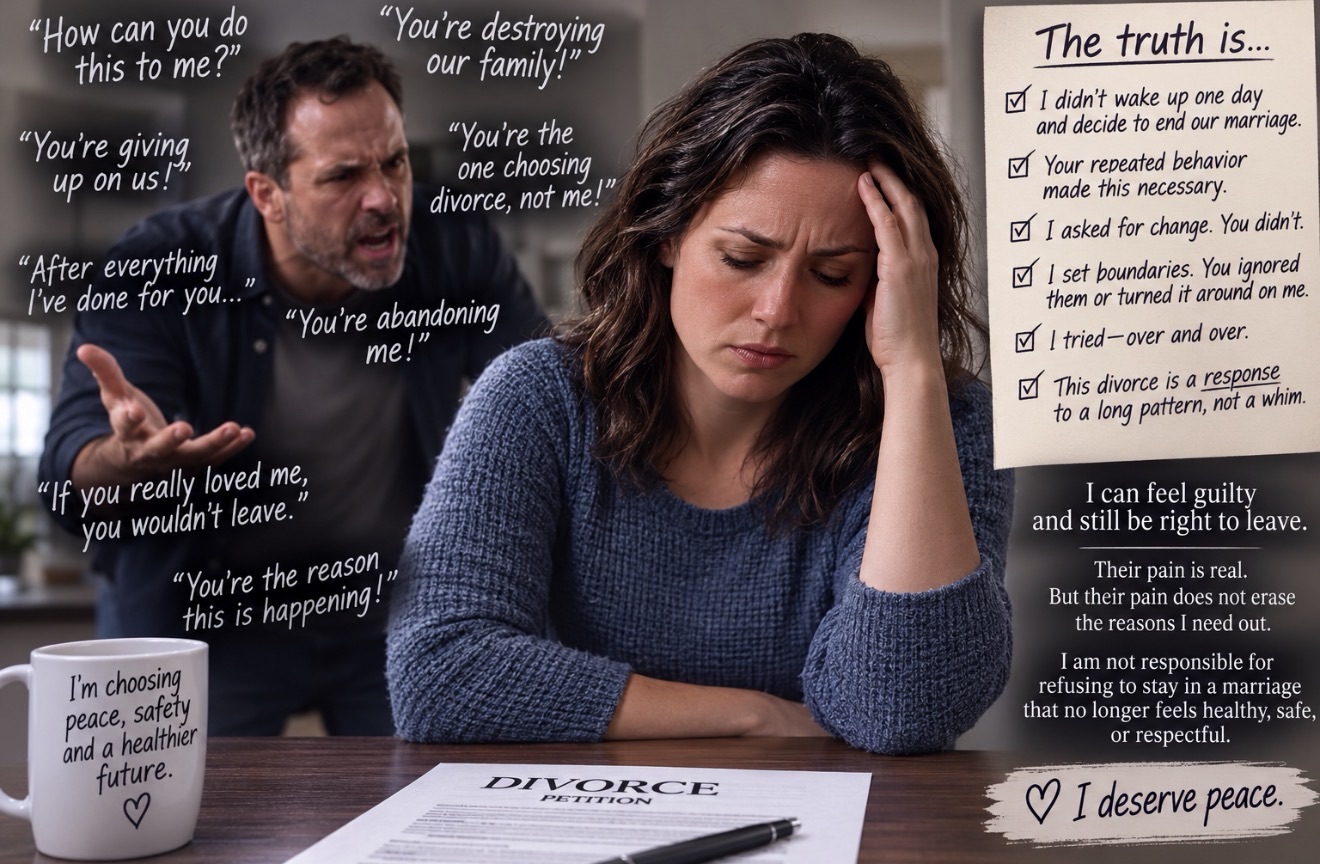
When Your Partner Makes You Feel Guilty for Filing for Divorce: When Blame Replaces Accountability

Deciding to file for divorce can be one of the most emotionally complicated decisions a person ever makes. Even when the relationship has become unhealthy, chronically conflictual, emotionally exhausting, or destructive, leaving can produce grief, doubt, fear, and guilt. Research has specifically identified guilt toward a former spouse as a meaningful part of the divorce experience, associated with factors such as regret, compassion, perceived responsibility for the separation, and psychological functioning (Baum et al., 2012). (PubMed)
But there is an important difference between feeling guilty because you care about another person’s pain and being made to feel guilty so that you will reconsider a decision made necessary by an ongoing pattern of harmful behavior.
Sometimes the partner who desperately wants to save the marriage focuses almost entirely on the divorce itself:
“How can you do this to me?”
“You’re destroying our family.”
“You’re giving up on us.”
“After everything I’ve done for you, you’re just walking away.”
“You’re the one choosing divorce, not me.”
Technically, one spouse may be the person who signs and files the paperwork. Psychologically and relationally, however, that does not necessarily mean that person single-handedly created the conditions that ended the marriage.
Sometimes filing for divorce is not the beginning of the problem.
It is the response to a problem that has existed for a very long time.
The Difference Between Filing for Divorce and Causing the Marriage to Fail
When someone says, “You’re the one who filed,” the statement may be factually accurate while leaving out most of the story.
The more important questions may be:
What happened before the filing?
What conversations took place?
What promises were repeatedly made and broken?
Were boundaries repeatedly violated?
Was there chronic dishonesty?
Was there infidelity?
Were there repeated episodes of yelling, humiliation, intimidation, manipulation, neglect, controlling behavior, substance-related chaos, financial irresponsibility, or emotional abandonment?
Did one spouse repeatedly communicate that something needed to change?
Were opportunities for counseling, reconciliation, or behavioral change offered?
And, perhaps most importantly:
Did the person who is now devastated by the divorce take the problems seriously before divorce became a reality?
A divorce petition does not tell the entire story of a marriage.
Imagine someone living in a house where the roof has leaked for years. They repeatedly point to the water damage and say, “We have to repair this.” Their partner minimizes the problem, promises to fix it later, becomes defensive whenever it is mentioned, or blames them for complaining.
Eventually the damage becomes unbearable, and the person moves out.
It would be strange to say:
“You destroyed our home because you moved.”
Moving did not create the leaking roof.
It was a response to living underneath it.
Relationships can work similarly.
“You’re Leaving Me” Can Distract From “Why Are You Leaving?”
A spouse facing divorce understandably experiences powerful emotions. They may feel abandoned, frightened, angry, embarrassed, rejected, or devastated. Those feelings deserve compassion.
But emotions and accountability are two different things.
A person can genuinely be heartbroken that you are leaving while simultaneously refusing to acknowledge the behavior that contributed to your decision.
That distinction matters.
Instead of asking:
“What did I do that brought our marriage to this point?”
they may ask:
“How could you do this to me?”
Instead of saying:
“I understand why you no longer trust me.”
they may say:
“You never gave me another chance.”
Instead of acknowledging:
“My behavior hurt you repeatedly.”
they may say:
“You’re throwing away everything we’ve built.”
The focus subtly shifts.
The conversation stops being about the pattern of behavior that damaged the relationship and becomes a trial concerning the person who finally decided they could no longer live with that pattern.
This type of blame reversal is particularly concerning when it occurs alongside manipulation, intimidation, gaslighting, coercive control, or other forms of emotional abuse. The National Domestic Violence Hotline identifies blaming a partner for one’s own unhealthy or abusive behavior as a warning sign of emotional abuse. It also identifies manipulation, humiliation, intimidation, excessive jealousy, monitoring, isolation, and gaslighting among behaviors that can constitute emotional abuse. (The Hotline)
Not every spouse who says something unfair during a painful divorce is abusive. Divorce brings intense emotions, and people sometimes speak defensively out of grief. What matters is whether there is a persistent pattern of avoiding responsibility while pressuring the other person to assume it.
Guilt Can Become a Powerful Form of Control
Guilt itself is not unhealthy.
Healthy guilt can tell us that we violated our values or harmed another person. It can motivate us to apologize, repair damage, and behave differently.
Manipulated guilt operates differently.
It communicates:
“Your decision to protect yourself is proof that you are hurting me.”
Research examining abusive relationship dynamics has found that shame and guilt can sometimes be deliberately elicited as mechanisms of coercive control. A qualitative study by Culos-Reed and colleagues examined what the researchers called “shame-to-guilt” behaviors—manipulative strategies through which abusive partners trigger shame and guilt in their partners. The researchers identified tactics involving emotional manipulation, threats, parenting, health concerns, religious values, and other emotionally significant areas. (PubMed)
This does not mean that every expression of sadness or guilt during divorce is manipulation.
A spouse is allowed to say:
“I don’t want this divorce.”
They are allowed to cry.
They are allowed to grieve.
They are allowed to wish you would reconsider.
They are even allowed to believe that divorce is the wrong decision.
What becomes problematic is when their emotional pain is repeatedly turned into evidence that you are morally obligated to remain in the relationship regardless of what the relationship has been doing to you.
Compassion does not require continued participation in an unhealthy relationship.
When Accountability Gets Replaced by Blame
Accountability sounds different from guilt-based pressure.
Accountability says:
“I hurt you.”
“I understand that my behavior had consequences.”
“I should have listened when you told me things needed to change.”
“I wish I had handled things differently.”
“I don’t want the marriage to end, but I understand that my actions contributed to where we are.”
“I’m going to work on myself whether you return or not.”
Blame sounds more like:
“Look what you’re doing to me.”
“You’re ruining everyone’s lives.”
“You’re selfish.”
“You’re breaking up the family.”
“If you really loved me, you wouldn’t leave.”
“You’re abandoning me when I need you most.”
The difference is significant.
Accountability examines one’s own behavior. Blame attempts to transfer responsibility for its consequences.
The National Domestic Violence Hotline makes a similar distinction when discussing apologies in abusive relationships. An apology that essentially says, “I’m sorry, but you made me do it,” shifts responsibility rather than accepting it. Genuine accountability requires recognizing one’s choices and taking meaningful steps to change future behavior. (The Hotline)
“But They Say They’ll Change Now”
This can be one of the most emotionally difficult parts of leaving.
Perhaps you spent months—or years—asking for changes.
You asked for communication.
You asked for honesty.
You asked them to stop yelling.
You asked them to seek treatment.
You asked for counseling.
You asked for affection.
You asked them to respect boundaries.
You explained how badly you were hurting.
Nothing produced sustained change.
Then you filed for divorce.
Suddenly there are tears, apologies, promises, therapy appointments, flowers, long messages, declarations of love, and statements such as:
“I finally understand.”
The natural question becomes:
Why did it take losing me for my pain to matter?
That question does not have a simple answer.
Sometimes the threat of losing a marriage genuinely awakens someone to the seriousness of their behavior. People can change, and genuine transformation is possible.
But urgency is not the same thing as transformation.
Promises made when consequences finally arrive should be evaluated according to sustained behavior over time, not simply according to their emotional intensity.
Accountability is demonstrated rather than announced.
The Trap of Remembering Only the Good
Guilt often becomes stronger when separation begins because distance can change how we remember a relationship.
You remember vacations.
Christmas mornings.
Inside jokes.
Their smile.
The day you met.
Your wedding.
The children being born.
The dreams you once shared.
Those memories are real.
But so are the other memories.
A painful marriage does not have to have been painful every minute to have become unhealthy.
This is particularly important in relationships involving abuse or coercive control. Recent psychological research describes how targets of partner abuse can become psychologically entrapped partly through processes of minimizing, justifying, normalizing, or reframing harmful behavior. Such processes can make evaluating the relationship-versus-self-preservation decision extraordinarily difficult (Arriaga et al., 2026). (PubMed)
Earlier qualitative research similarly found that self-blame can influence how people interpret intimate partner aggression, including situations in which partners effectively “turn the tables” and shift responsibility toward the person experiencing the harmful behavior. (PubMed Central (PMC))
You do not have to erase the good memories to acknowledge the bad ones.
Both can be true:
“We had beautiful moments.”
and
“I cannot continue living this way.”
You Can Love Someone and Still Leave
One of the most damaging misconceptions surrounding divorce is the idea that leaving proves you never loved the person.
Sometimes people leave precisely because they spent years trying not to.
They stayed through disappointment.
They forgave.
They hoped.
They rationalized.
They waited.
They believed promises.
They tried again.
Eventually they recognized that love was no longer enough to compensate for what was happening inside the relationship.
Love does not automatically create emotional safety.
Love does not create accountability.
Love does not cure addiction.
Love does not stop repeated infidelity.
Love does not make someone communicate.
Love does not eliminate controlling behavior.
Love does not force another person to seek help.
Love does not require accepting unlimited harm.
And loving someone does not obligate you to remain married to them.
You Can Feel Guilty Without Being Guilty
This may be the most important distinction.
Feeling guilty and actually being responsible for wrongdoing are not the same thing.
Research confirms that guilt toward a former spouse is common enough during divorce to be specifically measured as a psychological construct. (PubMed)
You may feel guilty because your spouse is crying.
You may feel guilty because your children are upset.
You may feel guilty when you see the empty side of the closet.
You may feel guilty when your spouse tells you they cannot imagine life without you.
You may feel guilty because you made vows you genuinely intended to keep.
You may feel guilty because part of you still loves them.
None of those feelings automatically establishes that leaving is wrong.
Sometimes guilt is simply the emotional cost of making a painful decision that affects someone you care about.
A useful question is not simply:
“Do I feel guilty?”
Ask instead:
“What exactly am I guilty of?”
If the answer is, “I am guilty because they are hurting,” examine that belief carefully.
Causing disappointment is not automatically wrongdoing.
Setting a boundary is not automatically cruelty.
Ending a relationship you can no longer participate in is not automatically betrayal.
And another person’s distress does not automatically create an obligation for you to reverse your decision.
Do Not Confuse Their Consequences With Your Cruelty
When unhealthy behavior continues long enough, consequences eventually appear.
The consequence might be separation.
It might be loss of trust.
It might be emotional distance.
It might ultimately be divorce.
The person experiencing those consequences may sincerely dislike them. But disliking a consequence does not mean the consequence was created maliciously by the other spouse.
This distinction becomes especially important when psychological abuse has occurred. Research has associated psychological abuse with significant mental-health consequences, including symptoms of depression and posttraumatic stress, even after accounting for other forms of partner violence. (PubMed)
More recent research on psychological abuse also emphasizes potential harms involving diminished agency, loss of self-belief, and feelings of entrapment. (PubMed)
Therefore, repeatedly telling someone that they are selfish or cruel for leaving can be particularly powerful when that person’s confidence in their own judgment has already been weakened.
When Guilt Continues After Separation
Leaving does not necessarily end unhealthy relational dynamics.
A review of 48 studies concerning post-separation abuse found that harmful behavior can continue after relationships end and may involve psychological, legal, economic, and other forms of abuse, including using children as part of the conflict. (PubMed)
That makes boundaries especially important during high-conflict separation.
If every conversation becomes another attempt to make you defend the divorce, it may become necessary to stop debating the decision.
You do not have to repeatedly prosecute your case before your spouse.
You can communicate practical matters without endlessly defending why you left.
A boundary might sound like:
“I understand that you disagree with my decision and that you’re hurting. I am not going to continue arguing about whether I am allowed to leave. I am willing to discuss the practical matters we need to resolve respectfully.”
That is not necessarily coldness.
It is a boundary.
Separate Compassion From Responsibility
You can have compassion for your spouse’s suffering without assuming responsibility for eliminating it.
You can say:
“I know you’re hurting.”
without saying:
“Therefore I must stay.”
You can say:
“I’m sorry our marriage ended this way.”
without saying:
“Everything was my fault.”
You can say:
“I wish things had been different.”
without saying:
“I should return to the same circumstances that caused me to leave.”
Mature compassion allows two realities to coexist:
Their pain matters.
Your well-being matters too.
Look at Patterns, Not the Last Conversation
When guilt overwhelms you, return to the history of the relationship rather than evaluating everything according to your spouse’s reaction to divorce.
Ask yourself:
- What was happening six months before I decided to leave?
- What was happening two years before?
- What had I repeatedly asked to change?
- What boundaries had I communicated?
- Were promises followed by sustained behavioral changes?
- Did I feel emotionally safe expressing concerns?
- Was I becoming healthier or less healthy inside the relationship?
- Was I staying because the relationship was improving, or because I was afraid of hurting the other person?
- If nothing changed for another five years, would I willingly choose this marriage again?
Those questions move the focus away from the emotional intensity of the present moment and toward the actual pattern that produced the decision.
Divorce Does Not Require a Villain
There is another important caution.
Not every failed marriage involves an abuser and a victim.
Sometimes two basically decent people develop destructive patterns together.
Sometimes incompatibility becomes impossible to overcome.
Sometimes both partners caused significant harm.
Sometimes one person contributed much more heavily than the other.
And sometimes one person’s behavior clearly became abusive, coercive, or dangerous.
Avoiding inappropriate guilt does not require rewriting your spouse as entirely evil or yourself as entirely innocent.
A healthier position is:
“I can acknowledge my mistakes without accepting responsibility for yours.”
That is accountability without self-erasure.
When There Has Been Emotional Abuse or Coercive Control
If the marriage has involved intimidation, threats, stalking, coercive control, physical violence, sexual coercion, severe financial control, threats involving children, or threats of self-harm intended to prevent separation, ordinary divorce advice may not be sufficient.
Separation can sometimes be a particularly vulnerable period in abusive relationships. Research on post-separation abuse demonstrates that abusive tactics may persist or evolve after a relationship ends. (PubMed)
In those circumstances, decisions concerning communication, meetings, housing, finances, children, and legal proceedings should be made with appropriate professional support and attention to safety.
The Question That Changes Everything
When your spouse says:
“How could you do this to me?”
you may find yourself drowning in guilt.
But there is another question worth asking:
“What happened between us that brought me to the point where divorce felt necessary?”
That question does not remove your responsibility.
It puts responsibility back into its proper context.
Marriage is a relationship.
Divorce paperwork may have one person’s signature on the first page, but the history behind that signature can contain years of experiences.
Filing is an action.
The reasons behind filing are the story.
Do not confuse the two.
Final Thoughts
The person who files for divorce is not automatically the person who destroyed the marriage.
Sometimes filing is the final acknowledgment that something has already become unsustainable.
Your spouse may genuinely love you.
They may genuinely be devastated.
They may genuinely wish you would stay.
Their feelings deserve to be recognized.
But their pain does not erase the history that led you here.
Healthy accountability requires everyone involved to examine their own choices. You can examine yours. You can apologize for the things you genuinely did wrong. You can learn from your mistakes. You can treat your spouse with dignity during the divorce.
But you do not have to carry their portion of the responsibility simply because they refuse to pick it up.
Perhaps the healthiest sentence a person leaving a destructive marriage can eventually learn to say is:
“I am responsible for how I leave. I am not responsible for pretending there was no reason I needed to.”
That distinction can be the beginning of moving from guilt toward clarity—and eventually toward peace.
References
Arriaga, X. B., Florkiewicz, R. M., & Gu, Y. (2026). The psychological entrapment of partner abuse. Current Opinion in Psychology, 70, 102305. https://doi.org/10.1016/j.copsyc.2026.102305 (PubMed)
Baum, N., et al. (2012). Assessing guilt toward the former spouse: The Guilt in Separation Scale. Psychological Assessment. https://doi.org/10.1037/a0027444 (PubMed)
Beck, C. J. A., Anderson, E. R., O’Hara, K. L., & Benjamin, G. A. H. (2013). Patterns of intimate partner violence in a large, epidemiological sample of divorcing couples. Journal of Family Psychology, 27(5), 743–753. https://doi.org/10.1037/a0034182 (PubMed)
Culos-Reed, S. N., et al. (2025). “Don’t you love me?” Abusers’ use of shame-to-guilt to coercively control 2SLGBTQQIA+ individuals and rural women experiencing intimate partner violence. Women’s Health. https://doi.org/10.1177/17455057251335361 (PubMed)
McLindon, E. V.-M., Brown, C., McKenzie, M., Tarzia, L., & Hegarty, K. (2026). Development and validation of the Psychological Abuse in Relationships Scale. Journal of Interpersonal Violence, 41(9–10), 1985–2008. https://doi.org/10.1177/08862605251325912 (PubMed)
Mechanic, M. B., Weaver, T. L., & Resick, P. A. (2008). Mental health consequences of intimate partner abuse: A multidimensional assessment of four different forms of abuse. Violence Against Women, 14(6), 634–654. https://doi.org/10.1177/1077801208319283 (PubMed)
National Domestic Violence Hotline. (n.d.). What is emotional abuse? (The Hotline)
National Domestic Violence Hotline. (n.d.). What if my abusive partner apologizes? (The Hotline)
Spearman, K. J., et al. (2023). Post-separation abuse: A literature review connecting tactics to harm. Journal of Family Trauma, Child Custody & Child Development. https://doi.org/10.1080/26904586.2023.2177233 (PubMed)
About the Author
John S. Collier, MSW, LCSW-S is a licensed clinical social worker, mental health professional, writer, and educator whose work focuses on relationships, emotional wellness, trauma, behavioral health, personal growth, and the complicated human experiences surrounding marriage, separation, grief, and major life transitions.

Through his professional background in social work and behavioral health, Collier approaches relationship struggles from both a clinical and deeply human perspective. His writing emphasizes personal accountability while recognizing that healthy relationships require responsibility from both partners. He encourages readers to distinguish between genuine remorse and destructive self-blame, between forgiveness and permission, and between loving another person and sacrificing one’s emotional well-being to maintain a relationship that has become unhealthy.
His work seeks to translate psychological and relationship concepts into practical language that ordinary people can apply to their everyday lives. Whether addressing divorce, depression, anxiety, trauma, family relationships, personal boundaries, or emotional healing, his goal is to help individuals better understand their experiences and move toward healthier, more intentional lives.
This article is intended for educational purposes and is not a substitute for individualized mental-health, legal, or medical advice.