WELCOME

Archives May 2026

Marriage, Needs, and Growing Together

A Look at Traditional and Modern Views of Marriage

Marriage has changed over time, but one thing has stayed the same: people want to feel loved, valued, and important to one another. The handout shown above teaches a traditional Christian view of marriage. It explains that a wife wants to feel special to her husband and wants to know that she plays an important role in his life. It also says that husbands should share their needs and be humble in how they treat their wives.

Many Christians believe these ideas come from the Bible. In Genesis 2:18, God said, “It is not good for the man to be alone,” and created a helper for Adam. In Ephesians 5:25, husbands are told to love their wives “just as Christ loved the church and gave himself up for her.” These verses teach love, service, sacrifice, and care in marriage.

The handout says that wives often want to feel needed and important. In many relationships, this can be true. Research shows that people in healthy marriages want to feel appreciated and emotionally safe. Marriage experts have found that couples who show admiration and kindness toward one another often have stronger relationships (Gottman & Silver, 2015).

The handout also talks about jealousy and says that women may fear being replaced. While jealousy can sometimes come from insecurity, many relationship experts explain that it often comes from fear of losing connection or trust. Healthy couples work through these feelings by talking openly and honestly rather than blaming one another (Johnson, 2019).

Another important idea in the handout is humility. It says husbands should share their failures and real needs instead of trying to appear perfect. Modern research supports this idea. Emotional openness helps people feel closer in relationships. When couples are honest about struggles, fears, and needs, trust often grows stronger (Brown, 2012).

At the same time, some people may see parts of the handout differently today. Modern marriage counselors often believe that both husbands and wives should meet each other’s emotional, spiritual, and practical needs. Many people now see marriage as a partnership where both people support one another equally. Healthy marriages often work best when both people feel heard, respected, and valued.

Still, the main message in both traditional and modern views is very similar: marriage works best when two people care for each other, communicate openly, and put effort into the relationship. Whether someone follows a traditional Christian marriage model or a more modern partnership model, kindness, honesty, trust, and love matter most.

No marriage is perfect. Every couple will struggle at times. But strong marriages are built over time through patience, forgiveness, good communication, and the willingness to grow together.

Biblical Support

  • Genesis 2:18 – God created a helper and companion.
  • Ephesians 5:25 – Husbands are called to love sacrificially.
  • 1 Peter 3:7 – Husbands should honor and understand their wives.
  • Ecclesiastes 4:9–10 – Two are stronger than one.
  • Proverbs 31:10–12 – A good spouse is valuable and trustworthy.

About the Author

John S. Collier, MSW, LCSW, is a licensed therapist, Master Mason, and founder of Southeast Kentucky Behavioral Health, LLC. With over 25 years of experience in behavioral health, John has helped individuals, couples, and families work through life’s struggles with compassion and understanding. His writing combines faith, psychology, and everyday life lessons to help people build healthier relationships and stronger lives. John lives in London, Kentucky, where he continues to serve his community through counseling, teaching, and writing.

References

Brown, B. (2012). Daring Greatly. Gotham Books.

The Holy Bible, New International Version. (2011). Zondervan.

Gottman, J., & Silver, N. (2015). The Seven Principles for Making Marriage Work. Harmony Books.

Johnson, S. (2019). Attachment Theory in Practice: Emotionally Focused Therapy (EFT) with Individuals, Couples, and Families. Guilford Press.

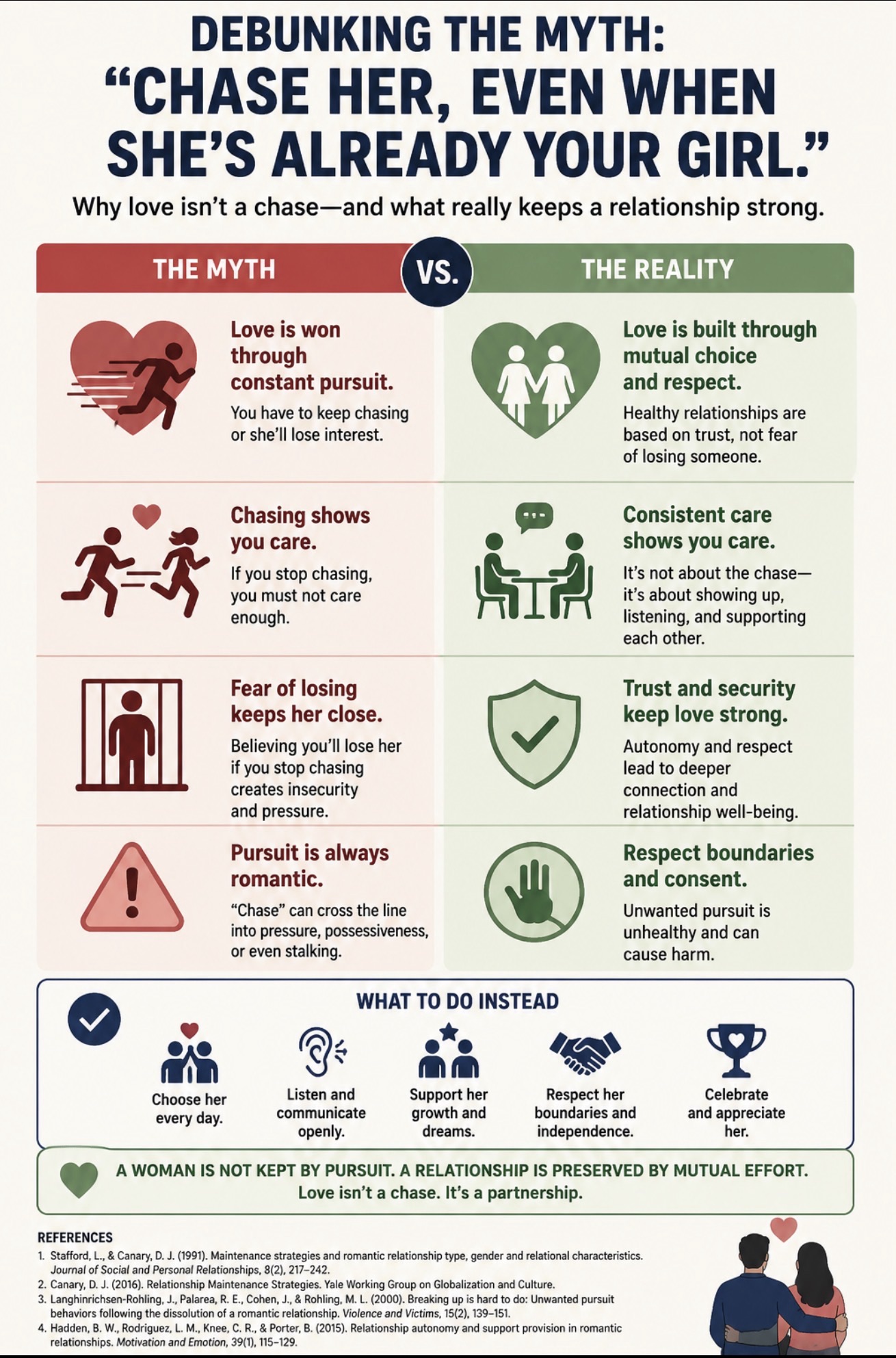
Don’t make him chase you.

I came across a meme on social media that said

“Chase her, even ehen she is your girl, that’s how you never lose her”.

This message in the picture sounds romantic, but it promotes an unhealthy relationship belief: that love must be proven through constant pursuit. In reality, healthy love is not maintained by chasing, pressure, fear, or emotional performance. It is maintained through mutual commitment, respect, emotional safety, and consistent care.

From social media: The Heart Speaks

Research on relationship maintenance identifies healthy behaviors such as positivity, openness, assurances, shared tasks, and social connection—not anxious pursuit or one-sided chasing. Stafford and Canary’s widely cited work found that positivity, assurances, and shared responsibilities were strong predictors of commitment, liking, satisfaction, and mutuality in relationships.  

The phrase “chase her, even when she’s already your girl” assumes that a woman must be continually pursued to prevent loss. That can sound flattering, but it can also imply insecurity: If I stop chasing, she will leave. Healthy relationships should not be built on fear of abandonment. They should be built on trust. Autonomy-supportive relationships, where partners feel respected rather than controlled, are associated with better relational well-being.  

There is also a serious boundary issue hidden in the word “chase.” Pursuit is only romantic when it is mutual, welcomed, and respectful. When pursuit becomes unwanted, persistent, or possessive, research connects it with unhealthy post-breakup behaviors and even stalking-like patterns. Studies on unwanted pursuit behaviors show that possessive and dependent forms of love are linked with greater risk after relationship dissolution.  

A healthier message would be: Choose her, respect her, nurture the relationship, and keep showing up—but do not chase her as if love is a game of possession.

Love should not require one partner to run and the other to chase. Mature love looks more like walking together. It means listening when she speaks, honoring her boundaries, being emotionally present, apologizing when wrong, celebrating her growth, and continuing to invest in the relationship without fear-based control.

A woman is not “kept” by pursuit. A relationship is preserved by mutual effort.

This article was written by John S Collier MSWLCSW. John has over 25 years in the social work in behavioral health field. He currently serves as an outpatient clinician and executive Director of Southeast Kentucky Behavioral Health based out of London Kentucky.

References

Stafford, L., & Canary, D. J. (1991). Maintenance strategies and romantic relationship type, gender and relational characteristics. Journal of Social and Personal Relationships.

Canary, D. J. (2016). Relationship Maintenance Strategies. Yale Working Group on Globalization and Culture.  

Langhinrichsen-Rohling, J., Palarea, R. E., Cohen, J., & Rohling, M. L. (2000). Breaking up is hard to do: Unwanted pursuit behaviors following the dissolution of a romantic relationship. Violence and Victims.  

Hadden, B. W., Rodriguez, L. M., Knee, C. R., & Porter, B. (2015). Relationship autonomy and support provision in romantic relationships. Motivation and Emotion.

What Makes a Woman Feel Safe Inside a Relationship?

Understanding Emotional Security, Trust, and Connection

When many people think about safety in a relationship, they think about physical safety—protection from harm, danger, or violence. While physical safety is foundational, what often determines whether a relationship thrives or struggles is something deeper: emotional safety. For many women, emotional safety becomes the foundation upon which intimacy, trust, vulnerability, affection, and long-term commitment are built.

Feeling safe in a relationship does not mean perfection. It does not mean a partner never makes mistakes, never disagrees, or never hurts feelings. Rather, it means a woman feels emotionally secure enough to be herself without fear of ridicule, rejection, abandonment, manipulation, or emotional instability. Safety creates trust, and trust creates connection.

Research consistently shows that emotional security is one of the strongest predictors of relationship satisfaction, emotional intimacy, and long-term stability (Gottman & Silver, 2015). Women who feel safe emotionally are often more likely to communicate openly, express affection, engage in healthy vulnerability, and develop deeper emotional intimacy with their partner.

Emotional Safety: The Foundation of Love

One of the greatest contributors to emotional safety is the ability to be vulnerable without fear. A woman who feels safe in a relationship knows she can express her emotions—even difficult emotions—without being mocked, dismissed, punished, or ignored.

Many women desire a relationship where they can say, “This hurt my feelings,” or “I feel overwhelmed,” without their emotions being minimized or met with defensiveness. Emotional safety means there is room for honesty.

This does not mean agreeing on everything. Healthy relationships involve disagreements. What matters is how disagreements are handled. Research by relationship experts has shown that contempt, criticism, stonewalling, and defensiveness are among the strongest predictors of relationship breakdown (Gottman & Silver, 2015). In contrast, respectful communication, repair attempts, and emotional responsiveness strengthen emotional security.

A woman often feels safest when she knows disagreements will not lead to humiliation, emotional withdrawal, threats, manipulation, or emotional chaos. Safety means conflict can happen while still preserving respect.

Consistency Builds Trust

One of the most overlooked aspects of emotional safety is consistency. A woman often feels emotionally safe when she knows her partner is dependable—not perfect, but predictable in character.

Consistency means words and actions align.

If a man says he will call, he calls. If he says he values honesty, he practices honesty. If he says he loves her, his actions demonstrate care, effort, and emotional availability. Inconsistent affection, unpredictable moods, or emotional distance can create anxiety within relationships, particularly for individuals with previous experiences of betrayal or abandonment (Johnson, 2019).

Emotional safety grows when there is reliability.

Many women do not necessarily seek grand gestures every day; rather, they seek reassurance through stability. Knowing a partner will remain emotionally present during hard moments often matters more than expensive gifts or romantic promises.

Healthy Communication Creates Security

Women frequently report feeling safest in relationships where communication feels respectful, calm, and emotionally mature.

This means:

  • Listening without interrupting
  • Responding without excessive defensiveness
  • Validating emotions even during disagreements
  • Avoiding yelling, blame, ridicule, or contempt
  • Being emotionally available during stress

Validation is particularly important. Validation does not mean agreeing with everything someone says. It simply means acknowledging that their emotions matter.

For example, there is a profound difference between:

Unsafe communication:
“You’re overreacting.”

and

Safe communication:
“I may not fully understand, but I can see this is hurting you.”

Research in attachment theory suggests that emotional responsiveness—the sense that a partner notices, values, and responds to emotional needs—is one of the strongest predictors of secure relationships (Johnson, 2019).

When a woman feels emotionally heard, she is often more willing to open her heart.

Respect and Boundaries Matter

Safety also grows through respect.

Respect means honoring boundaries, opinions, time, emotions, values, and individuality. Women often feel emotionally secure when they do not fear punishment for expressing differing viewpoints or maintaining healthy boundaries.

Healthy relationships allow room for individuality.

A woman should not feel pressured to become someone else to maintain peace. She should not fear emotional retaliation for honesty, friendships, personal goals, or differing perspectives.

Relationship researchers consistently note that mutual respect strongly predicts relational satisfaction and emotional well-being (Tatkin, 2012).

Respect is not merely politeness.

It is the repeated message communicated through actions:

“You matter here.”

Emotional Regulation Creates Calm

Many women feel safer with partners who are emotionally regulated.

This does not mean emotionless. It means emotionally mature.

A partner who can manage frustration, disappointment, anger, and conflict in healthy ways often creates emotional calm rather than chaos. Emotional unpredictability—such as explosive anger, silent treatment, manipulation, jealousy, or emotional volatility—can make relationships feel unsafe.

Safety often grows in environments where emotional storms are handled with steadiness.

This includes:

  • Calm communication during disagreements
  • Accountability after mistakes
  • Apologizing when wrong
  • Taking responsibility instead of shifting blame
  • Remaining emotionally present during difficult conversations

According to attachment researchers, emotional responsiveness and regulation significantly influence perceived safety in romantic bonds (Mikulincer & Shaver, 2016).

Safety Means Feeling Chosen

At a deeper emotional level, many women feel safe when they feel intentionally chosen.

Not tolerated.

Not convenient.

Chosen.

This includes emotional presence, reassurance, intentional effort, affection, consistency, and emotional investment. Feeling emotionally secure often comes from knowing:

“You matter to me, even when life gets difficult.”

Love is not simply spoken; it is repeatedly demonstrated through emotional consistency, trustworthiness, honesty, patience, kindness, and care.

Women often feel safest where there is no fear of emotional abandonment every time conflict arises.

Final Thoughts

At its core, what makes a woman feel safe inside a relationship is not dominance, perfection, wealth, or grand romantic gestures.

  • It is emotional security.
  • It is trust.
  • It is consistency.
  • It is respectful communication.
  • It is emotional maturity.
  • It is knowing she can be vulnerable without fear.

A healthy relationship becomes a place where two imperfect people create an environment of emotional peace rather than emotional survival. When safety exists, intimacy grows naturally. Walls lower. Trust deepens. Love becomes less about fear and more about connection.

In many ways, emotional safety is not simply what strengthens love—it is what allows love to fully exist.

About the Author

John S. Collier, MSW, LCSW is a licensed clinical social worker and behavioral health professional with extensive experience working with relationships, trauma, communication patterns, emotional wellness, and personal growth. Through his clinical work and writing, John seeks to help individuals and couples better understand emotional connection, healthy relationships, mental health, and personal healing. He is passionate about translating psychological concepts into relatable and practical guidance that people can apply in everyday life.

References

The Seven Principles for Making Marriage Work Gottman, J. M., & Silver, N. (2015). The Seven Principles for Making Marriage Work. Harmony Books.

Hold Me Tight Johnson, S. (2019). Hold Me Tight: Seven Conversations for a Lifetime of Love. Little, Brown Spark.

Attached Levine, A., & Heller, R. (2010). Attached: The New Science of Adult Attachment and How It Can Help You Find—and Keep—Love. TarcherPerigee.

Wired for Love Tatkin, S. (2012). Wired for Love: How Understanding Your Partner’s Brain and Attachment Style Can Help You Defuse Conflict and Build a Secure Relationship. New Harbinger Publications.

Attachment in Adulthood Mikulincer, M., & Shaver, P. R. (2016). Attachment in Adulthood: Structure, Dynamics, and Change. Guilford Press.


Are Men Loved Unconditionally? A Balanced Examination of Love, Expectations, and Human Relationships

The statement “men are not loved unconditionally” has gained significant attention in conversations about masculinity, relationships, and emotional health. Many men report feeling valued primarily for what they provide—financial security, emotional stability, protection, problem-solving, or status. At the same time, critics of this viewpoint argue that both men and women experience conditions in relationships and that healthy love is inherently reciprocal rather than unconditional. The truth likely exists somewhere between these extremes. Understanding this issue requires examining psychology, sociology, attachment theory, and cultural expectations surrounding gender.

Understanding Conditional vs. Unconditional Love

Unconditional love refers to caring for another person without requiring them to meet certain standards or expectations to receive affection or acceptance. It is often described in parent-child relationships, particularly between caregivers and infants, where love is ideally offered regardless of performance or achievement (Bowlby, 1988). In adult romantic relationships, however, unconditional love becomes more complex.

Most healthy adult relationships include some level of conditionality. People generally expect mutual respect, trust, emotional availability, faithfulness, and effort. A spouse who becomes abusive, chronically dishonest, or emotionally unavailable may find that love alone is insufficient to sustain the relationship. In this sense, romantic love is often conditional for both men and women because relationships involve boundaries and reciprocal investment (Gottman & Silver, 2015).

However, the question many men ask is not whether relationships have expectations, but whether men are uniquely valued for utility rather than emotional existence.

Why Many Men Feel Loved Conditionally

Many men report feeling that affection and admiration are tied to what they can do rather than who they are. Research suggests men often experience social pressure to fulfill traditional masculine roles such as provider, protector, leader, and emotional stabilizer (Mahalik et al., 2003). These expectations can create the perception that love and respect are dependent on performance.

For example, studies have shown that financial instability and unemployment can affect men’s relationship satisfaction and even marital stability more significantly than women’s in some contexts (Bertrand, Kamenica, & Pan, 2015). Men frequently report internalizing the belief that they must remain strong, productive, and emotionally composed in order to maintain attractiveness or value within relationships.

Socialization may also contribute to this perception. Boys are often encouraged to suppress vulnerable emotions with messages such as “man up,” “don’t cry,” or “be strong.” Over time, this can create emotional isolation and reinforce the idea that their struggles are tolerated only when they do not interfere with functioning (Levant, 2011). As a result, some men may feel emotionally supported only when they are successful or useful.

Psychologist Ronald Levant’s work on traditional masculinity highlights how restrictive emotional norms can lead men to feel disconnected from emotional intimacy, increasing depression, loneliness, and relational dissatisfaction (Levant & Richmond, 2007).

The Counterargument: Love Is Conditional for Everyone

While many men feel conditionally loved, researchers caution against oversimplifying the issue. Women also frequently report pressures tied to appearance, nurturing ability, emotional labor, and caregiving expectations. Many women experience fears of being valued primarily for youth, beauty, or emotional caregiving (Fredrickson & Roberts, 1997).

From a psychological perspective, romantic love generally involves mutual expectations because partnerships require cooperation. Healthy relationships are not typically unconditional in the way parental love ideally aspires to be. Rather, they are based on what researchers describe as secure attachment, where both partners consistently demonstrate trust, responsiveness, and emotional safety (Johnson, 2019).

In securely attached relationships, individuals are valued not merely for what they contribute but for who they are as people. Partners may experience seasons of unemployment, illness, grief, emotional struggle, or personal failure while still receiving love and support. This suggests that although adult love may contain conditions related to behavior and safety, it does not necessarily depend solely on performance or utility.

Additionally, some scholars argue that men may underreport emotional support due to cultural norms discouraging emotional awareness or vulnerability. Because men are less likely to seek emotional connection openly, they may unintentionally miss opportunities for deeper relational intimacy (Addis & Mahalik, 2003).

A More Accurate Question

Perhaps the better question is not “Are men loved unconditionally?” but rather “Do men feel emotionally safe enough to experience love fully?”

Many men long to be accepted during moments of weakness, grief, failure, fear, or uncertainty. They want reassurance that they are valued beyond achievement, income, or strength. Likewise, many women desire to be valued beyond appearance, caregiving, or emotional support. In this way, the human longing may be more universal than gender-specific.

Healthy love often exists somewhere between unconditional acceptance and reasonable expectations. Love may not be unconditional in the literal sense, but it can be deeply compassionate, forgiving, and enduring. Healthy relationships involve mutual grace—where both people are allowed to be imperfect without fearing abandonment at every failure.

Conclusion

The belief that men are not loved unconditionally reflects a real emotional experience for many men, especially those who have felt valued mainly for provision, protection, or performance. Research supports the idea that traditional masculine expectations can contribute to feelings of conditional worth and emotional isolation. However, evidence also suggests that romantic relationships are naturally reciprocal and contain expectations for both genders.

Rather than viewing love as entirely conditional or unconditional, a healthier perspective may recognize that strong relationships thrive when people are valued for both who they are and how they contribute. Men, like women, benefit most from relationships where vulnerability is safe, effort is appreciated, and love persists through hardship—not because someone is perfect, but because they are deeply known.

About the Author

John S. Collier, MSW, LCSW, is a licensed clinical social worker and behavioral health professional with experience helping individuals and families navigate relationships, emotional healing, trauma, communication, and personal growth. His work emphasizes practical insight, emotional honesty, and strengthening healthy interpersonal connections.

References

Addis, M. E., & Mahalik, J. R. (2003). Men, masculinity, and the contexts of help seeking. American Psychologist, 58(1), 5–14.

Bertrand, M., Kamenica, E., & Pan, J. (2015). Gender identity and relative income within households. The Quarterly Journal of Economics, 130(2), 571–614.

Bowlby, J. (1988). A secure base: Parent-child attachment and healthy human development. Basic Books.

Fredrickson, B. L., & Roberts, T. A. (1997). Objectification theory. Psychology of Women Quarterly, 21(2), 173–206.

Gottman, J., & Silver, N. (2015). The seven principles for making marriage work. Harmony Books.

Johnson, S. M. (2019). Attachment theory in practice: Emotionally focused therapy (EFT) with individuals, couples, and families. Guilford Press.

Levant, R. F. (2011). Research in the psychology of men and masculinity using the gender role strain paradigm. American Psychologist, 66(8), 765–776.

Levant, R. F., & Richmond, K. (2007). A review of research on masculinity ideologies. Psychology of Men & Masculinity, 8(3), 130–140.