Welcome to SOUTHEAST KENTUCKY BEHAVIORAL HEALTH

Category Healing after a Breakup

Surviving the Affair: The Ripple Effect

Part Eight: When Children, Family, and Friends Are Caught in the Middle

One of the greatest misconceptions about an affair is that it affects only the people directly involved. It does not.

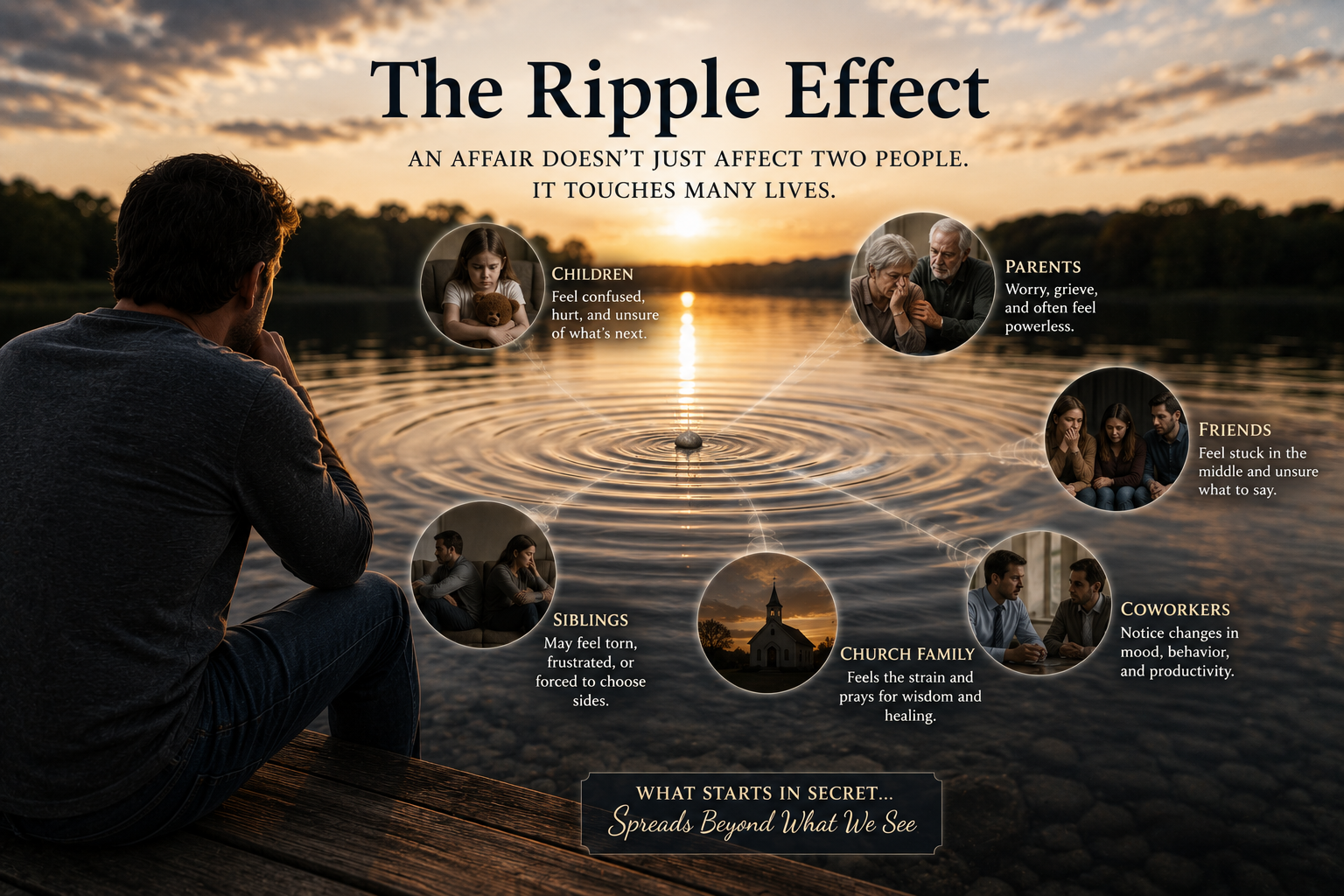
An affair begins between a few people, but its consequences often spread far beyond them. Children lose their sense of security. Parents struggle to watch their adult children suffer. Brothers and sisters are forced to choose sides. Close friends become uncomfortable. Church families become divided. Coworkers notice changes in mood and productivity. Even grandparents often find themselves grieving a family they no longer recognize.

Like a stone thrown into still water, the affair creates ripples that continue long after the initial impact. Most people focus on whether the marriage survives. Few stop to consider everyone else who must learn how to survive it as well. Whether reconciliation occurs or divorce becomes inevitable, the choices made during this season will shape many lives for years to come. The encouraging news is that while an affair creates widespread pain, wise decisions afterward can also create widespread healing.


Children Feel More Than Parents Realize

Many parents believe they have successfully hidden the affair from their children. Sometimes they have. More often, they have hidden only the details. Children notice changes long before they understand them. They notice silence replacing laughter. They notice separate bedrooms.

They notice tension at the dinner table. They notice tears behind closed doors. They notice parents becoming emotionally unavailable. Children may not know what happened. They almost always know something has happened.

When parents avoid honest, age-appropriate conversations, children often create their own explanations. Many blame themselves.

  • “Maybe Mom and Dad fight because I misbehave.”
  • “Maybe if I were better, things would go back to normal.”

Children were never responsible for the affair. They should never carry its emotional burden.


Protecting Children from Adult Problems

One of the greatest gifts parents can give their children during marital crisis is emotional protection. Children need parents. They do not need detectives. They do not need therapists. They do not need messengers. They do not need judges. Avoid placing children in situations where they feel responsible for managing adult emotions. That includes:

  • Asking children to keep secrets.
  • Criticizing the other parent in front of them.
  • Using children to gather information.
  • Expecting children to comfort an emotionally overwhelmed parent.
  • Asking children to choose sides.

Children deserve permission to love both parents. Even when one parent has made serious mistakes.


Family Members Often Grieve Too

Parents often feel helpless. They watch their son or daughter suffer. They wonder what they should say. How much should they become involved? Should they encourage reconciliation? Should they support divorce? Should they remain neutral? Family members frequently experience what psychologists call secondary trauma.

Although they were not directly betrayed, they suffer because someone they deeply love is hurting. Their instinct is to protect. Unfortunately, protection sometimes becomes pressure. Healthy support sounds like:

  • “I’m here for you.”
  • “Whatever decision you make, I want it to be a healthy one.”
  • Unhealthy support often sounds like:
  • “If you stay, I’ll never respect you again.” or “You have to forgive them.”

Neither statement allows healing.


Friends Often Don’t Know What to Do

Affairs place friendships in awkward positions. Mutual friends wonder whether they should remain connected to both spouses. Some withdraw completely because they fear saying the wrong thing. Others unintentionally make things worse by offering simplistic advice.

  • “Just move on.”
  • “Once a cheater, always a cheater.”
  • “Everything happens for a reason.”

People in deep emotional pain rarely need quick answers. They need compassionate listeners. Sometimes the greatest gift a friend can offer is quiet presence.


The Church Can Become Either a Hospital or a Courtroom

For people of faith, an affair often creates a second crisis. The spiritual crisis. Some individuals fear judgment. Others fear rejection. Some stop attending church entirely because they feel embarrassed. Healthy faith communities understand an important truth. Grace never eliminates accountability. Accountability should never eliminate grace.

Churches become places of healing when they speak truth with compassion, encourage repentance where needed, support healthy boundaries, and refuse to reduce people to the worst decision they have ever made. Every person involved needs wisdom. Every person involved needs hope.


Holidays, Birthdays, and Family Traditions Change

Families rarely anticipate how many ordinary moments become emotionally complicated after an affair.

  • Birthdays.
  • Christmas.
  • Thanksgiving.
  • Graduations.
  • Weddings.
  • Vacations.
  • Children’s sporting events.

Questions suddenly emerge. Who will attend? Who will sit where? Who should be invited? The healthiest families focus less on old expectations and more on creating emotionally safe experiences for everyone involved. Flexibility often becomes an expression of maturity.


Forgiveness Does Not Mean Ignoring Healthy Boundaries

Extended family members sometimes misunderstand forgiveness. Forgiveness does not require pretending everything is normal. Trust often returns gradually. Relationships sometimes need time before old traditions resume. Healthy boundaries communicate safety—not punishment. Families heal best when grace and wisdom work together.


Tools for Helping Families Heal

Whether the marriage survives or not, these practices help reduce long-term emotional harm:

  • Keep children out of adult conflicts.
  • Speak respectfully about one another in front of family members.
  • Encourage counseling for both adults and children when needed.
  • Create predictable routines to restore emotional stability.
  • Allow children to ask questions appropriate to their age.
  • Build healthy co-parenting communication if separation occurs.
  • Seek support from trusted friends, pastors, or counselors.
  • Be patient with extended family members as they process their own grief.
  • Protect family gatherings from unnecessary conflict.
  • Focus on long-term healing rather than short-term emotional victories.

A Christian Perspective

Throughout Scripture, God continually works through broken families. Abraham’s family struggled. Jacob’s family struggled. David’s family struggled. Yet God’s redemptive work continued.

An affair may change a family’s story. It does not remove God from the story. Colossians 3:13 reminds believers:

“Bear with each other and forgive one another if any of you has a grievance against someone. Forgive as the Lord forgave you.”

Forgiveness, patience, and grace do not erase painful consequences. They create the possibility of healing despite them. Families that practice truth, humility, and love often discover that while life may never return to what it once was, it can still become healthy again.


A Therapist’s Reflection

One of the most heartbreaking moments in counseling occurs when a child quietly asks, “Is this my fault?” The answer is always the same. “No.” Children did not create the affair. They cannot fix it. They should never be expected to carry it. Adults have the responsibility to protect children—not only physically, but emotionally. When parents choose maturity over revenge… When grandparents choose support over criticism…When friends choose listening over judgment…When churches choose restoration over condemnation…Healing spreads through the family just as surely as pain once did.

Affairs create ripples. So does grace. So does wisdom. So does love. The choices made after betrayal will become part of the legacy your family remembers. Choose the kind of legacy that leads toward healing.


About the Author

John S. Collier, MSW, LCSW-S is a licensed clinical social worker, psychotherapist, author, educator, and speaker with decades of experience helping individuals, couples, and families navigate life’s most difficult emotional challenges. Throughout his career, he has worked extensively with people struggling with relationship conflict, betrayal, anxiety, depression, trauma, grief, addiction, and life transitions. His counseling approach combines evidence-based psychological practices with practical wisdom, compassion, and a deep respect for each person’s unique journey.

John has devoted much of his professional life to understanding the complexities of human relationships. He has counseled couples working to rebuild trust after infidelity, individuals recovering from betrayal, and families seeking healing after painful life events. His clinical experience has reinforced one enduring truth: while relationships can be profoundly wounded, people possess an extraordinary capacity for growth, resilience, forgiveness, and transformation when they are equipped with the right tools and support.

As an author, John seeks to bridge the gap between professional mental health knowledge and everyday life. His writing translates complex psychological concepts into practical guidance that readers can understand and apply immediately. Whether addressing marriage, parenting, emotional wellness, trauma recovery, or spiritual growth, his goal is to provide resources that are both clinically sound and personally encouraging.

Surviving the Affair reflects John’s commitment to approaching infidelity with both honesty and compassion. Rather than reducing people to labels or stereotypes, he explores the emotional realities experienced by everyone affected—the betrayed spouse, the unfaithful partner, the affair partner, and the families whose lives are forever changed. Drawing upon years of therapeutic experience, he emphasizes accountability without condemnation, healing without minimizing pain, and hope without offering unrealistic promises.

John believes that healing begins when people are willing to face the truth with courage. While not every relationship can or should be restored, every individual has the capacity to grow beyond betrayal, rediscover integrity, and build a healthier future. His passion is helping readers move from surviving life’s greatest wounds to living with renewed purpose, emotional strength, and hope.

Through his books, speaking engagements, and counseling work, John continues to encourage others to pursue emotional health, healthy relationships, personal responsibility, and lasting transformation—one step at a time.h his counseling, writing, and educational work, John equips individuals and families with practical tools to strengthen relationships, heal emotional wounds, and build resilient futures.

References

American Academy of Pediatrics. (2016). Helping Children Cope with Divorce and Family Stress.

American Association for Marriage and Family Therapy. (2015). Infidelity. https://www.aamft.org

Bowen, M. (1978). Family Therapy in Clinical Practice. Jason Aronson.

Gottman, J. M., & Gottman, J. S. (2015). 10 Principles for Doing Effective Couples Therapy. W. W. Norton & Company.

Nichols, M. P., & Davis, S. D. (2020). Family Therapy: Concepts and Methods (12th ed.). Pearson.

Snyder, D. K., Baucom, D. H., & Gordon, K. C. (2007). Getting Past the Affair. Guilford Press.

The Holy Bible, New International Version. (2011). Zondervan.


Surviving the Affair: Choosing Integrity Over Desire

Part Seven: The Affair Partner Who Ends the Relationship but Struggles with the Loss

Sometimes the strongest act of love is walking away.

That statement may seem impossible to believe when your heart is breaking, yet it has proven true for countless people who have found themselves involved in an affair. There comes a moment when some affair partners reach a painful realization. They recognize that regardless of how deeply they care for the other person, the relationship has become inconsistent with the kind of life they want to live.

They may have prayed. They may have wrestled with guilt. They may have tried repeatedly to convince themselves that love justified continuing the relationship. Eventually, however, another voice became louder. The voice of conscience. Walking away rarely feels victorious.

It feels like grief. It feels like losing someone you genuinely loved while simultaneously believing that ending the relationship was the right thing to do. That emotional conflict creates one of the most complicated forms of grief a person can experience. You are mourning someone who is still alive. You are grieving a relationship that ended because you chose integrity over desire. Those two realities can coexist.


When Your Values Finally Catch Up

Many people involved in affairs describe living with constant internal conflict. They enjoyed the conversations. They cherished the emotional connection. They imagined a future together. Yet underneath every happy moment lived another emotion. Uneasiness. They knew they were participating in something that conflicted with their deepest values.

Psychologists often refer to this experience as cognitive dissonance—the emotional discomfort that develops when behavior and personal values no longer agree.

Over time, that discomfort becomes exhausting. Eventually something must change. Either values are abandoned. Or behavior changes. Healthy healing begins when our actions once again align with our convictions.


Why Doing the Right Thing Can Feel So Wrong

Many people assume that making the morally right decision should immediately produce peace. Real life is rarely that simple. Choosing integrity often hurts before it heals. You may wake each morning wondering how they are doing. You may instinctively reach for your phone before remembering there will be no message. Certain songs, places, holidays, and routines suddenly become painful reminders. Your heart may continue longing for someone your conscience knows you cannot pursue.

This does not mean your decision was wrong. It means you are grieving. Grief is not evidence that you chose incorrectly. It is evidence that something meaningful ended.


Missing Someone Does Not Mean You Should Return

One of the greatest temptations after ending an affair is confusing longing with direction. You miss them. You think about them. You dream about them. You wonder if they miss you. These emotions are normal.

They are not instructions. Emotions provide information. They should not always determine our decisions. Every healthy relationship requires more than intense feelings. It requires honesty, freedom, trust, and mutual integrity. When those qualities are absent, returning often recreates the very pain you worked so hard to escape.


Learning to Forgive Yourself

Many affair partners carry enormous guilt. Some believe they permanently damaged another family. Others feel ashamed for compromising their own standards. Still others struggle because they believe they should have ended the relationship much sooner. Healthy guilt can motivate growth. Unhealthy shame keeps people trapped in the past. Self-forgiveness is not pretending your choices had no consequences. It is accepting responsibility while believing that one chapter of your life does not have to define the entire story. Growth begins when accountability is joined with grace.


Rediscovering the Person You Were Becoming

Affairs often consume emotional energy. Life gradually begins revolving around secret conversations, uncertain plans, emotional highs, and heartbreaking disappointments. When the relationship ends, many people discover they no longer recognize themselves. Healing includes rediscovering interests, friendships, dreams, and personal goals that existed before the affair. Ask yourself:

  • Who do I want to become five years from now?
  • What kind of relationships reflect my deepest values?
  • What qualities do I want people to remember about my life?

Your future deserves more attention than your past.


Grief Can Become Growth

Loss changes people. The question is whether it changes them toward wisdom or toward bitterness. Every painful experience offers an invitation. Some people become harder. Others become healthier. Use this season to develop:

  • Emotional maturity.
  • Healthy relationship boundaries.
  • Spiritual depth.
  • Honest communication.
  • Self-respect.
  • Patience.
  • Integrity.

The relationship may have ended. Your personal growth does not have to.


Tools for Healing

If you have ended the affair but continue struggling emotionally, consider these practices:

  • Maintain complete no-contact with your former partner.
  • Work with a therapist experienced in relationship and attachment issues.
  • Journal both your grief and your personal growth.
  • Resist romanticizing the relationship by remembering both its joys and its costs.
  • Rebuild healthy friendships and community.
  • Develop meaningful daily routines.
  • Invest in your spiritual life through prayer, worship, and Scripture.
  • Practice self-compassion while remaining accountable for your choices.
  • Set clear standards for future relationships.
  • Allow yourself time to heal before pursuing another romantic relationship.

A Christian Perspective

One of the most beautiful themes throughout Scripture is restoration. God repeatedly meets people at the intersection of failure and repentance. Not to condemn them forever. But to invite them into something better. First John 1:9 reminds us:

“If we confess our sins, he is faithful and just and will forgive us our sins and purify us from all unrighteousness.”

Confession is not merely admitting wrongdoing. It is choosing a new direction. Sometimes the greatest act of faith is believing that God’s future is greater than your past. Walking away from an unhealthy relationship may feel like losing everything. In reality, it may become the first step toward becoming the person God created you to be.


A Therapist’s Reflection

One of the most moving conversations I have with former affair partners usually begins with tears. They quietly say,

“I knew ending it was the right thing…but I still miss them every day.”

I often respond with a simple observation. Doing the right thing does not always feel good immediately. Integrity frequently hurts before it heals. The pain you feel today is not necessarily punishment. Sometimes it is evidence that your conscience is becoming stronger than your impulses. Do not mistake temporary loneliness for permanent loss. You have not simply ended a relationship. You have begun building a life that no longer requires secrecy, divided loyalties, or compromise. One day you may look back on this season not as the time you lost someone…But as the moment you found yourself.

That is a different kind of love. One worth choosing.


About the Author

John S. Collier, MSW, LCSW-S is a licensed clinical social worker, psychotherapist, author, educator, and speaker with decades of experience helping individuals, couples, and families navigate life’s most difficult emotional challenges. Throughout his career, he has worked extensively with people struggling with relationship conflict, betrayal, anxiety, depression, trauma, grief, addiction, and life transitions. His counseling approach combines evidence-based psychological practices with practical wisdom, compassion, and a deep respect for each person’s unique journey.

John has devoted much of his professional life to understanding the complexities of human relationships. He has counseled couples working to rebuild trust after infidelity, individuals recovering from betrayal, and families seeking healing after painful life events. His clinical experience has reinforced one enduring truth: while relationships can be profoundly wounded, people possess an extraordinary capacity for growth, resilience, forgiveness, and transformation when they are equipped with the right tools and support.

As an author, John seeks to bridge the gap between professional mental health knowledge and everyday life. His writing translates complex psychological concepts into practical guidance that readers can understand and apply immediately. Whether addressing marriage, parenting, emotional wellness, trauma recovery, or spiritual growth, his goal is to provide resources that are both clinically sound and personally encouraging.

Surviving the Affair reflects John’s commitment to approaching infidelity with both honesty and compassion. Rather than reducing people to labels or stereotypes, he explores the emotional realities experienced by everyone affected—the betrayed spouse, the unfaithful partner, the affair partner, and the families whose lives are forever changed. Drawing upon years of therapeutic experience, he emphasizes accountability without condemnation, healing without minimizing pain, and hope without offering unrealistic promises.

John believes that healing begins when people are willing to face the truth with courage. While not every relationship can or should be restored, every individual has the capacity to grow beyond betrayal, rediscover integrity, and build a healthier future. His passion is helping readers move from surviving life’s greatest wounds to living with renewed purpose, emotional strength, and hope.

Through his books, speaking engagements, and counseling work, John continues to encourage others to pursue emotional health, healthy relationships, personal responsibility, and lasting transformation—one step at a time.onal pain toward lives marked by integrity, resilience, and hope. Through his writing and counseling, he encourages readers to embrace accountability while believing that lasting personal transformation is always possible.

References

American Association for Marriage and Family Therapy. (2015). Infidelity. https://www.aamft.org

Brown, B. (2012). Daring Greatly. Gotham Books.

Frankl, V. E. (2006). Man’s Search for Meaning. Beacon Press. (Original work published 1946)

Glass, S. P. (2003). Not “Just Friends”: Rebuilding Trust and Recovering Your Sanity After Infidelity. Free Press.

Johnson, S. M. (2019). Attachment Theory in Practice: Emotionally Focused Therapy (EFT) with Individuals, Couples, and Families. Guilford Press.

Levine, A., & Heller, R. (2010). Attached: The New Science of Adult Attachment and How It Can Help You Find—and Keep—Love. TarcherPerigee.

Perel, E. (2017). The State of Affairs: Rethinking Infidelity. Harper.

The Holy Bible, New International Version. (2011). Zondervan.


Surviving the Affair: Loving Someone You Cannot Keep

Part Six: The Affair Partner Who Doesn’t Want the Relationship to End

There is one person in nearly every affair who is rarely invited into the conversation. The affair partner. To many people, this individual is simply “the other woman” or “the other man.” They are viewed only through the pain they helped create. While they bear responsibility for their choices, reducing them to a stereotype rarely tells the whole story.

Some knowingly entered a relationship with a married person. Some were told the marriage was already over. Some believed divorce was only a matter of time. Some desperately tried to end the relationship but returned repeatedly. Others eventually fell deeply in love with someone they could never fully have.

None of these circumstances erase accountability. An affair causes real harm. Yet understanding the emotional world of the affair partner is not the same as excusing it. Healing begins with honesty—not caricatures.

This article is written for those who remain emotionally attached to someone who has chosen—or has been forced—to return to their marriage. You are grieving a relationship that may have felt deeply real, yet one that was built in secrecy and could never fully exist in the light. That grief deserves to be understood, even while acknowledging that the relationship itself was unhealthy.


When Fantasy Becomes Reality

Many affairs begin inside carefully controlled environments. There are no unpaid bills. No parenting disagreements. No household responsibilities. No extended family conflicts. There is only conversation, excitement, emotional intensity, and stolen moments. Psychologists sometimes describe this as a relationship protected from ordinary life.

Without everyday pressures, emotional intimacy often grows unusually fast. The relationship begins to feel extraordinary. Soulmate. Destiny. The one person who truly understands. These feelings are often sincere. But sincerity does not necessarily make them sustainable. Real relationships eventually require ordinary life. Most affairs never experience ordinary life.


Waiting for Tomorrow

Many affair partners live in a state of emotional suspension.

  • “After the holidays…”
  • “After the children graduate…”
  • “After the divorce…”
  • “Soon.”

Tomorrow becomes a promise that never quite arrives. Months become years. Life quietly passes. Many affair partners eventually realize they have built their future around someone else’s decisions. That realization is often devastating.


Loving Someone Who Chooses Someone Else

One of the deepest emotional wounds occurs when the married partner decides to end the affair and remain with their spouse. The affair partner often experiences intense emotions:

  • Grief.
  • Rejection.
  • Loneliness.
  • Confusion.
  • Shame.
  • Embarrassment.

Many wonder:

“Was any of it real?”

The answer is often yes. Feelings may have been genuine. But genuine feelings do not always produce healthy relationships. Love alone cannot overcome secrecy, divided loyalties, and broken trust.


The Hidden Cost of Being a Secret

Human beings were created for authentic connection. Healthy love thrives in openness. Affairs require concealment. Secret phone calls. Hidden messages. Excuses. Deleted conversations. Canceled holidays. Missed birthdays. Invisible grief. Over time, many affair partners begin realizing they are living a life that cannot be acknowledged publicly. They are important privately. Invisible publicly. That imbalance slowly erodes self-worth. Everyone deserves a relationship where they do not have to hide.


Hope Can Become a Prison

Hope is usually healthy. But misplaced hope can become emotionally imprisoning. Many affair partners continue waiting long after the relationship has effectively ended. They continue believing:

  • “Maybe they’ll come back.”
  • “Maybe they’re only staying because of the children.”
  • “Maybe next month everything will change.”

Hope becomes less about possibility and more about avoidance. Sometimes healing begins when hope changes direction. Instead of hoping someone returns… Begin hoping you become emotionally free.


You Are More Than This Relationship

One of the greatest dangers in any unhealthy relationship is identity fusion. Your entire sense of worth becomes connected to one person. When that relationship ends, it feels as though you disappear too. Healing requires rediscovering yourself outside the relationship.

Ask yourself:

  • Who was I before this affair?
  • What dreams have I postponed?
  • What values have I compromised?
  • What kind of relationship do I truly deserve?

These questions often become the beginning of genuine recovery.


Choosing Self-Respect

Walking away from someone you love may become one of the hardest decisions you ever make. It may also become one of the healthiest. Self-respect sometimes requires accepting painful reality rather than continuing to chase unlikely possibilities. Healthy love does not require constant secrecy. Healthy love does not leave one person waiting indefinitely. Healthy love does not require sacrificing your identity to remain emotionally connected.


Tools for Healing

If you are struggling to let go, consider these practical steps:

  • End all contact if the relationship has truly ended.
  • Allow yourself to grieve without romanticizing the relationship.
  • Work with a therapist to understand attachment patterns.
  • Reconnect with trusted friends and family.
  • Develop interests and goals that are independent of the relationship.
  • Journal honestly about both the joys and the costs of the affair.
  • Avoid monitoring your former partner’s social media.
  • Practice self-compassion while accepting responsibility for your choices.
  • Establish healthy relationship standards for the future.
  • Focus on becoming the person you hope to share your life with someday.

A Christian Perspective

Throughout Scripture, God continually calls people away from hiddenness and toward truth. The invitation is never merely to stop doing wrong. It is to step into a different way of living. John 8:32 reminds us:

“Then you will know the truth, and the truth will set you free.”

Sometimes the greatest freedom comes not from getting what we wanted…But from releasing what was never ours to keep. God’s grace is available to everyone. To the faithful spouse. To the unfaithful spouse. To the affair partner. Grace does not ignore responsibility. It offers transformation beyond it.


A Therapist’s Reflection

Over the years, I have counseled affair partners whose grief surprised even them. Many assumed they had no right to mourn. Others believed their pain would be dismissed because they helped create the situation. Yet grief does not disappear because others disapprove of it. It simply becomes lonely.

The healthiest healing begins when two truths are held together. You may have genuinely loved this person. And…The relationship may still have been unhealthy. Those truths can exist together. Do not allow one relationship—especially one built in secrecy—to determine your worth. Your future is not limited by this chapter. Healthy love does not ask you to remain hidden. It invites you to be fully known. And that kind of love is worth waiting for.


About the Author

John S. Collier, MSW, LCSW-S is a licensed clinical social worker, psychotherapist, author, educator, and speaker with decades of experience helping individuals, couples, and families navigate life’s most difficult emotional challenges. Throughout his career, he has worked extensively with people struggling with relationship conflict, betrayal, anxiety, depression, trauma, grief, addiction, and life transitions. His counseling approach combines evidence-based psychological practices with practical wisdom, compassion, and a deep respect for each person’s unique journey.

John has devoted much of his professional life to understanding the complexities of human relationships. He has counseled couples working to rebuild trust after infidelity, individuals recovering from betrayal, and families seeking healing after painful life events. His clinical experience has reinforced one enduring truth: while relationships can be profoundly wounded, people possess an extraordinary capacity for growth, resilience, forgiveness, and transformation when they are equipped with the right tools and support.

As an author, John seeks to bridge the gap between professional mental health knowledge and everyday life. His writing translates complex psychological concepts into practical guidance that readers can understand and apply immediately. Whether addressing marriage, parenting, emotional wellness, trauma recovery, or spiritual growth, his goal is to provide resources that are both clinically sound and personally encouraging.

Surviving the Affair reflects John’s commitment to approaching infidelity with both honesty and compassion. Rather than reducing people to labels or stereotypes, he explores the emotional realities experienced by everyone affected—the betrayed spouse, the unfaithful partner, the affair partner, and the families whose lives are forever changed. Drawing upon years of therapeutic experience, he emphasizes accountability without condemnation, healing without minimizing pain, and hope without offering unrealistic promises.

John believes that healing begins when people are willing to face the truth with courage. While not every relationship can or should be restored, every individual has the capacity to grow beyond betrayal, rediscover integrity, and build a healthier future. His passion is helping readers move from surviving life’s greatest wounds to living with renewed purpose, emotional strength, and hope.

Through his books, speaking engagements, and counseling work, John continues to encourage others to pursue emotional health, healthy relationships, personal responsibility, and lasting transformation—one step at a time.toward healing, personal responsibility, and lasting transformation.

References

American Association for Marriage and Family Therapy. (2015). Infidelity. https://www.aamft.org

Brown, B. (2012). Daring Greatly. Gotham Books.

Glass, S. P. (2003). Not “Just Friends”: Rebuilding Trust and Recovering Your Sanity After Infidelity. Free Press.

Johnson, S. M. (2019). Attachment Theory in Practice: Emotionally Focused Therapy (EFT) with Individuals, Couples, and Families. Guilford Press.

Levine, A., & Heller, R. (2010). Attached: The New Science of Adult Attachment and How It Can Help You Find—and Keep—Love. TarcherPerigee.

Mikulincer, M., & Shaver, P. R. (2016). Attachment in Adulthood: Structure, Dynamics, and Change (2nd ed.). Guilford Press.

Perel, E. (2017). The State of Affairs: Rethinking Infidelity. Harper.

The Holy Bible, New International Version. (2011). Zondervan.


Surviving the Affair: The Long Road Home

Part Five: The Unfaithful Spouse Who Wants to Reconcile

For many unfaithful spouses, the affair ends long before the consequences do. The excitement disappears. The fantasy fades. Reality arrives. What remains is often a marriage hanging by a thread, a spouse whose trust has been shattered, children who sense that something has changed, and an overwhelming awareness that a single series of choices has altered the lives of everyone involved.

Many people expect that once the affair has ended and the truth has been told, healing should begin quickly. Instead, they discover something far more difficult. Ending the affair was the easiest part. Becoming trustworthy again is the real challenge.

If you are the unfaithful spouse who desperately wants to save your marriage, you are about to undertake one of the most demanding emotional journeys of your life. There are no shortcuts. There are no perfect apologies. There are no words powerful enough to erase what has happened. There is only one path forward. Consistent truth. Patient humility. Daily integrity.


Love Is No Longer Measured by Words

After an affair, declarations of love often lose much of their meaning.

  • “I love you.”
  • “I promise.”
  • “It will never happen again.”
  • “I’ve changed.”

Your spouse has likely heard those kinds of assurances before. The currency of reconciliation is no longer promises. It is consistency. Every truthful answer. Every kept commitment. Every transparent decision. Every patient response during difficult conversations. These become the new language of love. Trust is rebuilt one ordinary day at a time.


Understanding Your Spouse’s Trauma

One of the greatest mistakes an unfaithful spouse can make is expecting the injured spouse to “move on.”

Trauma does not work that way. Your spouse may experience:

  • Intrusive thoughts.
  • Flashbacks.
  • Panic.
  • Difficulty sleeping.
  • Emotional numbness.
  • Anger that seems to appear without warning.
  • Obsessive questions.
  • Fear whenever routines unexpectedly change.

These reactions are not attempts to punish you. They are symptoms of betrayal trauma. When you understand this, your role changes. Instead of becoming defensive, you become reassuring. Instead of arguing, you become present. Instead of demanding forgiveness, you become patient.


Transparency Is Temporary.

Trustworthiness Is Forever.

Many couples establish temporary accountability measures after an affair. Open phones. Shared passwords. Location sharing. Detailed schedules. These practices can be helpful. But transparency alone is not the destination. Eventually your spouse must discover something much deeper. That honesty has become your character—not simply your strategy. Trust returns when integrity becomes who you are instead of something you perform.


Remorse Is Different Than Shame

Healthy reconciliation requires genuine remorse. Remorse focuses on the pain you caused. Shame focuses primarily on yourself.

Shame says:Remorse says:
“I’m such a terrible person.”“I am deeply sorry for what I have done to you.”
Shame often seeks comfort.Remorse seeks restoration.
One keeps the focus on you.The other keeps the focus on healing your spouse.

Stop Defending. Start Listening.

Many unfaithful spouses become exhausted by repeated conversations.

  • “I’ve already answered that.”
  • “We’ve talked about this.”
  • “Why can’t you let it go?”

While understandable, these responses often communicate emotional distance. The injured spouse is rarely asking the same question because they forgot the answer. They are asking because they are trying to make sense of a shattered reality. Sometimes they are not looking for new information. They are looking for new safety. Patient listening becomes one of the greatest gifts you can offer.


Rebuilding a New Marriage

Healthy reconciliation is never about returning to the old marriage. The old marriage ended the day the affair was discovered. Your task now is to build something stronger. A healthier marriage often includes:

  • Honest communication.
  • Emotional openness.
  • Healthy conflict resolution.
  • Shared spiritual growth.
  • Clear personal boundaries.
  • Mutual accountability.
  • Intentional time together.
  • Regular conversations about emotional needs.

Great marriages are rarely accidental. They are built deliberately.


Accept That Healing Has No Deadline

One of the most common questions I hear is:

“How long will this take?”

There is no universal answer. For some couples, emotional stability begins returning within a year. For others, healing continues for several years. The timetable is not determined by your discomfort. It is determined by your spouse’s nervous system, your consistency, and the gradual rebuilding of emotional safety. Patience is not merely waiting. Patience is remaining loving while you wait.


Becoming the Person You Wish You Had Been

One of the healthiest questions you can ask yourself is not:

“How do I save my marriage?”

Instead ask:

“What kind of husband or wife do I want to become?”

If you become that person consistently, your spouse will notice. Whether reconciliation ultimately succeeds or not, personal transformation will never be wasted. Character always outlives circumstances.


Tools for Reconciliation

If you desire to rebuild your marriage, commit to practices that strengthen both your character and your relationship.

  • End all contact with the affair partner permanently.
  • Answer questions honestly without minimizing your actions.
  • Participate in both individual and couples counseling.
  • Learn healthy communication and conflict-resolution skills.
  • Become completely transparent in your daily life.
  • Accept accountability without becoming defensive.
  • Read books together on affair recovery and marriage restoration.
  • Develop spiritual practices together through prayer and Scripture.
  • Demonstrate consistency over months and years—not merely days.
  • Focus on becoming trustworthy rather than simply appearing trustworthy.

A Christian Perspective

The Christian message is one of both accountability and redemption. Repentance is more than saying, “I’m sorry.” Repentance means changing direction. It means becoming a different person through God’s transforming grace. Second Corinthians 7:10 teaches:

“Godly sorrow brings repentance that leads to salvation and leaves no regret, but worldly sorrow brings death.”

Godly sorrow does not merely feel guilty. It produces change. That change is often the greatest evidence of sincere repentance. Your spouse may never completely forget the affair. But through humility, faithfulness, and God’s grace, your future does not have to resemble your past.


A Therapist’s Reflection

Over the years, I have watched many couples attempt reconciliation. The marriages that survived were not necessarily those with the least painful affairs. They were the marriages in which the unfaithful spouse embraced complete humility. They stopped trying to defend themselves. They stopped keeping score. They stopped asking when their spouse would “get over it.” Instead, they asked a different question every day.

“What can I do today to help you feel safe?”

That simple question changes everything. Trust is not rebuilt through dramatic gestures. It is rebuilt through thousands of ordinary moments of honesty. One truthful conversation. One kept promise. One humble apology. One patient response. Repeated day after day. Eventually those moments become a new story. Not a story about an affair. A story about redemption. And redemption, while never guaranteed, remains one of the most beautiful possibilities in any marriage.


About the Author

John S. Collier, MSW, LCSW-S is a licensed clinical social worker, psychotherapist, author, educator, and speaker with decades of experience helping individuals, couples, and families navigate life’s most difficult emotional challenges. Throughout his career, he has worked extensively with people struggling with relationship conflict, betrayal, anxiety, depression, trauma, grief, addiction, and life transitions. His counseling approach combines evidence-based psychological practices with practical wisdom, compassion, and a deep respect for each person’s unique journey.

John has devoted much of his professional life to understanding the complexities of human relationships. He has counseled couples working to rebuild trust after infidelity, individuals recovering from betrayal, and families seeking healing after painful life events. His clinical experience has reinforced one enduring truth: while relationships can be profoundly wounded, people possess an extraordinary capacity for growth, resilience, forgiveness, and transformation when they are equipped with the right tools and support.

As an author, John seeks to bridge the gap between professional mental health knowledge and everyday life. His writing translates complex psychological concepts into practical guidance that readers can understand and apply immediately. Whether addressing marriage, parenting, emotional wellness, trauma recovery, or spiritual growth, his goal is to provide resources that are both clinically sound and personally encouraging.

Surviving the Affair reflects John’s commitment to approaching infidelity with both honesty and compassion. Rather than reducing people to labels or stereotypes, he explores the emotional realities experienced by everyone affected—the betrayed spouse, the unfaithful partner, the affair partner, and the families whose lives are forever changed. Drawing upon years of therapeutic experience, he emphasizes accountability without condemnation, healing without minimizing pain, and hope without offering unrealistic promises.

John believes that healing begins when people are willing to face the truth with courage. While not every relationship can or should be restored, every individual has the capacity to grow beyond betrayal, rediscover integrity, and build a healthier future. His passion is helping readers move from surviving life’s greatest wounds to living with renewed purpose, emotional strength, and hope.

Through his books, speaking engagements, and counseling work, John continues to encourage others to pursue emotional health, healthy relationships, personal responsibility, and lasting transformation—one step at a time.es, emotional accountability, healthy communication, and Christian principles of grace and restoration. Through his writing, counseling, and educational work, John is committed to helping people heal emotional wounds, strengthen relationships, and discover that lasting transformation is possible when truth, humility, and hope work together.

References

American Association for Marriage and Family Therapy. (2015). Infidelity. https://www.aamft.org

Baucom, D. H., Snyder, D. K., & Gordon, K. C. (2009). Helping Couples Get Past the Affair: A Clinician’s Guide. Guilford Press.

Glass, S. P. (2003). Not “Just Friends”: Rebuilding Trust and Recovering Your Sanity After Infidelity. Free Press.

Gordon, K. C., Baucom, D. H., & Snyder, D. K. (2004). An integrative intervention for promoting recovery from extramarital affairs. Journal of Marital and Family Therapy, 30(2), 213–231.

Gottman, J. M., & Gottman, J. S. (2015). 10 Principles for Doing Effective Couples Therapy. W. W. Norton & Company.

Johnson, S. M. (2019). Attachment Theory in Practice. Guilford Press.

Perel, E. (2017). The State of Affairs: Rethinking Infidelity. Harper.

Spring, J. A. (2012). After the Affair: Healing the Pain and Rebuilding Trust When a Partner Has Been Unfaithful (2nd ed.). Harper.

The Holy Bible, New International Version. (2011). Zondervan.