Welcome to SOUTHEAST KENTUCKY BEHAVIORAL HEALTH

Category Healing after a Breakup

Article Eight: When Peace Feels Uncomfortable

Learning to Live Without the Chaos

By John S. Collier, MSW, LCSW-S
Part of the Healing After Heartbreak Series

The Story

It is Saturday morning. Your phone is quiet. No one is accusing you of something. No argument is waiting to begin. You do not have to explain where you were, defend what you said, or guess what mood another person is in. This should feel peaceful.

Instead, you feel restless.

You check your phone several times. You walk from room to room. You begin thinking about your former partner. Part of you misses the excitement, the long talks, and the intense moments when everything felt close again. Then you wonder, Why do I feel empty now that the fighting has stopped?

The answer may be uncomfortable, but it is important. When you live with emotional chaos for a long time, your mind and body can become used to being on alert. Calm may feel strange because you have not yet learned how to live inside it. Peace is not always felt as peace at first. Sometimes, it feels like silence, boredom, loneliness, or even danger.

Takeaway: Feeling uncomfortable in the quiet does not mean you belong back in the chaos.

Your Body Learned to Stay Ready

Unhealthy relationships are not always painful every moment. They may move between conflict and closeness.

One day, your partner is loving and attentive. The next day, they seem distant or angry. A small disagreement becomes a major argument. After hours or days of tension, there may be an apology, affection, or promise to change. Then the cycle begins again.

When this pattern continues, you may start watching for changes in voice, facial expressions, text messages, or body language. You learn to notice every small sign that trouble may be coming.

Research shows that unpredictable threats can create longer-lasting anxiety than threats that are clearly signaled. When people do not know when something unpleasant might happen, their bodies may remain on alert for a longer period (Grillon et al., 2004⁠).

This does not mean everyone leaving a difficult relationship has a trauma disorder. It means that repeated uncertainty can teach a person to stay watchful. After the relationship ends, the danger may be gone, but the habit of watching can remain.

Takeaway: Your body may still be preparing for problems that are no longer happening.

Calm May Feel Empty at First

Imagine living for years beside a busy highway. You hear cars, trucks, horns, and sirens throughout the day and night. Then you move to a quiet country road.

The same thing can happen emotionally.

On your first night, the silence may feel strange. You might have trouble sleeping because something seems missing. You became used to the noise, even though the noise was not good for your rest.

If your relationship was filled with arguments, breakups, reunions, accusations, apologies, and promises, your mind became used to strong emotional changes. When those changes stop, everyday life may seem flat. You might mistake the lack of chaos for a lack of love. You may begin to believe that peace is boring or that something must be wrong. But peace is not empty. It is simply quieter than conflict.

Takeaway: Quiet can feel uncomfortable because it is unfamiliar—not because it is unhealthy.

Intensity Is Not the Same as Intimacy

An intense relationship can feel deeply meaningful.

You may have stayed awake talking until morning. You may have shared painful secrets. You may have broken up and reunited many times. Each reunion may have felt powerful because it followed fear, anger, or loss. Those feelings were real. However, strong feelings do not always mean a relationship is strong.

Intensity is about how powerful a feeling is.
Intimacy is about how safely two people can know and trust each other.

Intensity says, “I cannot live without you.”

Intimacy says, “I can be honest with you and still feel respected.”

Intensity may rise quickly after a painful argument. Intimacy grows slowly through honesty, responsibility, trust, and steady behavior.

Studies of romantic conflict show that relationship arguments can create real physical stress responses. Attachment insecurity can also affect how strongly a person reacts during conflict and how quickly the body settles afterward (Powers et al., 2006⁠; Taylor et al., 2018⁠). That emotional rush can be mistaken for passion. Yet a racing heart is not always a sign of deep love. Sometimes it is a sign that your body is preparing for another painful moment.

Takeaway: A relationship can be emotionally intense without being emotionally safe.

You May Miss the Relief More Than the Conflict

Most people do not miss being criticized, ignored, controlled, or hurt. What they may miss is the relief that came when the conflict stopped. After a terrible argument, an apology can feel powerful. A hug may feel warmer. A peaceful evening may seem almost perfect because it follows hours or days of fear.

You may remember that relief as proof of love. But relief and safety are different. Relief happens when pain temporarily stops. Safety exists when you do not have to keep preparing for the pain to return.

It is similar to taking off a shoe that is too tight. The relief feels wonderful, but that does not mean the shoe was good for you. The relief was created by the discomfort that came before it. Healthy love should not require repeated emotional injury before kindness feels meaningful.

Takeaway: Sometimes what felt like deep connection was actually relief after distress.

Boredom May Be Hidden Grief

After a breakup, boredom is not always a lack of things to do. It can be grief wearing ordinary clothes.

You may miss having someone to think about all day. You may miss trying to solve the relationship. You may miss waiting for a call, planning your next conversation, or wondering what your partner meant.

Even painful relationships can give a person a sense of purpose:

How can I make this better?
How can I keep them happy?
How can I prevent another argument?
How can I get us back to the good part?

When the relationship ends, that job disappears. You are no longer managing the other person’s emotions. You are no longer trying to save the relationship.

The open space can feel like emptiness.

A breakup can also disturb your sense of identity. Research has found that partners often develop shared routines, activities, friendships, and ideas about who they are. When the relationship ends, a person may temporarily feel less sure of themselves (Slotter et al., 2010⁠).

You may not need more excitement. You may need time to discover who you are when you are no longer trying to survive the relationship.

Takeaway: What feels like boredom may be grief, lost purpose, or an identity waiting to be rebuilt.

Do Not Create Problems to Feel Normal

When peace feels uncomfortable, some people unknowingly create new conflict. You might send a message you know will begin an argument. You might check your former partner’s social media until you find something upsetting. You may enter a new relationship quickly or become suspicious when the new person treats you well.

You may even test someone’s love by withdrawing, accusing, threatening to leave, or asking the same question many times. These actions are not always planned. They may be attempts to return to an emotional state that feels familiar. When your life becomes calm, pause before creating a problem. Ask yourself:

  • Is something truly wrong, or does the quiet feel unusual?
  • Am I responding to what is happening now or to what happened before?
  • Do I need excitement, or do I need healthy connection?
  • Am I protecting myself, or am I testing someone?
  • What would a calm response look like?

Peace may feel unfamiliar, but you do not have to destroy it to make life feel normal again.

Takeaway: Do not mistake the discomfort of healing for proof that something is wrong.

A Simple Exercise: Peace or Disconnection?

Not every quiet situation is healthy. Silence can sometimes come from avoidance, loneliness, or emotional neglect. The goal is not to accept every empty relationship in the name of peace.

Use this exercise to tell the difference.

Unfamiliar Peace

Unhealthy Disconnection

I can speak without fear.

I am ignored when I try to speak.

Problems are discussed calmly.

Problems are avoided or punished.

I have room to think and rest.

I feel invisible and emotionally abandoned.

Words and actions usually match.

I receive mixed messages and broken promises.

I do not have to earn basic kindness.

Affection is withheld to control me.

Calm feels strange because I am used to conflict.

Calm feels empty because there is no care, effort, or connection.

Look at what is happening, not only at how unfamiliar it feels.

A healthy relationship may be quieter than your former relationship, but it should not leave you unseen. Peace includes honesty, respect, warmth, effort, and room for both people to have a voice.

Takeaway: Healthy peace is calm and connected—not silent and uncaring.

Teaching Yourself That Peace Is Safe

You do not have to force yourself to feel peaceful. You can learn peace through small, repeated experiences.

Begin by building a few steady routines. Wake up at a regular time. Eat meals without checking your former partner’s page. Take a short walk. Call someone who makes you feel grounded. Sit quietly for five minutes without trying to solve your whole future.

Research on habit formation shows that repeated actions in a consistent setting can slowly become more automatic. The amount of time varies widely, and missing one day does not erase the progress already made (Lally et al., 2010⁠).

You can also practice naming what you feel:

“Nothing bad is happening. The quiet simply feels unfamiliar.”

“I am not being abandoned. I am spending time alone.”

“I do not have to create a crisis to feel connected.”

“I can let this moment be calm.”

Mindfulness means paying attention to the present moment without quickly judging it. Research involving couples found that greater mindfulness during conflict was linked with better recovery from stress under some difficult interaction conditions (Laurent et al., 2016⁠).

You are not trying to erase the past. You are teaching your mind and body that the present is different.

Takeaway: Peace becomes more comfortable when you experience it repeatedly without running from it.

🌿 Therapist’s Note

Healing may feel less exciting than the relationship that hurt you. There may be no dramatic apology, late-night reunion, sudden promise, or emotional rescue.

Do not confuse the absence of drama with the absence of progress.

Sometimes healing looks like sleeping through the night. It looks like eating without a knot in your stomach. It looks like going several hours without checking your phone. It looks like making a decision without wondering how another person will react.

These moments may seem small, but they are signs that your life is becoming your own again.

Slotter, E. B., Gardner, W. L., & Finkel, E. J. (2010). Who am I without you? The influence of romantic breakup on the self-concept⁠. Personality and Social Psychology Bulletin, 36(2), 147–160.

Layout note: Place a 2” × 2.5” symbolic photograph on the right side of the Therapist’s Note with text wrapping. Use a warm, cinematic image of a steaming cup beside an open journal in a quiet room at sunrise. The mood should feel peaceful, reflective, and real.

When More Support May Be Needed

Some people settle into a calmer life with time, support, and new routines. Others continue to feel tense, frightened, or unable to rest.

Consider speaking with a qualified mental health professional if you regularly experience panic, nightmares, severe anxiety, depression, constant alertness, or a strong urge to return to a dangerous relationship.

You should also seek support if your former partner is threatening, stalking, controlling, or frightening you. In those situations, safety matters more than closure.

Getting help does not mean you are weak. It means you are taking your healing seriously.

Takeaway: You do not have to teach yourself peace without support.

Final Thoughts

Chaos can make you feel busy, needed, and emotionally alive. Peace asks you to slow down and face the feelings that the chaos once covered.

At first, that may feel lonely.

Stay with it.

The quiet is not punishing you. It is giving you room to hear yourself again. The slow days are not empty. They are giving your mind and body time to recover.

One day, you will stop waiting for the next argument. You will stop reading kindness as a warning. You will stop believing that love must hurt before it feels meaningful.

Peace may be unfamiliar today, but unfamiliar things can become home.

About the Author

John S. Collier, MSW, LCSW-S, is a Licensed Clinical Social Worker and the Executive Director of Southeast Kentucky Behavioral Health, LLC. With more than 25 years of experience in the behavioral health field, he has worked with individuals, couples, families, and communities facing some of life’s most difficult challenges. His clinical expertise includes trauma, grief, anxiety, depression, relationship issues, and life transitions. John believes that healing happens when people feel seen, heard, and supported with compassion and respect. He is passionate about translating psychological research into practical tools that empower people to understand their emotions, strengthen their relationships, and build healthier, more meaningful lives. As a therapist, speaker, and writer, John’s goal is simple: to offer hope, guidance, and practical solutions.

References

Grillon, C., Baas, J. P., Lissek, S., Smith, K., & Milstein, J. (2004). Anxious responses to predictable and unpredictable aversive events⁠. Behavioral Neuroscience, 118(5), 916–924.

Lally, P., van Jaarsveld, C. H. M., Potts, H. W. W., & Wardle, J. (2010). How are habits formed: Modelling habit formation in the real world⁠. European Journal of Social Psychology, 40(6), 998–1009.

Laurent, H. K., Hertz, R., Nelson, B., & Laurent, S. M. (2016). Mindfulness during romantic conflict moderates the impact of negative partner behaviors on cortisol responses⁠. Hormones and Behavior, 79, 45–51.

Powers, S. I., Pietromonaco, P. R., Gunlicks, M., & Sayer, A. (2006). Dating couples’ attachment styles and patterns of cortisol reactivity and recovery in response to a relationship conflict⁠. Journal of Personality and Social Psychology, 90(4), 613–628.

Taylor, N. C., Seedall, R. B., Robinson, W. D., & Bradford, K. (2018). The systemic interaction of attachment on psychophysiological arousal in couple conflict⁠. Journal of Marital and Family Therapy, 44(1), 46–60.

Series Reminder

Healing doesn’t mean forgetting. It means carrying yesterday without letting it steal tomorrow.

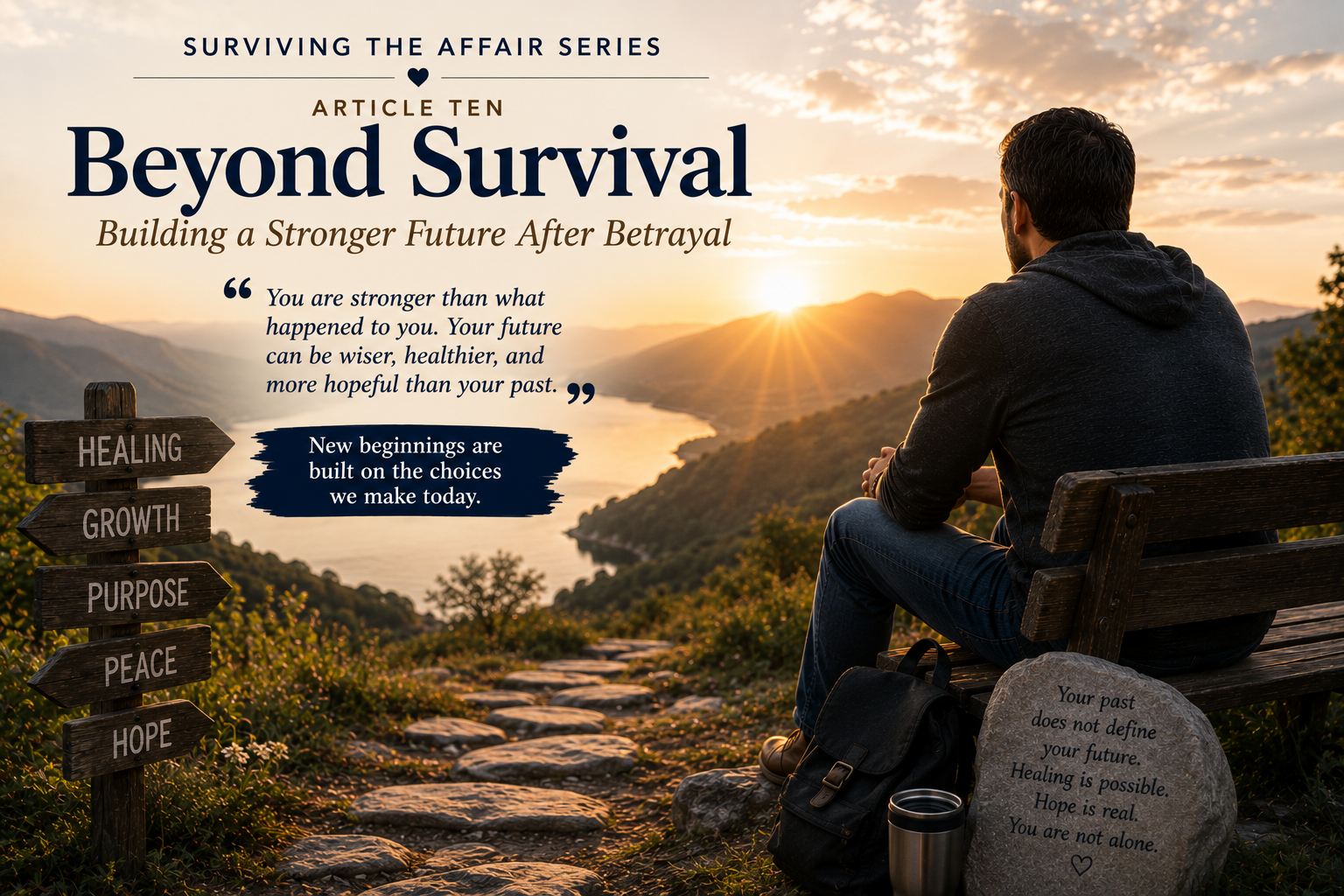
Surviving the Affair: Beyond Survival

Part Ten: Building a Stronger Future After Betrayal

At some point, nearly every person recovering from an affair asks the same question:

“Will I ever feel normal again?”

It is a deeply human question. After months—or sometimes years—of emotional turmoil, counseling appointments, difficult conversations, sleepless nights, and painful decisions, people naturally long for the day when life no longer revolves around the affair. They want peace. They want joy. They want to stop measuring every conversation against the past. They want to wake up without immediately remembering what happened.

The encouraging truth is this:

For many people, that day does come. Not because the affair is forgotten. Not because the pain never existed. But because healing gradually becomes stronger than the wound. Recovery is not simply about surviving betrayal. It is about becoming someone healthier, wiser, and emotionally stronger than you were before the crisis began. This final chapter is not about ending a painful story. It is about beginning a new one.


Healing Changes You

Many people begin counseling hoping to become the person they were before the affair. Ironically, the healthiest outcome is often something different. Healthy recovery does not recreate the past. It creates growth. People frequently discover strengths they never knew they possessed. They become better communicators. They establish healthier boundaries. They learn emotional regulation. They become more intentional in relationships. They deepen their spiritual lives.

While no one would choose the pain of betrayal, many eventually recognize that the healing process transformed them into someone more emotionally mature than they had ever been before. This is what psychologists often describe as post-traumatic growth—positive psychological change that emerges from successfully navigating profound adversity. Growth does not justify suffering. It demonstrates that suffering does not have the final word.


If You Rebuild the Marriage

Some marriages survive infidelity. A smaller number become healthier than they were before. Not because the affair improved the relationship. Rather, because the crisis forced both spouses to confront unhealthy patterns that had existed long before the affair occurred. Healthy reconciled marriages often develop:

  • Honest communication.
  • Emotional transparency.
  • Greater empathy.
  • Consistent accountability.
  • Shared spiritual growth.
  • Intentional quality time.
  • Renewed commitment to protecting the relationship.

Trust returns slowly. Sometimes over several years. Each truthful conversation becomes another brick in rebuilding the foundation. Eventually, trust becomes less about forgetting the past and more about confidence in today’s choices.


If the Marriage Ends

For others, healing continues outside the marriage. Divorce does not automatically mean failure. Sometimes it reflects the difficult reality that one or both partners were unwilling or unable to rebuild a healthy relationship. Life after divorce often begins with grief. Then comes adjustment. Eventually, many discover hope. New routines develop. Children adapt. Friendships deepen. Purpose returns. Life begins to feel possible again. Although the family structure has changed, healing remains available. Your future is not cancelled because your marriage ended.


Learning to Trust Again

One of the greatest fears after betrayal is trusting another person. Some decide they will never become vulnerable again. While understandable, emotional isolation often prolongs suffering. Healthy trust develops gradually. It begins with yourself. Can I recognize unhealthy patterns? Can I communicate honestly? Can I establish healthy boundaries? Can I respond to red flags instead of ignoring them? Confidence grows as these questions receive healthier answers. Eventually, trusting others becomes less frightening because you trust your own wisdom.


Your Identity Is More Than Your Pain

Perhaps the greatest danger after an affair is allowing the betrayal to become your identity. Some introduce themselves internally as:

  • “I am the one who was cheated on.”
  • “I am the one who destroyed my marriage.”
  • “I am the affair partner.”

Those descriptions may explain part of your story. They should never define your entire life. You are more than your worst decision. You are more than someone else’s worst decision. Healing allows identity to shift from victimhood toward purpose. From shame toward dignity. From regret toward wisdom. From survival toward flourishing.


Choosing Healthy Relationships Going Forward

Whether you remain married, remarry someday, or remain single, healthy relationships share common characteristics. They include:

  • Mutual respect.
  • Honest communication.
  • Emotional safety.
  • Shared responsibility.
  • Healthy conflict resolution.
  • Appropriate boundaries.
  • Genuine friendship.
  • Spiritual and emotional intimacy.

Healthy love is not built upon perfection. It is built upon consistency.


Your Story Can Help Someone Else

Many people initially want to hide every part of their experience. Over time, some discover that their greatest pain becomes one of their greatest opportunities to serve. Their story encourages another struggling couple. Their wisdom comforts someone newly betrayed. Their experience offers hope to someone who believes healing is impossible. Scars often become testimonies. Not because suffering was good. But because healing became visible.


Tools for Living Beyond Betrayal

As you continue moving forward, these practices support lasting emotional health:

  • Continue investing in personal growth long after the crisis has passed.
  • Prioritize honest communication in every important relationship.
  • Maintain healthy emotional and physical boundaries.
  • Practice forgiveness without abandoning wisdom.
  • Develop consistent spiritual disciplines through prayer and Scripture.
  • Stay connected to supportive family, friends, and community.
  • Celebrate progress rather than expecting perfection.
  • Seek counseling whenever new challenges arise.
  • Remember that healing is ongoing, not a destination.
  • Live intentionally rather than reactively.

A Christian Perspective

Scripture repeatedly reminds us that God specializes in restoration. Joel 2:25 contains one of the Bible’s most hopeful promises:

“I will restore to you the years that the locusts have eaten…” (ESV)

Restoration does not always mean restoring the same marriage. Sometimes it means restoring the same person. Sometimes it means restoring hope. Sometimes it means restoring purpose. Sometimes it means restoring faith. God’s greatest work often begins after our greatest heartbreak. No matter how your story concludes, His invitation remains the same:

Walk forward with Him.


A Therapist’s Reflection

If I could leave every reader with one final thought, it would be this:

Do not measure your life by the day the affair happened.

Measure it by the person you are becoming because you refused to stay there. Healing is rarely dramatic. It is usually quiet. It is choosing honesty one conversation at a time. Forgiveness one day at a time. Healthy boundaries one decision at a time. Faith one prayer at a time. Eventually, those small choices become a transformed life. The affair may always be one chapter of your story. It does not have to be the title. Your future is still unwritten. Your relationships can still be healthy. Your heart can still know peace. Your family can still experience joy. And your life can still reflect hope. You have survived. Now it is time to live.


About the Author

John S. Collier, MSW, LCSW-S is a licensed clinical social worker, psychotherapist, author, educator, and speaker with decades of experience helping individuals, couples, and families navigate life’s most difficult emotional challenges. Throughout his career, he has worked extensively with people struggling with relationship conflict, betrayal, anxiety, depression, trauma, grief, addiction, and life transitions. His counseling approach combines evidence-based psychological practices with practical wisdom, compassion, and a deep respect for each person’s unique journey.

John has devoted much of his professional life to understanding the complexities of human relationships. He has counseled couples working to rebuild trust after infidelity, individuals recovering from betrayal, and families seeking healing after painful life events. His clinical experience has reinforced one enduring truth: while relationships can be profoundly wounded, people possess an extraordinary capacity for growth, resilience, forgiveness, and transformation when they are equipped with the right tools and support.

As an author, John seeks to bridge the gap between professional mental health knowledge and everyday life. His writing translates complex psychological concepts into practical guidance that readers can understand and apply immediately. Whether addressing marriage, parenting, emotional wellness, trauma recovery, or spiritual growth, his goal is to provide resources that are both clinically sound and personally encouraging.

Surviving the Affair reflects John’s commitment to approaching infidelity with both honesty and compassion. Rather than reducing people to labels or stereotypes, he explores the emotional realities experienced by everyone affected—the betrayed spouse, the unfaithful partner, the affair partner, and the families whose lives are forever changed. Drawing upon years of therapeutic experience, he emphasizes accountability without condemnation, healing without minimizing pain, and hope without offering unrealistic promises.

John believes that healing begins when people are willing to face the truth with courage. While not every relationship can or should be restored, every individual has the capacity to grow beyond betrayal, rediscover integrity, and build a healthier future. His passion is helping readers move from surviving life’s greatest wounds to living with renewed purpose, emotional strength, and hope.

Through his books, speaking engagements, and counseling work, John continues to encourage others to pursue emotional health, healthy relationships, personal responsibility, and lasting transformation—one step at a time.ountability, and restoration. Through his clinical work and writing, he equips readers with practical tools to build emotionally healthy relationships, strengthen resilience, and discover hope after life’s most difficult experiences.

References

American Psychological Association. (2023). Clinical Practice Guideline for the Treatment of Posttraumatic Stress Disorder.

Calhoun, L. G., & Tedeschi, R. G. (2014). Handbook of Posttraumatic Growth: Research and Practice. Routledge.

Gottman, J. M., & Gottman, J. S. (2015). 10 Principles for Doing Effective Couples Therapy. W. W. Norton & Company.

Snyder, D. K., Baucom, D. H., & Gordon, K. C. (2007). Getting Past the Affair. Guilford Press.

Spring, J. A. (2012). After the Affair (2nd ed.). Harper.

Tedeschi, R. G., & Calhoun, L. G. (2004). “Posttraumatic Growth: Conceptual Foundations and Empirical Evidence.” Psychological Inquiry, 15(1), 1–18.

The Holy Bible, English Standard Version. Crossway.


Articles in this Series:

This series has been written for every person whose life has been altered by an affair. Each article focuses on one unique perspective because healing looks different depending upon where someone stands.

Surviving the Affair: Forgiveness, Reconciliation, and Letting Go

Part Nine: When Healing Doesn’t Always Mean Staying Together

Perhaps no word creates more confusion after an affair than the word forgiveness. Some people believe forgiveness means forgetting. Others believe it means trusting again. Some think it requires reconciliation. Others refuse to forgive because they believe doing so somehow excuses what happened.

In my years of counseling individuals and couples after infidelity, I have discovered that very few people actually struggle with the idea of forgiveness. They struggle with what they think forgiveness means. If we misunderstand forgiveness, we either demand it too quickly or avoid it altogether. Neither response promotes healing. Forgiveness is one of the most misunderstood concepts in psychology, relationships, and Christianity. Understanding it correctly often becomes one of the most important turning points in recovery.


Forgiveness Is Not Saying It Didn’t Matter

Some wounds permanently change a person’s life. An affair may result in divorce. Children may experience years of emotional pain. Friendships may end. Financial stability may disappear. Trust may never fully return. Acknowledging these realities does not mean forgiveness is impossible. It means forgiveness begins with honesty. Real forgiveness never minimizes the seriousness of betrayal. It fully recognizes the depth of the wound. Only then can healing begin.


Forgiveness Is Not Reconciliation

This distinction cannot be overstated. Forgiveness and reconciliation are related. They are not identical. Forgiveness is something one person can choose. Reconciliation requires two people. One person can forgive. Both people must rebuild trust. Reconciliation requires:

  • Genuine repentance.
  • Radical honesty.
  • Transparency.
  • Accountability.
  • Emotional safety.
  • Consistent trustworthy behavior.
  • Mutual willingness to rebuild the relationship.

Without these elements, reconciliation becomes unsafe. Forgiveness may still occur. Reconciliation may not.


Forgiveness Is Not Trust

One of the most painful mistakes couples make is expecting forgiveness to immediately restore trust. Trust is earned. Forgiveness is given. Trust grows through repeated demonstrations of honesty. Forgiveness grows through emotional healing. A spouse may forgive today. Trust may require months—or years—to return. That is normal. Healthy forgiveness never ignores wisdom.


Bitterness Is a Heavy Burden

Many people refuse forgiveness because they believe it protects them. “If I stay angry, I’ll never be hurt again.” Unfortunately, bitterness rarely protects. It imprisons. Bitterness quietly occupies emotional space that could otherwise be filled with peace. It influences future relationships. It affects physical health. It changes the way we see ourselves. It changes the way we see others. Eventually, bitterness begins hurting the person carrying it more than the person who caused it. Forgiveness is not setting someone else free. It is refusing to remain emotionally chained to what they did.


What If They Never Apologize?

One of the most difficult realities is that some people never receive the apology they deserve. The unfaithful spouse may deny responsibility. The affair partner may never acknowledge the harm. Some people simply disappear. Waiting for another person’s remorse before healing often leaves us emotionally dependent upon someone who has already demonstrated unreliability. Healing cannot depend upon another person’s choices. Your recovery belongs to you.


Forgiveness Is a Process, Not a Moment

Many people expect forgiveness to happen all at once. Instead, it often unfolds gradually. One day you notice the anger feels slightly less intense. Months later, the memories no longer dominate every conversation. Years later, you discover the affair has become part of your history rather than your identity. Forgiveness usually grows quietly. Like physical healing, it often happens so gradually that we fail to notice until we compare where we are today with where we once were.


When Reconciliation Isn’t Healthy

Not every marriage should continue. Repeated affairs. Abuse. Manipulation. Addiction without treatment. Chronic dishonesty. Refusal to accept responsibility. These situations may make reconciliation unsafe. Choosing divorce in such circumstances is not necessarily evidence of unforgiveness. Sometimes healthy boundaries require ending the relationship. God values truth and safety as much as He values reconciliation. Wisdom requires knowing the difference.


What Letting Go Really Means

Letting go does not mean pretending the affair never happened. It means releasing your need to control what cannot be changed. You cannot rewrite yesterday. You can choose how yesterday influences tomorrow. Letting go means:

  • Releasing revenge.
  • Releasing constant rumination.
  • Releasing the need to make the other person suffer.
  • Releasing unrealistic expectations.
  • Choosing emotional freedom instead of emotional captivity.

That process rarely happens overnight. It is practiced one decision at a time.


Tools for Moving Forward

Whether your marriage survives or ends, these practices encourage emotional healing:

  • Work with a therapist experienced in betrayal trauma.
  • Journal your thoughts and emotional progress.
  • Practice mindfulness when intrusive memories arise.
  • Establish healthy emotional and physical boundaries.
  • Learn the difference between forgiveness and trust.
  • Invest in supportive friendships.
  • Develop daily spiritual practices through prayer and Scripture.
  • Focus on becoming emotionally healthy rather than emotionally vindicated.
  • Celebrate progress rather than demanding perfection.
  • Give yourself permission to heal at your own pace.

A Christian Perspective

When Jesus taught about forgiveness, He never suggested that wrongdoing should be ignored. Rather, He demonstrated that forgiveness is an act of surrender to God rather than an approval of sin. Ephesians 4:31–32 encourages believers:

“Get rid of all bitterness, rage and anger… Be kind and compassionate to one another, forgiving each other, just as in Christ God forgave you.”

Biblical forgiveness is rooted in freedom. Freedom from bitterness. Freedom from revenge. Freedom to trust God’s justice rather than carrying the burden yourself. Forgiveness is not weakness. It is spiritual strength.


A Therapist’s Reflection

One question I frequently ask clients is this:

“If the affair could no longer control your emotional life, what kind of person would you become?”

At first, many struggle to answer. Their identity has become intertwined with the betrayal. Over time, however, something beautiful begins to happen. They stop defining themselves by what someone did to them. They begin defining themselves by who they are becoming. That is healing. Forgiveness does not erase scars. It changes what those scars represent. Instead of reminders of permanent defeat…They become evidence that you survived. Whether your marriage continues or ends… Whether the apology comes or never arrives…Whether trust is rebuilt or permanently broken…Your future is still yours to write.

Do not allow another person’s choices to become the author of the rest of your life. Healing is possible. Freedom is possible. And forgiveness—properly understood—may become one of the greatest gifts you ever give yourself.


About the Author

John S. Collier, MSW, LCSW-S is a licensed clinical social worker, psychotherapist, author, educator, and speaker with decades of experience helping individuals, couples, and families navigate life’s most difficult emotional challenges. Throughout his career, he has worked extensively with people struggling with relationship conflict, betrayal, anxiety, depression, trauma, grief, addiction, and life transitions. His counseling approach combines evidence-based psychological practices with practical wisdom, compassion, and a deep respect for each person’s unique journey.

John has devoted much of his professional life to understanding the complexities of human relationships. He has counseled couples working to rebuild trust after infidelity, individuals recovering from betrayal, and families seeking healing after painful life events. His clinical experience has reinforced one enduring truth: while relationships can be profoundly wounded, people possess an extraordinary capacity for growth, resilience, forgiveness, and transformation when they are equipped with the right tools and support.

As an author, John seeks to bridge the gap between professional mental health knowledge and everyday life. His writing translates complex psychological concepts into practical guidance that readers can understand and apply immediately. Whether addressing marriage, parenting, emotional wellness, trauma recovery, or spiritual growth, his goal is to provide resources that are both clinically sound and personally encouraging.

Surviving the Affair reflects John’s commitment to approaching infidelity with both honesty and compassion. Rather than reducing people to labels or stereotypes, he explores the emotional realities experienced by everyone affected—the betrayed spouse, the unfaithful partner, the affair partner, and the families whose lives are forever changed. Drawing upon years of therapeutic experience, he emphasizes accountability without condemnation, healing without minimizing pain, and hope without offering unrealistic promises.

John believes that healing begins when people are willing to face the truth with courage. While not every relationship can or should be restored, every individual has the capacity to grow beyond betrayal, rediscover integrity, and build a healthier future. His passion is helping readers move from surviving life’s greatest wounds to living with renewed purpose, emotional strength, and hope.

Through his books, speaking engagements, and counseling work, John continues to encourage others to pursue emotional health, healthy relationships, personal responsibility, and lasting transformation—one step at a time.onal pain toward lives marked by integrity, resilience, and hope. Through his writing and counseling, he encourages readers to embrace accountability while believing that lasting personal transformation is always possible. with practical tools for healing, resilience, and lasting personal growth.

References

American Psychiatric Association. (2022). Diagnostic and Statistical Manual of Mental Disorders (5th ed., text rev.). American Psychiatric Association Publishing.

Baucom, D. H., Snyder, D. K., & Gordon, K. C. (2009). Helping Couples Get Past the Affair: A Clinician’s Guide. Guilford Press.

Enright, R. D. (2001). Forgiveness Is a Choice: A Step-by-Step Process for Resolving Anger and Restoring Hope. American Psychological Association.

Glass, S. P. (2003). Not “Just Friends”: Rebuilding Trust and Recovering Your Sanity After Infidelity. Free Press.

Spring, J. A. (2012). After the Affair: Healing the Pain and Rebuilding Trust When a Partner Has Been Unfaithful (2nd ed.). Harper.

Worthington, E. L. (2006). Forgiveness and Reconciliation: Theory and Application. Routledge.

Worthington, E. L. (2013). Moving Forward: Six Steps to Forgiving Yourself and Breaking Free from the Past. WaterBrook.

The Holy Bible, New International Version. (2011). Zondervan.


Articles in this Series:

This series has been written for every person whose life has been altered by an affair. Each article focuses on one unique perspective because healing looks different depending upon where someone stands.