Welcome to SOUTHEAST KENTUCKY BEHAVIORAL HEALTH
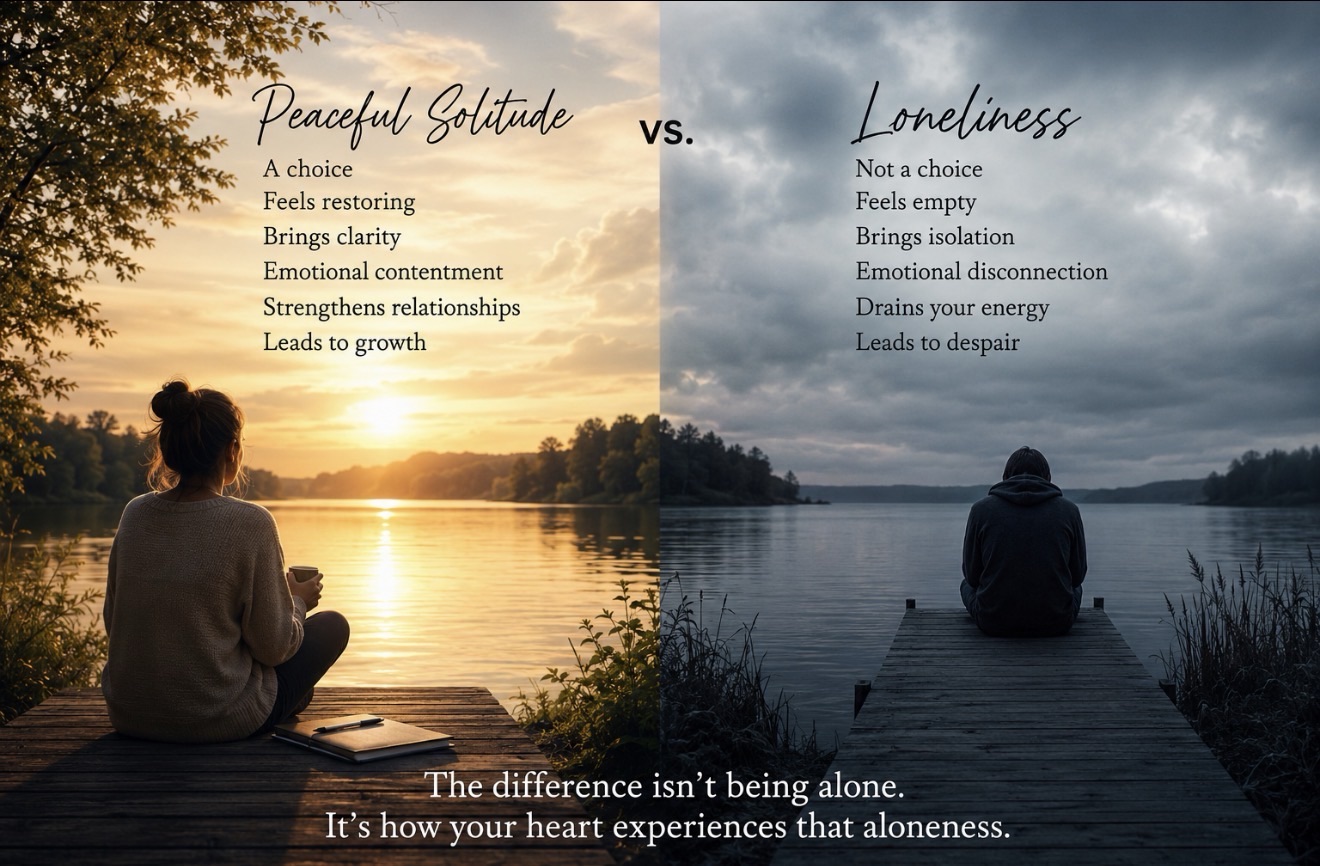
Peace or Loneliness? Learning the Difference Between a Calm Life and Feeling Alone

Many people think that a busy life is a happy life. We often hear that we should always be doing something, talking to people, or staying connected online. Because of this, when life becomes quiet, we may wonder if something is wrong. We might ask ourselves, “Am I feeling peaceful, or am I just lonely?”

Many people confuse peace with loneliness because both can happen when we are alone. Even though they may look the same on the outside, they feel very different on the inside. Learning the difference can help us enjoy quiet times, build healthier relationships, and take better care of our mental health.


What Is Peaceful Solitude?

Peaceful solitude means choosing to spend time alone and feeling happy and calm while doing it. Instead of feeling sad, people often feel rested, creative, and refreshed.

Psychologist Anthony Storr (1988) believed that spending time alone can help people think clearly, solve problems, and learn more about themselves. Many artists, writers, scientists, and spiritual leaders have spent quiet time alone to help them grow and create new ideas.

People who enjoy peaceful solitude often:

  • Feel safe while they are alone.
  • Enjoy hobbies and interests.
  • Take time to think and reflect.
  • Feel calm inside.
  • Keep healthy friendships.
  • Feel free instead of trapped.

The biggest difference is that they choose to be alone.


What Is Loneliness?

Loneliness is very different from peaceful solitude.

Researcher John Cacioppo said that loneliness happens when people feel they do not have enough close or meaningful relationships (Cacioppo & Patrick, 2008).

A person can feel lonely even if they are surrounded by people.

Someone can:

  • Be married and still feel lonely.
  • Have many followers on social media and still feel alone.
  • Go to church every week and still feel disconnected.
  • Work around many people and still feel like no one understands them.

Loneliness is not about being by yourself.

It is about feeling disconnected from others.


How Peace Feels

When people experience peaceful solitude, they often feel:

  • Calm
  • Thankful
  • Free
  • Relaxed
  • Happy
  • Hopeful
  • Confident
  • Clear-minded

They may say things like:

“I enjoy having time to myself.”

“I finally have time to think.”

“Life feels simple.”

“I don’t feel like I’m missing anything.”


How Loneliness Feels

Loneliness often brings feelings like:

  • Sadness
  • Emptiness
  • Restlessness
  • Feeling forgotten
  • Wanting someone to talk to
  • Worry
  • Depression
  • Hopelessness

People may think:

“Nobody understands me.”

“I wish someone would call me.”

“No one notices me.”

“I don’t matter.”

These feelings are very different from the peace that comes from healthy solitude.


What Happens in the Brain?

Research shows that quiet time can actually help your brain. WWhen people spend peaceful time alone, their brains have time to organize memories, solve problems, think creatively, and plan for the future (Raichle, 2015). But long-lasting loneliness affects the body in a different way.

Studies show that loneliness can increase:

  • Stress hormones
  • High blood pressure
  • Trouble sleeping
  • Anxiety
  • Depression
  • Heart disease
  • The risk of dying earlier (Holt-Lunstad et al., 2015)

Our bodies react differently depending on whether we feel peaceful or rejected.


The Power of Choice

One of the biggest differences between peace and loneliness is choice. Peace is something we choose. Loneliness often feels like something that happens to us. Imagine two people sitting alone on a Saturday afternoon. One person is reading a favorite book and enjoying the quiet. The other person wishes someone would visit or call. Both people are alone. But only one feels lonely.


Self-Worth Matters

People who feel good about themselves are usually more comfortable spending time alone. Researchers Ryan and Deci (2020) explain that people need three important things:

  • To feel capable.
  • To have some independence.
  • To have healthy relationships.

Peaceful solitude helps people become more independent while still staying connected to others. Loneliness happens when those important relationships are missing.


Why We Confuse Peace with Loneliness

Busy Culture

Today’s world tells us that being busy means being successful. If someone spends a Friday night at home, others may think they have no friends. But many healthy people enjoy quiet evenings to relax, read, pray, or spend time with family.


Social Media

Social media usually shows people’s best moments. We see vacations, parties, birthdays, and celebrations. This can make us believe everyone else is happier than we are. Research shows that spending too much time comparing ourselves to others on social media can actually increase loneliness (Primack et al., 2017).


Fear of Missing Out

Many people experience something called Fear of Missing Out (FOMO). They worry that everyone else is having more fun. Peace says,

“I’m happy where I am.”

FOMO says,

“I wonder if everyone else is happier than me.”


Signs You Are Feeling Peace

You may be experiencing peace if:

  • You enjoy quiet time.
  • You like your hobbies.
  • You have healthy friendships.
  • You feel safe and calm.
  • You are thankful.
  • Your alone time helps you feel rested.
  • You can call friends when you want to, but you don’t depend on them to feel happy.

Signs You May Be Lonely

You may be lonely if:

  • Silence feels painful.
  • You always need distractions.
  • You feel forgotten.
  • You feel empty inside.
  • You stop spending time with people.
  • You feel hopeless.
  • You feel alone even when others are around.
  • Your anxiety gets worse when you are by yourself.

Peace Helps You Grow

Research shows that learning to enjoy quiet time can make people stronger emotionally. Healthy solitude helps people:

  • Control their emotions.
  • Become more creative.
  • Grow spiritually.
  • Learn about themselves.
  • Make better decisions.
  • Become more independent.
  • Stay calmer during stressful times.

This is one reason why people have practiced prayer, meditation, journaling, and quiet reflection for thousands of years.


When Peace Turns into Isolation

Even healthy solitude can become unhealthy if it lasts too long. Warning signs include:

  • Avoiding everyone.
  • Turning down every invitation.
  • Feeling more depressed.
  • Losing motivation.
  • Not taking care of yourself.
  • Feeling emotionally numb.
  • Feeling sad for many weeks.

If these problems continue, it is important to talk with a mental health professional.


A Christian View

The Bible shows that spending quiet time alone can help people grow closer to God. Jesus often went away by Himself to pray (Luke 5:16). Moses met with God on Mount Sinai (Exodus 24). Elijah heard God’s gentle voice while he was alone (1 Kings 19:11–13). Paul also spent time alone after becoming a Christian before beginning his ministry (Galatians 1:17–18).

These times alone helped them listen to God and prepare for what He wanted them to do. But they did not stay alone forever. They returned to help and serve other people. ĎGod created us to spend time with Him and to have healthy relationships with others.


Questions to Ask Yourself

If you are not sure whether you are feeling peace or loneliness, ask yourself:

  • Do I enjoy this quiet time?
  • Am I choosing to be alone?
  • Do I feel happy inside?
  • Can I reach out to friends when I want to?
  • Does my quiet time give me energy?
  • Do I want healthy friendships, or am I hiding from people?
  • Is this season helping me grow?

Being honest with yourself can help you understand what you are really feeling.


Conclusion

The difference between peace and loneliness is not about how many people are around you. It is about how you feel inside. Peace means you are comfortable with yourself. You enjoy quiet moments, grow in your faith, and stay connected to people who care about you.

Loneliness is the painful feeling that you need connection but do not have it.

Learning the difference can help you enjoy healthy quiet time while also building strong and meaningful relationships. A peaceful life is not an empty life. Sometimes, the quiet moments are where we find healing, hope, purpose, and a deeper relationship with God.

About the Author

John S. Collier, MSW, LCSW, is a Licensed Clinical Social Worker, behavioral health executive, author, and speaker with more than 25 years of experience helping individuals, couples, and families navigate life’s most difficult emotional challenges. As the founder and Clinical Director of Southeast Kentucky Behavioral Health, LLC, he has dedicated his career to helping people build healthier relationships, strengthen emotional resilience, and find lasting hope through evidence-based therapeutic practices integrated with timeless biblical principles. His clinical work focuses on trauma, attachment, anxiety, depression, emotional regulation, and relationship dynamics, allowing him to translate complex psychological concepts into practical tools that readers can apply in everyday life. Through his books, articles, and presentations, John writes with compassion, authenticity, and a deep belief that healing is possible when truth, grace, and intentional growth come together. His mission is to equip readers with both the scientific understanding and spiritual encouragement needed to cultivate lives marked by peace, purpose, and meaningful connection.


References

Cacioppo, J. T., & Patrick, W. (2008). Loneliness: Human nature and the need for social connection. W. W. Norton.

Hawkley, L. C., & Cacioppo, J. T. (2010). Loneliness matters: A theoretical and empirical review of consequences and mechanisms. Annals of Behavioral Medicine, 40(2), 218–227. https://doi.org/10.1007/s12160-010-9210-8

Holt-Lunstad, J., Smith, T. B., Baker, M., Harris, T., & Stephenson, D. (2015). Loneliness and social isolation as risk factors for mortality: A meta-analytic review. Perspectives on Psychological Science, 10(2), 227–237. https://doi.org/10.1177/1745691614568352

Primack, B. A., Shensa, A., Sidani, J. E., et al. (2017). Social media use and perceived social isolation among young adults in the United States. American Journal of Preventive Medicine, 53(1), 1–8. https://doi.org/10.1016/j.amepre.2017.01.010

Raichle, M. E. (2015). The brain’s default mode network. Annual Review of Neuroscience, 38, 433–447. https://doi.org/10.1146/annurev-neuro-071013-014030

Ryan, R. M., & Deci, E. L. (2020). Intrinsic and extrinsic motivation from a self-determination theory perspective: Definitions, theory, practices, and future directions. Contemporary Educational Psychology, 61, 101860. https://doi.org/10.1016/j.cedpsych.2020.101860

Storr, A. (1988). Solitude: A return to the self. Free Press.

You Should Never Have to Play Detective: How Healthy Relationships Create Security Instead of Suspicion

One of the most exhausting experiences in a romantic relationship is feeling like you have to become an investigator rather than a partner. You begin analyzing text messages, studying social media activity, questioning changes in routine, replaying conversations in your mind, and searching for hidden meanings behind every word or behavior. Instead of experiencing peace, your emotional energy is consumed by uncertainty.

Many people mistakenly believe that this constant vigilance is proof of how deeply they love someone. In reality, it is often evidence that something fundamental is missing: emotional security.

A healthy relationship does not require detective work. It naturally cultivates trust through consistency, honesty, transparency, and emotional safety. Security is not something one partner repeatedly demands; it is something both partners consistently create.

The statement, “A healthy relationship doesn’t make you feel like you have to play detective. It makes you feel secure without asking,” captures one of the clearest indicators of relational health. Security is not created through endless reassurance alone—it develops because a person’s actions repeatedly demonstrate reliability and integrity.


Why People Become Detectives

When trust begins to erode, the human brain naturally attempts to fill in missing information. From an evolutionary perspective, uncertainty represents potential danger. The brain would rather create explanations—even inaccurate ones—than tolerate ambiguity.

Psychologists refer to this as uncertainty reduction, the natural tendency to seek information when situations feel unpredictable (Berger & Calabrese, 1975).

This often leads individuals to:

  • Check phones
  • Monitor social media
  • Question every delay
  • Replay conversations repeatedly
  • Search for inconsistencies
  • Compare current behavior with past patterns
  • Read hidden meanings into ordinary events

Ironically, the more someone investigates, the less secure they often become. Every unanswered question creates three new questions.

The relationship gradually shifts from connection to surveillance.


The Difference Between Healthy Curiosity and Hypervigilance

Healthy partners ask questions. – Hypervigilant partners conduct investigations.

The difference lies in motivation.

Healthy curiosity seeks understanding. – Hypervigilance seeks protection from anticipated betrayal.

Individuals who have experienced betrayal, abandonment, inconsistent caregiving, or previous infidelity frequently develop heightened sensitivity to potential threats (Mikulincer & Shaver, 2016). Their nervous system learns that safety cannot be assumed.

As a result, they begin searching for evidence that confirms their fears. Unfortunately, anxiety rarely says,

“Everything is probably okay.”

Instead it whispers,

“Look again. You probably missed something.”


What Creates Emotional Security?

Security is not created by grand romantic gestures. It is created by ordinary consistency repeated over time. Research by psychologist John Gottman has consistently shown that trust develops through countless small interactions in which partners repeatedly choose honesty, responsiveness, and emotional availability (Gottman & Silver, 2015).

Security grows when someone:

  • Does what they say they will do.
  • Keeps promises.
  • Is emotionally available.
  • Answers difficult questions honestly.
  • Communicates openly.
  • Shows consistency between words and actions.
  • Makes their partner feel valued rather than tolerated.

Trust is not built in dramatic moments. It is built in ordinary Tuesdays.


Transparency Is Different Than Surveillance

Some people mistakenly believe that complete surveillance creates trust. It does not. Knowing every password does not automatically produce security. Tracking someone’s location does not automatically eliminate fear. Reading every text message does not automatically heal betrayal. Transparency is voluntarily offered. Surveillance is demanded. Healthy couples willingly share information because they have nothing to hide—not because they are forced to prove their innocence every day. Trust cannot survive when one partner constantly feels like they are on trial.


Insecure Relationships Create Constant Guessing

When emotional safety is absent, people begin asking themselves questions like:

  • “Why haven’t they texted?”
  • “Why did they seem distant?”
  • “Who liked that picture?”
  • “Why did they smile at that person?”
  • “Why did they suddenly become protective of their phone?”

Over time these questions become mentally exhausting. The relationship slowly becomes less about love and more about gathering evidence. Instead of enjoying each other’s presence, partners begin managing each other’s suspicions. This is emotionally unsustainable.


Secure Relationships Reduce Mental Noise

One of the most overlooked benefits of a healthy relationship is mental quietness. You stop wondering where you stand. You stop wondering if you’re enough. You stop wondering whether affection will disappear tomorrow. Secure attachment provides what psychologists call a safe haven and a secure base (Bowlby, 1988).

A safe haven is someone who provides comfort during stress. A secure base is someone whose presence allows you to confidently explore life because you know they will remain emotionally available. When those needs are consistently met, anxiety decreases. Your mind becomes quieter.


Consistency Is More Convincing Than Words

Many unhealthy relationships are filled with reassuring words but inconsistent behavior. Someone may repeatedly say:

  • “Trust me.”
  • “Nothing’s wrong.”
  • “You’re overthinking.”

Yet their behavior continues creating confusion. Research consistently demonstrates that trust is based more on predictable behavior than verbal reassurance (Rempel, Holmes, & Zanna, 1985). People believe patterns. Not promises.


Emotional Safety Changes Everything

Emotional safety allows people to become fully themselves. They no longer fear punishment for expressing feelings. They no longer hide needs. They no longer worry that honesty will be weaponized against them. Psychologist Sue Johnson, developer of Emotionally Focused Therapy (EFT), explains that secure emotional bonds reduce distress because partners become reliable sources of comfort rather than uncertainty (Johnson, 2019). Healthy love feels emotionally predictable. Not emotionally confusing.


When Detective Work Is Actually Warning You

There is an important distinction that should not be ignored. Sometimes people feel suspicious because anxiety is distorting reality. Other times, their instincts are responding to genuine inconsistencies. If someone repeatedly:

  • Lies
  • Hides information
  • Gaslights concerns
  • Breaks promises
  • Violates boundaries
  • Creates confusion intentionally

then the issue is not insecurity. The issue is trustworthiness. Healthy relationships welcome honest conversations. Unhealthy relationships often punish them. The goal is never blind trust. The goal is earned trust.


Building a Relationship That Doesn’t Require Investigation

Healthy couples intentionally cultivate trust. Some practical ways include:

  • Communicating honestly, even when conversations are uncomfortable.
  • Being consistent between words and actions.
  • Following through on commitments.
  • Taking responsibility for mistakes without defensiveness.
  • Offering reassurance through dependable behavior rather than empty promises.
  • Addressing concerns early before resentment grows.
  • Respecting healthy boundaries while remaining emotionally transparent.
  • Choosing integrity when no one is watching.

Over time, these behaviors create a relationship where partners naturally relax into security.


The Peace of Being Known

Perhaps the greatest gift of a healthy relationship is not excitement. It is peace. It is the quiet confidence that someone chooses you every day. It is knowing you do not have to decode hidden messages. You do not have to search for clues. You do not have to become an investigator. You simply experience what trust feels like. Healthy love removes the constant need for proof because its evidence is visible every day. Security is not the absence of questions. It is the consistent presence of answers. A healthy relationship allows your heart to rest because the person beside you has repeatedly shown—through honesty, consistency, and genuine care—that your trust is safe with them.


About the Author

John S. Collier, MSW, LCSW-S is a licensed clinical social worker, author, educator, and speaker with extensive experience helping individuals, couples, and families navigate emotional, behavioral, and relational challenges. Throughout his career, he has specialized in cognitive behavioral therapy, relationship dynamics, anxiety disorders, trauma recovery, and emotional resilience. His writing bridges psychological research with practical, everyday application, presenting complex concepts in language that is both accessible and meaningful. John is passionate about equipping readers with evidence-based tools that foster healthier relationships, emotional well-being, and personal growth. Through his books and articles, he encourages readers to build lives marked by wisdom, authenticity, resilience, and hope.


References

Berger, C. R., & Calabrese, R. J. (1975). Some explorations in initial interaction and beyond: Toward a developmental theory of interpersonal communication. Human Communication Research, 1(2), 99–112.

Bowlby, J. (1988). A Secure Base: Parent-Child Attachment and Healthy Human Development. New York, NY: Basic Books.

Gottman, J. M., & Silver, N. (2015). The Seven Principles for Making Marriage Work (Revised ed.). New York, NY: Harmony Books.

Johnson, S. M. (2019). Attachment Theory in Practice: Emotionally Focused Therapy (EFT) with Individuals, Couples, and Families. New York, NY: Guilford Press.

Mikulincer, M., & Shaver, P. R. (2016). Attachment in Adulthood: Structure, Dynamics, and Change (2nd ed.). New York, NY: Guilford Press.

Rempel, J. K., Holmes, J. G., & Zanna, M. P. (1985). Trust in close relationships. Journal of Personality and Social Psychology, 49(1), 95–112.

Listening to Understand, Not to Win

Many couples argue because they are trying to win, not because they don’t care. When people listen just to prove their point, conversations turn into fights. When people listen to understand, conversations turn into chances to grow closer.

Listening to understand means you are trying to truly hear what your partner feels and needs—even if you do not fully agree. This kind of listening builds trust, safety, and connection in marriage.


Listening to Win vs. Listening to Understand

Listening to Win

When someone listens to win, they are:

  • planning what to say next
  • defending themselves
  • trying to prove they are right
  • pointing out mistakes

This makes the other person feel unheard and unsafe. When people feel unsafe, they shut down or fight back.

Listening to Understand

When someone listens to understand, they are:

  • focused on the other person
  • trying to understand feelings
  • asking questions instead of accusing
  • showing care and respect

Research shows that feeling understood lowers anger and helps couples solve problems together (Gottman Institute, n.d.).


Why Feeling Heard Matters So Much

When your partner feels heard, their body and brain calm down. They are more open to problem-solving. Studies on active listening show that people communicate better when they feel emotionally understood, not judged (Rogers & Farson, 1957).

You do not have to agree to show understanding. You only have to show that you are trying to understand.


A Helpful Rule: Understand First, Respond Later

A simple rule for couples is this:

Do not argue with something you do not fully understand yet.

Before responding, try to explain your partner’s point in your own words. This shows effort and care.

Example:

  • “What I hear you saying is that you felt ignored when I didn’t respond.”
  • “It sounds like that really hurt you.”

This approach reduces defensiveness and keeps conversations respectful (Gottman Institute, n.d.).


5 Simple Skills for Listening to Understand

1. Give Full Attention

Put down your phone. Look at your partner. Show that they matter.

2. Don’t Interrupt

Let your partner finish speaking. Interrupting sends the message that their feelings don’t matter.

3. Repeat What You Heard

Say:

  • “So you’re saying…”
    This helps prevent misunderstandings.

4. Name the Feeling

Try:

  • “It sounds like you felt frustrated.”
    This helps your partner feel seen.

5. Ask If You Got It Right

End with:

  • “Did I understand that correctly?”
    This turns the conversation into teamwork.

These steps are core parts of active listening and emotional connection (StatPearls, 2023).


A Simple Script Couples Can Use

Partner A:
“I feel hurt when this happens.”

Partner B:
“What I hear is that you felt hurt because ____. Did I get that right?”

Partner A:
“Yes” or “Almost—here’s what I mean…”

Partner B:
“Thank you for explaining. Tell me more.”

This small change can completely shift the tone of a conversation.


Common Mistakes to Avoid

  • Trying to fix the problem too fast
  • Saying “yes, but…”
  • Correcting small details instead of focusing on feelings
  • Getting defensive right away

When emotions are high, understanding must come before solutions.


Conclusion

Listening to understand, not to win, changes marriages. It creates safety. It builds trust. It helps couples feel like partners instead of opponents.

When both people feel heard, even hard conversations become moments of connection.

Reframes for Couples

Use these simple reframes during conflict:

  • ❌ “You’re wrong.”
    ✅ “Help me understand your point.”
  • ❌ “You’re overreacting.”
    ✅ “I see this really matters to you.”
  • ❌ “Here’s why I did that.”
    ✅ “I want to understand how that affected you.”
  • ❌ “You always…”
    ✅ “When this happens, it feels…”
  • ❌ “I need to defend myself.”
    ✅ “I need to listen first.”

Strong marriages are not built on being right.
They are built on being present, patient, and willing to understand.


This article was written by John S. Collier, MSW, LCSW-S. He is a Licensed Clinical Social Worker and behavioral health professional with extensive experience working with individuals, couples, and families. He specializes in relationship dynamics, emotional regulation, trauma-informed care, and communication patterns that impact long-term connection. John is known for blending clinical insight with practical, real-life guidance that helps couples move from conflict toward understanding, safety, and emotional growth. His work focuses on helping people build healthier relationships through empathy, accountability, and intentional communication.


Reflective Questions

  1. Do I listen to understand or to respond?
  2. What helps me feel heard by my partner?
  3. What habits do I have that shut conversations down?
  4. How do I react when I feel misunderstood?
  5. What would change if I focused more on understanding than winning?

References


How to live with (and respond to) a spouse who constantly criticizes

When your spouse acts like nothing is ever good enough, it doesn’t just “hurt your feelings”—it can slowly erode emotional safety, closeness, and even your mental health. Research on couples shows that criticism (attacking a partner’s character) is one of the most toxic conflict patterns, especially because it often pulls both partners into predictable spirals (defensiveness, shutdown, contempt). 

Below are practical, evidence-informed ways to cope and respond—without losing yourself in the process.

1) Name what’s happening (and why it’s so exhausting)

Constant criticism usually contains one of these “hidden drivers”:

Anxiety + control: “If everything is perfect, I’ll feel safe.” Unmet needs: “I don’t know how to ask for comfort, help, or attention—so I complain.” Resentment buildup: Old hurts leak out as nitpicking. Poor emotion regulation: When someone can’t downshift, they communicate harshly and perceive conversations as more hostile.  A learned communication style: Some people grew up around negativity or “tough love.” Also: persistent perceived criticism in marriage has been linked to higher depressive symptoms over time. So if you’re feeling worn down, that reaction makes sense. 

2) Separate a complaint from a character attack

A turning point is learning to respond differently to these two categories: A complaint (workable) “Can you put the dishes in the dishwasher?” A character attack (harmful) “You never do anything right. You’re so lazy.” The Gottman model calls the second one criticism (global attack on who you are) and flags it as a high-risk pattern for relationship breakdown when it becomes chronic.  Your goal: steer conversations back to specific behaviors and requests, and refuse the “you are the problem” framing.

3) Use a boundary statement that is calm, firm, and repeatable

Boundaries aren’t punishments—they’re clarity about what you will and won’t engage with. Try one of these scripts: “I want to hear what you need. I’m not willing to be spoken to with insults. If you tell me the specific issue, I’ll listen.” “I’m open to feedback. I’m not open to being put down. Let’s restart.” “If this stays disrespectful, I’m going to take a 20-minute break and we can try again.”

This aligns with what couples research and clinical approaches emphasize: reducing escalations, stopping the cycle, and re-engaging when emotions are lower.  Key detail: don’t over-explain. One sentence. Then follow through.

4) Don’t counter-criticize—interrupt the cycle

When someone criticizes, the natural reflex is to defend, explain, or counterattack. Unfortunately, that often fuels the exact loop that keeps couples stuck (criticize → defend → intensify → withdraw/shutdown). 

Instead, try a 3-step “interrupt”: Validate the emotion (not the insult): “You sound really frustrated.” Ask for a specific request: “What would you like me to do differently—specifically—next time?” Offer a small workable option: “I can do A tonight or B tomorrow. Which matters most?” You’re not “letting it slide.” You’re refusing to fight on the battlefield that criticism creates.

5) Use Nonviolent Communication to translate criticism into needs

Nonviolent Communication (NVC) is a widely used framework to reduce defensiveness by focusing on observations, feelings, needs, and requests.  A simple translation tool:

Observation (no judgment): “When I hear ‘nothing is ever good enough…’” Feeling: “…I feel discouraged and tense.” Need: “I need respect and teamwork.” Request: “Will you tell me one specific change you want, without insults?” Even if your spouse doesn’t “do NVC,” you can use this structure to keep yourself grounded and keep the conversation concrete.

6) Protect your self-worth (because constant criticism chips at it)

If you live with a chronic critic, you need intentional self-protection: Reality-check journaling: Write what was said vs. what’s true. Anchor feedback to trusted sources: mentors, friends, your own standards—not just your spouse’s mood. Limit “performance-based love”: Don’t chase approval that never arrives. Build replenishment into your week: exercise, faith practices, hobbies, supportive community—whatever restores you. This isn’t selfish; it’s necessary. Persistent criticism correlates with worse emotional outcomes over time. 

7) Choose the right “time and container” for hard talks

Constant critics often criticize in the moment—driving, bedtime, right as you walk in the door. Try proposing a container: “I want to address concerns. Can we do it tonight at 7:30 for 20 minutes, phones down?” “Let’s each share one appreciation, one concern, and one request.” If your spouse refuses any structured conversation and only wants to criticize on impulse, that’s important data about the health of the dynamic.

8) Know when it’s crossed into emotional abuse

Not all criticism is abuse—but it becomes dangerous when there’s a pattern of: insults, name-calling, humiliation “moving goalposts” so you can never succeed contempt, mockery, disgust intimidation, threats, or coercive control isolation from friends/family punishment for expressing needs. If that’s present, prioritize safety, support, and professional help. A couples framework is useful only when both partners can be respectful and accountable.

9) When to seek couples counseling (and what to look for)

Consider couples therapy if: the criticism is frequent and escalating you feel you’re “walking on eggshells” conversations end in shutdown or blowups repair attempts don’t work anymore. Evidence-based approaches often target these negative cycles directly and help partners identify what’s underneath them (fear, loneliness, disappointment) rather than fighting on the surface.  If your spouse won’t go, individual therapy can still help you set boundaries, strengthen self-trust, and decide what you will do if the pattern doesn’t change.

This article was written by John S. Collier, MSW, LCSW-S. Mr. Collier has over 25 years experience in the Social Work field. He currently serves as the Executive Director of Southeast Kentucky Behavioral Health.

References

Gottman Institute. (n.d.). The Four Horsemen: Criticism, Contempt, Defensiveness, and Stonewalling.  Gottman Institute. (2025). The Four Horsemen: Criticism.  Peterson-Post, K. M., Rhoades, G. K., Stanley, S. M., & Markman, H. J. (2014). Perceived criticism and marital adjustment predict depressive symptoms in married couples.  Klein, S. R., et al. (2016). Emotion regulation and perceptions of hostile criticism in couples (summary/abstract).  PositivePsychology.com. (2020). Your complete Nonviolent Communication guide.  Center for Nonviolent Communication. (n.d.). NVC skills in intimate relationships.  Verywell Mind. (2023). How nonviolent communication can change your relationship.