More Than “Thank You”: Honoring Veterans Through Gratitude, Understanding, and Support
By John S. Collier, MSW, LCSW-S
Executive Director, Southeast Kentucky Behavioral Health, LLC
“Your courage. Your sacrifice. Our gratitude. Always.”
Veterans Day gives us an opportunity not only to say those words, but also to think about what they should mean after November 11 is over.
Veterans Day Is About Those Who Served
Veterans Day traces its roots to the end of World War I. Fighting ceased on November 11, 1918, at the eleventh hour of the eleventh day of the eleventh month. What began as Armistice Day was later changed to Veterans Day so the nation could honor veterans from all periods of military service. The U.S. Department of Veterans Affairs describes the purpose of Veterans Day as honoring America’s veterans for their patriotism, love of country, and willingness to serve and sacrifice for the common good. That distinction matters.
Memorial Day provides a special time to remember those who died in service to the nation. Veterans Day gives us an opportunity to recognize all who served in the United States Armed Forces. The national Veterans Day ceremony is held each November 11 at Arlington National Cemetery and is specifically intended to honor and thank those who served. So when we meet a veteran at work, at church, in our neighborhoods, in our families, or in a behavioral health office, we are meeting someone whose life includes an experience many civilians will never fully share.
The Uniform May Come Off, but Some Experiences Come Home
Military service does not automatically mean that someone has a mental health condition. We should never assume that every veteran has PTSD, depression, substance-use problems, or difficulty adjusting to civilian life.
At the same time, we should understand that military service can expose people to experiences that carry lasting consequences.
The VA National Center for PTSD reports that about 7% of U.S. veterans experience PTSD at some point during their lives. The numbers vary considerably according to service era, deployment experiences, trauma exposure and other factors. Those statistics remind us of an important principle in behavioral health:
Veterans are not diagnoses. They are people.
Some may need treatment. Some may never need formal mental health services. Some may struggle years after leaving service. Others may demonstrate extraordinary resilience. Often, several of these things can be true at different points in the same person’s life.
Our responsibility is to make sure that when help is needed, asking for that help is treated as an act of strength rather than weakness.
When “Thank You for Your Service” Must Become More
The phrase “Thank you for your service” matters.
But gratitude becomes more meaningful when it produces action.
The most recent 2026 National Veteran Suicide Prevention Annual Report, summarized by the Department of Veterans Affairs, reports 6,488 veteran suicide deaths in 2024, averaging 17.7 deaths per day. Perhaps one of the most important findings is that 62% of veterans who died by suicide in 2024 had not received VA health care during the year of death or the year before. That should concern every behavioral health professional, health-care organization, family and community.
It also tells us that veteran mental health cannot be viewed solely as the responsibility of the VA.
Veterans live in our communities.
They walk through the doors of community mental health centers. They visit primary-care offices. They attend churches. They work beside us. They coach youth sports. They raise families. They own businesses. They become teachers, first responders, counselors and community leaders.
Sometimes the person who needs someone to ask, “Are you really doing okay?” is already standing beside us.
Behavioral Health Organizations Have a Role
Community behavioral health providers can be an important part of that safety net.
In 2026, the Substance Abuse and Mental Health Services Administration released a specific toolkit for community behavioral health organizations serving service members, veterans and their families. The guidance emphasizes identifying veterans in care, understanding military and veteran experiences, and incorporating that knowledge into mental health and substance-use services. That does not require treating every veteran differently.
It means learning enough to ask better questions.
Instead of simply asking:
“Have you experienced trauma?”
we may also need to ask:
“Have you ever served in the military?”
And when the answer is yes, clinicians should understand that military culture, deployments, combat exposure, injuries, loss, transitions from military to civilian life and other service-related experiences may be important parts of the person’s story.
Good behavioral health care begins by understanding the whole person.
Supporting the Family Matters Too
Military service affects more than the person who wears the uniform.
Spouses, partners, parents, children and caregivers may experience deployments, separations, uncertainty, reintegration and changes that come with military life and the transition afterward.
That is why veteran-informed behavioral health care should recognize families as part of the larger picture.
SAMHSA maintains resources specifically designed to help communities strengthen behavioral health systems for service members, veterans and their families through cooperation among federal, state and local organizations. This is an especially important lesson for community-based behavioral health organizations.
Sometimes helping a veteran means helping the family surrounding that veteran.
Honor Without Stigma
Perhaps one of the greatest ways behavioral health professionals can honor veterans is by helping remove the idea that seeking treatment represents weakness.
The opposite is true.
There is strength in recognizing when something is wrong.
There is courage in discussing trauma.
There is courage in admitting that sleep has become difficult, that anger has become hard to control, that alcohol or another substance has become a coping mechanism, or that memories from years ago still interfere with everyday life.
And there is tremendous courage in saying:
“I need help.”
Evidence-based treatment exists for conditions such as PTSD. VA research, for example, has supported trauma-focused approaches including Prolonged Exposure and Cognitive Processing Therapy, including delivery of some treatment through telehealth. No veteran should believe that treatment diminishes what that person accomplished in uniform.
Our Veterans Are Also Our Coworkers
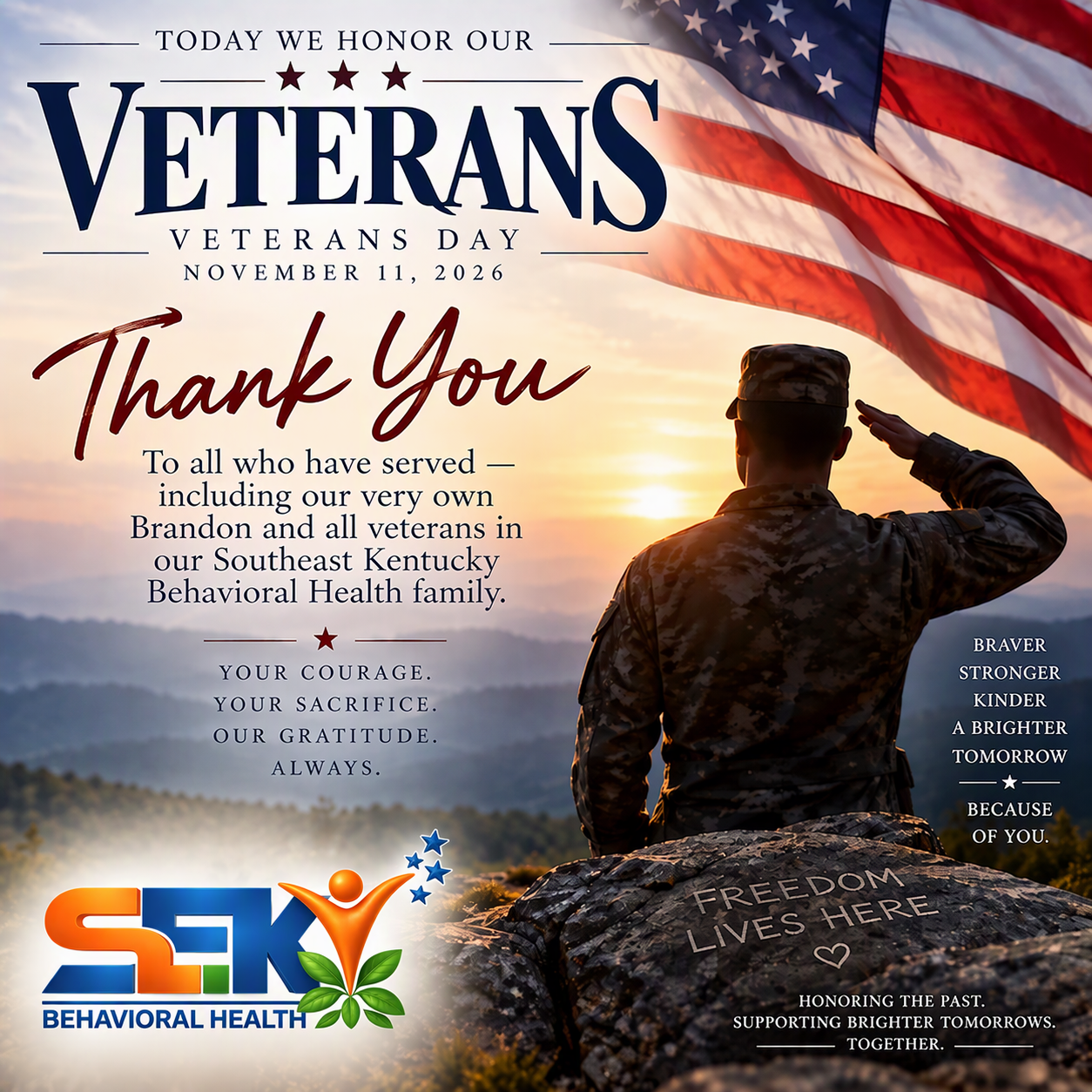
The image that inspired this article recognizes Brandon, one of our own, along with every veteran within the Southeast Kentucky Behavioral Health family and throughout our communities.
That is important.
Veterans are not an abstract population represented only by statistics.
They are people we know.
They sit across from us at meetings.
They work beside us.
They are members of our families and communities.
Today, Southeast Kentucky Behavioral Health says thank you to Brandon and to every veteran who has served our nation.
But our gratitude should extend beyond a graphic posted on Veterans Day.
It should appear in how we treat people.
It should appear in the services we provide.
It should appear in how carefully we listen.
It should appear in our willingness to recognize when somebody may be struggling.
And it should appear in our willingness to stand beside that person when help is needed.
“Your courage. Your sacrifice. Our gratitude. Always.”
The final word may actually be the most important.
Always.
Not only November 11.
Not only when the flag is displayed.
Not only when ceremonies are held.
Not only when someone is wearing a uniform.
Always.
A Message to Our Veterans
To every veteran in Southeast Kentucky and beyond:
Thank you for answering a call that many others never had to answer.
Thank you for the time away from families.
Thank you for the missed birthdays, holidays and ordinary days that cannot be replaced.
Thank you for carrying responsibilities most Americans will never completely understand.
And if military service left wounds that cannot be seen, please understand something equally important:
Those wounds do not make you weak.
Asking for help does not erase courage.
Receiving counseling does not erase service.
Taking medication when clinically appropriate does not erase strength.
Talking about what happened does not diminish sacrifice.
A strong person can still hurt.
A brave person can still need help.
A veteran can be proud of service and still need someone to walk beside them.
Those truths can exist together.
Conclusion: Honoring the Past, Supporting a Brighter Tomorrow
The Veterans Day image includes another fitting statement:
“Honoring the past. Supporting brighter tomorrows. Together.”
That captures what Veterans Day should ask of us.
We remember.
We recognize sacrifice.
We express gratitude.
But then we move forward together.
For those of us working in behavioral health, that means making sure veterans and their families know that compassionate, respectful and evidence-based care is available.
For everyone else, it may mean something much simpler:
Check on the veteran in your life.
Listen.
Include.
Respect.
Remember.
And sometimes simply sit beside someone long enough for that person to know they do not have to carry everything alone.
To Brandon, to the veterans within the Southeast Kentucky Behavioral Health family, and to all who have served: thank you.
Your service matters.
Your sacrifice matters.
And you still matter today.
Need Help?
Veterans experiencing a crisis do not have to face it alone. The Veterans Crisis Line is available 24 hours a day, 7 days a week. Call 988 and press 1, or use 988’s text/chat options. Veterans do not have to be enrolled in VA health care to use the Veterans Crisis Line.
About the Author
John S. Collier, MSW, LCSW-S is a Licensed Clinical Social Worker Supervisor and Executive Director of Southeast Kentucky Behavioral Health, LLC. His professional work focuses on behavioral health, clinical social work, leadership, community-based services and strengthening access to mental health care. He is also the author of The Mind’s Trestle Board, where he writes about mental health, relationships, faith, personal responsibility, resilience and the experiences that shape people’s lives.
References
U.S. Department of Veterans Affairs. (2026). 2026 National Veteran Suicide Prevention Annual Report and Veteran Suicide Data and Reporting. U.S.
Department of Veterans Affairs. History of Veterans Day. U.S. Department of Veterans Affairs. (2026). Veterans Day. National Center for PTSD, U.S. Department of Veterans Affairs. (2026). Epidemiology and Impact of PTSD. National Center for PTSD, U.S.
Department of Veterans Affairs. (2026). How Common Is PTSD in Veterans? Substance Abuse and Mental Health Services Administration. (2026). Engaging Service Members, Veterans, and Families: A Toolkit for Certified Community Behavioral Health Clinics. Substance Abuse and Mental Health Services Administration. Service Members, Veterans, and Their Families Technical Assistance Center. U.S. Department of Veterans Affairs, Office of Research & Development. Posttraumatic Stress Disorder (PTSD).