Welcome to SOUTHEAST KENTUCKY BEHAVIORAL HEALTH

Archives October 2026

From Victim to Survivor: Reclaiming the Life That Was Never Theirs to Take

By John S. Collier, MSW, LCSW-S

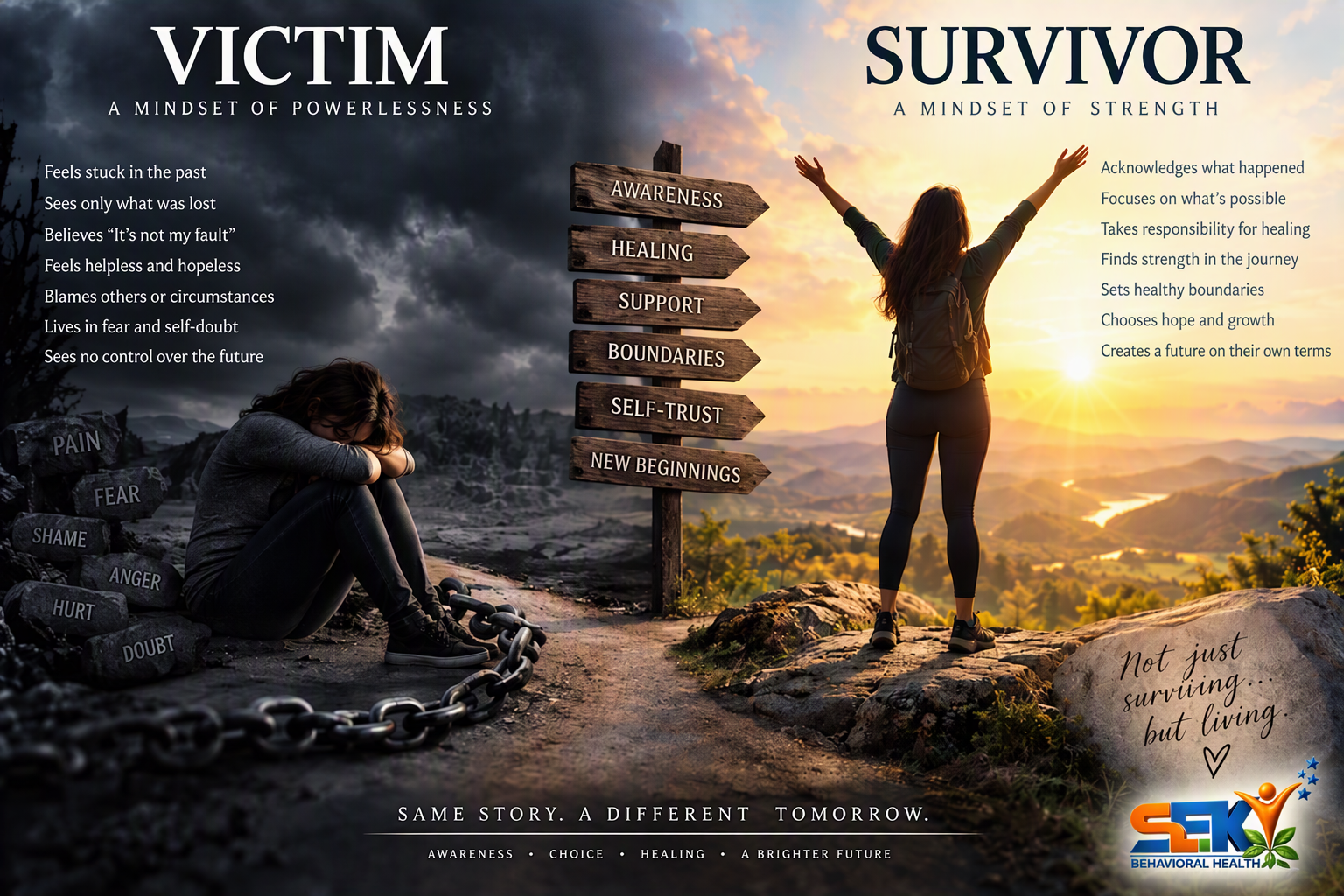
There is a difference between being a victim and living permanently from the frame of mind of a victim.

If someone abused you, betrayed you, abandoned you, assaulted you, neglected you, manipulated you, or harmed you, you may have truly been a victim.

That is a fact.

Calling yourself a survivor does not change the facts. It does not make what happened smaller. It does not excuse the person who hurt you.

It changes something else.

It changes who gets to write the next chapter.

A victim asks:

“Look what they did to me.”

A survivor eventually learns to ask:

“What am I going to do with my life now?”

That may sound like a small difference.

It isn’t.

It may be one of the most important changes that happens during healing.


First, There Is No Shame in Being a Victim

Before talking about a “victim mindset,” we need to be extraordinarily careful with our words.

A person who has experienced trauma may feel afraid, angry, powerless, suspicious, overwhelmed, or emotionally numb. These responses should not automatically be interpreted as weakness or a character problem.

SAMHSA describes trauma as experiences that can have lasting effects on a person’s mental, physical, social, emotional, or spiritual well-being. It also emphasizes that people respond to traumatic experiences differently. Strong support and resilient qualities can influence how someone responds. Likewise, the American Psychological Association recognizes that trauma can have long-lasting psychological and physical consequences, including PTSD, depression, anxiety, sleep problems, dissociation, and other difficulties. So when someone has been badly hurt, telling them to “stop acting like a victim” can be cruel and clinically misguided.

There are times when surviving is enough.

Getting through the day is enough.

Staying safe is enough.

Getting out of bed is enough.

But there may eventually come a point when survival asks something more of us.

The question changes from:

“What happened to me?”

to:

“What happens next?”


The Victim Frame of Mind

The victim frame of mind is not simply sadness about something painful.

It occurs when the injury becomes the lens through which a person begins interpreting much of life.

Something terrible happened to me.

Therefore:

  • I am powerless.
  • People cannot be trusted.
  • My life will always be this way.
  • There is nothing I can do.
  • Someone else must change before I can heal.
  • My past determines my future.
  • What was taken from me can never be rebuilt.
  • Because I was hurt, I will always be broken.

These beliefs are understandable after trauma.

But understandable does not necessarily mean helpful forever.

One particularly important example is avoidance. VA National Center for PTSD explains that wanting to avoid reminders of trauma is common, but relying heavily on avoidance can worsen PTSD symptoms and make moving forward more difficult. A coping strategy that once helped you survive can eventually become the wall preventing you from living.

That is one of trauma’s cruel contradictions.


The Survivor Frame of Mind

The survivor does not pretend the wound never happened.

The survivor learns to carry the scar without allowing the scar to become an identity.

The survivor can say:

Yes, that happened.

Yes, it hurt me.

Yes, I have wounds from it.

No, it was not fair.

No, I did not deserve it.

And yes, I still have a life to live.

Research on resilience after trauma examines precisely this question: how people adapt following profoundly difficult experiences and how resilience can be fostered after trauma. Survival is therefore not denial.

It is not saying:

“It didn’t hurt.”

It is saying:

“It hurt, and I am still here.”


Victim Thinking Says, “They Have the Power.”

Survivor thinking says:

“I have choices.”

Perhaps you could not choose what happened.

You can choose what you do today.

You can choose whether to ask for help.

You can choose your boundaries.

You can choose whom you allow close to you.

You can choose whether to continue treatment.

You can choose whether the people who wounded your past are permitted to control your future.

Trauma-informed care itself recognizes the importance of safety, trust, collaboration, empowerment, voice, and choice in recovery. SAMHSA identifies these ideas among the central principles of trauma-informed approaches. That word matters:

Choice.

Trauma frequently involves losing control.

Recovery often involves discovering where control still exists.


“Why Did This Happen to Me?”

Nearly everyone who has suffered deeply has asked some version of this question.

Why me?

Why did they do it?

Why didn’t someone protect me?

Why didn’t I see it?

Why didn’t I leave sooner?

Why didn’t anyone believe me?

Those questions deserve compassion.

But there is another question that can eventually become more useful:

“Given that this happened, who do I want to become now?”

That question cannot rewrite yesterday.

It can begin changing tomorrow.


Survivors Learn the Difference Between Responsibility and Blame

This may be the hardest concept in the entire journey.

You are not necessarily responsible for what happened to you.

But you eventually become responsible for what you do with what happened to you.

Those are completely different statements.

If someone injured you, responsibility for that action belongs to that person.

Healing belongs to you.

That may feel terribly unfair.

It often is.

Sometimes another person creates the wound while you are left doing the work of repairing it.

But refusing to heal until the person who hurt you makes everything right can leave your future tied to the very person who harmed your past.

Your healing does not need their permission.

Your recovery does not require their understanding.

Your future does not require their apology.

Accountability matters. Justice matters. Acknowledgment matters. In fact, the American Psychological Association recognizes the potential importance of acknowledgment, apology, redress, and restitution in trauma recovery. But your life cannot always remain suspended while waiting for those things.


How Do You Become the Survivor?

There is no switch that suddenly changes someone from victim to survivor.

Healing tends to be a process.

Some days you may feel strong.

The next day, something may trigger an old wound and make you feel as though you have gone backward.

You haven’t necessarily failed.

Here are several places to begin.


1. Tell the Truth About What Happened

Survivorship doesn’t begin by minimizing the past.

It begins with truth.

It happened.

It hurt.

It affected me.

You do not have to defend the person who hurt you.

You do not have to rewrite history to make other people comfortable.

Healing requires honesty.

And sometimes that honesty needs to happen with a qualified mental health professional rather than alone.


2. Stop Making the Wound Your Identity

Notice the enormous difference between these statements:

“I experienced abuse.”

and

“I am damaged.”

Or:

“Someone betrayed me.”

and

“I am unlovable.”

An event is not an identity.

Trauma can influence identity development, and researchers continue to study the relationship between trauma exposure and identity. What happened may always be part of your story.

It does not have to become your entire definition.

You are more than the worst thing someone ever did to you.


3. Identify What You Still Control

Take a sheet of paper and make two columns.

I Cannot Control

  • What happened yesterday
  • What another person thinks
  • Whether someone admits wrongdoing
  • Whether someone apologizes
  • Whether everyone understands my story
  • Another person’s choices

I Can Influence or Control

  • What I do today
  • Whether I ask for help
  • My boundaries
  • Many of my daily choices
  • Whose advice I seek
  • Whether I participate in treatment
  • How I respond when old patterns appear
  • What kind of person I am trying to become

Spend less energy fighting the first list.

Invest more energy in the second.

That is where your power lives.


4. Recognize Avoidance

Avoidance can feel like safety.

Sometimes it is appropriate to avoid genuine danger. But avoiding every thought, emotion, place, relationship, or reminder associated with what happened is different.

The VA National Center for PTSD notes that emotional and behavioral avoidance can interfere with recovery and that effective PTSD treatments can help people learn to cope with trauma-related thoughts and feelings. The U.S. Department of Veterans Affairs has similarly developed recovery materials specifically focused on identifying problematic avoidance behaviors and gradually changing behaviors that keep people stuck in trauma recovery. Courage does not mean never being afraid.

Sometimes courage is simply deciding:

“Fear is present, but fear is no longer making every decision.”


5. Build Boundaries Instead of Walls

Trauma may teach:

Never trust anybody again.

Healing teaches something more sophisticated:

Learn who has earned your trust.

A wall keeps everyone outside.

A boundary has a gate.

A survivor learns when to open it, when to close it, and who receives a key.


6. Allow Yourself to Receive Help

Being a survivor does not mean doing everything alone.

Actually, refusing every form of help can sometimes keep people isolated.

SAMHSA emphasizes safety, peer support, trust, collaboration, and empowerment as important elements within trauma-informed approaches. Help may include professional counseling, trusted friends and family, support groups, medical care, community resources, or spiritual support according to your beliefs and circumstances.

Strength isn’t proving that you need nobody.

Sometimes strength is finally admitting:

“I don’t have to carry all of this by myself.”


7. Give Yourself Permission to Have a Future

Trauma keeps pulling the mind backward.

Healing gradually teaches it to look forward again.

Make plans.

Set a goal.

Learn something.

Build something.

Reconnect carefully.

Create new routines.

Find something meaningful enough that tomorrow becomes more than another day spent thinking about yesterday.

This does not dishonor what happened.

It demonstrates that what happened did not win.


Forgiveness Is Not the Price of Admission

People are sometimes told that they cannot heal unless they forgive the person who hurt them.

I would be careful with that message.

Forgiveness may be deeply meaningful for some people, especially within their spiritual beliefs. But forgiveness should not be confused with denying harm, restoring an unsafe relationship, abandoning boundaries, or removing accountability.

You can heal while still saying:

“What you did was wrong.”

You can move forward without pretending it never happened.

You can have compassion and boundaries at the same time.


Survival Is Not Becoming Who You Were Before

Perhaps this is where we sometimes misunderstand recovery.

After something profound happens, you may never become exactly the person you were before.

That doesn’t automatically mean something has been lost forever.

Perhaps the goal isn’t to go backward.

Perhaps it is to move forward.

Wiser.

More discerning.

More compassionate.

Better acquainted with your boundaries.

More aware of your strength.

More intentional about the life you build.

Resilience research has increasingly examined not merely whether people endure trauma, but how resilience may be fostered following it. The goal isn’t to become untouched.

It is to become unowned by what touched you.


The Day You Become a Survivor

There may never be a ceremony.

Nobody hands you a certificate.

You probably won’t wake up one morning completely free from every painful memory.

Instead, the transformation may happen quietly.

One day you realize you haven’t thought about it for several hours.

Then perhaps an entire day.

You recognize a trigger and choose a different response.

You establish a boundary you once believed you couldn’t establish.

You stop explaining yourself to somebody committed to misunderstanding you.

You ask for help.

You laugh again without feeling guilty.

You make plans.

You love again.

You hope again.

And somewhere along the way, your vocabulary changes.

You stop saying:

“This is who I am because of what they did.”

And begin saying:

“This is who I am becoming despite what happened.”

That is the difference.

The victim’s story is centered around what was done.

The survivor’s story acknowledges what was done but slowly turns toward what comes next.


Conclusion: Take Back the Pen

You cannot erase pages that have already been written.

Some pages may contain things you wish had never happened.

Some contain loss.

Others contain betrayal, fear, grief, humiliation, abandonment, or pain.

There is no wisdom in pretending those pages aren’t there.

Read them when you need to.

Grieve them.

Talk about them.

Learn from them.

Get professional help working through them when necessary.

But eventually, remember something extraordinarily important:

There are blank pages after them.

And those pages still belong to you.

Being a survivor does not mean saying, “It didn’t hurt me.”

It means being able to say:

“It hurt me. It changed me. There were days when I didn’t know whether I could carry it anymore. But I am still here, and what happened to me will not be given the authority to decide everything that happens next.”

You didn’t choose every chapter.

But you can still take back the pen.


About the Author

John S. Collier, MSW, LCSW-S

John S. Collier is a Licensed Clinical Social Worker Supervisor and the Executive Director of Southeast Kentucky Behavioral Health, LLC. His career in social work and behavioral health has included years of work with individuals and families experiencing mental health concerns, trauma, behavioral challenges, relationship difficulties, developmental disabilities, and complicated life transitions.

He earned his bachelor’s degree and became a Certified Social Worker in 2004 before continuing his education and professional development in clinical social work. He became a Licensed Clinical Social Worker in 2010 and later earned the credential of Licensed Clinical Social Worker Supervisor.

As Executive Director of Southeast Kentucky Behavioral Health, Collier works in behavioral health leadership, clinical services, organizational development, community-based behavioral supports, and advocacy for individuals and families throughout southeastern Kentucky.

He is also the author of The Mind’s Trestle Board, where he writes about mental health, relationships, masculinity, family, morality, personal responsibility, faith, emotional growth, and the difficult process of becoming a better version of ourselves. His writing often draws from the intersection of clinical experience, human behavior, personal reflection, and the belief that people should never be reduced to the worst moment of their lives.


References

American Psychological Association. (2024). Individual, collective, and intergenerational trauma recovery: Considering the restorative roles of restitution and reparations.

American Psychological Association. Nugent, N. R., Sumner, J. A., & Amstadter, A. B. (2014). Resilience after trauma: From surviving to thriving. European Journal of Psychotraumatology, 5.

PubMed Central. Substance Abuse and Mental Health Services Administration. (2026). Trauma and violence: What is trauma and its effects? SAMHSA.

Substance Abuse and Mental Health Services Administration. (2023). Practical guide for implementing a trauma-informed approach. SAMHSA.

Truskauskaite-Kuneviciene, I., Brailovskaia, J., Kamite, Y., Petrauskaite, G., Margraf, J., & Kazlauskas, E. (2020). Does trauma shape identity? Exploring the links between lifetime trauma exposure and identity status in emerging adulthood. Frontiers in Psychology, 11, 570644.

PubMed Central. U.S. Department of Veterans Affairs, National Center for PTSD. (2026). Avoidance. National Center for PTSD. U.S. Department of Veterans Affairs, South Central MIRECC. (2022). An active approach to recovering from trauma: Breaking the cycle of safety aids and avoidance. U.S. Department of Veterans Affairs.
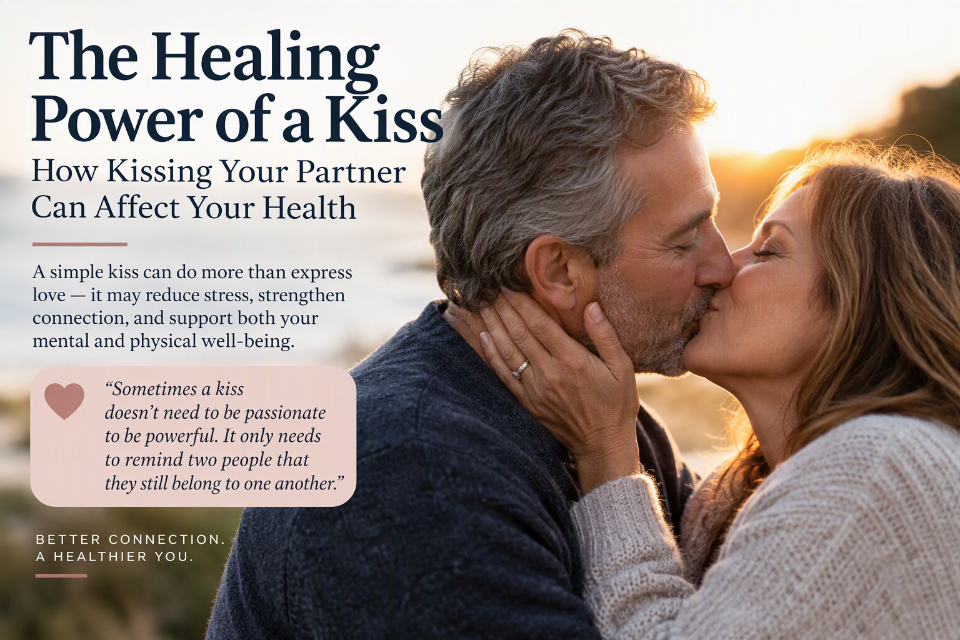
The Healing Power of a Kiss: How Kissing Your Partner Can Affect Your Health

A kiss can last only a few seconds, but the experience can communicate something much larger: I see you. I am here. You matter to me.

Between committed partners, kissing does not always have to lead somewhere else. Sometimes it is simply affection. A goodbye kiss before work, a kiss after a difficult day, or a quiet kiss before going to sleep can become part of the language through which two people maintain their connection.

Interestingly, research suggests that affectionate behaviors such as kissing may affect more than the relationship itself. They can also interact with the body’s stress response and may be associated with certain measures of physical health.

A Kiss and the Stress Response

One of the better-supported potential health effects of affectionate kissing involves stress.

Kissing and other forms of affectionate touch have been associated with changes in hormones involved in attachment and stress, including oxytocin and cortisol. Cortisol is an important part of the body’s stress-response system, while oxytocin is associated with social bonding and attachment. That does not mean a kiss magically removes the problems of the day.

The bills still have to be paid.
The children still need attention.
Work may still be stressful.
The disagreement may still need to be resolved.

But affection can communicate something powerful in the middle of those circumstances:

“Whatever is happening around us, we are still connected.”

That feeling of connection can matter.

Kissing May Affect More Than Emotions

Researchers have also examined whether kissing is associated with physical health markers.

In a study using data from 863 U.S. adults, researcher Kory Floyd examined relationships among kissing frequency, stress, and blood lipids. The study found significant indirect associations between kissing frequency and triglycerides and HDL cholesterol among participants reporting seven or more kisses during the previous month, with stress serving as a mediating factor. That’s fascinating, but it requires an important word of caution.

This does not mean kissing should be considered a treatment for high cholesterol or cardiovascular disease. The healthier interpretation is that affectionate relationships and reduced stress may interact with physical health in ways researchers are continuing to understand.

A kiss isn’t medicine. But affection may be one of the small ways our relationships interact with our physical well-being.

Your Brain Notices Affection

Affection is not merely an abstract emotional experience.

The brain and body respond to it.

Kissing has been associated with neurochemicals involved in reward, bonding, and mood, including dopamine, oxytocin, and serotonin, while affectionate contact has also been associated with reductions in cortisol. That helps explain something couples often understand intuitively.

Sometimes your partner doesn’t need you to solve anything.

They need you to stop.

Look at them.

Put down the phone.

Give them your attention.

Give them a kiss.

And remind them that they are not carrying everything alone.

The Relationship May Benefit Too

Perhaps one of the most meaningful effects of kissing has nothing to do with laboratory numbers.

It is communication.

A kiss can mean:

Good morning.

I missed you.

I’m proud of you.

Thank you.

I’m sorry.

I’m glad you’re here.

We’re okay.

Goodnight.

Physical affection can reinforce feelings of attachment and closeness between partners, and oxytocin is closely associated with bonding. Over years together, these little rituals may become especially meaningful.

Grand romantic gestures are memorable. Daily affection, however, is often what fills the enormous spaces between those moments.

But Let’s Not Turn Kissing Into a Miracle Cure

The internet is filled with dramatic claims about kissing.

Some articles claim it burns significant calories, prevents cavities, boosts immunity, eliminates allergies, cures headaches, or provides cardiovascular exercise.

Those claims deserve caution.

Current evidence is much stronger for stress reduction, emotional connection, bonding, and relationship-related benefits than for portraying kissing as a medical treatment. Even recent health-oriented reviews caution that many of its physical benefits are modest and that kissing should not substitute for medical treatment or exercise. That’s actually a more interesting conclusion.

Kissing doesn’t have to cure anything to matter.

It’s more nuanced:

Affectionate kissing between healthy, consenting partners can be part of emotional connection and stress regulation, but it isn’t risk-free or a replacement for healthcare.

Maybe the Small Things Aren’t So Small

We tend to look for complicated solutions to complicated lives.

Better diets.

Exercise programs.

Supplements.

Vacations.

Meditation.

Therapy.

All of those can have their place.

But somewhere in our pursuit of health, we shouldn’t overlook the human need for affection and meaningful connection.

After years together, couples can gradually become very good business partners.

Who is picking up the kids?

Did you pay the electric bill?

What’s for dinner?

Who has the appointment tomorrow?

Did you call the insurance company?

We can become so busy managing a life together that we forget to experience one another.

A kiss interrupts that routine.

For a moment, there isn’t a mortgage, schedule, deadline, diagnosis, argument, or overflowing laundry basket.

There are simply two people acknowledging one another.

Perhaps that is the most important health lesson contained in something as ordinary as a kiss.

Sometimes a kiss doesn’t need to be passionate to be powerful. It only needs to remind two people that beneath everything they have to do, they still belong to one another.

Conclusion

Science should not be exaggerated. Kissing isn’t going to replace exercise, medication, good nutrition, sleep, or appropriate mental and physical healthcare.

But neither should we dismiss affection as insignificant.

Research gives us good reason to believe that kissing and other forms of affectionate communication can interact with stress, bonding, emotional well-being, and potentially some physiological measures. Maybe the lesson isn’t that everyone needs to kiss more because it will magically make them healthier.

Maybe it is simpler than that.

Human beings need connection.

And sometimes one of the simplest ways two partners say “I’m still here with you” doesn’t require words at all.

About the Author

John S. Collier, MSW, LCSW-S

John S. Collier, MSW, LCSW-S, is a Licensed Clinical Social Worker Supervisor, behavioral health professional, writer, and Executive Director of Southeast Kentucky Behavioral Health, LLC. His career in social work and behavioral health has given him the opportunity to work with individuals, families, professionals, and communities while developing a deeper understanding of the many factors that shape emotional health, relationships, personal growth, and human behavior.

John began his professional journey in social work after earning his bachelor’s degree and becoming a Certified Social Worker in 2004. He later advanced his education and clinical training, ultimately becoming a Licensed Clinical Social Worker in 2010 and earning the credentials to provide clinical supervision to other social workers.

Today, as Executive Director of Southeast Kentucky Behavioral Health, LLC, John works in the behavioral health field in southeastern Kentucky, with particular attention to improving access to quality mental health services in rural communities. His professional interests include clinical social work, mental health, Positive Behavior Support, family relationships, human development, organizational leadership, and the ways that relationships and life experiences influence emotional well-being.

John is also the author of The Mind’s Trestle Board, where his writing moves beyond the walls of the counseling office. He explores marriage, relationships, parenting, masculinity, faith, grief, trust, morality, personal responsibility, emotional growth, forgiveness, and the difficult process of becoming a better version of ourselves.

His writing is shaped not only by professional education and clinical experience, but also by the belief that some of life’s most important lessons are found in ordinary moments. A conversation between spouses, an argument with someone we love, a parent’s interaction with a child, a mistake we regret, an act of forgiveness, or even something as simple as a kiss goodbye can reveal something meaningful about attachment, connection, character, and the human need to belong.

Through The Mind’s Trestle Board, John encourages readers to slow down long enough to examine those moments rather than simply pass through them. Drawing upon behavioral science, social-work principles, life experience, and personal reflection, he seeks to translate complicated ideas about mental health and relationships into language that ordinary people can understand and apply to everyday life.

A recurring theme in his writing is that growth is not the same as perfection. People make mistakes. Relationships become strained. Families face difficult seasons. Individuals sometimes discover uncomfortable truths about themselves. What matters is whether we are willing to examine ourselves honestly, accept responsibility when responsibility belongs to us, learn from experience, seek wisdom, and continue becoming better people.

His work also reflects the importance of faith, family, commitment, compassion, accountability, and service to others. Rather than presenting himself as someone who has mastered those principles, John writes from the perspective of someone who continues to wrestle with what they mean in real life.

Ultimately, The Mind’s Trestle Board is built around a simple idea: our minds, relationships, choices, failures, successes, and experiences are constantly shaping the people we are becoming.

John’s hope is that his writing gives readers a reason to pause, think, talk with the people they love, question old assumptions, and perhaps look at an ordinary part of life from a different perspective.

Love Them Because They Are Worth Loving

Why Building Love Primarily on How Someone Makes You Feel Can Be Dangerous

By John S. Collier, MSW, LCSW-S

There is a phrase we hear often when people talk about falling in love:

“I love the way you make me feel.”

It sounds beautiful.

And there is nothing wrong with feeling good around the person you love. We should hope our relationships bring happiness, comfort, affection, peace, laughter, attraction, safety, and belonging.

But there is a danger hidden inside those words when they become the reason we love someone.

Because feelings change.

People change.

Life changes.

And if I love you primarily because of what loving you does for me, what happens when you can no longer make me feel that way?

Maybe real love has to begin somewhere deeper.

Maybe I should not love you simply because you make me feel loved.

Maybe I should love you because you are worth loving.

Because you deserve to be loved.

And because, when the feelings rise and fall as feelings inevitably do, I still choose to love you.

“Love that depends entirely upon a feeling is in danger whenever the feeling changes.”


Feelings Are Powerful, but They Are Not Permanent

Our feelings are real, but they are also remarkably fluid.

A single conversation can change our mood. Stress can change it. Exhaustion can change it. Grief can change it. Financial pressure, parenting problems, illness, work, disappointment, aging, anxiety, and depression can all influence what we feel.

Romantic love itself has biological and psychological components. Research discussed by the American Psychological Association describes how early romantic love engages reward and motivational systems within the brain. That helps explain something many of us already know from experience.

Falling in love can feel incredible.

But a lifelong relationship cannot depend upon continually recreating the emotional intensity of falling in love.

Psychologist Robert Sternberg’s well-known triangular theory describes love through three components: intimacy, passion, and decision/commitment. Notice that last word:

Commitment.

There is emotion in love.

There is attraction in love.

There is intimacy in love.

But there is also decision.

That distinction matters.


The Problem With “I Love How You Make Me Feel”

There is a subtle difference between saying:

“I love you, and being loved by you makes me happy.”

and saying:

“I love you because you make me happy.”

Those statements may sound almost identical, but they can represent very different foundations.

In the first, happiness is a fruit of the relationship.

In the second, happiness can become a condition of the relationship.

If your primary value to me is your ability to make me feel good about myself, secure, wanted, important, admired, attractive, understood, or happy, I may gradually stop seeing you and begin seeing what you provide for me.

Without realizing it, love can become transactional:

You give me this feeling, and in return, I give you my love.

That is a dangerous bargain because neither person can maintain it forever.


No Person Can Carry the Responsibility for Your Happiness

There will be seasons when the person you love simply does not have much left to give.

They may be grieving.

They may become sick.

They may lose a parent.

They may struggle emotionally.

They may have problems at work.

They may become overwhelmed by raising children.

They may become frightened, tired, discouraged, irritable, or quiet.

They may need you far more than they are capable of giving to you.

And there is an important question hidden inside those difficult seasons:

Can I continue loving you when you are temporarily unable to make me feel the way you once did?

That may be one of the tests separating love as an emotion from love as a commitment.

If my love depends on what you supply emotionally, then your difficult season becomes my relationship crisis.

Instead of asking,

“What does the person I love need from me?”

I begin asking,

“Why aren’t you making me happy anymore?”

Those are completely different questions.


When Love Becomes About Me

There is a paradox here.

We can become very focused on another person while actually being preoccupied with ourselves.

I need your attention.

I need your reassurance.

I need you to respond a certain way.

I need you to make me feel important.

I need you to make me feel secure.

I need you to demonstrate that you love me.

There is nothing wrong with having relational needs. Healthy relationships require reciprocity, communication, respect, affection, trust, and appropriate boundaries.

The danger comes when another human being becomes responsible for constantly regulating our sense of worth.

At that point, we may not be asking:

“Who are you?”

We may really be asking:

“Who am I when I am reflected in your eyes?”

And those questions are worlds apart.


Love the Person, Not Just the Experience of the Person

There is something I think we should ask ourselves occasionally:

If this person stopped making me feel extraordinary, would I still believe they were extraordinary?

That question can be uncomfortable.

But it gets to the heart of mature love.

The person you love is more than an experience you are having.

They are a whole human being.

They have hopes you did not create.

Fears you did not cause.

Dreams that existed before you.

Wounds you may never completely understand.

Weaknesses.

Strengths.

Insecurities.

Failures.

Convictions.

Responsibilities.

And a life that possesses value apart from what it contributes to yours.

Research on motivations for romantic relationships also suggests that people enter relationships for different reasons, including love and care, family and children, status and resources, and other motivations. Those motivations are associated with people’s broader values and the qualities they seek in partners. So it is worth examining not simply whom we love, but why we love them.


“You Make Me Happy” Is a Gift, Not a Job Description

I hope the person you love makes you happy.

But happiness should be received as a gift rather than imposed as a job description.

Think about the difference.

Gift:

“Your presence brings happiness into my life, and I am grateful for it.”

Demand:

“Your responsibility is to keep me happy, and something is wrong with you whenever you don’t.”

The first produces gratitude.

The second can produce resentment.

The person you love should not have to wake every morning wondering whether they are successfully maintaining your emotional state.

That burden eventually becomes exhausting.


Feelings Are Weather. Commitment Is the House.

Feelings remind me of weather.

Some mornings are warm and clear.

Some evenings bring storms.

Occasionally the wind howls against the windows.

Sometimes rain seems to last for days.

But we don’t tear down the house every time the weather changes.

We build something capable of standing through changing weather.

Relationships need that kind of architecture.

Attraction may help bring two people together.

Emotion may deepen their connection.

Shared experiences may strengthen their bond.

But eventually love has to become something capable of surviving a rainy season.

Feelings are weather. Commitment is the house we build so love has somewhere to live when the storm comes.


Love Is Not Blind

Choosing love does not mean tolerating cruelty, abuse, manipulation, chronic betrayal, coercion, or dangerous behavior.

Commitment should never be used as justification for remaining unsafe.

Healthy love includes boundaries.

Healthy love can say no.

Healthy love can confront harmful behavior.

Healthy love can require change.

And sometimes loving someone does not mean continuing a particular relationship.

The idea that love involves choice should never become an excuse for mistreatment.

Choosing love means recognizing another person’s humanity and worth. It does not require abandoning your own.


There Will Be Days When Love Feels Different

Long relationships inevitably have ordinary days.

Nobody writes songs about Tuesday evening when both people are exhausted, the kitchen needs cleaning, someone forgot to pay a bill, and neither person has much interesting to say.

But those moments matter.

Because much of love is lived there.

Not on anniversaries.

Not during vacations.

Not inside perfect photographs.

But in kitchens.

Hospital rooms.

Cars.

Waiting rooms.

Grocery stores.

School parking lots.

Funerals.

Bad mornings.

Long nights.

And thousands of completely ordinary Tuesdays.

The intensity of emotion may change over time. Sternberg’s framework is useful precisely because love is not reduced to passion alone. Intimacy and commitment are distinct parts of the larger relationship. Sometimes love feels like fireworks.

Sometimes love feels like sitting beside someone who has nothing left to say and quietly letting them know:

You don’t have to entertain me.

You don’t have to impress me.

You don’t have to make me feel anything right now.

I’m still here.


The Question Changes

Immature love often asks:

“What am I getting from you?”

Mature love increasingly learns to ask:

“What can I give to this relationship without losing myself in the process?”

That doesn’t mean becoming a martyr.

It means learning reciprocity rather than keeping score.

There will be times when I carry more.

There will be times when you carry more.

And perhaps there will be moments when neither of us feels particularly strong, so we simply carry what we can together.


Love Is Also a Choice

This may be one of the least romantic sounding things we can say about love, yet I believe it is one of the most beautiful:

Sometimes love is a decision.

Sternberg’s theory explicitly incorporates decision and commitment as part of love. That does not make love cold.

It makes love dependable.

“I choose you” may ultimately mean more than “I feel something for you.”

Because feelings happen to us.

Choices require something from us.

There are mornings when you wake up feeling deeply connected to the person beside you.

There may be other mornings when frustration or hurt is sitting between you.

The question then becomes:

What will I do with the love I promised when love doesn’t feel effortless?


Love Someone Because They Are Worth Loving

Perhaps we need to change some of our language.

Instead of:

“I love you because you make me feel special.”

Try:

“I love you, and I am grateful that you make me feel special.”

Instead of:

“I love you because you make me happy.”

Try:

“I love you, and sharing my life with you brings me happiness.”

Instead of:

“I love you because of what you do for me.”

Try:

“I love who you are, not merely what you provide for me.”

Then perhaps arrive at something even deeper:

“I love you because I have come to know you. I see something worthy in you. I respect the human being you are. And I choose to participate in loving you.”

That kind of love has roots.


Love Them When They Cannot Perform for You

One day the person you love may not look the way they once did.

Neither will you.

Their body may change.

Their health may change.

Their career may change.

Their confidence may disappear for a while.

Perhaps their laughter will become harder to find.

Perhaps life will humble them.

And you might be given the extraordinary responsibility of loving someone during a season when they do not even feel very lovable themselves.

That is when love may become less glamorous but more meaningful.

Because then you are no longer saying:

“I love what I experience when I am with you.”

You are saying:

“I love you.”

Period.


And Let Them Love You the Same Way

There is another side to this.

You deserve a love that does not require you to perform happiness for someone else.

You should be able to have a bad day.

To grieve.

To struggle.

To get something wrong.

To need reassurance.

To grow.

To age.

To change.

To become tired.

To occasionally have very little to give.

Healthy relationships still require responsibility, repair, communication, and mutual effort. Love is not permission to stop caring for the relationship.

But you should not have to constantly prove your value by producing a particular emotional experience for somebody else.

You are not an emotional vending machine.

Neither is the person you love.


Conclusion: I Choose to Love You

Maybe love begins with a feeling.

A glance.

A conversation.

A smile.

Something inexplicable that draws two lives toward one another.

There is nothing wrong with that.

But if love becomes mature, eventually it must become more than what I feel when you walk into the room.

Because feelings rise.

Feelings fall.

Bodies change.

Circumstances change.

People disappoint each other.

Life interrupts our plans.

Storms arrive.

And eventually every relationship encounters a moment when feelings alone are not enough.

That is when love gets the opportunity to become something deeper.

I don’t want to love you merely because you make me feel important.

I want to recognize that you are important.

I don’t want to love you only because you make me feel worthy.

I want to remember that you have worth of your own.

I don’t want my love to disappear simply because life becomes difficult and the emotional reward feels smaller for a season.

I want to love you because I have looked carefully at the human being standing before me and decided:

You are worth loving.

You deserve love.

And today, I choose to love you.

Tomorrow, I want to make that choice again.

And the next day, again.

Perhaps that is one of the quiet secrets of lasting love.

It isn’t one enormous choice made at an altar, on an anniversary, or during some perfect moment.

It is thousands of ordinary choices.

I see you.

I value you.

I respect you.

I will not make you responsible for every emotion inside me.

And even when love feels different than it did yesterday, I will remember why I chose to love you in the first place.

The deepest love may not be, “I love you because of how you make me feel.” It may be, “I know who you are, I believe you are worth loving, and I choose to love you.”


About the Author

John S. Collier, MSW, LCSW-S is a Licensed Clinical Social Worker Supervisor and the Executive Director of Southeast Kentucky Behavioral Health, LLC. His career in social work and behavioral health has given him the opportunity to work with individuals and families facing trauma, mental health challenges, relationship difficulties, major life transitions, and the everyday struggles that shape human growth.

John writes The Mind’s Trestle Board as a place to explore the intersection of mental health, relationships, personal responsibility, faith, morality, fatherhood, emotional development, and the lifelong work of becoming a better human being.

His writing is grounded in the belief that growth does not require perfection. It requires honesty, humility, reflection, responsibility, and a willingness to keep working on ourselves. Through both his professional experience and personal reflections, he encourages readers to look beneath their immediate emotions and consider the values, choices, commitments, and relationships upon which a meaningful life is built.


References

American Psychological Association. (2023). What happens in your brain when you’re in love? The article discusses neuroscience research concerning romantic love, motivation, and the brain’s reward systems. Myers, E. /
Simply Psychology. (2026). Sternberg’s triangular theory of love. Overview of Robert Sternberg’s model of intimacy, passion, and decision/commitment.
Psych Central. The psychology of love: Theories and facts. Overview of psychological perspectives on love, attachment, and Sternberg’s triangular theory.
Tartakovsky, E. (2023). The psychology of romantic relationships: motivations and mate preferences. Frontiers in Psychology, 14, 1273607. The study examined romantic motivations, personal values, and partner preferences among 1,121 young adults.
PsyPost. (2024). The psychology of love: 10 groundbreaking insights into the science of relationships. Discussion of research concerning relationship quality and psychological well-being.

There Should Be No One You Side With Against Your Spouse

Marriage, Loyalty, Boundaries, and the Difference Between Protecting Your Spouse and Blindly Defending Them

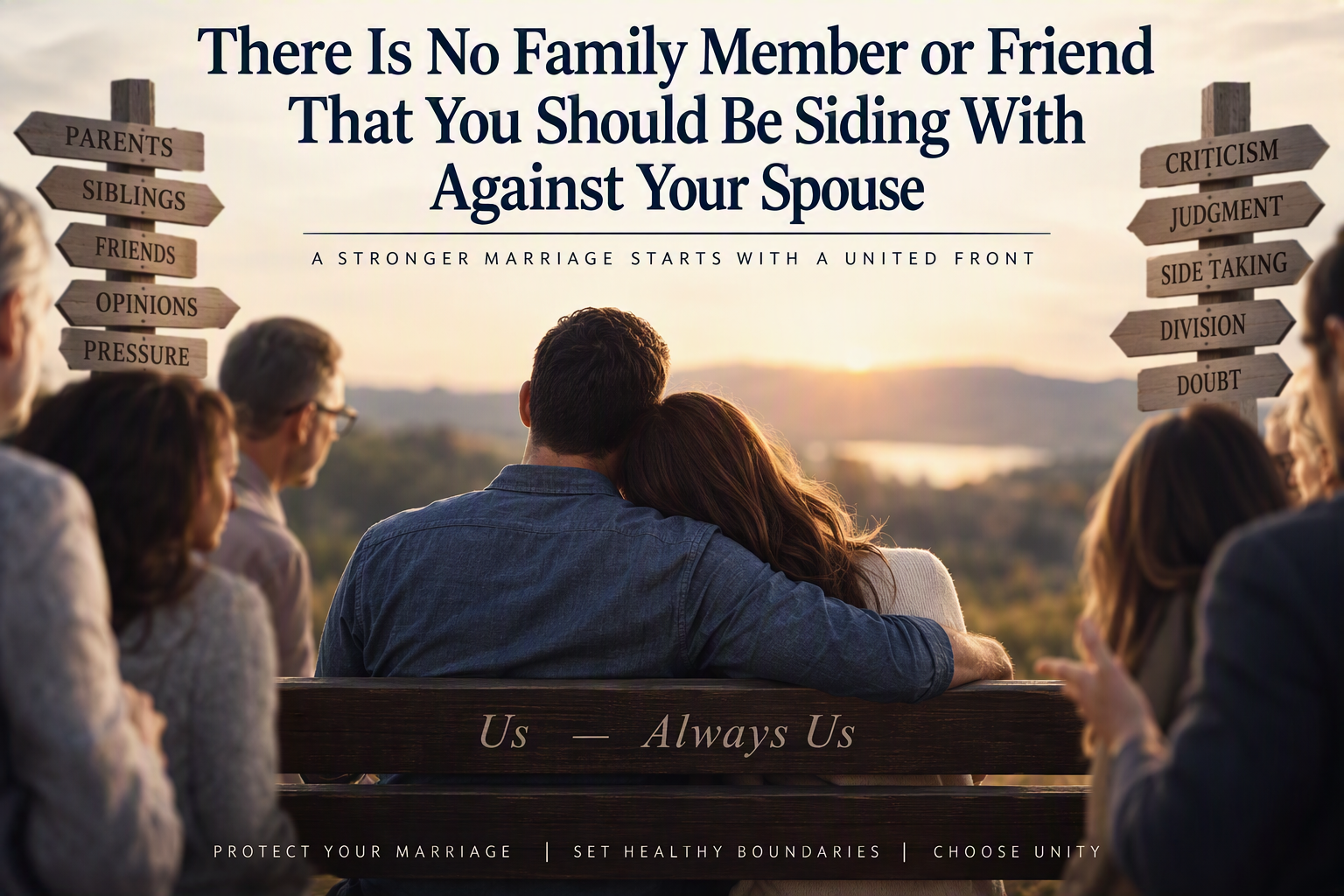
Marriage does not require you to believe your spouse is always right. It does require something deeper: your spouse should never have to wonder whether you and someone outside the marriage have formed an alliance against them.

Parents matter. Children matter. Brothers and sisters matter. Friends matter.

But marriage creates a relationship that is different from all of them.

When two people choose marriage, they are saying, in effect, We are going to build a life together. When trouble comes, we will face it from the same side of the table.

That does not mean covering up wrongdoing. It does not mean tolerating abuse. It does not mean agreeing with every decision your spouse makes.

It means that disagreements should be handled within the marriage rather than by recruiting outsiders to fight against the person you married.

You may disagree with your spouse without becoming their enemy.

That distinction can determine whether a marriage becomes stronger through conflict or slowly fractures beneath it.


Your Spouse Is Supposed to Be Your Teammate

One of the most important shifts in marriage is moving from an individual mindset toward a shared identity.

Before marriage, your parents, siblings, or close friends may have been the people you automatically turned toward when something went wrong. Marriage changes that structure.

The field of family psychology recognizes that intimate relationships exist within larger family and social systems. Couple relationships are affected by family influences, individual differences, developmental changes, and broader social relationships. This means healthy marriage does not require abandoning the people you love.

It requires establishing appropriate boundaries around the marriage.

The Gottman Institute explains that healthy boundaries identify what we will and will not tolerate and help protect well-being within relationships. Boundaries are not primarily about controlling someone else’s behavior. They involve deciding how we ourselves will respond. That distinction is important.

Marriage should not say:

“Nobody else matters anymore.”

It should say:

“Other people matter, but they do not get to divide us.”


The Dangerous Triangle

Imagine a husband and wife have an argument.

The husband calls his mother.

He tells her everything his wife said, perhaps emphasizing her worst words and minimizing his own.

His mother becomes angry with his wife.

He feels validated.

Later, the husband and wife reconcile.

There is only one problem.

His mother didn’t reconcile with his wife.

She remembers everything.

Or reverse the roles.

A wife becomes angry with her husband and immediately begins texting a friend.

“You won’t believe what he did.”

The friend confirms what the wife already believes.

“He’s wrong.”

“I wouldn’t tolerate that.”

“You deserve better.”

Now the original marital problem has changed.

It is no longer simply:

Husband and wife versus a problem.

It has become:

Husband versus wife and friend.

Or:

Wife versus husband and family.

That difference matters.


When “Getting Advice” Becomes Building an Alliance

Seeking wise counsel is not wrong.

Sometimes it is necessary.

A trusted minister, therapist, mentor, family member, or mature friend may help us recognize something we cannot see ourselves.

The question is not simply:

“Did I talk to someone?”

The better question is:

“Why did I talk to them?”

Was I seeking wisdom?

Or was I gathering ammunition?

Was I genuinely asking:

“Help me understand my spouse’s perspective.”

Or was I really asking:

“Tell me I’m right and my spouse is wrong.”

Those are completely different conversations.

Healthy counsel should move us toward honesty, accountability, safety, and constructive communication, not deeper into resentment.


What Loyalty Does Not Mean

This deserves emphasis.

Loyalty is not blindness.

Your spouse can be wrong.

You can tell them so.

You can establish boundaries.

You can refuse to participate in destructive behavior.

You can seek professional guidance.

And situations involving abuse, threats, coercion, serious addiction, criminal behavior, or immediate danger require a different response. Protecting yourself or another person from harm is not betraying a marriage.

Healthy boundaries help people identify what is acceptable and respond when those limits are crossed. The Gottman Institute specifically distinguishes boundaries from attempts to control another person’s behavior and describes boundaries as important to healthy relationships and personal well-being. So saying:

“Never side against your spouse”

should not mean:

“Defend your spouse no matter what they do.”

I believe a healthier principle is:

Never allow another person to turn you and your spouse into opposing teams.

You can tell your spouse:

“I love you, but I believe you were wrong.”

That is different from telling someone else:

“You’re right about my spouse. Let’s confront them together.”

One is accountability inside a relationship.

The other can become an alliance against it.


Parents Should Not Be Placed Above the Marriage

This can be one of the hardest transitions for married adults.

A person can deeply love and honor their parents while recognizing that marriage establishes a new primary partnership.

Problems arise when a parent continues to carry veto power over marital decisions.

Maybe your mother thinks your spouse spends money incorrectly.

Maybe your father thinks your spouse is raising the children incorrectly.

Maybe your family criticizes where you live, how you spend holidays, whose family you visit, or how you handle your household.

You can listen respectfully.

But eventually you must be capable of saying:

“I love you, but this is something my spouse and I must decide together.”

Healthy boundaries do not require hostility toward family. In fact, boundaries can preserve relationships by making expectations clearer. The Gottman Institute describes boundaries as limits that help people protect what works for them while recognizing that they cannot control what other people say or do. Sometimes loving your parents means having the courage to disappoint them.


Your Friends Should Not Become a Jury

Friendship can be invaluable during difficult times.

But friends hear the version of your marriage you give them.

If every time you become angry you tell your friends everything your spouse has done wrong, you may unknowingly create a jury that hears only the prosecution.

Then months later you forgive your spouse.

Your friends may not.

You remember the apology.

They remember the story.

You remember the reconciliation.

They remember watching you cry.

You remember your spouse’s growth.

They remember your description of your spouse at their worst.

Be careful about giving people permanent pictures of the person you love based on temporary moments in your marriage.

There is a difference between seeking support and building a case.


Do Not Embarrass Your Spouse to Win an Argument

There is another form of siding against your spouse that happens publicly.

You are with friends or family.

Your spouse says something.

Someone criticizes them.

And you join in.

Everyone laughs.

Perhaps you say:

“I’ve been telling her that forever.”

Or:

“You should try living with him.”

Everyone laughs again.

Except your spouse.

Sometimes these comments are dismissed as jokes.

But repeated public humiliation can communicate something painful:

“When other people are here, I am willing to sacrifice your dignity for their approval.”

Marriage should be one of the places where people’s vulnerabilities are safest.

A spouse should not constantly fear becoming the punchline when friends or relatives arrive.


Correct Privately Whenever Possible

There will be times when your spouse is wrong in front of other people.

You do not have to pretend otherwise.

But unless immediate intervention is necessary, many disagreements can wait.

You can say:

“Let’s talk about this when we get home.”

Then actually talk about it.

Privately you may say:

“I love you, but I think you handled that badly.”

That is not betrayal.

That is honest marriage.

Loyalty and accountability can live in the same house.

In fact, they should.


The Goal Is Not “You Versus Me”

Healthy marital conflict should eventually become:

Us versus the problem.

Not:

Me versus you.

And certainly not:

Me and my mother versus you.

Me and my best friend versus you.

Me and the children versus you.

Me and your family versus you.

When outsiders become soldiers in marital disagreements, everybody can lose.

The marriage becomes a battlefield instead of a partnership.


Children Should Not Be Recruited Either

This principle becomes even more important when children are involved.

A child should not become a messenger, spy, referee, counselor, or emotional ally in an adult marital dispute.

Statements such as:

“You know how your mother is.”

or

“Your father only thinks about himself.”

invite children into adult conflict.

Whatever frustration exists between spouses should, whenever safely possible, remain an adult responsibility.

Children should be free to love both parents without feeling that loving one means betraying the other.


Family Systems Matter

Family psychology does not view marriages in isolation. Couple relationships exist inside broader systems involving parents, children, extended relatives, culture, developmental history, and social relationships. American Psychological Association’s Journal of Family Psychology specifically describes family psychology as incorporating systems, developmental, cultural, and relationship perspectives. Research has also examined Bowen’s concepts of differentiation and individuation in married couples, including emotional reactivity involving parents. That helps explain why these conflicts can feel so powerful.

You can be 45 years old and suddenly feel 15 again when your parent disapproves of you.

You can love your spouse while still desperately wanting your family’s approval.

Maturity does not require cutting your family off.

It requires learning how to remain connected to people without allowing those relationships to control your marriage.


Before You Tell Someone About Your Spouse, Ask Yourself Five Questions

1. Am I seeking wisdom or validation?

Do I genuinely want guidance, or do I want someone to tell me I’m right?

2. Would I say this if my spouse were sitting beside me?

If not, consider why.

3. Will telling this person help repair my marriage?

Or will it simply make another person dislike my spouse?

4. Am I telling the whole story?

Have I included my own mistakes?

5. Is this person for our marriage?

Good advisers do not automatically take your side.

Sometimes the best friend says:

“I understand you’re angry, but you need to go home and talk to your spouse.”

That is friendship.


A Good Friend Protects the Marriage Too

Perhaps we also need to rethink what friendship looks like when someone comes to us complaining about their spouse.

Instead of immediately agreeing with them, perhaps we should ask:

“Have you talked to your spouse about this?”

“What do you think your spouse would say happened?”

“Is there something you could have done differently?”

“Do you want me to listen, or do you honestly want my opinion?”

Sometimes loyalty to a friend means refusing to help them destroy something important in a moment of anger.


Your Spouse Should Not Have to Compete for Your Loyalty

There are few feelings more painful in marriage than believing everyone else’s voice carries more weight than yours.

Your spouse should not have to defeat your mother, father, brother, sister, best friend, adult child, coworker, or social circle just to feel heard by you.

That does not mean your spouse always wins.

It means the marriage gets its own room to work things out.

When there is disagreement, talk.

When there is hurt, address it.

When there is confusion, ask questions.

When there is resentment, speak before the resentment becomes contempt.

When you need help, seek wise and trustworthy counsel.

But do not turn the people around you into an army against the person beside you.


Marriage Is Choosing “Us” Again and Again

The deepest promises of marriage are rarely lived out during weddings.

They are lived out afterward.

They happen around kitchen tables.

In hospital rooms.

During arguments.

During financial trouble.

When families disagree.

When children are struggling.

When somebody hurts somebody.

When pride whispers:

“Make them pay.”

When your friend says:

“You’re completely right.”

When your family says:

“We told you so.”

Those are the moments when marriage asks a harder question:

Are we still a team?

Sometimes the answer sounds like:

“I think you’re wrong, but I’m going to talk to you about it, not everybody else.”

Sometimes it sounds like:

“Mom, I love you, but this is between my spouse and me.”

Sometimes:

“Please don’t speak about my husband that way.”

Or:

“Please don’t disrespect my wife.”

And sometimes it is simply:

“Let’s go home and figure this out together.”

The strongest marriages are not marriages without disagreement. They are marriages where disagreement does not automatically destroy loyalty.


Conclusion

Your spouse does not need you to believe they are perfect.

They need to know you are committed.

There should not be a family member, friend, coworker, or acquaintance with whom you regularly form an alliance against your spouse.

That does not prevent accountability.

It makes healthy accountability possible.

Love says:

“I will tell you the truth.”

Loyalty says:

“I will protect what we have.”

Maturity says:

“I can disagree with you without humiliating you.”

Wisdom says:

“We may need help, but I will seek help that moves us toward health rather than deeper division.”

And marriage says:

“When problems come, I want us standing shoulder to shoulder looking at the problem, rather than standing across the room looking at each other as the enemy.”

Family will have opinions.

Friends will have opinions.

The world will have opinions.

Listen when wisdom is present.

Accept correction when correction is deserved.

Protect yourself when safety requires it.

But never forget the person with whom you decided to build your life.

You do not have to agree on everything to remain on the same team.


About the Author

John S. Collier, MSW, LCSW-S

John S. Collier is a Licensed Clinical Social Worker Supervisor and the Executive Director of Southeast Kentucky Behavioral Health, LLC. His professional career in social work and behavioral health has included years of working with individuals and families navigating trauma, relationships, emotional struggles, behavioral challenges, personal growth, and major life transitions.

John is also the author of The Mind’s Trestle Board, where he writes about mental health, relationships, marriage, family, morality, faith, personal responsibility, and the difficult work of becoming a better version of ourselves. His writing often explores the place where professional understanding meets the realities of everyday life.

At the center of his work is a simple belief: growth does not require perfection. It requires honesty, humility, accountability, compassion, and the willingness to keep working on ourselves.


References

American Psychological Association. (n.d.). Journal of Family Psychology. American Psychological Association.

Gottman Institute. (2022). The truth about boundaries. The Gottman Institute.

Gottman Institute. (2024). Setting boundaries with others. The Gottman Institute.

Gottman Institute. (2025). The Gottman guide to setting and enforcing boundaries.

Skowron, E. A., Stanley, K. L., & Shapiro, M. D. (2009). A longitudinal perspective on differentiation of self, interpersonal and psychological well-being in young adulthood. Contemporary Family Therapy, 31, 3–18.

Related research literature on differentiation and married couples is indexed through Springer.