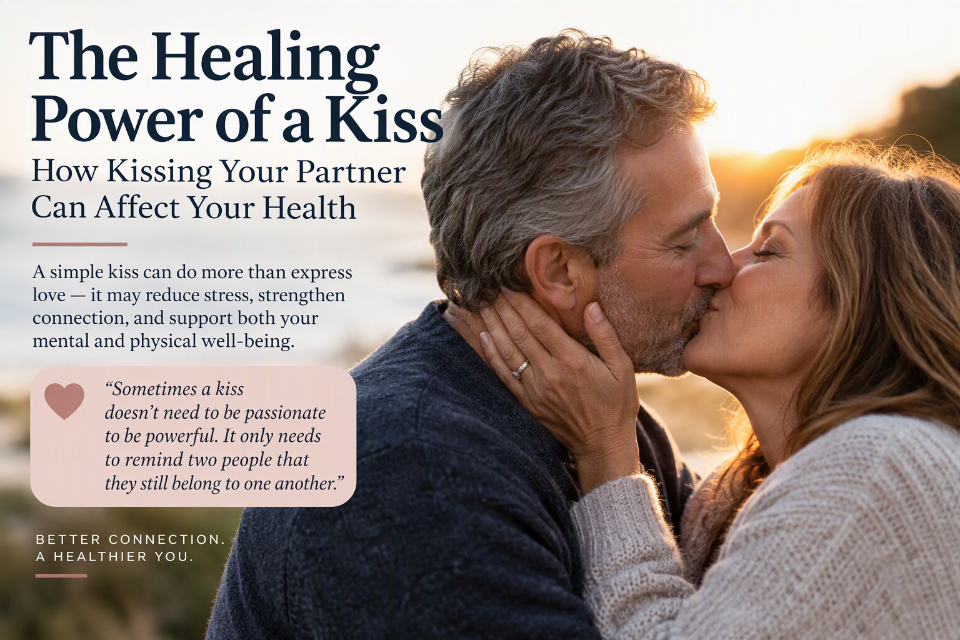
The Healing Power of a Kiss: How Kissing Your Partner Can Affect Your Health
A kiss can last only a few seconds, but the experience can communicate something much larger: I see you. I am here. You matter to me.
Between committed partners, kissing does not always have to lead somewhere else. Sometimes it is simply affection. A goodbye kiss before work, a kiss after a difficult day, or a quiet kiss before going to sleep can become part of the language through which two people maintain their connection.
Interestingly, research suggests that affectionate behaviors such as kissing may affect more than the relationship itself. They can also interact with the body’s stress response and may be associated with certain measures of physical health.
A Kiss and the Stress Response
One of the better-supported potential health effects of affectionate kissing involves stress.
Kissing and other forms of affectionate touch have been associated with changes in hormones involved in attachment and stress, including oxytocin and cortisol. Cortisol is an important part of the body’s stress-response system, while oxytocin is associated with social bonding and attachment. That does not mean a kiss magically removes the problems of the day.
The bills still have to be paid.
The children still need attention.
Work may still be stressful.
The disagreement may still need to be resolved.
But affection can communicate something powerful in the middle of those circumstances:
“Whatever is happening around us, we are still connected.”
That feeling of connection can matter.
Kissing May Affect More Than Emotions
Researchers have also examined whether kissing is associated with physical health markers.
In a study using data from 863 U.S. adults, researcher Kory Floyd examined relationships among kissing frequency, stress, and blood lipids. The study found significant indirect associations between kissing frequency and triglycerides and HDL cholesterol among participants reporting seven or more kisses during the previous month, with stress serving as a mediating factor. That’s fascinating, but it requires an important word of caution.
This does not mean kissing should be considered a treatment for high cholesterol or cardiovascular disease. The healthier interpretation is that affectionate relationships and reduced stress may interact with physical health in ways researchers are continuing to understand.
A kiss isn’t medicine. But affection may be one of the small ways our relationships interact with our physical well-being.
Your Brain Notices Affection
Affection is not merely an abstract emotional experience.
The brain and body respond to it.
Kissing has been associated with neurochemicals involved in reward, bonding, and mood, including dopamine, oxytocin, and serotonin, while affectionate contact has also been associated with reductions in cortisol. That helps explain something couples often understand intuitively.
Sometimes your partner doesn’t need you to solve anything.
They need you to stop.
Look at them.
Put down the phone.
Give them your attention.
Give them a kiss.
And remind them that they are not carrying everything alone.
The Relationship May Benefit Too
Perhaps one of the most meaningful effects of kissing has nothing to do with laboratory numbers.
It is communication.
A kiss can mean:
Good morning.
I missed you.
I’m proud of you.
Thank you.
I’m sorry.
I’m glad you’re here.
We’re okay.
Goodnight.
Physical affection can reinforce feelings of attachment and closeness between partners, and oxytocin is closely associated with bonding. Over years together, these little rituals may become especially meaningful.
Grand romantic gestures are memorable. Daily affection, however, is often what fills the enormous spaces between those moments.
But Let’s Not Turn Kissing Into a Miracle Cure
The internet is filled with dramatic claims about kissing.
Some articles claim it burns significant calories, prevents cavities, boosts immunity, eliminates allergies, cures headaches, or provides cardiovascular exercise.
Those claims deserve caution.
Current evidence is much stronger for stress reduction, emotional connection, bonding, and relationship-related benefits than for portraying kissing as a medical treatment. Even recent health-oriented reviews caution that many of its physical benefits are modest and that kissing should not substitute for medical treatment or exercise. That’s actually a more interesting conclusion.
Kissing doesn’t have to cure anything to matter.
It’s more nuanced:
Affectionate kissing between healthy, consenting partners can be part of emotional connection and stress regulation, but it isn’t risk-free or a replacement for healthcare.
Maybe the Small Things Aren’t So Small
We tend to look for complicated solutions to complicated lives.
Better diets.
Exercise programs.
Supplements.
Vacations.
Meditation.
Therapy.
All of those can have their place.
But somewhere in our pursuit of health, we shouldn’t overlook the human need for affection and meaningful connection.
After years together, couples can gradually become very good business partners.
Who is picking up the kids?
Did you pay the electric bill?
What’s for dinner?
Who has the appointment tomorrow?
Did you call the insurance company?
We can become so busy managing a life together that we forget to experience one another.
A kiss interrupts that routine.
For a moment, there isn’t a mortgage, schedule, deadline, diagnosis, argument, or overflowing laundry basket.
There are simply two people acknowledging one another.
Perhaps that is the most important health lesson contained in something as ordinary as a kiss.
Sometimes a kiss doesn’t need to be passionate to be powerful. It only needs to remind two people that beneath everything they have to do, they still belong to one another.
Conclusion
Science should not be exaggerated. Kissing isn’t going to replace exercise, medication, good nutrition, sleep, or appropriate mental and physical healthcare.
But neither should we dismiss affection as insignificant.
Research gives us good reason to believe that kissing and other forms of affectionate communication can interact with stress, bonding, emotional well-being, and potentially some physiological measures. Maybe the lesson isn’t that everyone needs to kiss more because it will magically make them healthier.
Maybe it is simpler than that.
Human beings need connection.
And sometimes one of the simplest ways two partners say “I’m still here with you” doesn’t require words at all.
About the Author
John S. Collier, MSW, LCSW-S
John S. Collier, MSW, LCSW-S, is a Licensed Clinical Social Worker Supervisor, behavioral health professional, writer, and Executive Director of Southeast Kentucky Behavioral Health, LLC. His career in social work and behavioral health has given him the opportunity to work with individuals, families, professionals, and communities while developing a deeper understanding of the many factors that shape emotional health, relationships, personal growth, and human behavior.
John began his professional journey in social work after earning his bachelor’s degree and becoming a Certified Social Worker in 2004. He later advanced his education and clinical training, ultimately becoming a Licensed Clinical Social Worker in 2010 and earning the credentials to provide clinical supervision to other social workers.

Today, as Executive Director of Southeast Kentucky Behavioral Health, LLC, John works in the behavioral health field in southeastern Kentucky, with particular attention to improving access to quality mental health services in rural communities. His professional interests include clinical social work, mental health, Positive Behavior Support, family relationships, human development, organizational leadership, and the ways that relationships and life experiences influence emotional well-being.
John is also the author of The Mind’s Trestle Board, where his writing moves beyond the walls of the counseling office. He explores marriage, relationships, parenting, masculinity, faith, grief, trust, morality, personal responsibility, emotional growth, forgiveness, and the difficult process of becoming a better version of ourselves.
His writing is shaped not only by professional education and clinical experience, but also by the belief that some of life’s most important lessons are found in ordinary moments. A conversation between spouses, an argument with someone we love, a parent’s interaction with a child, a mistake we regret, an act of forgiveness, or even something as simple as a kiss goodbye can reveal something meaningful about attachment, connection, character, and the human need to belong.
Through The Mind’s Trestle Board, John encourages readers to slow down long enough to examine those moments rather than simply pass through them. Drawing upon behavioral science, social-work principles, life experience, and personal reflection, he seeks to translate complicated ideas about mental health and relationships into language that ordinary people can understand and apply to everyday life.
A recurring theme in his writing is that growth is not the same as perfection. People make mistakes. Relationships become strained. Families face difficult seasons. Individuals sometimes discover uncomfortable truths about themselves. What matters is whether we are willing to examine ourselves honestly, accept responsibility when responsibility belongs to us, learn from experience, seek wisdom, and continue becoming better people.
His work also reflects the importance of faith, family, commitment, compassion, accountability, and service to others. Rather than presenting himself as someone who has mastered those principles, John writes from the perspective of someone who continues to wrestle with what they mean in real life.
Ultimately, The Mind’s Trestle Board is built around a simple idea: our minds, relationships, choices, failures, successes, and experiences are constantly shaping the people we are becoming.
John’s hope is that his writing gives readers a reason to pause, think, talk with the people they love, question old assumptions, and perhaps look at an ordinary part of life from a different perspective.