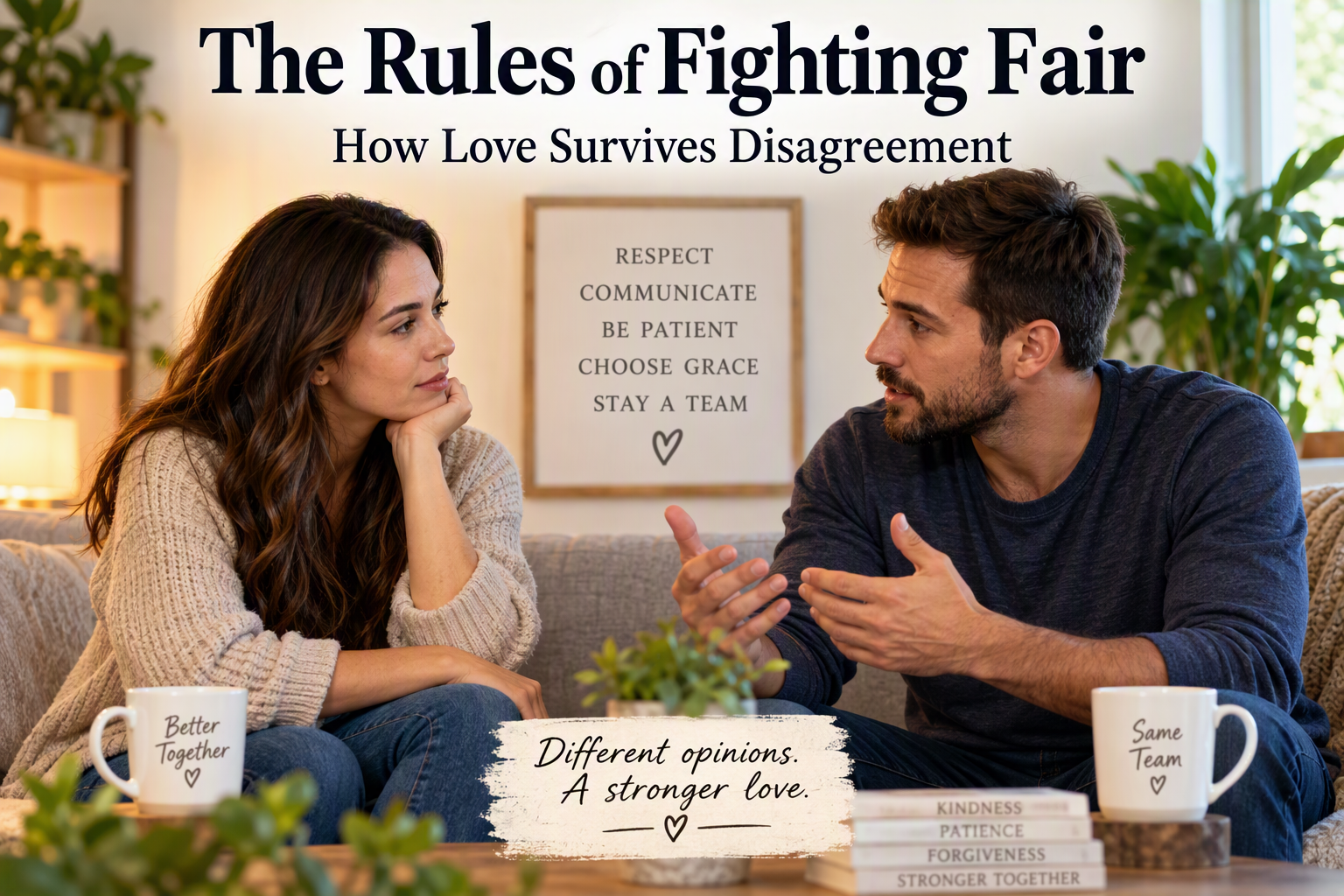
The Rules of Fighting Fair: How Love Survives Disagreement
Every relationship has arguments. No matter how deeply two people love each other, there will be moments of frustration, misunderstanding, disappointment, and hurt. The difference between healthy relationships and unhealthy ones is not whether conflict exists. The difference is how conflict is handled.
The image above presents five simple but powerful rules for couples during arguments. At first glance, they seem obvious. Yet these principles address some of the most common mistakes that damage trust and intimacy. They remind us that being angry with someone is not a license to stop loving them.
Research consistently shows that conflict itself is not the greatest threat to a relationship. Rather, it is destructive communication patterns, contempt, criticism, stonewalling, and defensiveness that place relationships at risk (Gottman & Silver, 2015).
Rule #1: Be Mad at Me, But Don’t Insult Me
“Anger is not a ticket to speak carelessly.”
When emotions run high, words often become weapons. People say things they never truly mean because they want the other person to feel the same pain they are feeling.
The problem is that arguments eventually end, but hurtful words often remain.
You may forget what the disagreement was about, but you rarely forget being called worthless, stupid, selfish, or unlovable. According to relationship researcher John Gottman, contempt and personal attacks are among the strongest predictors of relationship dissatisfaction and eventual separation (Gottman & Silver, 2015).
Healthy couples understand an important truth: attack the problem, not the person.
You can say:
- “That hurt me.”
- “I am disappointed.”
- “I feel ignored.”
Without saying:
- “You’re pathetic.”
- “You never do anything right.”
- “You’re just like your mother.”
Respect should not disappear simply because peace has.
Anger can be temporary. The damage caused by contempt can be permanent.
Rule #2: Be Mad at Me, But Tell Me Why
“Don’t assume I know.”
One of the greatest relationship myths is that people should automatically know what is wrong.
The truth is that nobody can read minds.
Many arguments grow larger because one partner believes the other should already understand the issue. Meanwhile, the other person is confused and becomes frustrated trying to guess.
Clear communication is one of the strongest predictors of relationship success. Research by Markman, Stanley, and Blumberg (2010) found that couples who communicate concerns directly and clearly are better able to resolve conflict and maintain emotional intimacy.
Instead of saying:
- “You know exactly what you did.”
Try saying:
- “When this happened, it made me feel unimportant.”
People cannot fix problems they do not understand.
Love requires communication, not telepathy.
As marriage and family therapist Virginia Satir observed, communication is to relationships what breathing is to life. Without it, connection slowly deteriorates (Satir, 1988).
Rule #3: Be Mad at Me, But Don’t Broadcast It
Conflict belongs between the people involved.
Too often people rush to social media, group texts, friends, family members, or coworkers to discuss relationship problems before discussing them with their partner.
While outside support can sometimes be helpful, publicly shaming a partner almost never improves the relationship.
Once private details become public, they cannot easily be taken back.
Strong relationships protect each other’s dignity, even during difficult moments. Maintaining emotional safety and mutual respect helps partners feel secure enough to resolve disagreements constructively (Tatkin, 2012).
This does not mean remaining silent about abuse, manipulation, or situations involving safety concerns. Those circumstances require outside support and intervention. However, ordinary relationship disagreements generally benefit from privacy, maturity, and direct communication.
A couple should be teammates solving a problem together, not opponents recruiting spectators.
Rule #4: Be Mad at Me, But Don’t Forget My Good Qualities
Conflict has a way of shrinking our perspective.
When we are hurt, our minds naturally focus on the thing causing the pain. Suddenly one mistake feels larger than a thousand acts of kindness.
Psychologists often describe this tendency as negative filtering, where attention becomes focused on a person’s flaws while overlooking their strengths.
A healthy relationship requires balance.
Remember:
- The person who forgot an anniversary may also be the person who supported you through difficult times.
- The person who made a mistake may also be the person who loves you deeply.
- The person frustrating you today may be the person who has stood beside you for years.
Research from the Gottman Institute has found that successful couples maintain a strong ratio of positive interactions to negative interactions, even during periods of conflict (The Gottman Institute, 2024).
A moment of failure should not erase a history of goodness.
Rule #5: Be Mad at Me, But Remember Grace
“Remember all the times I’ve forgiven you.”
This final point may be the most powerful.
Every person who has been in a long-term relationship has needed forgiveness. No one is perfect. No one gets everything right.
Healthy couples recognize that relationships are not scoreboards.
Love is strengthened when both people remember that they have received grace as often as they have given it.
Research from the Greater Good Science Center at the University of California, Berkeley indicates that forgiveness is associated with stronger relationships, better emotional health, reduced stress, and greater overall well-being (Greater Good Science Center, 2023).
Forgiveness does not excuse harmful behavior or remove accountability. Instead, it acknowledges that human beings are flawed and that lasting relationships require compassion.
The question is not whether your partner will eventually disappoint you.
They will.
The question is whether there is enough humility, understanding, and forgiveness to move forward together.
The Real Secret Behind Healthy Arguments
Many people believe successful couples avoid conflict. The truth is quite the opposite.
Successful couples argue.
They disagree.
They become frustrated.
They occasionally hurt one another.
What separates them from struggling couples is that they continue fighting for the relationship while addressing the problem.
They remember that the person sitting across from them is not the enemy.
The problem is the enemy.
Relationship experts consistently emphasize that couples who approach conflict as a shared challenge rather than a battle to be won are more likely to experience long-term satisfaction and stability (Markman et al., 2010; Gottman & Silver, 2015).
The argument should never become a contest about who wins. It should become a conversation about how both people can heal, learn, and grow.
Because at the end of the day, the healthiest relationships are not those free from anger.
They are the relationships where love remains present even when anger arrives.
“Being angry with someone is not the opposite of loving them. Treating them without respect is.”
About the Author
John S. Collier, MSW, LCSW-S is the Executive Director of Southeast Kentucky Behavioral Health, LLC and author of The Mind’s Trestle Board. Through his writing, he explores relationships, personal growth, emotional wellness, morality, and the challenges people face as they seek meaningful connections with others. His work blends professional behavioral health experience with practical life lessons intended to encourage reflection, healing, and personal development.

References
Chapman, G. (2015). The 5 Love Languages: The Secret to Love That Lasts. Northfield Publishing.
Gottman, J. M., & Silver, N. (2015). The Seven Principles for Making Marriage Work (Revised ed.). Harmony Books.
Greater Good Science Center. (2023). The Science of Forgiveness. University of California, Berkeley.
Harvard Health Publishing. (2022). Communication and Conflict Resolution in Relationships. Harvard Medical School.
Markman, H. J., Stanley, S. M., & Blumberg, S. L. (2010). Fighting for Your Marriage (3rd ed.). Jossey-Bass.
Mayo Clinic Staff. (2023). Healthy Communication and Relationship Wellness. Mayo Clinic.
Satir, V. (1988). The New Peoplemaking. Science and Behavior Books.
Tatkin, S. (2012). Wired for Love: How Understanding Your Partner’s Brain and Attachment Style Can Help You Defuse Conflict and Build a Secure Relationship. New Harbinger Publications.
The Gottman Institute. (2024). Managing Conflict in Relationships.