Welcome to SOUTHEAST KENTUCKY BEHAVIORAL HEALTH
When All You Remember Are the Bad Things in a Relationship

Why Painful Memories Can Become Stronger Than the Good Ones

Have you ever looked back at a relationship and wondered why you can only remember the bad things? Maybe you were married for many years. Maybe you dated someone for a long time. Maybe the relationship ended recently, or maybe it ended years ago. You know there had to be some good times.

There were probably times when you laughed together. You may have taken trips, celebrated birthdays, watched movies, eaten dinner together, or stayed up late talking. There may have been hugs, kisses, jokes, holidays, and ordinary days when everything seemed okay. But now, when you think about the relationship, those memories seem far away. Instead, you remember the fights.

  • You remember the hurtful words.
  • You remember feeling ignored.
  • You remember the lies.
  • You remember being disappointed.
  • You remember the times you cried.
  • You remember feeling alone, even when the other person was sitting beside you.

And you may wonder: Why can I remember everything that hurt me, but hardly remember anything good? There are several possible reasons. It does not always mean that every part of the relationship was bad. It may mean that the painful parts had a stronger effect on you. Understanding why this happens can help you understand your feelings, your memories, and yourself.


Your Memory Is Not a Video Camera

We sometimes think our memory works like a video camera. We believe our brain records everything that happens and stores it exactly the way it happened. But memory does not work that way. Our brains choose what information to notice, store, and remember. Feelings can affect this process. Stress, sadness, fear, anger, and other strong emotions can also change what we remember.

Research has shown that emotional problems can affect the way people remember events from their own lives (Williams et al., 2007). This is important when thinking about an old relationship. Imagine that you were with someone for ten years. During those ten years, you probably shared thousands of normal moments.

  • You ate meals together.
  • You watched television.
  • You drove places.
  • You went shopping.
  • You talked about work.
  • You went to bed.
  • You woke up the next morning.

Most of these normal moments may not become strong memories. But imagine that during those ten years, your partner said something very cruel during an argument. That conversation may have lasted only five minutes. Yet you might remember those five minutes for the next twenty years.

Why?

Because those five minutes hurt. The brain may give more attention to something that feels important, dangerous, painful, or emotional. So a painful memory can become stronger than hundreds of normal memories.


Our Brains Pay Attention to Danger

The human brain is designed to notice danger. This helped human beings survive for thousands of years. Imagine a person walking through the woods long ago. They see beautiful flowers beside the trail. Later, they see a dangerous animal near the same trail. Which memory is more important for survival? The dangerous animal. Remembering the flowers would be nice. Remembering the danger could save their life. We are no longer living the same way our early ancestors did, but our brains still pay attention to things that feel dangerous.

In relationships, danger is not always physical. Sometimes it is emotional.

  • Being rejected can hurt.
  • Being cheated on can hurt.
  • Being lied to can hurt.
  • Being screamed at can hurt.
  • Being made fun of can hurt.
  • Feeling unwanted can hurt.
  • Being ignored by someone you love can hurt.

If these things happen often, your brain may begin paying close attention to them. Your mind may be trying to protect you. It may be saying: “Remember this so it does not happen again.”


Bad Memories Can Feel Bigger Than Good Memories

Suppose you and your partner had a wonderful vacation. You laughed. You ate good food. You walked on the beach. You took pictures. You had fun. Years later, you may remember that it was a nice vacation, but many of the small details may disappear. Now imagine that on the last night of the vacation, you had a terrible argument. Your partner said something that broke your heart. Years later, you may have trouble remembering what you ate or where you went during the vacation. But you remember exactly where you were standing when those painful words were spoken.

You may even remember the person’s face. You may remember the room. You may remember what you were wearing. You may remember how your stomach felt. That does not mean the entire vacation was terrible. It means the painful moment had a strong emotional effect on you. Research shows that emotions can affect what we pay attention to and what we later remember (Williams et al., 2007).


Your Feelings Today Can Affect What You Remember

How you feel today can sometimes affect what you remember about yesterday. For example, when you are angry with someone, it may be easier to remember other times that person made you angry. One memory can lead to another. You remember one lie. Then another. Then another. You remember one argument. Then you remember another argument from three years earlier. Soon your mind has created a long list of everything that person ever did wrong.

The positive memories may still exist. They may simply be harder to reach at that moment. Depression can also affect the way people remember their lives. Researchers have found a connection between depression and problems remembering clear, specific personal experiences (Sumner et al., 2010; Williams et al., 2007).

This does not mean painful memories are fake. It means our current emotions can affect which memories are easiest to find.


Thinking About the Same Hurt Over and Over Makes It Stronger

Sometimes we do something called rumination. Rumination means thinking about the same upsetting situation again and again. You might think:

  • “Why did she do that?”
  • “Why did he say that?”
  • “Why didn’t I leave?”
  • “Why didn’t I notice what was happening?”
  • “Was I not good enough?”
  • “Did this person ever really love me?”
  • “What should I have said?”
  • “What would have happened if I had done something differently?”

Thinking about these questions once may help us understand what happened. Thinking about them hundreds of times may keep us stuck. Research has connected rumination with certain problems in autobiographical memory, which means memory about our own lives (Sumner, 2012).

Think about it this way. A happy event may have happened once. But you may have replayed a painful event in your mind 500 times. Each time you replay it, you give it more attention. That can make the memory easier to find.


Some Memories Stay Because There Was Never Closure

Painful memories can also remain strong when something never felt finished.

Imagine that your partner hurt you.

You told them how you felt.

  • They listened.
  • They apologized.
  • They took responsibility.
  • They changed their behavior.

Over time, you began trusting them again. Now imagine something different. You may still remember what happened, but the memory now has an ending. Your partner hurt you. You tried talking about it. They denied it. They blamed you. They refused to talk about it. Nothing changed. Then the relationship ended. You may still be asking:

  • “Why did this happen?”
  • “Why didn’t they care?”
  • “Did they understand how much they hurt me?”
  • “Why wasn’t I enough?”
  • “Was the relationship ever real?”

Your brain may keep returning to the memory because you never received an answer. But there is an important lesson here:

Sometimes closure does not come from the other person.

Sometimes you have to create your own closure.

You may never understand why someone treated you a certain way. Healing may begin when you realize you do not need every answer before you can move forward.


A Bad Ending Can Change How You Remember the Beginning

The way a relationship ends can change the way you remember the whole relationship. This can happen after cheating or another serious betrayal. Imagine discovering that your partner had been lying to you. Suddenly, you begin thinking about old memories differently. You look at an old vacation picture and wonder:

  • “Was this person lying to me then?”
  • You remember a business trip and wonder:
  • “Was that really a business trip?”
  • You remember hearing, “I love you,” and wonder:
  • “Did they really mean it?”

The memory itself has not changed. What changed is what you now know. New information can change the meaning of old memories. That can make even happy memories painful.


Sometimes Anger Is Easier Than Sadness

This can be difficult to admit. Sometimes being angry at someone feels easier than missing them. Anger can make us feel strong. Grief can make us feel weak and exposed. It may feel easier to say: “She was terrible to me.” than: “I loved her, and losing her broke my heart.”

It may feel easier to say: “He never cared about me.” than: “There were wonderful parts of our relationship, and I miss those parts.”

Both feelings can exist. You can love someone and be angry with them. You can miss someone and know you should not be together. You can forgive someone and still choose not to have them in your life. You can remember beautiful moments while also remembering terrible ones. You can admit: “I loved this person.” And also say: “This relationship was not healthy for me.” Both statements can be true.


Remembering Mostly Bad Things Does Not Automatically Mean You Have Trauma

People sometimes use the word trauma for every painful experience. Trauma is more complicated than that. A painful relationship can have a deep emotional effect without automatically causing post-traumatic stress disorder, or PTSD. Research has found that traumatic experiences, depression, avoidance, rumination, and memory can be connected in complicated ways (Moore & Zoellner, 2007; Sumner, 2012).

Simply remembering bad things about an old relationship does not mean you have PTSD. However, professional help may be useful if memories are causing serious problems in your daily life. For example, you may want to talk with a qualified mental health professional if memories cause strong fear, nightmares, panic, major sleep problems, constant avoidance, or serious problems in current relationships.


Depression Can Make Good Memories Harder to Find

Depression can affect more than how we feel today. It can affect how we look at yesterday. Research has found that people experiencing depression may have difficulty remembering clear and specific events from their lives (Sumner et al., 2010; Williams et al., 2007). Someone might say: “My whole marriage was terrible.” Maybe that is true. But another possibility should also be considered. Perhaps the marriage contained both good and bad experiences, but the painful memories are easier to reach right now.This is why it can help to slow down before making statements such as:

  • “Nothing was ever good.”
  • “They never loved me.”
  • “I wasted every year.”
  • “Every memory was terrible.”

Those feelings deserve to be taken seriously. But feelings and memories should also be explored carefully.


Your Mind May Be Trying to Protect You

Sometimes your mind keeps painful memories close because it wants to protect you. Imagine touching a hot stove. The pain teaches you something: Do not touch that again. Emotional pain can sometimes work in a similar way. Your brain remembers betrayal because it does not want you to be betrayed again. It remembers rejection because it wants you to notice warning signs. It remembers being controlled because it wants you to protect your freedom. It remembers being ignored because it wants you to choose someone who listens. The memory may be trying to teach you something. But there is a difference between learning from pain and living inside pain. A lesson can protect your future. Constantly replaying the hurt can steal your present.


Be Careful About Turning the Whole Relationship Into One Story

After a painful breakup or divorce, people sometimes create one simple story about the relationship.

  • “I wasted ten years.”
  • “She never loved me.”
  • “He never cared.”
  • “Everything was fake.”
  • “I was miserable every day.”

Sometimes those statements may describe someone’s true experience. But sometimes they are attempts to make a complicated relationship easier to understand. Relationships are often more complicated than “good” or “bad.” A person may have loved you and still hurt you. A person may have had good qualities and still been unhealthy for you. You may have made wonderful memories together and still needed to leave. You may have made mistakes too. Recognizing those things does not excuse harmful behavior. It simply allows you to tell yourself a more complete story.


You Do Not Have to Hate Someone to Move On

This is one of the hardest lessons after a relationship ends: You do not have to turn someone into a terrible person before you are allowed to let them go. Maybe your former partner had good qualities. Maybe they loved you in the best way they knew how. Maybe you loved them. Maybe you shared wonderful years. And maybe the relationship still needed to end. Those ideas can exist together.

  • You can say: “There were good times.” And: “There were painful times.”
  • You can say: “I loved this person.” And: “I do not want the relationship back.”
  • You can say: “I forgive what happened.” And: “I will not allow it to happen again.”
  • You can say: “I miss parts of what we had.” And: “I am happier moving forward.”

Healing does not require hating someone. Sometimes healing means seeing the whole person and the whole relationship clearly.


A Simple Exercise: Tell the Whole Story

If you can only remember the bad things, try writing down the story of your relationship.

Do not decide whether it was good or bad.

Just tell the truth.

The Beginning

Ask yourself:

  • How did we meet?
  • What did I like about this person?
  • What made me happy?
  • Why did I choose this relationship?
  • What dreams did we have?
  • What are some good memories from that time?

The Middle

Ask yourself:

  • When did things begin changing?
  • What problems appeared?
  • What was still good?
  • What became difficult?
  • What did I need that I was not getting?
  • What did my partner need?
  • What mistakes did I make?
  • What mistakes did my partner make?
  • Did we try to fix the problems?

The Ending

Ask yourself:

  • When did I realize the relationship might not survive?
  • What happened?
  • What hurt me the most?
  • What did I try to change?
  • What did the other person try to change?
  • What finally caused the relationship to end?

What Do I Miss?

Be truthful. Maybe you miss their laugh. Maybe you miss Sunday mornings. Maybe you miss traveling together. Maybe you miss having someone beside you. Missing something does not mean you should go back. It simply means something mattered to you.

What Am I Glad Is Over?

Write this down too. Maybe you no longer have to worry about arguments. Maybe you no longer feel controlled. Maybe you no longer wonder whether someone is lying. Maybe your home feels peaceful again. Recognize that freedom.

What Did I Learn?

This may be the most important question. What did the relationship teach you about love? What did it teach you about communication? What did it teach you about trust? What did it teach you about boundaries? What did it teach you about yourself? What will you do differently in your next relationship?


Ask What the Memory Is Really About

When the same painful memory keeps coming back, ask yourself: “What does this memory mean to me?”

Maybe the memory is really about rejection. Maybe it is about feeling unwanted. Maybe it is about embarrassment. Maybe it is about being abandoned. Maybe it is about feeling like you were not good enough. Maybe it is about losing trust. Sometimes the event is over, but the message you took from the event is still hurting you.

For example, your partner may have left you. That is what happened. But you may have told yourself: “They left because I am not worth loving.” That is an interpretation. Those are not the same thing. Someone leaving you does not prove that you are unlovable. Someone cheating does not prove that you were not good enough. Someone rejecting you does not decide your value. Understanding the difference between what happened and what you decided it meant about you can be an important part of healing.


Remembering the Good Does Not Mean You Want the Relationship Back

People sometimes become afraid of good memories. They think: “If I remember the good times, maybe I will want them back.” Not necessarily. Remembering is not returning. Forgiving is not forgetting. Understanding is not excusing. You can remember a wonderful Christmas together without wanting another Christmas together.

You can remember laughing on vacation without forgetting the pain that came later. You can remember being in love without believing the relationship should have lasted forever. The memory belongs to you. You do not have to destroy every good memory just because the relationship ended badly.


The Goal Is Not to Forget the Bad

Healing does not mean pretending bad things never happened. It also does not mean forcing yourself to think positively. The goal is to remember the whole story. You might eventually be able to say: “We had good times.” “We had bad times.” “I loved this person.”

  • “This person hurt me.”
  • “I hurt them sometimes too.”
  • “I made mistakes.”
  • “I learned.”
  • “I changed.”
  • “I survived the ending.”
  • “And I kept moving forward.”

That is a much stronger story than simply saying:

“Everything was terrible.”


Final Thoughts

If all you can remember about a relationship is the negative things, do not immediately assume something is wrong with you. Your memories may be showing you where you were hurt. They may be showing you what still needs attention. They may be reminding you of something you never understood. They may be connected to anger, sadness, grief, depression, rumination, or unresolved questions. Or your memories may simply be telling you that certain experiences affected you much more deeply than you realized at the time.

Do not force yourself to remember good things. Instead, become curious about the memories that remain.

Ask:

  • Why does this memory still hurt?
  • What did I lose?
  • What did I learn?
  • What am I still angry about?
  • What do I still wish had happened differently?
  • What am I afraid will happen in another relationship?
  • What do I need to forgive myself for?

And finally:

What do I want to carry forward, and what am I ready to leave behind?

Healing does not mean erasing your past. It means reaching a place where your past no longer controls your present. You can remember the hurt without living in it. You can remember the love without returning to it. You can remember the mistakes without allowing them to define you. And one day, instead of thinking only about everything that went wrong, you may be able to look back and say: “Some of it was beautiful. Some of it was painful. All of it taught me something. But it is no longer where I live.”


About the Author

John S. Collier, MSW, LCSW-S

John S. Collier is a Licensed Clinical Social Worker with professional experience in behavioral health, counseling, mental health services, and helping individuals and families work through difficult life experiences.

His work focuses on helping people better understand the connection between thoughts, emotions, behaviors, relationships, and personal experiences. He has a particular interest in presenting mental health information in a way that ordinary people can understand and use in their daily lives.

Rather than treating emotional struggles as complicated ideas that can only be understood by professionals, John believes people can benefit from learning why they think, feel, and behave the way they do. Understanding does not remove every painful experience, but it can give people tools for responding to those experiences in healthier ways.

His writing often explores relationships, depression, anxiety, trauma, grief, personal growth, family relationships, communication, emotional healing, faith, and the challenges people face during major life changes.

John’s approach emphasizes an important idea: a person’s past can help explain where they are today without having to determine where they will be tomorrow.

Through education, reflection, and practical mental health tools, his goal is to help readers better understand themselves, recognize unhealthy patterns, build stronger relationships, develop healthy boundaries, and move toward greater emotional well-being.


References

Moore, S. A., & Zoellner, L. A. (2007). Overgeneral autobiographical memory and traumatic events: An evaluative review. Psychological Bulletin, 133(3), 419–437. https://doi.org/10.1037/0033-2909.133.3.419

Sumner, J. A. (2012). The mechanisms underlying overgeneral autobiographical memory: An evaluative review of evidence for the CaR-FA-X model. Clinical Psychology Review, 32(1), 34–48. https://doi.org/10.1016/j.cpr.2011.10.003

Sumner, J. A., Griffith, J. W., & Mineka, S. (2010). Overgeneral autobiographical memory as a predictor of the course of depression: A meta-analysis. Behaviour Research and Therapy, 48(7), 614–625. https://doi.org/10.1016/j.brat.2010.03.013

Williams, J. M. G., Barnhofer, T., Crane, C., Hermans, D., Raes, F., Watkins, E., & Dalgleish, T. (2007). Autobiographical memory specificity and emotional disorder. Psychological Bulletin, 133(1), 122–148. https://doi.org/10.1037/0033-2909.133.1.122


Educational Disclaimer: This article is for educational purposes and is not intended to diagnose or treat any mental health condition. People experiencing significant emotional distress or difficulty functioning should consider speaking with a qualified mental health professional.
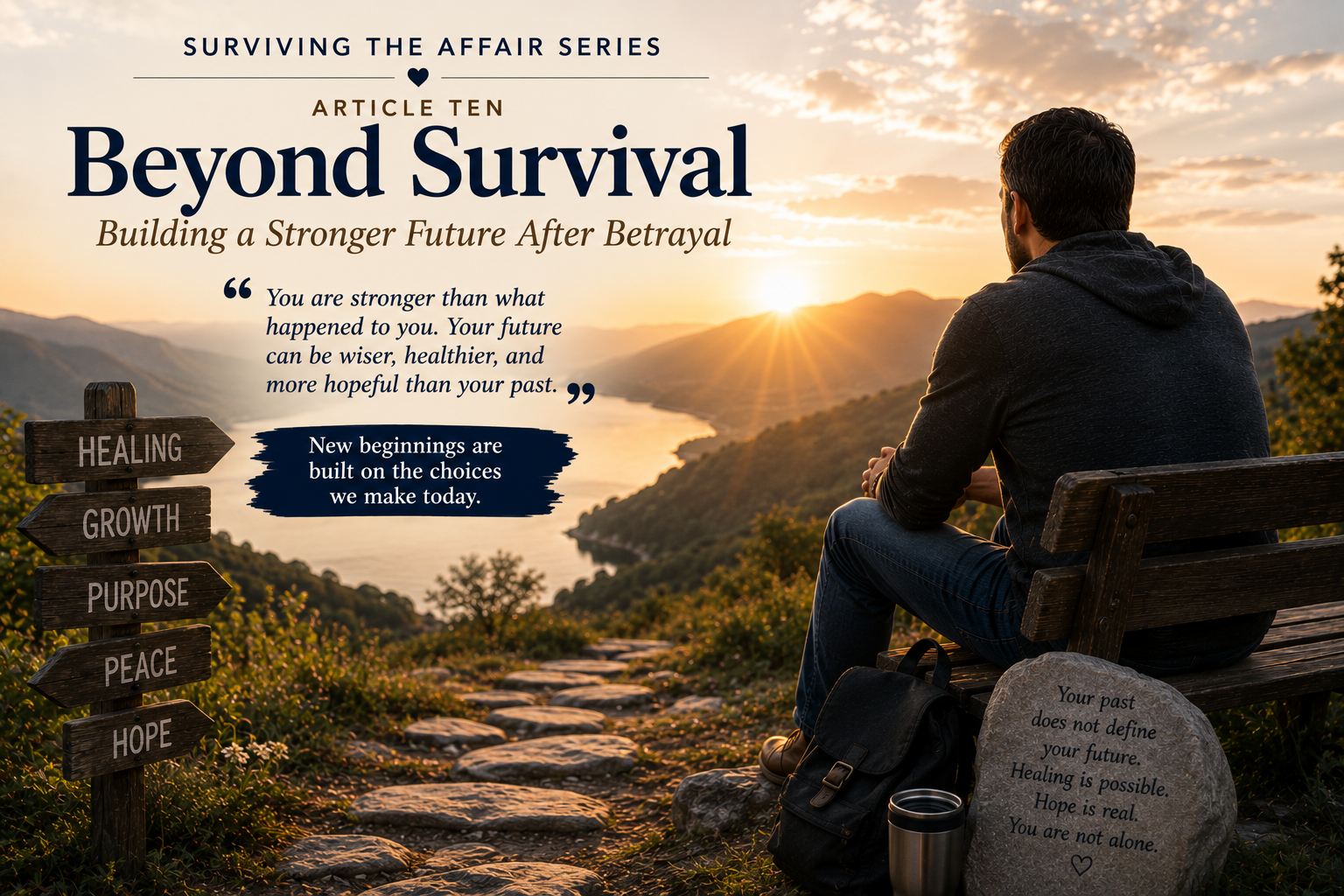
Surviving the Affair: Beyond Survival

Part Ten: Building a Stronger Future After Betrayal

At some point, nearly every person recovering from an affair asks the same question:

“Will I ever feel normal again?”

It is a deeply human question. After months—or sometimes years—of emotional turmoil, counseling appointments, difficult conversations, sleepless nights, and painful decisions, people naturally long for the day when life no longer revolves around the affair. They want peace. They want joy. They want to stop measuring every conversation against the past. They want to wake up without immediately remembering what happened.

The encouraging truth is this:

For many people, that day does come. Not because the affair is forgotten. Not because the pain never existed. But because healing gradually becomes stronger than the wound. Recovery is not simply about surviving betrayal. It is about becoming someone healthier, wiser, and emotionally stronger than you were before the crisis began. This final chapter is not about ending a painful story. It is about beginning a new one.


Healing Changes You

Many people begin counseling hoping to become the person they were before the affair. Ironically, the healthiest outcome is often something different. Healthy recovery does not recreate the past. It creates growth. People frequently discover strengths they never knew they possessed. They become better communicators. They establish healthier boundaries. They learn emotional regulation. They become more intentional in relationships. They deepen their spiritual lives.

While no one would choose the pain of betrayal, many eventually recognize that the healing process transformed them into someone more emotionally mature than they had ever been before. This is what psychologists often describe as post-traumatic growth—positive psychological change that emerges from successfully navigating profound adversity. Growth does not justify suffering. It demonstrates that suffering does not have the final word.


If You Rebuild the Marriage

Some marriages survive infidelity. A smaller number become healthier than they were before. Not because the affair improved the relationship. Rather, because the crisis forced both spouses to confront unhealthy patterns that had existed long before the affair occurred. Healthy reconciled marriages often develop:

  • Honest communication.
  • Emotional transparency.
  • Greater empathy.
  • Consistent accountability.
  • Shared spiritual growth.
  • Intentional quality time.
  • Renewed commitment to protecting the relationship.

Trust returns slowly. Sometimes over several years. Each truthful conversation becomes another brick in rebuilding the foundation. Eventually, trust becomes less about forgetting the past and more about confidence in today’s choices.


If the Marriage Ends

For others, healing continues outside the marriage. Divorce does not automatically mean failure. Sometimes it reflects the difficult reality that one or both partners were unwilling or unable to rebuild a healthy relationship. Life after divorce often begins with grief. Then comes adjustment. Eventually, many discover hope. New routines develop. Children adapt. Friendships deepen. Purpose returns. Life begins to feel possible again. Although the family structure has changed, healing remains available. Your future is not cancelled because your marriage ended.


Learning to Trust Again

One of the greatest fears after betrayal is trusting another person. Some decide they will never become vulnerable again. While understandable, emotional isolation often prolongs suffering. Healthy trust develops gradually. It begins with yourself. Can I recognize unhealthy patterns? Can I communicate honestly? Can I establish healthy boundaries? Can I respond to red flags instead of ignoring them? Confidence grows as these questions receive healthier answers. Eventually, trusting others becomes less frightening because you trust your own wisdom.


Your Identity Is More Than Your Pain

Perhaps the greatest danger after an affair is allowing the betrayal to become your identity. Some introduce themselves internally as:

  • “I am the one who was cheated on.”
  • “I am the one who destroyed my marriage.”
  • “I am the affair partner.”

Those descriptions may explain part of your story. They should never define your entire life. You are more than your worst decision. You are more than someone else’s worst decision. Healing allows identity to shift from victimhood toward purpose. From shame toward dignity. From regret toward wisdom. From survival toward flourishing.


Choosing Healthy Relationships Going Forward

Whether you remain married, remarry someday, or remain single, healthy relationships share common characteristics. They include:

  • Mutual respect.
  • Honest communication.
  • Emotional safety.
  • Shared responsibility.
  • Healthy conflict resolution.
  • Appropriate boundaries.
  • Genuine friendship.
  • Spiritual and emotional intimacy.

Healthy love is not built upon perfection. It is built upon consistency.


Your Story Can Help Someone Else

Many people initially want to hide every part of their experience. Over time, some discover that their greatest pain becomes one of their greatest opportunities to serve. Their story encourages another struggling couple. Their wisdom comforts someone newly betrayed. Their experience offers hope to someone who believes healing is impossible. Scars often become testimonies. Not because suffering was good. But because healing became visible.


Tools for Living Beyond Betrayal

As you continue moving forward, these practices support lasting emotional health:

  • Continue investing in personal growth long after the crisis has passed.
  • Prioritize honest communication in every important relationship.
  • Maintain healthy emotional and physical boundaries.
  • Practice forgiveness without abandoning wisdom.
  • Develop consistent spiritual disciplines through prayer and Scripture.
  • Stay connected to supportive family, friends, and community.
  • Celebrate progress rather than expecting perfection.
  • Seek counseling whenever new challenges arise.
  • Remember that healing is ongoing, not a destination.
  • Live intentionally rather than reactively.

A Christian Perspective

Scripture repeatedly reminds us that God specializes in restoration. Joel 2:25 contains one of the Bible’s most hopeful promises:

“I will restore to you the years that the locusts have eaten…” (ESV)

Restoration does not always mean restoring the same marriage. Sometimes it means restoring the same person. Sometimes it means restoring hope. Sometimes it means restoring purpose. Sometimes it means restoring faith. God’s greatest work often begins after our greatest heartbreak. No matter how your story concludes, His invitation remains the same:

Walk forward with Him.


A Therapist’s Reflection

If I could leave every reader with one final thought, it would be this:

Do not measure your life by the day the affair happened.

Measure it by the person you are becoming because you refused to stay there. Healing is rarely dramatic. It is usually quiet. It is choosing honesty one conversation at a time. Forgiveness one day at a time. Healthy boundaries one decision at a time. Faith one prayer at a time. Eventually, those small choices become a transformed life. The affair may always be one chapter of your story. It does not have to be the title. Your future is still unwritten. Your relationships can still be healthy. Your heart can still know peace. Your family can still experience joy. And your life can still reflect hope. You have survived. Now it is time to live.


About the Author

John S. Collier, MSW, LCSW-S is a licensed clinical social worker, psychotherapist, author, educator, and speaker with decades of experience helping individuals, couples, and families navigate life’s most difficult emotional challenges. Throughout his career, he has worked extensively with people struggling with relationship conflict, betrayal, anxiety, depression, trauma, grief, addiction, and life transitions. His counseling approach combines evidence-based psychological practices with practical wisdom, compassion, and a deep respect for each person’s unique journey.

John has devoted much of his professional life to understanding the complexities of human relationships. He has counseled couples working to rebuild trust after infidelity, individuals recovering from betrayal, and families seeking healing after painful life events. His clinical experience has reinforced one enduring truth: while relationships can be profoundly wounded, people possess an extraordinary capacity for growth, resilience, forgiveness, and transformation when they are equipped with the right tools and support.

As an author, John seeks to bridge the gap between professional mental health knowledge and everyday life. His writing translates complex psychological concepts into practical guidance that readers can understand and apply immediately. Whether addressing marriage, parenting, emotional wellness, trauma recovery, or spiritual growth, his goal is to provide resources that are both clinically sound and personally encouraging.

Surviving the Affair reflects John’s commitment to approaching infidelity with both honesty and compassion. Rather than reducing people to labels or stereotypes, he explores the emotional realities experienced by everyone affected—the betrayed spouse, the unfaithful partner, the affair partner, and the families whose lives are forever changed. Drawing upon years of therapeutic experience, he emphasizes accountability without condemnation, healing without minimizing pain, and hope without offering unrealistic promises.

John believes that healing begins when people are willing to face the truth with courage. While not every relationship can or should be restored, every individual has the capacity to grow beyond betrayal, rediscover integrity, and build a healthier future. His passion is helping readers move from surviving life’s greatest wounds to living with renewed purpose, emotional strength, and hope.

Through his books, speaking engagements, and counseling work, John continues to encourage others to pursue emotional health, healthy relationships, personal responsibility, and lasting transformation—one step at a time.ountability, and restoration. Through his clinical work and writing, he equips readers with practical tools to build emotionally healthy relationships, strengthen resilience, and discover hope after life’s most difficult experiences.

References

American Psychological Association. (2023). Clinical Practice Guideline for the Treatment of Posttraumatic Stress Disorder.

Calhoun, L. G., & Tedeschi, R. G. (2014). Handbook of Posttraumatic Growth: Research and Practice. Routledge.

Gottman, J. M., & Gottman, J. S. (2015). 10 Principles for Doing Effective Couples Therapy. W. W. Norton & Company.

Snyder, D. K., Baucom, D. H., & Gordon, K. C. (2007). Getting Past the Affair. Guilford Press.

Spring, J. A. (2012). After the Affair (2nd ed.). Harper.

Tedeschi, R. G., & Calhoun, L. G. (2004). “Posttraumatic Growth: Conceptual Foundations and Empirical Evidence.” Psychological Inquiry, 15(1), 1–18.

The Holy Bible, English Standard Version. Crossway.


Articles in this Series:

This series has been written for every person whose life has been altered by an affair. Each article focuses on one unique perspective because healing looks different depending upon where someone stands.

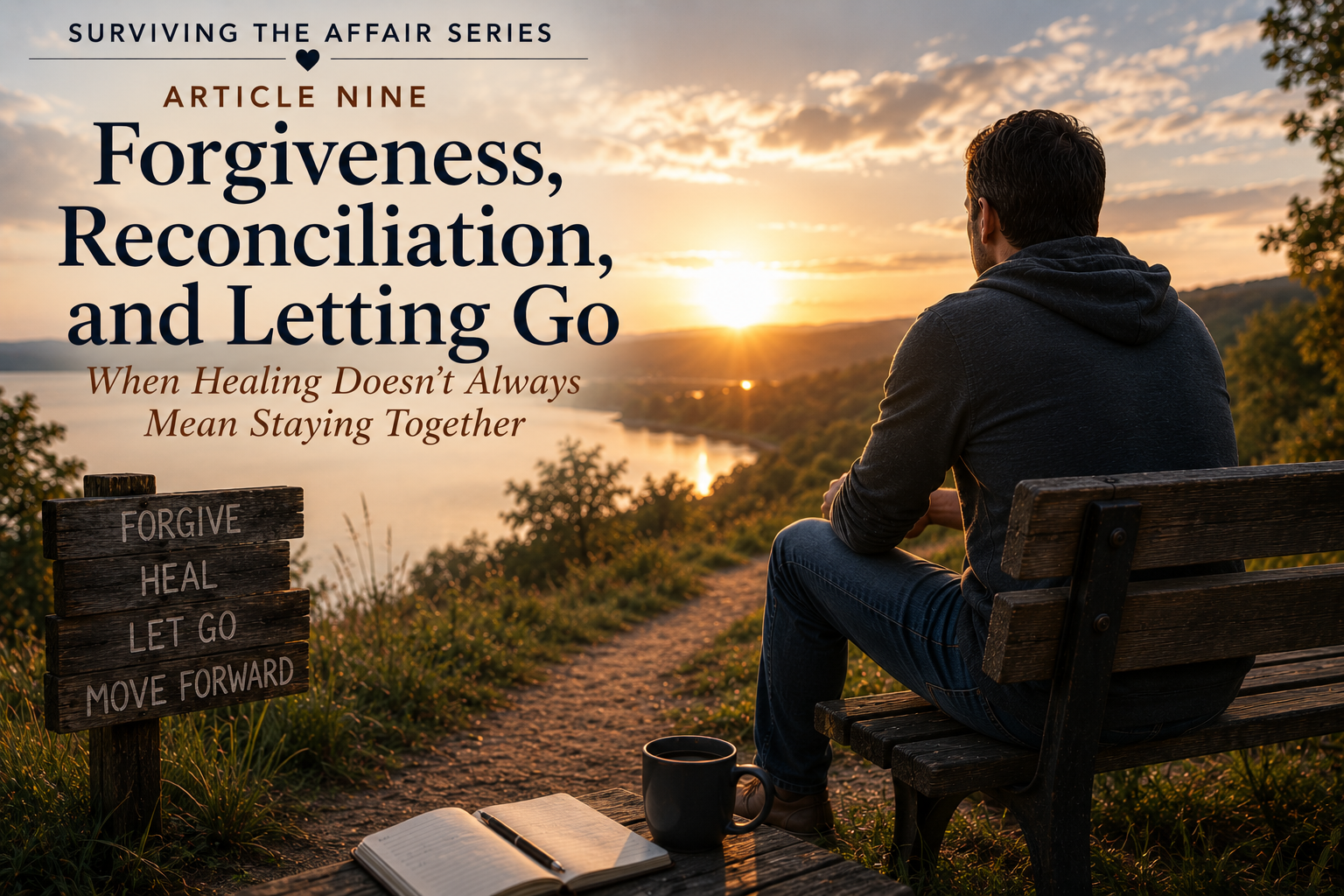
Surviving the Affair: Forgiveness, Reconciliation, and Letting Go

Part Nine: When Healing Doesn’t Always Mean Staying Together

Perhaps no word creates more confusion after an affair than the word forgiveness. Some people believe forgiveness means forgetting. Others believe it means trusting again. Some think it requires reconciliation. Others refuse to forgive because they believe doing so somehow excuses what happened.

In my years of counseling individuals and couples after infidelity, I have discovered that very few people actually struggle with the idea of forgiveness. They struggle with what they think forgiveness means. If we misunderstand forgiveness, we either demand it too quickly or avoid it altogether. Neither response promotes healing. Forgiveness is one of the most misunderstood concepts in psychology, relationships, and Christianity. Understanding it correctly often becomes one of the most important turning points in recovery.


Forgiveness Is Not Saying It Didn’t Matter

Some wounds permanently change a person’s life. An affair may result in divorce. Children may experience years of emotional pain. Friendships may end. Financial stability may disappear. Trust may never fully return. Acknowledging these realities does not mean forgiveness is impossible. It means forgiveness begins with honesty. Real forgiveness never minimizes the seriousness of betrayal. It fully recognizes the depth of the wound. Only then can healing begin.


Forgiveness Is Not Reconciliation

This distinction cannot be overstated. Forgiveness and reconciliation are related. They are not identical. Forgiveness is something one person can choose. Reconciliation requires two people. One person can forgive. Both people must rebuild trust. Reconciliation requires:

  • Genuine repentance.
  • Radical honesty.
  • Transparency.
  • Accountability.
  • Emotional safety.
  • Consistent trustworthy behavior.
  • Mutual willingness to rebuild the relationship.

Without these elements, reconciliation becomes unsafe. Forgiveness may still occur. Reconciliation may not.


Forgiveness Is Not Trust

One of the most painful mistakes couples make is expecting forgiveness to immediately restore trust. Trust is earned. Forgiveness is given. Trust grows through repeated demonstrations of honesty. Forgiveness grows through emotional healing. A spouse may forgive today. Trust may require months—or years—to return. That is normal. Healthy forgiveness never ignores wisdom.


Bitterness Is a Heavy Burden

Many people refuse forgiveness because they believe it protects them. “If I stay angry, I’ll never be hurt again.” Unfortunately, bitterness rarely protects. It imprisons. Bitterness quietly occupies emotional space that could otherwise be filled with peace. It influences future relationships. It affects physical health. It changes the way we see ourselves. It changes the way we see others. Eventually, bitterness begins hurting the person carrying it more than the person who caused it. Forgiveness is not setting someone else free. It is refusing to remain emotionally chained to what they did.


What If They Never Apologize?

One of the most difficult realities is that some people never receive the apology they deserve. The unfaithful spouse may deny responsibility. The affair partner may never acknowledge the harm. Some people simply disappear. Waiting for another person’s remorse before healing often leaves us emotionally dependent upon someone who has already demonstrated unreliability. Healing cannot depend upon another person’s choices. Your recovery belongs to you.


Forgiveness Is a Process, Not a Moment

Many people expect forgiveness to happen all at once. Instead, it often unfolds gradually. One day you notice the anger feels slightly less intense. Months later, the memories no longer dominate every conversation. Years later, you discover the affair has become part of your history rather than your identity. Forgiveness usually grows quietly. Like physical healing, it often happens so gradually that we fail to notice until we compare where we are today with where we once were.


When Reconciliation Isn’t Healthy

Not every marriage should continue. Repeated affairs. Abuse. Manipulation. Addiction without treatment. Chronic dishonesty. Refusal to accept responsibility. These situations may make reconciliation unsafe. Choosing divorce in such circumstances is not necessarily evidence of unforgiveness. Sometimes healthy boundaries require ending the relationship. God values truth and safety as much as He values reconciliation. Wisdom requires knowing the difference.


What Letting Go Really Means

Letting go does not mean pretending the affair never happened. It means releasing your need to control what cannot be changed. You cannot rewrite yesterday. You can choose how yesterday influences tomorrow. Letting go means:

  • Releasing revenge.
  • Releasing constant rumination.
  • Releasing the need to make the other person suffer.
  • Releasing unrealistic expectations.
  • Choosing emotional freedom instead of emotional captivity.

That process rarely happens overnight. It is practiced one decision at a time.


Tools for Moving Forward

Whether your marriage survives or ends, these practices encourage emotional healing:

  • Work with a therapist experienced in betrayal trauma.
  • Journal your thoughts and emotional progress.
  • Practice mindfulness when intrusive memories arise.
  • Establish healthy emotional and physical boundaries.
  • Learn the difference between forgiveness and trust.
  • Invest in supportive friendships.
  • Develop daily spiritual practices through prayer and Scripture.
  • Focus on becoming emotionally healthy rather than emotionally vindicated.
  • Celebrate progress rather than demanding perfection.
  • Give yourself permission to heal at your own pace.

A Christian Perspective

When Jesus taught about forgiveness, He never suggested that wrongdoing should be ignored. Rather, He demonstrated that forgiveness is an act of surrender to God rather than an approval of sin. Ephesians 4:31–32 encourages believers:

“Get rid of all bitterness, rage and anger… Be kind and compassionate to one another, forgiving each other, just as in Christ God forgave you.”

Biblical forgiveness is rooted in freedom. Freedom from bitterness. Freedom from revenge. Freedom to trust God’s justice rather than carrying the burden yourself. Forgiveness is not weakness. It is spiritual strength.


A Therapist’s Reflection

One question I frequently ask clients is this:

“If the affair could no longer control your emotional life, what kind of person would you become?”

At first, many struggle to answer. Their identity has become intertwined with the betrayal. Over time, however, something beautiful begins to happen. They stop defining themselves by what someone did to them. They begin defining themselves by who they are becoming. That is healing. Forgiveness does not erase scars. It changes what those scars represent. Instead of reminders of permanent defeat…They become evidence that you survived. Whether your marriage continues or ends… Whether the apology comes or never arrives…Whether trust is rebuilt or permanently broken…Your future is still yours to write.

Do not allow another person’s choices to become the author of the rest of your life. Healing is possible. Freedom is possible. And forgiveness—properly understood—may become one of the greatest gifts you ever give yourself.


About the Author

John S. Collier, MSW, LCSW-S is a licensed clinical social worker, psychotherapist, author, educator, and speaker with decades of experience helping individuals, couples, and families navigate life’s most difficult emotional challenges. Throughout his career, he has worked extensively with people struggling with relationship conflict, betrayal, anxiety, depression, trauma, grief, addiction, and life transitions. His counseling approach combines evidence-based psychological practices with practical wisdom, compassion, and a deep respect for each person’s unique journey.

John has devoted much of his professional life to understanding the complexities of human relationships. He has counseled couples working to rebuild trust after infidelity, individuals recovering from betrayal, and families seeking healing after painful life events. His clinical experience has reinforced one enduring truth: while relationships can be profoundly wounded, people possess an extraordinary capacity for growth, resilience, forgiveness, and transformation when they are equipped with the right tools and support.

As an author, John seeks to bridge the gap between professional mental health knowledge and everyday life. His writing translates complex psychological concepts into practical guidance that readers can understand and apply immediately. Whether addressing marriage, parenting, emotional wellness, trauma recovery, or spiritual growth, his goal is to provide resources that are both clinically sound and personally encouraging.

Surviving the Affair reflects John’s commitment to approaching infidelity with both honesty and compassion. Rather than reducing people to labels or stereotypes, he explores the emotional realities experienced by everyone affected—the betrayed spouse, the unfaithful partner, the affair partner, and the families whose lives are forever changed. Drawing upon years of therapeutic experience, he emphasizes accountability without condemnation, healing without minimizing pain, and hope without offering unrealistic promises.

John believes that healing begins when people are willing to face the truth with courage. While not every relationship can or should be restored, every individual has the capacity to grow beyond betrayal, rediscover integrity, and build a healthier future. His passion is helping readers move from surviving life’s greatest wounds to living with renewed purpose, emotional strength, and hope.

Through his books, speaking engagements, and counseling work, John continues to encourage others to pursue emotional health, healthy relationships, personal responsibility, and lasting transformation—one step at a time.onal pain toward lives marked by integrity, resilience, and hope. Through his writing and counseling, he encourages readers to embrace accountability while believing that lasting personal transformation is always possible. with practical tools for healing, resilience, and lasting personal growth.

References

American Psychiatric Association. (2022). Diagnostic and Statistical Manual of Mental Disorders (5th ed., text rev.). American Psychiatric Association Publishing.

Baucom, D. H., Snyder, D. K., & Gordon, K. C. (2009). Helping Couples Get Past the Affair: A Clinician’s Guide. Guilford Press.

Enright, R. D. (2001). Forgiveness Is a Choice: A Step-by-Step Process for Resolving Anger and Restoring Hope. American Psychological Association.

Glass, S. P. (2003). Not “Just Friends”: Rebuilding Trust and Recovering Your Sanity After Infidelity. Free Press.

Spring, J. A. (2012). After the Affair: Healing the Pain and Rebuilding Trust When a Partner Has Been Unfaithful (2nd ed.). Harper.

Worthington, E. L. (2006). Forgiveness and Reconciliation: Theory and Application. Routledge.

Worthington, E. L. (2013). Moving Forward: Six Steps to Forgiving Yourself and Breaking Free from the Past. WaterBrook.

The Holy Bible, New International Version. (2011). Zondervan.


Articles in this Series:

This series has been written for every person whose life has been altered by an affair. Each article focuses on one unique perspective because healing looks different depending upon where someone stands.

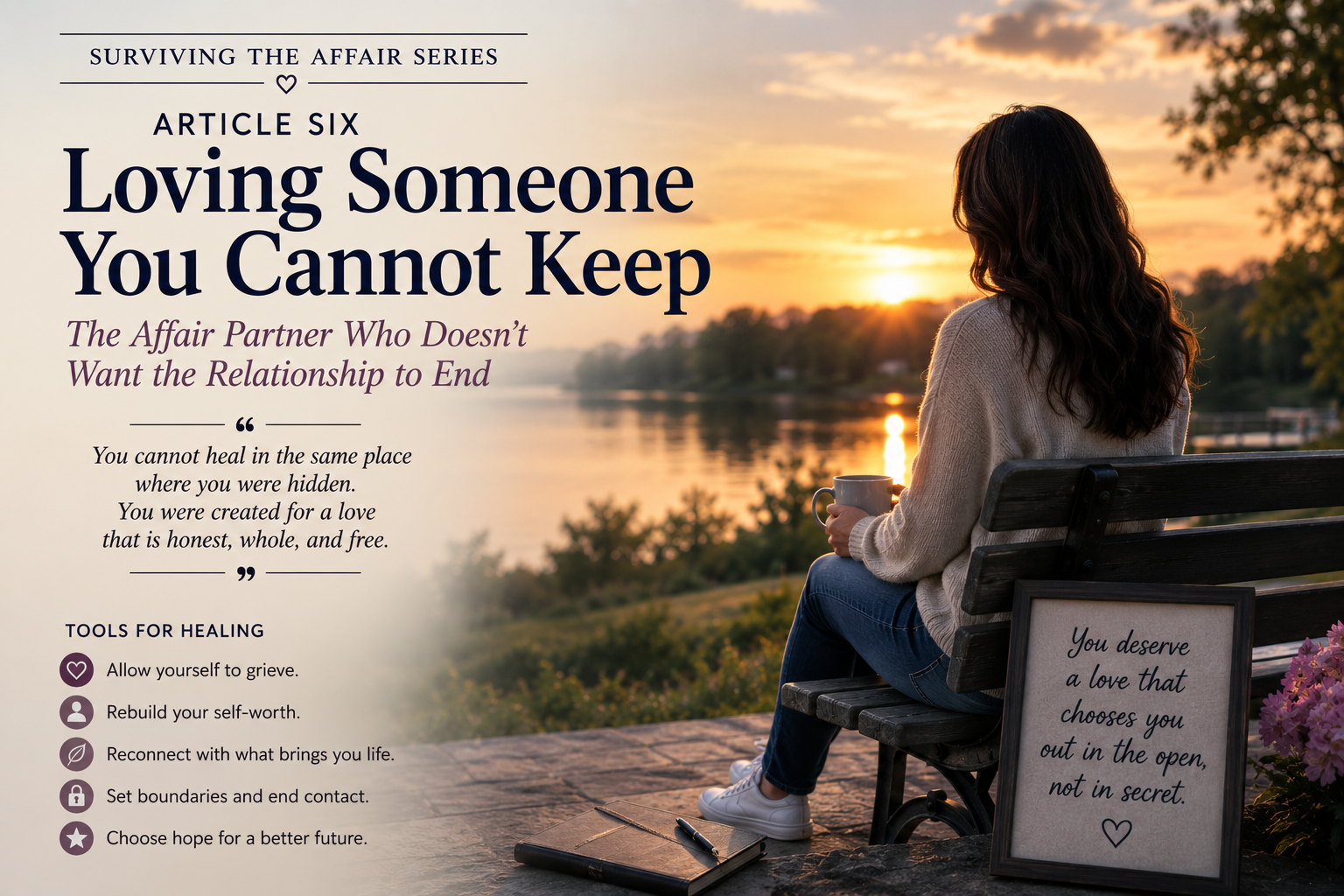
Surviving the Affair: Loving Someone You Cannot Keep

Part Six: The Affair Partner Who Doesn’t Want the Relationship to End

There is one person in nearly every affair who is rarely invited into the conversation. The affair partner. To many people, this individual is simply “the other woman” or “the other man.” They are viewed only through the pain they helped create. While they bear responsibility for their choices, reducing them to a stereotype rarely tells the whole story.

Some knowingly entered a relationship with a married person. Some were told the marriage was already over. Some believed divorce was only a matter of time. Some desperately tried to end the relationship but returned repeatedly. Others eventually fell deeply in love with someone they could never fully have.

None of these circumstances erase accountability. An affair causes real harm. Yet understanding the emotional world of the affair partner is not the same as excusing it. Healing begins with honesty—not caricatures.

This article is written for those who remain emotionally attached to someone who has chosen—or has been forced—to return to their marriage. You are grieving a relationship that may have felt deeply real, yet one that was built in secrecy and could never fully exist in the light. That grief deserves to be understood, even while acknowledging that the relationship itself was unhealthy.


When Fantasy Becomes Reality

Many affairs begin inside carefully controlled environments. There are no unpaid bills. No parenting disagreements. No household responsibilities. No extended family conflicts. There is only conversation, excitement, emotional intensity, and stolen moments. Psychologists sometimes describe this as a relationship protected from ordinary life.

Without everyday pressures, emotional intimacy often grows unusually fast. The relationship begins to feel extraordinary. Soulmate. Destiny. The one person who truly understands. These feelings are often sincere. But sincerity does not necessarily make them sustainable. Real relationships eventually require ordinary life. Most affairs never experience ordinary life.


Waiting for Tomorrow

Many affair partners live in a state of emotional suspension.

  • “After the holidays…”
  • “After the children graduate…”
  • “After the divorce…”
  • “Soon.”

Tomorrow becomes a promise that never quite arrives. Months become years. Life quietly passes. Many affair partners eventually realize they have built their future around someone else’s decisions. That realization is often devastating.


Loving Someone Who Chooses Someone Else

One of the deepest emotional wounds occurs when the married partner decides to end the affair and remain with their spouse. The affair partner often experiences intense emotions:

  • Grief.
  • Rejection.
  • Loneliness.
  • Confusion.
  • Shame.
  • Embarrassment.

Many wonder:

“Was any of it real?”

The answer is often yes. Feelings may have been genuine. But genuine feelings do not always produce healthy relationships. Love alone cannot overcome secrecy, divided loyalties, and broken trust.


The Hidden Cost of Being a Secret

Human beings were created for authentic connection. Healthy love thrives in openness. Affairs require concealment. Secret phone calls. Hidden messages. Excuses. Deleted conversations. Canceled holidays. Missed birthdays. Invisible grief. Over time, many affair partners begin realizing they are living a life that cannot be acknowledged publicly. They are important privately. Invisible publicly. That imbalance slowly erodes self-worth. Everyone deserves a relationship where they do not have to hide.


Hope Can Become a Prison

Hope is usually healthy. But misplaced hope can become emotionally imprisoning. Many affair partners continue waiting long after the relationship has effectively ended. They continue believing:

  • “Maybe they’ll come back.”
  • “Maybe they’re only staying because of the children.”
  • “Maybe next month everything will change.”

Hope becomes less about possibility and more about avoidance. Sometimes healing begins when hope changes direction. Instead of hoping someone returns… Begin hoping you become emotionally free.


You Are More Than This Relationship

One of the greatest dangers in any unhealthy relationship is identity fusion. Your entire sense of worth becomes connected to one person. When that relationship ends, it feels as though you disappear too. Healing requires rediscovering yourself outside the relationship.

Ask yourself:

  • Who was I before this affair?
  • What dreams have I postponed?
  • What values have I compromised?
  • What kind of relationship do I truly deserve?

These questions often become the beginning of genuine recovery.


Choosing Self-Respect

Walking away from someone you love may become one of the hardest decisions you ever make. It may also become one of the healthiest. Self-respect sometimes requires accepting painful reality rather than continuing to chase unlikely possibilities. Healthy love does not require constant secrecy. Healthy love does not leave one person waiting indefinitely. Healthy love does not require sacrificing your identity to remain emotionally connected.


Tools for Healing

If you are struggling to let go, consider these practical steps:

  • End all contact if the relationship has truly ended.
  • Allow yourself to grieve without romanticizing the relationship.
  • Work with a therapist to understand attachment patterns.
  • Reconnect with trusted friends and family.
  • Develop interests and goals that are independent of the relationship.
  • Journal honestly about both the joys and the costs of the affair.
  • Avoid monitoring your former partner’s social media.
  • Practice self-compassion while accepting responsibility for your choices.
  • Establish healthy relationship standards for the future.
  • Focus on becoming the person you hope to share your life with someday.

A Christian Perspective

Throughout Scripture, God continually calls people away from hiddenness and toward truth. The invitation is never merely to stop doing wrong. It is to step into a different way of living. John 8:32 reminds us:

“Then you will know the truth, and the truth will set you free.”

Sometimes the greatest freedom comes not from getting what we wanted…But from releasing what was never ours to keep. God’s grace is available to everyone. To the faithful spouse. To the unfaithful spouse. To the affair partner. Grace does not ignore responsibility. It offers transformation beyond it.


A Therapist’s Reflection

Over the years, I have counseled affair partners whose grief surprised even them. Many assumed they had no right to mourn. Others believed their pain would be dismissed because they helped create the situation. Yet grief does not disappear because others disapprove of it. It simply becomes lonely.

The healthiest healing begins when two truths are held together. You may have genuinely loved this person. And…The relationship may still have been unhealthy. Those truths can exist together. Do not allow one relationship—especially one built in secrecy—to determine your worth. Your future is not limited by this chapter. Healthy love does not ask you to remain hidden. It invites you to be fully known. And that kind of love is worth waiting for.


About the Author

John S. Collier, MSW, LCSW-S is a licensed clinical social worker, psychotherapist, author, educator, and speaker with decades of experience helping individuals, couples, and families navigate life’s most difficult emotional challenges. Throughout his career, he has worked extensively with people struggling with relationship conflict, betrayal, anxiety, depression, trauma, grief, addiction, and life transitions. His counseling approach combines evidence-based psychological practices with practical wisdom, compassion, and a deep respect for each person’s unique journey.

John has devoted much of his professional life to understanding the complexities of human relationships. He has counseled couples working to rebuild trust after infidelity, individuals recovering from betrayal, and families seeking healing after painful life events. His clinical experience has reinforced one enduring truth: while relationships can be profoundly wounded, people possess an extraordinary capacity for growth, resilience, forgiveness, and transformation when they are equipped with the right tools and support.

As an author, John seeks to bridge the gap between professional mental health knowledge and everyday life. His writing translates complex psychological concepts into practical guidance that readers can understand and apply immediately. Whether addressing marriage, parenting, emotional wellness, trauma recovery, or spiritual growth, his goal is to provide resources that are both clinically sound and personally encouraging.

Surviving the Affair reflects John’s commitment to approaching infidelity with both honesty and compassion. Rather than reducing people to labels or stereotypes, he explores the emotional realities experienced by everyone affected—the betrayed spouse, the unfaithful partner, the affair partner, and the families whose lives are forever changed. Drawing upon years of therapeutic experience, he emphasizes accountability without condemnation, healing without minimizing pain, and hope without offering unrealistic promises.

John believes that healing begins when people are willing to face the truth with courage. While not every relationship can or should be restored, every individual has the capacity to grow beyond betrayal, rediscover integrity, and build a healthier future. His passion is helping readers move from surviving life’s greatest wounds to living with renewed purpose, emotional strength, and hope.

Through his books, speaking engagements, and counseling work, John continues to encourage others to pursue emotional health, healthy relationships, personal responsibility, and lasting transformation—one step at a time.toward healing, personal responsibility, and lasting transformation.

References

American Association for Marriage and Family Therapy. (2015). Infidelity. https://www.aamft.org

Brown, B. (2012). Daring Greatly. Gotham Books.

Glass, S. P. (2003). Not “Just Friends”: Rebuilding Trust and Recovering Your Sanity After Infidelity. Free Press.

Johnson, S. M. (2019). Attachment Theory in Practice: Emotionally Focused Therapy (EFT) with Individuals, Couples, and Families. Guilford Press.

Levine, A., & Heller, R. (2010). Attached: The New Science of Adult Attachment and How It Can Help You Find—and Keep—Love. TarcherPerigee.

Mikulincer, M., & Shaver, P. R. (2016). Attachment in Adulthood: Structure, Dynamics, and Change (2nd ed.). Guilford Press.

Perel, E. (2017). The State of Affairs: Rethinking Infidelity. Harper.

The Holy Bible, New International Version. (2011). Zondervan.