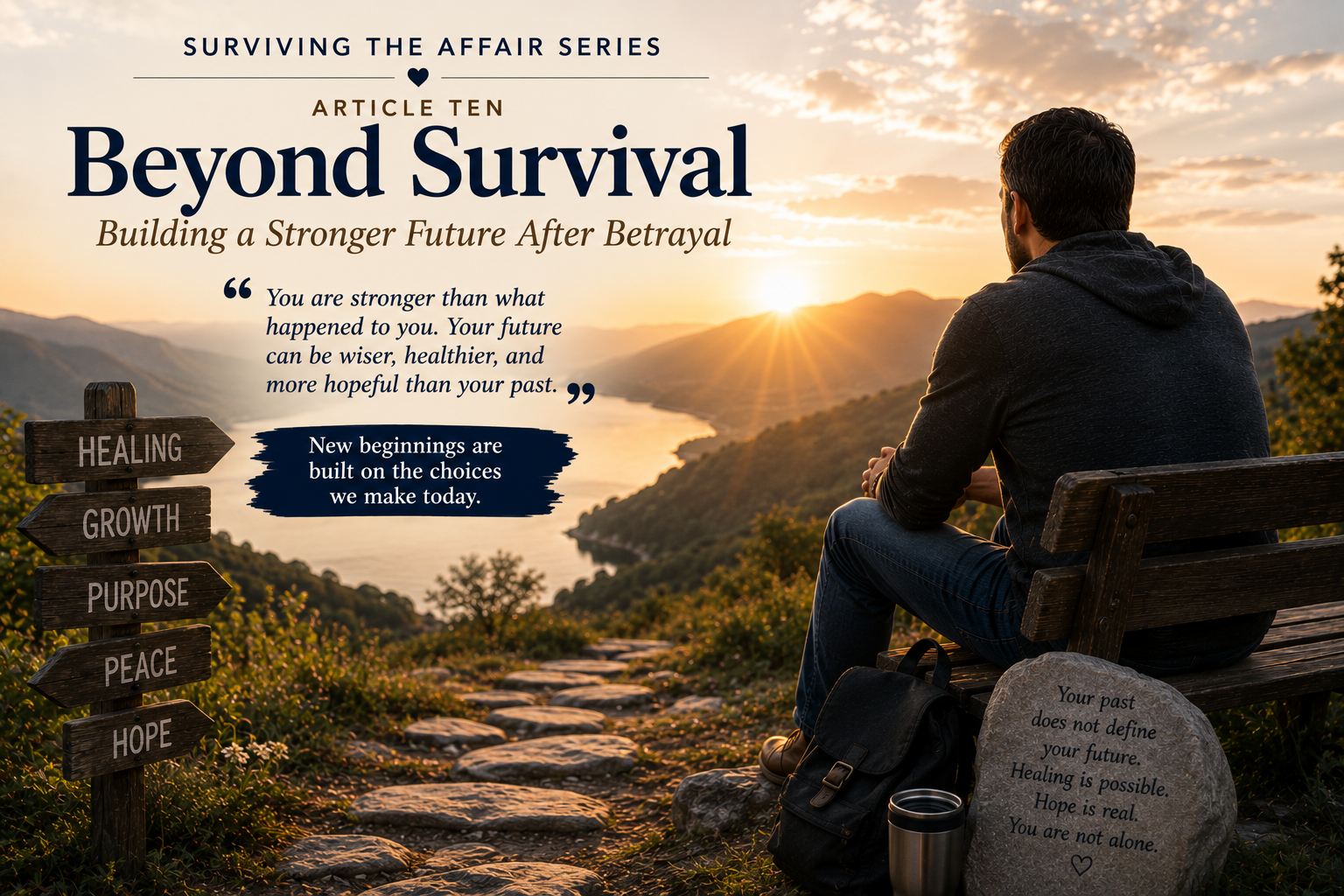
Surviving the Affair: Beyond Survival
Part Ten: Building a Stronger Future After Betrayal
At some point, nearly every person recovering from an affair asks the same question:
“Will I ever feel normal again?”
It is a deeply human question. After months—or sometimes years—of emotional turmoil, counseling appointments, difficult conversations, sleepless nights, and painful decisions, people naturally long for the day when life no longer revolves around the affair. They want peace. They want joy. They want to stop measuring every conversation against the past. They want to wake up without immediately remembering what happened.
The encouraging truth is this:
For many people, that day does come. Not because the affair is forgotten. Not because the pain never existed. But because healing gradually becomes stronger than the wound. Recovery is not simply about surviving betrayal. It is about becoming someone healthier, wiser, and emotionally stronger than you were before the crisis began. This final chapter is not about ending a painful story. It is about beginning a new one.
Healing Changes You
Many people begin counseling hoping to become the person they were before the affair. Ironically, the healthiest outcome is often something different. Healthy recovery does not recreate the past. It creates growth. People frequently discover strengths they never knew they possessed. They become better communicators. They establish healthier boundaries. They learn emotional regulation. They become more intentional in relationships. They deepen their spiritual lives.
While no one would choose the pain of betrayal, many eventually recognize that the healing process transformed them into someone more emotionally mature than they had ever been before. This is what psychologists often describe as post-traumatic growth—positive psychological change that emerges from successfully navigating profound adversity. Growth does not justify suffering. It demonstrates that suffering does not have the final word.
If You Rebuild the Marriage
Some marriages survive infidelity. A smaller number become healthier than they were before. Not because the affair improved the relationship. Rather, because the crisis forced both spouses to confront unhealthy patterns that had existed long before the affair occurred. Healthy reconciled marriages often develop:
- Honest communication.
- Emotional transparency.
- Greater empathy.
- Consistent accountability.
- Shared spiritual growth.
- Intentional quality time.
- Renewed commitment to protecting the relationship.
Trust returns slowly. Sometimes over several years. Each truthful conversation becomes another brick in rebuilding the foundation. Eventually, trust becomes less about forgetting the past and more about confidence in today’s choices.
If the Marriage Ends
For others, healing continues outside the marriage. Divorce does not automatically mean failure. Sometimes it reflects the difficult reality that one or both partners were unwilling or unable to rebuild a healthy relationship. Life after divorce often begins with grief. Then comes adjustment. Eventually, many discover hope. New routines develop. Children adapt. Friendships deepen. Purpose returns. Life begins to feel possible again. Although the family structure has changed, healing remains available. Your future is not cancelled because your marriage ended.
Learning to Trust Again
One of the greatest fears after betrayal is trusting another person. Some decide they will never become vulnerable again. While understandable, emotional isolation often prolongs suffering. Healthy trust develops gradually. It begins with yourself. Can I recognize unhealthy patterns? Can I communicate honestly? Can I establish healthy boundaries? Can I respond to red flags instead of ignoring them? Confidence grows as these questions receive healthier answers. Eventually, trusting others becomes less frightening because you trust your own wisdom.
Your Identity Is More Than Your Pain
Perhaps the greatest danger after an affair is allowing the betrayal to become your identity. Some introduce themselves internally as:
- “I am the one who was cheated on.”
- “I am the one who destroyed my marriage.”
- “I am the affair partner.”
Those descriptions may explain part of your story. They should never define your entire life. You are more than your worst decision. You are more than someone else’s worst decision. Healing allows identity to shift from victimhood toward purpose. From shame toward dignity. From regret toward wisdom. From survival toward flourishing.
Choosing Healthy Relationships Going Forward
Whether you remain married, remarry someday, or remain single, healthy relationships share common characteristics. They include:
- Mutual respect.
- Honest communication.
- Emotional safety.
- Shared responsibility.
- Healthy conflict resolution.
- Appropriate boundaries.
- Genuine friendship.
- Spiritual and emotional intimacy.
Healthy love is not built upon perfection. It is built upon consistency.
Your Story Can Help Someone Else
Many people initially want to hide every part of their experience. Over time, some discover that their greatest pain becomes one of their greatest opportunities to serve. Their story encourages another struggling couple. Their wisdom comforts someone newly betrayed. Their experience offers hope to someone who believes healing is impossible. Scars often become testimonies. Not because suffering was good. But because healing became visible.
Tools for Living Beyond Betrayal
As you continue moving forward, these practices support lasting emotional health:
- Continue investing in personal growth long after the crisis has passed.
- Prioritize honest communication in every important relationship.
- Maintain healthy emotional and physical boundaries.
- Practice forgiveness without abandoning wisdom.
- Develop consistent spiritual disciplines through prayer and Scripture.
- Stay connected to supportive family, friends, and community.
- Celebrate progress rather than expecting perfection.
- Seek counseling whenever new challenges arise.
- Remember that healing is ongoing, not a destination.
- Live intentionally rather than reactively.
A Christian Perspective
Scripture repeatedly reminds us that God specializes in restoration. Joel 2:25 contains one of the Bible’s most hopeful promises:
“I will restore to you the years that the locusts have eaten…” (ESV)
Restoration does not always mean restoring the same marriage. Sometimes it means restoring the same person. Sometimes it means restoring hope. Sometimes it means restoring purpose. Sometimes it means restoring faith. God’s greatest work often begins after our greatest heartbreak. No matter how your story concludes, His invitation remains the same:
Walk forward with Him.
A Therapist’s Reflection
If I could leave every reader with one final thought, it would be this:
Do not measure your life by the day the affair happened.
Measure it by the person you are becoming because you refused to stay there. Healing is rarely dramatic. It is usually quiet. It is choosing honesty one conversation at a time. Forgiveness one day at a time. Healthy boundaries one decision at a time. Faith one prayer at a time. Eventually, those small choices become a transformed life. The affair may always be one chapter of your story. It does not have to be the title. Your future is still unwritten. Your relationships can still be healthy. Your heart can still know peace. Your family can still experience joy. And your life can still reflect hope. You have survived. Now it is time to live.
About the Author

John S. Collier, MSW, LCSW-S is a licensed clinical social worker, psychotherapist, author, educator, and speaker with decades of experience helping individuals, couples, and families navigate life’s most difficult emotional challenges. Throughout his career, he has worked extensively with people struggling with relationship conflict, betrayal, anxiety, depression, trauma, grief, addiction, and life transitions. His counseling approach combines evidence-based psychological practices with practical wisdom, compassion, and a deep respect for each person’s unique journey.
John has devoted much of his professional life to understanding the complexities of human relationships. He has counseled couples working to rebuild trust after infidelity, individuals recovering from betrayal, and families seeking healing after painful life events. His clinical experience has reinforced one enduring truth: while relationships can be profoundly wounded, people possess an extraordinary capacity for growth, resilience, forgiveness, and transformation when they are equipped with the right tools and support.
As an author, John seeks to bridge the gap between professional mental health knowledge and everyday life. His writing translates complex psychological concepts into practical guidance that readers can understand and apply immediately. Whether addressing marriage, parenting, emotional wellness, trauma recovery, or spiritual growth, his goal is to provide resources that are both clinically sound and personally encouraging.
Surviving the Affair reflects John’s commitment to approaching infidelity with both honesty and compassion. Rather than reducing people to labels or stereotypes, he explores the emotional realities experienced by everyone affected—the betrayed spouse, the unfaithful partner, the affair partner, and the families whose lives are forever changed. Drawing upon years of therapeutic experience, he emphasizes accountability without condemnation, healing without minimizing pain, and hope without offering unrealistic promises.
John believes that healing begins when people are willing to face the truth with courage. While not every relationship can or should be restored, every individual has the capacity to grow beyond betrayal, rediscover integrity, and build a healthier future. His passion is helping readers move from surviving life’s greatest wounds to living with renewed purpose, emotional strength, and hope.
Through his books, speaking engagements, and counseling work, John continues to encourage others to pursue emotional health, healthy relationships, personal responsibility, and lasting transformation—one step at a time.ountability, and restoration. Through his clinical work and writing, he equips readers with practical tools to build emotionally healthy relationships, strengthen resilience, and discover hope after life’s most difficult experiences.
References
American Psychological Association. (2023). Clinical Practice Guideline for the Treatment of Posttraumatic Stress Disorder.
Calhoun, L. G., & Tedeschi, R. G. (2014). Handbook of Posttraumatic Growth: Research and Practice. Routledge.
Gottman, J. M., & Gottman, J. S. (2015). 10 Principles for Doing Effective Couples Therapy. W. W. Norton & Company.
Snyder, D. K., Baucom, D. H., & Gordon, K. C. (2007). Getting Past the Affair. Guilford Press.
Spring, J. A. (2012). After the Affair (2nd ed.). Harper.
Tedeschi, R. G., & Calhoun, L. G. (2004). “Posttraumatic Growth: Conceptual Foundations and Empirical Evidence.” Psychological Inquiry, 15(1), 1–18.
The Holy Bible, English Standard Version. Crossway.
Articles in this Series:
This series has been written for every person whose life has been altered by an affair. Each article focuses on one unique perspective because healing looks different depending upon where someone stands.
- Part One: The Wounds No One Sees
An overview of betrayal, trauma, grief, and the emotional complexity of affairs. - Part Two: When Forgiveness Feels Impossible
Understanding intrusive memories, resentment, trauma, and why forgiveness cannot be forced. - Part Three: Choosing Hope
Learning how trust is rebuilt, boundaries are established, and reconciliation becomes possible. - Part Four: When You No Longer Want to Stay
Navigating honesty, responsibility, guilt, and ending a marriage with integrity rather than continued deception. - Part Five: The Long Road Home
Understanding genuine remorse, rebuilding trust, transparency, and becoming trustworthy again. - Part Six: Loving Somone You Cannot Keep
Exploring attachment, hope, grief, and accepting that loving someone does not always justify continuing the relationship. - Part Seven: Choosing Integrity Over Desire
Examining grief, guilt, loneliness, moral conflict, and healing after choosing integrity over desire. - Part Eight: The Ripple Affect
Understanding the wider ripple effects of infidelity and protecting those who never chose to be part of the story. - Article Nine: Forgiveness, Reconciliation, and Letting Go
Separating forgiveness from reconciliation and understanding what emotional freedom truly means. - Part Ten: Beyond Survival
Whether the marriage survives or ends, discovering how people rebuild identity, hope, purpose, and healthy relationships again.