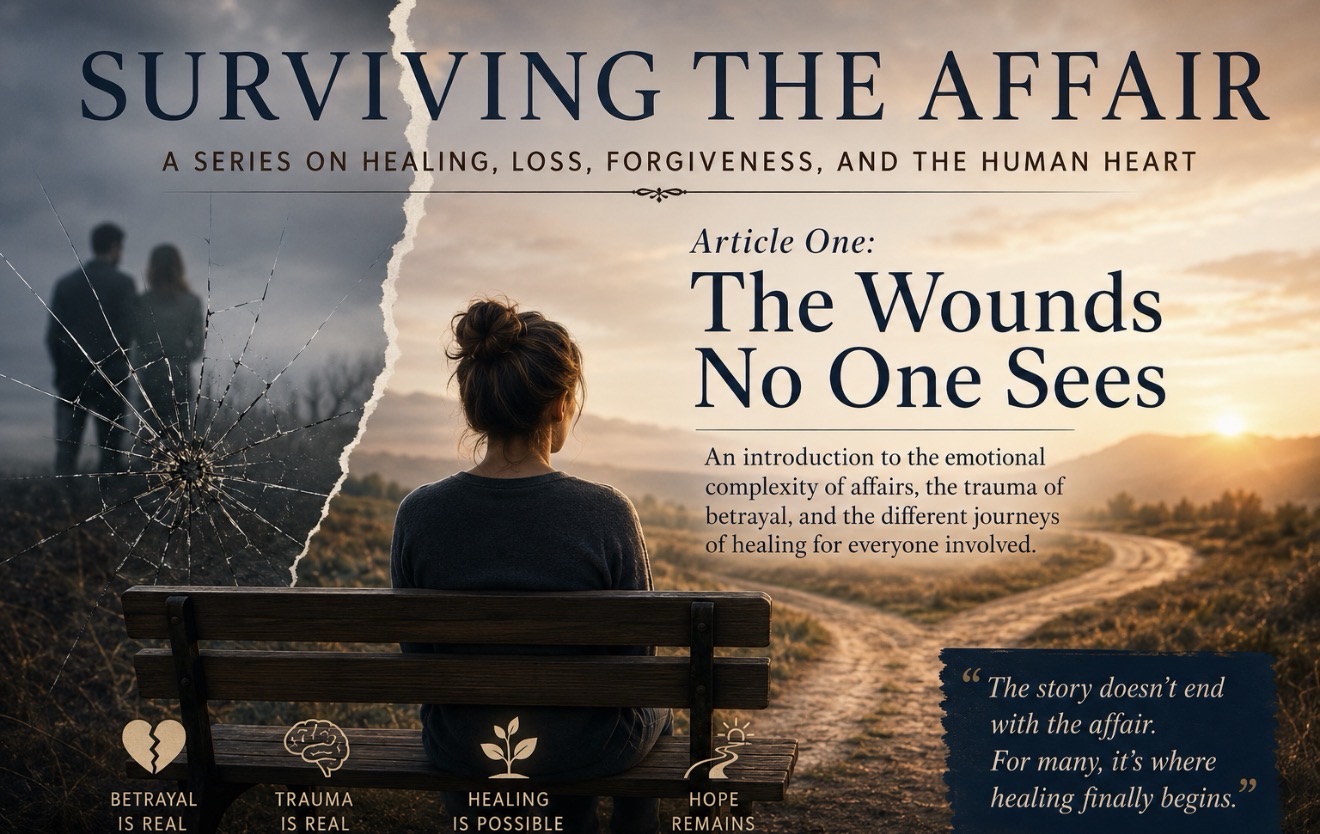
Surviving an Affair: The Wounds No One Sees
Part One: The Wounds No One Sees
An Introduction to a Series on Healing, Loss, Forgiveness, and the Human Heart
Few experiences in life shake a person as deeply as an affair.
People often describe it as feeling like a death without a funeral. A marriage may still exist on paper, yet the relationship that once felt safe has suddenly become unfamiliar. The person you trusted may now feel like a stranger. Memories that once brought comfort become sources of suspicion. Even time itself seems divided into two eras: before the affair and after the affair.
For the person who had the affair, life is often just as complicated, though in very different ways. They may carry overwhelming guilt, shame, confusion, or regret. Others feel trapped between two lives, unable to fully let go of either. Some desperately want to repair what they have broken. Others know they no longer want the marriage but struggle with the devastation their decisions have created.
Then there is another person who is frequently forgotten in discussions about affairs—the affair partner. Society often paints this individual as the villain, yet reality is usually more complicated. Some knowingly pursued a married person. Others were deceived about the marriage. Some eventually develop genuine love. Some become trapped in secrecy. Some wrestle with profound guilt and end the relationship despite intense emotional pain. Others desperately hope the relationship will survive and cannot understand why they are expected simply to disappear.
Affairs create victims in every direction. This series is not written to excuse betrayal. Neither is it written to condemn people with simplistic judgments. It is written because healing only begins when we understand what people are actually experiencing rather than what we assume they should be experiencing.
Affairs Are Rarely About One Moment
Popular culture often portrays affairs as impulsive mistakes or irresistible romances. In reality, affairs usually develop over time through hundreds of seemingly insignificant choices.
The emotional distance between spouses often begins long before anyone notices it.
Conversations become shorter. Affection becomes routine. Stress replaces curiosity. Resentment quietly accumulates. Loneliness grows unnoticed. This does not excuse infidelity. Many marriages experience loneliness without betrayal.
Rather, it reminds us that affairs typically occur within complex emotional systems involving unmet needs, poor boundaries, personal vulnerabilities, opportunity, distorted thinking, and countless decisions that gradually move someone farther from integrity.
Likewise, the devastation that follows cannot be understood by simply asking, “Why did you cheat?”
The more important questions often become:
- Why did this happen?
- What was everyone searching for?
- Can trust ever return?
- What does forgiveness actually require?
- Is reconciliation always the healthiest choice?
- Can someone genuinely change?
- How do people rebuild their identity after betrayal?
These are difficult questions. This series does not promise easy answers. Instead, it hopes to offer honest ones.
Every Person Experiences a Different Grief
One affair may involve three people. Yet it often creates three entirely different grief journeys. The betrayed spouse grieves trust. The unfaithful spouse often grieves identity.
The affair partner frequently grieves a relationship that was never allowed to exist openly. Each person’s suffering is real. Each person’s responsibility is different. Understanding suffering is never the same as removing accountability. Healthy healing requires both compassion and responsibility. One without the other produces either cruelty or denial.
Trauma Changes the Brain
Researchers increasingly recognize that discovering an affair often produces symptoms remarkably similar to post-traumatic stress. Many betrayed spouses experience:
- intrusive thoughts
- obsessive questioning
- nightmares
- emotional numbness
- panic attacks
- hypervigilance
- difficulty concentrating
- sudden emotional flooding
Many describe replaying images they never witnessed but cannot stop imagining. Simple reminders—a restaurant, a song, a hotel, a text notification—can instantly reactivate overwhelming emotional pain. Friends often say, “You need to move on.” But trauma does not respond to commands. Healing requires safety before trust. Understanding before forgiveness. Stability before decisions.
Shame Becomes Everyone’s Prison
Affairs rarely leave only one person ashamed.
| The betrayed spouse often wonders: | The unfaithful spouse often thinks: |
| “What was wrong with me?” | “What kind of person have I become?” |
| “Why wasn’t I enough?” | “Will anyone ever trust me again?” |
| “How did I not see this?” | “Have I destroyed everything good about my life?” |
Even the affair partner may ask:
“Am I simply the person who destroys marriages?”
“Will I always be someone’s secret?”
Shame tells each person a different lie. Healing begins by separating identity from behavior. People are responsible for what they have done. They are not forever defined by the worst decision they have ever made.
There Is No Universal Right Ending
One of the greatest mistakes people make is assuming every affair should end exactly the same way. Some marriages become stronger after extraordinary work. Others should end because betrayal exposed patterns of abuse, manipulation, addiction, or chronic dishonesty.
Some couples reconcile. Some separate peacefully. Some divorce painfully. Some rebuild friendship. Others never speak again. There is no formula. The healthiest outcome is not measured by whether the marriage survives. It is measured by whether the people involved become emotionally healthier, more honest, more accountable, and more capable of living with integrity.
Who This Series Is For
This series has been written for every person whose life has been altered by an affair. Each article focuses on one unique perspective because healing looks different depending upon where someone stands.
Part One: The Wounds No One Sees
An overview of betrayal, trauma, grief, and the emotional complexity of affairs.
Part Two: When Forgiveness Feels Impossible
Understanding intrusive memories, resentment, trauma, and why forgiveness cannot be forced.
Part Three: Choosing Hope
Learning how trust is rebuilt, boundaries are established, and reconciliation becomes possible.
Part Four: When You No Longer Want to Stay
Navigating honesty, responsibility, guilt, and ending a marriage with integrity rather than continued deception.
Part Five: The Long Road Home
Understanding genuine remorse, rebuilding trust, transparency, and becoming trustworthy again.
Part Six: Loving Somone You Cannot Keep
Exploring attachment, hope, grief, and accepting that loving someone does not always justify continuing the relationship.
Part Seven: Choosing Integrity Over Desire
Examining grief, guilt, loneliness, moral conflict, and healing after choosing integrity over desire.
Part Eight: The Ripple Affect
Understanding the wider ripple effects of infidelity and protecting those who never chose to be part of the story.
Article Nine: Forgiveness, Reconciliation, and Letting Go
Separating forgiveness from reconciliation and understanding what emotional freedom truly means.
Part Ten: Beyond Survival
Whether the marriage survives or ends, discovering how people rebuild identity, hope, purpose, and healthy relationships again.
A Therapist’s Reflection
Over the years, I have sat with people from every side of an affair. I have watched betrayed spouses collapse under the weight of unimaginable pain. I have listened to men and women who committed affairs weep because they could not recognize the person they had become.
I have counseled affair partners whose grief was complicated by secrecy, shame, and the painful realization that love built upon hidden foundations often cannot survive. One truth has become increasingly clear. Very few people wake up intending to destroy lives. Yet without healthy boundaries, emotional honesty, accountability, and courage, ordinary people can slowly drift into extraordinary destruction.
Fortunately, another truth is equally real. People can change. Trust can sometimes be rebuilt. Character can be strengthened. Even when relationships cannot be restored, lives can. Healing does not erase the past. It transforms what the past is allowed to become. That is the journey this series hopes to begin. Because surviving an affair is not merely about surviving betrayal.
It is ultimately about rediscovering truth, integrity, courage, and hope after everything familiar has been shaken. The story does not end with the affair. For many people, it is where genuine healing finally begins. Before the author biography, it is common to include a professional headshot with the text wrapped to the left if the layout allows.
About the Author

John S. Collier, MSW, LCSW-S is a licensed clinical social worker, psychotherapist, author, educator, and speaker with decades of experience helping individuals, couples, and families navigate life’s most difficult emotional challenges. Throughout his career, he has worked extensively with people struggling with relationship conflict, betrayal, anxiety, depression, trauma, grief, addiction, and life transitions. His counseling approach combines evidence-based psychological practices with practical wisdom, compassion, and a deep respect for each person’s unique journey.
John has devoted much of his professional life to understanding the complexities of human relationships. He has counseled couples working to rebuild trust after infidelity, individuals recovering from betrayal, and families seeking healing after painful life events. His clinical experience has reinforced one enduring truth: while relationships can be profoundly wounded, people possess an extraordinary capacity for growth, resilience, forgiveness, and transformation when they are equipped with the right tools and support.
As an author, John seeks to bridge the gap between professional mental health knowledge and everyday life. His writing translates complex psychological concepts into practical guidance that readers can understand and apply immediately. Whether addressing marriage, parenting, emotional wellness, trauma recovery, or spiritual growth, his goal is to provide resources that are both clinically sound and personally encouraging.
Surviving the Affair reflects John’s commitment to approaching infidelity with both honesty and compassion. Rather than reducing people to labels or stereotypes, he explores the emotional realities experienced by everyone affected—the betrayed spouse, the unfaithful partner, the affair partner, and the families whose lives are forever changed. Drawing upon years of therapeutic experience, he emphasizes accountability without condemnation, healing without minimizing pain, and hope without offering unrealistic promises.
John believes that healing begins when people are willing to face the truth with courage. While not every relationship can or should be restored, every individual has the capacity to grow beyond betrayal, rediscover integrity, and build a healthier future. His passion is helping readers move from surviving life’s greatest wounds to living with renewed purpose, emotional strength, and hope.
Through his books, speaking engagements, and counseling work, John continues to encourage others to pursue emotional health, healthy relationships, personal responsibility, and lasting transformation—one step at a time.
References
American Association for Marriage and Family Therapy. (2015). Infidelity. https://www.aamft.org
American Psychiatric Association. (2022). Diagnostic and statistical manual of mental disorders (5th ed., text rev.; DSM-5-TR). American Psychiatric Association Publishing.
Atkins, D. C., Baucom, D. H., & Jacobson, N. S. (2001). Understanding infidelity: Correlates in a national random sample. Journal of Family Psychology, 15(4), 735–749. https://doi.org/10.1037/0893-3200.15.4.735
Baucom, D. H., Snyder, D. K., & Gordon, K. C. (2009). Helping couples get past the affair: A clinician’s guide. Guilford Press.
Brown, B. (2012). Daring greatly: How the courage to be vulnerable transforms the way we live, love, parent, and lead. Gotham Books.
Brown, E. (2001). Affairs: A guide to working through the repercussions of infidelity. Jossey-Bass.
Cloud, H., & Townsend, J. (2017). Boundaries: When to say yes, how to say no to take control of your life (Updated and expanded ed.). Zondervan.
Exline, J. J., Worthington, E. L., Hill, P., & McCullough, M. E. (2003). Forgiveness and justice: A research agenda for social and personality psychology. Personality and Social Psychology Review, 7(4), 337–348.
Fincham, F. D., & May, R. W. (2017). Infidelity in romantic relationships. Current Opinion in Psychology, 13, 70–74. https://doi.org/10.1016/j.copsyc.2016.03.008
Glass, S. P. (2003). Not “Just Friends”: Rebuilding trust and recovering your sanity after infidelity. Free Press.
Glass, S. P., & Staeheli, J. (2004). Not “Just Friends”: Protect your relationship from infidelity and heal the trauma of betrayal. Free Press.
Gordon, K. C., Baucom, D. H., & Snyder, D. K. (2004). An integrative intervention for promoting recovery from extramarital affairs. Journal of Marital and Family Therapy, 30(2), 213–231.
Gottman, J. M., & Gottman, J. S. (2015). 10 principles for doing effective couples therapy. W. W. Norton & Company.
Gottman, J. M., & Silver, N. (2015). The seven principles for making marriage work (Revised ed.). Harmony Books.
Janis, I. L., & Mann, L. (1977). Decision making: A psychological analysis of conflict, choice, and commitment. Free Press.
Johnson, S. M. (2019). Attachment theory in practice: Emotionally focused therapy (EFT) with individuals, couples, and families. Guilford Press.
Mikulincer, M., & Shaver, P. R. (2016). Attachment in adulthood: Structure, dynamics, and change (2nd ed.). Guilford Press.
Perel, E. (2017). The state of affairs: Rethinking infidelity. Harper.
Shapiro, F. (2018). Eye movement desensitization and reprocessing (EMDR) therapy: Basic principles, protocols, and procedures (3rd ed.). Guilford Press.
Snyder, D. K., Baucom, D. H., & Gordon, K. C. (2007). Getting past the affair: A program to help you cope, heal, and move on—Together or apart. Guilford Press.
Spring, J. A. (2012). After the affair: Healing the pain and rebuilding trust when a partner has been unfaithful (2nd ed.). Harper.
Worthington, E. L. (2006). Forgiveness and reconciliation: Theory and application. Routledge.
Worthington, E. L. (2013). Moving forward: Six steps to forgiving yourself and breaking free from the past. WaterBrook.
The Holy Bible, New International Version. (2011). Zondervan.
The Holy Bible, English Standard Version. (2016). Crossway.
Articles in this Series:
This series has been written for every person whose life has been altered by an affair. Each article focuses on one unique perspective because healing looks different depending upon where someone stands.
- Part One: The Wounds No One Sees
An overview of betrayal, trauma, grief, and the emotional complexity of affairs. - Part Two: When Forgiveness Feels Impossible
Understanding intrusive memories, resentment, trauma, and why forgiveness cannot be forced. - Part Three: Choosing Hope
Learning how trust is rebuilt, boundaries are established, and reconciliation becomes possible. - Part Four: When You No Longer Want to Stay
Navigating honesty, responsibility, guilt, and ending a marriage with integrity rather than continued deception. - Part Five: The Long Road Home
Understanding genuine remorse, rebuilding trust, transparency, and becoming trustworthy again. - Part Six: Loving Somone You Cannot Keep
Exploring attachment, hope, grief, and accepting that loving someone does not always justify continuing the relationship. - Part Seven: Choosing Integrity Over Desire
Examining grief, guilt, loneliness, moral conflict, and healing after choosing integrity over desire. - Part Eight: The Ripple Affect
Understanding the wider ripple effects of infidelity and protecting those who never chose to be part of the story. - Article Nine: Forgiveness, Reconciliation, and Letting Go
Separating forgiveness from reconciliation and understanding what emotional freedom truly means. - Part Ten: Beyond Survival
Whether the marriage survives or ends, discovering how people rebuild identity, hope, purpose, and healthy relationships again.