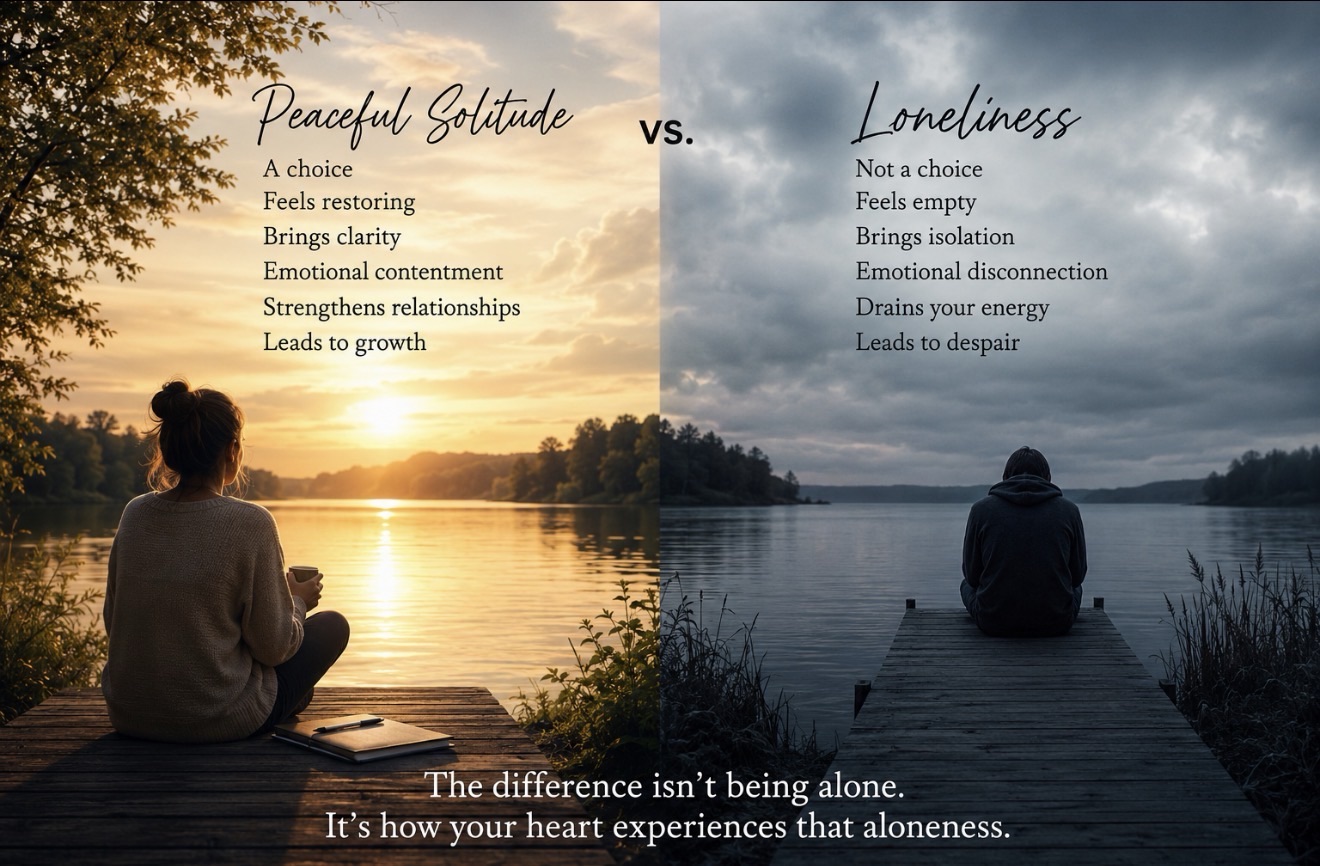
Peace or Loneliness? Learning the Difference Between a Calm Life and Feeling Alone
Many people think that a busy life is a happy life. We often hear that we should always be doing something, talking to people, or staying connected online. Because of this, when life becomes quiet, we may wonder if something is wrong. We might ask ourselves, “Am I feeling peaceful, or am I just lonely?”
Many people confuse peace with loneliness because both can happen when we are alone. Even though they may look the same on the outside, they feel very different on the inside. Learning the difference can help us enjoy quiet times, build healthier relationships, and take better care of our mental health.
What Is Peaceful Solitude?
Peaceful solitude means choosing to spend time alone and feeling happy and calm while doing it. Instead of feeling sad, people often feel rested, creative, and refreshed.
Psychologist Anthony Storr (1988) believed that spending time alone can help people think clearly, solve problems, and learn more about themselves. Many artists, writers, scientists, and spiritual leaders have spent quiet time alone to help them grow and create new ideas.
People who enjoy peaceful solitude often:
- Feel safe while they are alone.
- Enjoy hobbies and interests.
- Take time to think and reflect.
- Feel calm inside.
- Keep healthy friendships.
- Feel free instead of trapped.
The biggest difference is that they choose to be alone.
What Is Loneliness?
Loneliness is very different from peaceful solitude.
Researcher John Cacioppo said that loneliness happens when people feel they do not have enough close or meaningful relationships (Cacioppo & Patrick, 2008).
A person can feel lonely even if they are surrounded by people.
Someone can:
- Be married and still feel lonely.
- Have many followers on social media and still feel alone.
- Go to church every week and still feel disconnected.
- Work around many people and still feel like no one understands them.
Loneliness is not about being by yourself.
It is about feeling disconnected from others.
How Peace Feels
When people experience peaceful solitude, they often feel:
- Calm
- Thankful
- Free
- Relaxed
- Happy
- Hopeful
- Confident
- Clear-minded
They may say things like:
“I enjoy having time to myself.”
“I finally have time to think.”
“Life feels simple.”
“I don’t feel like I’m missing anything.”
How Loneliness Feels
Loneliness often brings feelings like:
- Sadness
- Emptiness
- Restlessness
- Feeling forgotten
- Wanting someone to talk to
- Worry
- Depression
- Hopelessness
People may think:
“Nobody understands me.”
“I wish someone would call me.”
“No one notices me.”
“I don’t matter.”
These feelings are very different from the peace that comes from healthy solitude.
What Happens in the Brain?
Research shows that quiet time can actually help your brain. WWhen people spend peaceful time alone, their brains have time to organize memories, solve problems, think creatively, and plan for the future (Raichle, 2015). But long-lasting loneliness affects the body in a different way.
Studies show that loneliness can increase:
- Stress hormones
- High blood pressure
- Trouble sleeping
- Anxiety
- Depression
- Heart disease
- The risk of dying earlier (Holt-Lunstad et al., 2015)
Our bodies react differently depending on whether we feel peaceful or rejected.
The Power of Choice
One of the biggest differences between peace and loneliness is choice. Peace is something we choose. Loneliness often feels like something that happens to us. Imagine two people sitting alone on a Saturday afternoon. One person is reading a favorite book and enjoying the quiet. The other person wishes someone would visit or call. Both people are alone. But only one feels lonely.
Self-Worth Matters
People who feel good about themselves are usually more comfortable spending time alone. Researchers Ryan and Deci (2020) explain that people need three important things:
- To feel capable.
- To have some independence.
- To have healthy relationships.
Peaceful solitude helps people become more independent while still staying connected to others. Loneliness happens when those important relationships are missing.
Why We Confuse Peace with Loneliness
Busy Culture
Today’s world tells us that being busy means being successful. If someone spends a Friday night at home, others may think they have no friends. But many healthy people enjoy quiet evenings to relax, read, pray, or spend time with family.
Social Media
Social media usually shows people’s best moments. We see vacations, parties, birthdays, and celebrations. This can make us believe everyone else is happier than we are. Research shows that spending too much time comparing ourselves to others on social media can actually increase loneliness (Primack et al., 2017).
Fear of Missing Out
Many people experience something called Fear of Missing Out (FOMO). They worry that everyone else is having more fun. Peace says,
“I’m happy where I am.”
FOMO says,
“I wonder if everyone else is happier than me.”
Signs You Are Feeling Peace
You may be experiencing peace if:
- You enjoy quiet time.
- You like your hobbies.
- You have healthy friendships.
- You feel safe and calm.
- You are thankful.
- Your alone time helps you feel rested.
- You can call friends when you want to, but you don’t depend on them to feel happy.
Signs You May Be Lonely
You may be lonely if:
- Silence feels painful.
- You always need distractions.
- You feel forgotten.
- You feel empty inside.
- You stop spending time with people.
- You feel hopeless.
- You feel alone even when others are around.
- Your anxiety gets worse when you are by yourself.
Peace Helps You Grow
Research shows that learning to enjoy quiet time can make people stronger emotionally. Healthy solitude helps people:
- Control their emotions.
- Become more creative.
- Grow spiritually.
- Learn about themselves.
- Make better decisions.
- Become more independent.
- Stay calmer during stressful times.
This is one reason why people have practiced prayer, meditation, journaling, and quiet reflection for thousands of years.
When Peace Turns into Isolation
Even healthy solitude can become unhealthy if it lasts too long. Warning signs include:
- Avoiding everyone.
- Turning down every invitation.
- Feeling more depressed.
- Losing motivation.
- Not taking care of yourself.
- Feeling emotionally numb.
- Feeling sad for many weeks.
If these problems continue, it is important to talk with a mental health professional.
A Christian View
The Bible shows that spending quiet time alone can help people grow closer to God. Jesus often went away by Himself to pray (Luke 5:16). Moses met with God on Mount Sinai (Exodus 24). Elijah heard God’s gentle voice while he was alone (1 Kings 19:11–13). Paul also spent time alone after becoming a Christian before beginning his ministry (Galatians 1:17–18).
These times alone helped them listen to God and prepare for what He wanted them to do. But they did not stay alone forever. They returned to help and serve other people. ĎGod created us to spend time with Him and to have healthy relationships with others.
Questions to Ask Yourself
If you are not sure whether you are feeling peace or loneliness, ask yourself:
- Do I enjoy this quiet time?
- Am I choosing to be alone?
- Do I feel happy inside?
- Can I reach out to friends when I want to?
- Does my quiet time give me energy?
- Do I want healthy friendships, or am I hiding from people?
- Is this season helping me grow?
Being honest with yourself can help you understand what you are really feeling.
Conclusion
The difference between peace and loneliness is not about how many people are around you. It is about how you feel inside. Peace means you are comfortable with yourself. You enjoy quiet moments, grow in your faith, and stay connected to people who care about you.
Loneliness is the painful feeling that you need connection but do not have it.
Learning the difference can help you enjoy healthy quiet time while also building strong and meaningful relationships. A peaceful life is not an empty life. Sometimes, the quiet moments are where we find healing, hope, purpose, and a deeper relationship with God.
About the Author
John S. Collier, MSW, LCSW, is a Licensed Clinical Social Worker, behavioral health executive, author, and speaker with more than 25 years of experience helping individuals, couples, and families navigate life’s most difficult emotional challenges. As the founder and Clinical Director of Southeast Kentucky Behavioral Health, LLC, he has dedicated his career to helping people build healthier relationships, strengthen emotional resilience, and find lasting hope through evidence-based therapeutic practices integrated with timeless biblical principles. His clinical work focuses on trauma, attachment, anxiety, depression, emotional regulation, and relationship dynamics, allowing him to translate complex psychological concepts into practical tools that readers can apply in everyday life. Through his books, articles, and presentations, John writes with compassion, authenticity, and a deep belief that healing is possible when truth, grace, and intentional growth come together. His mission is to equip readers with both the scientific understanding and spiritual encouragement needed to cultivate lives marked by peace, purpose, and meaningful connection.
References
Cacioppo, J. T., & Patrick, W. (2008). Loneliness: Human nature and the need for social connection. W. W. Norton.
Hawkley, L. C., & Cacioppo, J. T. (2010). Loneliness matters: A theoretical and empirical review of consequences and mechanisms. Annals of Behavioral Medicine, 40(2), 218–227. https://doi.org/10.1007/s12160-010-9210-8
Holt-Lunstad, J., Smith, T. B., Baker, M., Harris, T., & Stephenson, D. (2015). Loneliness and social isolation as risk factors for mortality: A meta-analytic review. Perspectives on Psychological Science, 10(2), 227–237. https://doi.org/10.1177/1745691614568352
Primack, B. A., Shensa, A., Sidani, J. E., et al. (2017). Social media use and perceived social isolation among young adults in the United States. American Journal of Preventive Medicine, 53(1), 1–8. https://doi.org/10.1016/j.amepre.2017.01.010
Raichle, M. E. (2015). The brain’s default mode network. Annual Review of Neuroscience, 38, 433–447. https://doi.org/10.1146/annurev-neuro-071013-014030
Ryan, R. M., & Deci, E. L. (2020). Intrinsic and extrinsic motivation from a self-determination theory perspective: Definitions, theory, practices, and future directions. Contemporary Educational Psychology, 61, 101860. https://doi.org/10.1016/j.cedpsych.2020.101860
Storr, A. (1988). Solitude: A return to the self. Free Press.