Welcome to SOUTHEAST KENTUCKY BEHAVIORAL HEALTH
Surviving the Affair: Choosing Integrity Over Desire

Part Seven: The Affair Partner Who Ends the Relationship but Struggles with the Loss

Sometimes the strongest act of love is walking away.

That statement may seem impossible to believe when your heart is breaking, yet it has proven true for countless people who have found themselves involved in an affair. There comes a moment when some affair partners reach a painful realization. They recognize that regardless of how deeply they care for the other person, the relationship has become inconsistent with the kind of life they want to live.

They may have prayed. They may have wrestled with guilt. They may have tried repeatedly to convince themselves that love justified continuing the relationship. Eventually, however, another voice became louder. The voice of conscience. Walking away rarely feels victorious.

It feels like grief. It feels like losing someone you genuinely loved while simultaneously believing that ending the relationship was the right thing to do. That emotional conflict creates one of the most complicated forms of grief a person can experience. You are mourning someone who is still alive. You are grieving a relationship that ended because you chose integrity over desire. Those two realities can coexist.


When Your Values Finally Catch Up

Many people involved in affairs describe living with constant internal conflict. They enjoyed the conversations. They cherished the emotional connection. They imagined a future together. Yet underneath every happy moment lived another emotion. Uneasiness. They knew they were participating in something that conflicted with their deepest values.

Psychologists often refer to this experience as cognitive dissonance—the emotional discomfort that develops when behavior and personal values no longer agree.

Over time, that discomfort becomes exhausting. Eventually something must change. Either values are abandoned. Or behavior changes. Healthy healing begins when our actions once again align with our convictions.


Why Doing the Right Thing Can Feel So Wrong

Many people assume that making the morally right decision should immediately produce peace. Real life is rarely that simple. Choosing integrity often hurts before it heals. You may wake each morning wondering how they are doing. You may instinctively reach for your phone before remembering there will be no message. Certain songs, places, holidays, and routines suddenly become painful reminders. Your heart may continue longing for someone your conscience knows you cannot pursue.

This does not mean your decision was wrong. It means you are grieving. Grief is not evidence that you chose incorrectly. It is evidence that something meaningful ended.


Missing Someone Does Not Mean You Should Return

One of the greatest temptations after ending an affair is confusing longing with direction. You miss them. You think about them. You dream about them. You wonder if they miss you. These emotions are normal.

They are not instructions. Emotions provide information. They should not always determine our decisions. Every healthy relationship requires more than intense feelings. It requires honesty, freedom, trust, and mutual integrity. When those qualities are absent, returning often recreates the very pain you worked so hard to escape.


Learning to Forgive Yourself

Many affair partners carry enormous guilt. Some believe they permanently damaged another family. Others feel ashamed for compromising their own standards. Still others struggle because they believe they should have ended the relationship much sooner. Healthy guilt can motivate growth. Unhealthy shame keeps people trapped in the past. Self-forgiveness is not pretending your choices had no consequences. It is accepting responsibility while believing that one chapter of your life does not have to define the entire story. Growth begins when accountability is joined with grace.


Rediscovering the Person You Were Becoming

Affairs often consume emotional energy. Life gradually begins revolving around secret conversations, uncertain plans, emotional highs, and heartbreaking disappointments. When the relationship ends, many people discover they no longer recognize themselves. Healing includes rediscovering interests, friendships, dreams, and personal goals that existed before the affair. Ask yourself:

  • Who do I want to become five years from now?
  • What kind of relationships reflect my deepest values?
  • What qualities do I want people to remember about my life?

Your future deserves more attention than your past.


Grief Can Become Growth

Loss changes people. The question is whether it changes them toward wisdom or toward bitterness. Every painful experience offers an invitation. Some people become harder. Others become healthier. Use this season to develop:

  • Emotional maturity.
  • Healthy relationship boundaries.
  • Spiritual depth.
  • Honest communication.
  • Self-respect.
  • Patience.
  • Integrity.

The relationship may have ended. Your personal growth does not have to.


Tools for Healing

If you have ended the affair but continue struggling emotionally, consider these practices:

  • Maintain complete no-contact with your former partner.
  • Work with a therapist experienced in relationship and attachment issues.
  • Journal both your grief and your personal growth.
  • Resist romanticizing the relationship by remembering both its joys and its costs.
  • Rebuild healthy friendships and community.
  • Develop meaningful daily routines.
  • Invest in your spiritual life through prayer, worship, and Scripture.
  • Practice self-compassion while remaining accountable for your choices.
  • Set clear standards for future relationships.
  • Allow yourself time to heal before pursuing another romantic relationship.

A Christian Perspective

One of the most beautiful themes throughout Scripture is restoration. God repeatedly meets people at the intersection of failure and repentance. Not to condemn them forever. But to invite them into something better. First John 1:9 reminds us:

“If we confess our sins, he is faithful and just and will forgive us our sins and purify us from all unrighteousness.”

Confession is not merely admitting wrongdoing. It is choosing a new direction. Sometimes the greatest act of faith is believing that God’s future is greater than your past. Walking away from an unhealthy relationship may feel like losing everything. In reality, it may become the first step toward becoming the person God created you to be.


A Therapist’s Reflection

One of the most moving conversations I have with former affair partners usually begins with tears. They quietly say,

“I knew ending it was the right thing…but I still miss them every day.”

I often respond with a simple observation. Doing the right thing does not always feel good immediately. Integrity frequently hurts before it heals. The pain you feel today is not necessarily punishment. Sometimes it is evidence that your conscience is becoming stronger than your impulses. Do not mistake temporary loneliness for permanent loss. You have not simply ended a relationship. You have begun building a life that no longer requires secrecy, divided loyalties, or compromise. One day you may look back on this season not as the time you lost someone…But as the moment you found yourself.

That is a different kind of love. One worth choosing.


About the Author

John S. Collier, MSW, LCSW-S is a licensed clinical social worker, psychotherapist, author, educator, and speaker with decades of experience helping individuals, couples, and families navigate life’s most difficult emotional challenges. Throughout his career, he has worked extensively with people struggling with relationship conflict, betrayal, anxiety, depression, trauma, grief, addiction, and life transitions. His counseling approach combines evidence-based psychological practices with practical wisdom, compassion, and a deep respect for each person’s unique journey.

John has devoted much of his professional life to understanding the complexities of human relationships. He has counseled couples working to rebuild trust after infidelity, individuals recovering from betrayal, and families seeking healing after painful life events. His clinical experience has reinforced one enduring truth: while relationships can be profoundly wounded, people possess an extraordinary capacity for growth, resilience, forgiveness, and transformation when they are equipped with the right tools and support.

As an author, John seeks to bridge the gap between professional mental health knowledge and everyday life. His writing translates complex psychological concepts into practical guidance that readers can understand and apply immediately. Whether addressing marriage, parenting, emotional wellness, trauma recovery, or spiritual growth, his goal is to provide resources that are both clinically sound and personally encouraging.

Surviving the Affair reflects John’s commitment to approaching infidelity with both honesty and compassion. Rather than reducing people to labels or stereotypes, he explores the emotional realities experienced by everyone affected—the betrayed spouse, the unfaithful partner, the affair partner, and the families whose lives are forever changed. Drawing upon years of therapeutic experience, he emphasizes accountability without condemnation, healing without minimizing pain, and hope without offering unrealistic promises.

John believes that healing begins when people are willing to face the truth with courage. While not every relationship can or should be restored, every individual has the capacity to grow beyond betrayal, rediscover integrity, and build a healthier future. His passion is helping readers move from surviving life’s greatest wounds to living with renewed purpose, emotional strength, and hope.

Through his books, speaking engagements, and counseling work, John continues to encourage others to pursue emotional health, healthy relationships, personal responsibility, and lasting transformation—one step at a time.onal pain toward lives marked by integrity, resilience, and hope. Through his writing and counseling, he encourages readers to embrace accountability while believing that lasting personal transformation is always possible.

References

American Association for Marriage and Family Therapy. (2015). Infidelity. https://www.aamft.org

Brown, B. (2012). Daring Greatly. Gotham Books.

Frankl, V. E. (2006). Man’s Search for Meaning. Beacon Press. (Original work published 1946)

Glass, S. P. (2003). Not “Just Friends”: Rebuilding Trust and Recovering Your Sanity After Infidelity. Free Press.

Johnson, S. M. (2019). Attachment Theory in Practice: Emotionally Focused Therapy (EFT) with Individuals, Couples, and Families. Guilford Press.

Levine, A., & Heller, R. (2010). Attached: The New Science of Adult Attachment and How It Can Help You Find—and Keep—Love. TarcherPerigee.

Perel, E. (2017). The State of Affairs: Rethinking Infidelity. Harper.

The Holy Bible, New International Version. (2011). Zondervan.


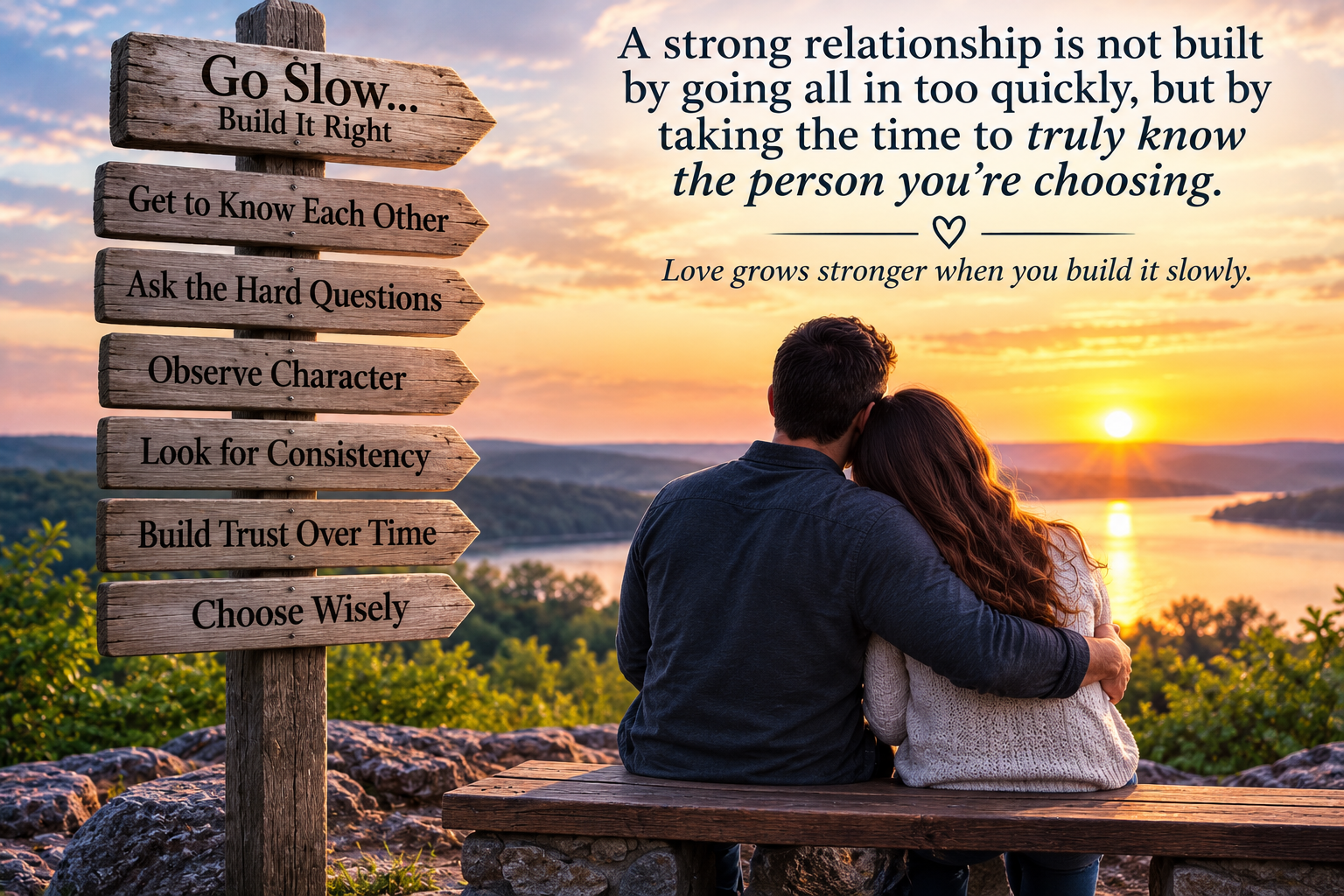
Going All In: The Hidden Risks of Rushing Into a Relationship

There is something undeniably romantic about the phrase “going all in.” Movies celebrate it. Love songs glorify it. Friends often admire people who seem fearless enough to dive headfirst into love. We are told that real love requires vulnerability, commitment, and complete investment.

While commitment is essential for a healthy relationship, there is an important distinction between healthy commitment and premature emotional investment. One is built on knowledge, trust, and experience. The other is often built on hope, attraction, and assumptions.

Many relationships don’t fail because two people were incompatible. They fail because they became emotionally committed long before they truly knew one another.


The Difference Between Attraction and Knowledge

Attraction happens quickly. Knowledge takes time. During the first weeks or months of dating, we naturally see the best version of another person. Psychologists sometimes refer to this as the honeymoon phase, where the brain is flooded with dopamine, oxytocin, and other neurochemicals that create excitement, optimism, and emotional attachment (Fisher, 2004). Unfortunately, these same chemicals can reduce our ability to evaluate a relationship objectively.

When people “go all in” too quickly, they often mistake:

  • Chemistry for compatibility
  • Passion for stability
  • Attention for commitment
  • Potential for reality

Those are not the same things.


We Fall in Love With Who We Think They Are

One of the greatest dangers of rushing a relationship is that we begin filling in the blanks ourselves. Instead of learning who someone truly is, we imagine who they could become. We overlook inconsistencies. We excuse red flags.

We create explanations for behaviors we don’t fully understand. Psychologists call this idealization—seeing another person through the lens of hope rather than reality (Murray, Holmes, & Griffin, 1996). The problem is that relationships are built on reality, not imagination. Eventually, every relationship moves from fantasy to reality. When that happens, many people don’t feel like their partner changed. Instead, they finally see what was there all along.


Emotional Investment Changes Your Judgment

Imagine buying a house. Would you purchase it after walking through the front door for five minutes? Probably not. You would inspect the foundation. Look at the roof. Check for water damage. Review the neighborhood. Ask difficult questions. Relationships deserve at least that much careful consideration. Yet emotionally, many people commit after only a handful of exciting conversations. Once we become emotionally invested, our brains begin protecting that investment.

Instead of asking, “Is this the right person?”

we begin asking, “How can I make this work?”

Those are completely different questions.


The Cost of Ignoring Red Flags

Red flags rarely appear as dramatic warning signs. Most begin as small moments. Perhaps they become irritated when they don’t get their way. Maybe they avoid accountability. Perhaps they speak disrespectfully about former partners. Maybe they struggle with honesty. Perhaps they become controlling in subtle ways. Someone who rushes into commitment often dismisses these concerns because the emotional reward feels greater than the potential risk. Unfortunately, ignored patterns rarely disappear. They usually become stronger. Dating is not primarily about convincing someone to stay. It is about discovering whether staying would be wise.


Love Needs Observation

Healthy relationships require curiosity. Observe how someone handles disappointment. Observe how they manage stress. Observe how they treat people who have nothing to offer them. Observe how they speak about family. Observe whether their words consistently match their actions. Character reveals itself over time. No conversation can replace experience. No promise can replace consistency. No chemistry can replace integrity.


Why Slow Relationships Often Last Longer

Research consistently suggests that relationships built gradually often develop stronger foundations because trust is earned rather than assumed (Stanley, Rhoades, & Markman, 2006). People sometimes fear moving slowly because they worry someone else will “take” the person they’re dating. Ironically, healthy people generally respect appropriate pacing. Individuals who pressure immediate commitment often reveal more about their own insecurity than about their love. Real intimacy grows. It cannot be rushed.


The Difference Between Commitment and Surrender

Healthy commitment says: “I’m choosing you because I know who you are.”

Unhealthy surrender says: “I’m choosing you because I hope you’ll become who I need.”

One is based on evidence. The other is based on emotion. One grows stronger over time. The other becomes increasingly fragile.


Questions Worth Asking Yourself

Before going “all in,” consider asking yourself:

  • What do I actually know about this person’s character?
  • Have I seen them during conflict?
  • How do they respond when they don’t get what they want?
  • Do their actions consistently match their words?
  • Am I attracted to who they are today or who I hope they’ll become?
  • If nothing about this person ever changed, would I still choose this relationship five years from now?

These questions may not feel romantic, but they are deeply loving—because they protect both people from building a relationship on unrealistic expectations.


A Better Way to Love

Moving slowly does not mean loving less. It means loving wisely. Healthy relationships are not races.

They are discoveries. Every shared experience reveals another layer of a person’s character. Trust is built 0through repeated consistency. Respect grows through mutual understanding. Love deepens through truth rather than fantasy.

Going “all in” is admirable when it follows genuine knowledge of another person. Going all in before you truly know someone is less an act of courage than a gamble. The strongest relationships are rarely built by those who rushed toward commitment. They are built by two people who allowed time to reveal character, chose honesty over fantasy, and discovered that lasting love is not found by moving faster—it is found by building a foundation strong enough to support a lifetime.


About the Author

John S. Collier, MSW, LCSW-S is a licensed clinical social worker, therapist, author, and educator with extensive experience helping individuals, couples, and families navigate relationship challenges, anxiety, trauma, and emotional well-being. Throughout his career, he has worked with people from diverse backgrounds, combining evidence-based psychological principles with practical, real-world applications that readers can immediately apply to their daily lives.

John’s writing bridges the gap between academic research and everyday experience, making complex psychological concepts understandable and useful. His work emphasizes emotional maturity, healthy communication, personal responsibility, and building relationships founded on trust, authenticity, and mutual respect. Whether writing about mental health, family dynamics, leadership, or personal growth, his goal is to provide readers with insights that encourage lasting change and healthier, more meaningful lives.

References

Fisher, H. (2004). Why We Love: The Nature and Chemistry of Romantic Love. Henry Holt.

Murray, S. L., Holmes, J. G., & Griffin, D. W. (1996). The benefits of positive illusions: Idealization and the construction of satisfaction in close relationships. Journal of Personality and Social Psychology, 70(1), 79–98.

Stanley, S. M., Rhoades, G. K., & Markman, H. J. (2006). Sliding versus deciding: Inertia and the premarital cohabitation effect. Family Relations, 55(4), 499–509.

Gottman, J. M., & Silver, N. (2015). The Seven Principles for Making Marriage Work (Revised ed.). Harmony Books.


Being Intentional and Productive During Divorce Recovery

Divorce is not merely a legal process; it is a profound psychological, emotional, and identity-based transition. Research consistently shows that divorce ranks among the most stressful life events, often comparable to bereavement or serious illness (Holmes & Rahe, 1967). While the pain of divorce is unavoidable, prolonged suffering is not inevitable. Recovery becomes more adaptive—and ultimately more healing—when individuals approach this season with intentionality and purpose rather than avoidance or emotional paralysis.

Understanding Divorce as a Transition, Not a Failure

One of the most significant barriers to recovery is the tendency to frame divorce solely as a personal failure. This narrative fuels shame, rumination, and identity collapse. Contemporary psychological models instead conceptualize divorce as a life transition that disrupts routines, roles, and attachment bonds (Amato, 2010). When individuals reframe divorce as a transition requiring adjustment—not a verdict on their worth—they are better positioned to engage in productive healing behaviors.

Intentional recovery begins with acknowledging loss while resisting the urge to remain psychologically anchored in the past. This balance allows grief to be processed without becoming one’s permanent emotional residence.

The Role of Intentionality in Emotional Healing

Intentionality refers to making deliberate, values-driven choices rather than reacting solely to emotional distress. Following divorce, emotions often fluctuate rapidly—anger, sadness, relief, fear, and loneliness may coexist. Without intentional structure, individuals may default to maladaptive coping strategies such as isolation, substance use, rebound relationships, or excessive rumination (Sbarra & Emery, 2005).

Intentional recovery involves:

  • Setting boundaries with the former spouse
  • Creating predictable daily routines
  • Choosing behaviors aligned with long-term well-being rather than short-term relief

Research on self-regulation and coping demonstrates that purposeful goal-setting during periods of stress improves emotional stability and resilience (Baumeister & Vohs, 2007).

Productivity as a Stabilizing Force

Productivity during divorce recovery does not mean relentless busyness or emotional suppression. Instead, it involves engaging in meaningful activities that restore a sense of competence, agency, and identity. Studies indicate that mastery-oriented activities—such as learning new skills, maintaining employment, or pursuing health goals—can counteract the helplessness often experienced after relational loss (Bandura, 1997).

Productive behaviors that support recovery include:

  • Rebuilding physical health through exercise and sleep hygiene
  • Establishing financial literacy and independence
  • Engaging in purposeful work or service
  • Developing new personal or professional goals

These actions help regulate mood, rebuild confidence, and create forward momentum during a time that often feels stagnant.

Reconstructing Identity After Divorce

Divorce frequently dismantles shared identity—roles such as spouse, partner, or co-parent may change abruptly. Identity reconstruction is a central task of recovery (Hetherington & Kelly, 2002). Intentional individuals actively explore who they are becoming rather than clinging to who they were.

This process may involve reassessing values, redefining boundaries, and clarifying personal beliefs about relationships, trust, and commitment. Therapeutic research shows that individuals who engage in reflective meaning-making following divorce experience greater long-term psychological growth (Tashiro & Frazier, 2003).

Avoiding the Trap of Emotional Avoidance

Productivity must not become a mechanism for emotional avoidance. Suppressing grief or anger often prolongs distress rather than resolving it. Healthy recovery requires alternating between action and reflection—doing the work of daily life while allowing space for emotional processing.

Mindfulness-based and acceptance-oriented approaches emphasize acknowledging pain without allowing it to dictate behavior (Hayes et al., 2006). This balance enables individuals to move forward without denying the emotional reality of their experience.

Being intentional and productive during divorce recovery is not about rushing healing or minimizing loss. It is about choosing to engage with life in ways that foster stability, growth, and self-respect while grief runs its natural course. Divorce changes a person’s life, but it does not have to define the rest of it. Through deliberate choices, meaningful action, and reflective growth, recovery can become not just an ending—but a turning point.

This article was written by John S, Collier, MSW, LCSW-S. Mr. Collier has over 25 years of experience in the Social Work field. He currently serves as the Executive Director and Outpatient Behavioral Health Therapist for Southeast Kentucky Behavioral Health in London Kentucky. He may be reached by phone at (606) 657-0532 and by email at john@sekybh.com.


References

Amato, P. R. (2010). Research on divorce: Continuing trends and new developments. Journal of Marriage and Family, 72(3), 650–666. https://doi.org/10.1111/j.1741-3737.2010.00723.x

Bandura, A. (1997). Self-efficacy: The exercise of control. New York, NY: Freeman.

Baumeister, R. F., & Vohs, K. D. (2007). Self-regulation, ego depletion, and motivation. Social and Personality Psychology Compass, 1(1), 115–128. https://doi.org/10.1111/j.1751-9004.2007.00001.x

Hayes, S. C., Luoma, J. B., Bond, F. W., Masuda, A., & Lillis, J. (2006). Acceptance and commitment therapy: Model, processes, and outcomes. Behaviour Research and Therapy, 44(1), 1–25. https://doi.org/10.1016/j.brat.2005.06.006

Hetherington, E. M., & Kelly, J. (2002). For better or for worse: Divorce reconsidered. New York, NY: W. W. Norton & Company.

Holmes, T. H., & Rahe, R. H. (1967). The social readjustment rating scale. Journal of Psychosomatic Research, 11(2), 213–218. https://doi.org/10.1016/0022-3999(67)90010-4

Sbarra, D. A., & Emery, R. E. (2005). The emotional sequelae of nonmarital relationship dissolution: Analysis of change and intraindividual variability over time. Personal Relationships, 12(2), 213–232. https://doi.org/10.1111/j.1350-4126.2005.00112.x

Tashiro, T., & Frazier, P. (2003). “I’ll never be in a relationship like that again”: Personal growth following romantic relationship breakups. Personal Relationships, 10(1), 113–128. https://doi.org/10.1111/1475-6811.00039


I