Welcome to SOUTHEAST KENTUCKY BEHAVIORAL HEALTH
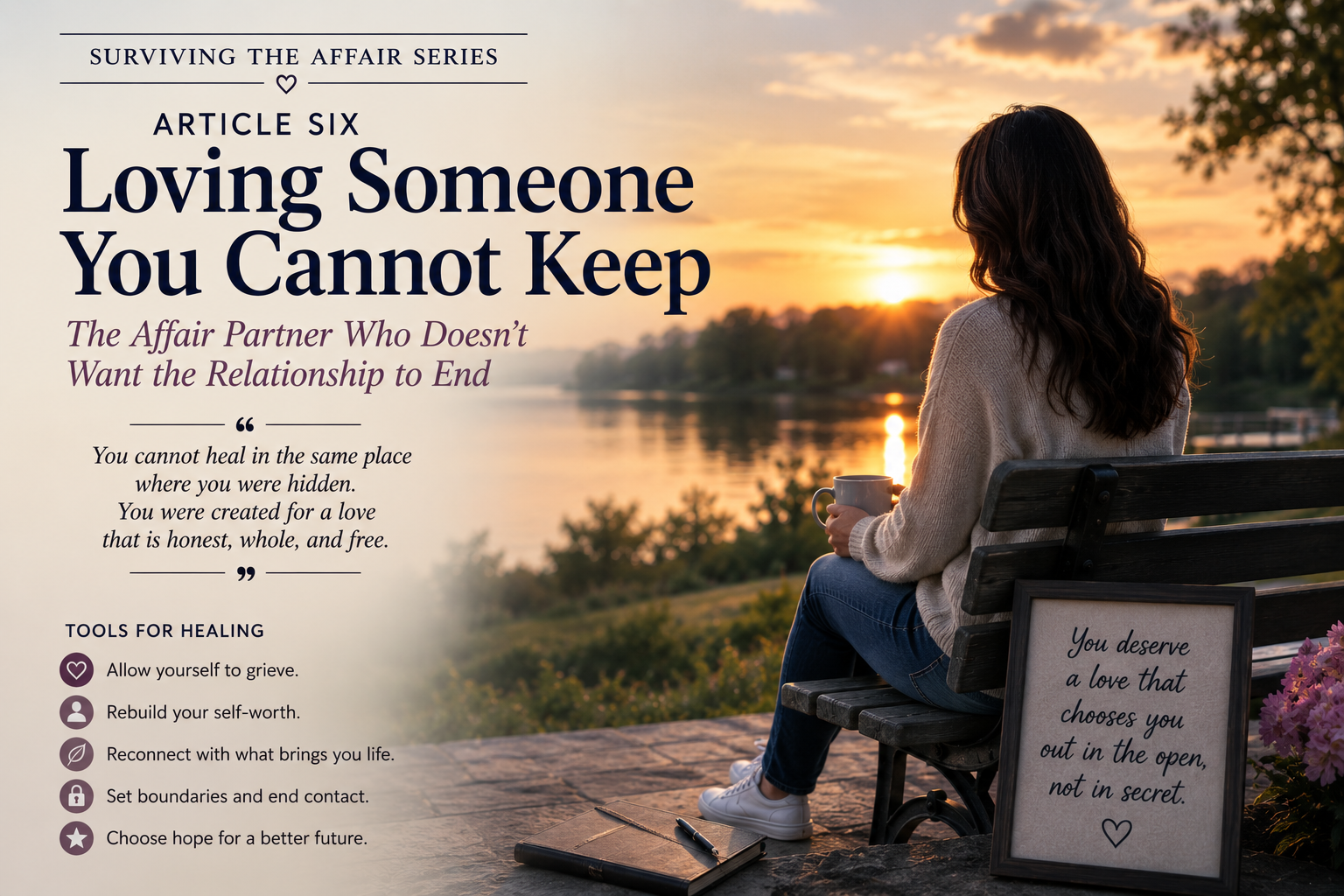
Surviving the Affair: Loving Someone You Cannot Keep

Part Six: The Affair Partner Who Doesn’t Want the Relationship to End

There is one person in nearly every affair who is rarely invited into the conversation. The affair partner. To many people, this individual is simply “the other woman” or “the other man.” They are viewed only through the pain they helped create. While they bear responsibility for their choices, reducing them to a stereotype rarely tells the whole story.

Some knowingly entered a relationship with a married person. Some were told the marriage was already over. Some believed divorce was only a matter of time. Some desperately tried to end the relationship but returned repeatedly. Others eventually fell deeply in love with someone they could never fully have.

None of these circumstances erase accountability. An affair causes real harm. Yet understanding the emotional world of the affair partner is not the same as excusing it. Healing begins with honesty—not caricatures.

This article is written for those who remain emotionally attached to someone who has chosen—or has been forced—to return to their marriage. You are grieving a relationship that may have felt deeply real, yet one that was built in secrecy and could never fully exist in the light. That grief deserves to be understood, even while acknowledging that the relationship itself was unhealthy.


When Fantasy Becomes Reality

Many affairs begin inside carefully controlled environments. There are no unpaid bills. No parenting disagreements. No household responsibilities. No extended family conflicts. There is only conversation, excitement, emotional intensity, and stolen moments. Psychologists sometimes describe this as a relationship protected from ordinary life.

Without everyday pressures, emotional intimacy often grows unusually fast. The relationship begins to feel extraordinary. Soulmate. Destiny. The one person who truly understands. These feelings are often sincere. But sincerity does not necessarily make them sustainable. Real relationships eventually require ordinary life. Most affairs never experience ordinary life.


Waiting for Tomorrow

Many affair partners live in a state of emotional suspension.

  • “After the holidays…”
  • “After the children graduate…”
  • “After the divorce…”
  • “Soon.”

Tomorrow becomes a promise that never quite arrives. Months become years. Life quietly passes. Many affair partners eventually realize they have built their future around someone else’s decisions. That realization is often devastating.


Loving Someone Who Chooses Someone Else

One of the deepest emotional wounds occurs when the married partner decides to end the affair and remain with their spouse. The affair partner often experiences intense emotions:

  • Grief.
  • Rejection.
  • Loneliness.
  • Confusion.
  • Shame.
  • Embarrassment.

Many wonder:

“Was any of it real?”

The answer is often yes. Feelings may have been genuine. But genuine feelings do not always produce healthy relationships. Love alone cannot overcome secrecy, divided loyalties, and broken trust.


The Hidden Cost of Being a Secret

Human beings were created for authentic connection. Healthy love thrives in openness. Affairs require concealment. Secret phone calls. Hidden messages. Excuses. Deleted conversations. Canceled holidays. Missed birthdays. Invisible grief. Over time, many affair partners begin realizing they are living a life that cannot be acknowledged publicly. They are important privately. Invisible publicly. That imbalance slowly erodes self-worth. Everyone deserves a relationship where they do not have to hide.


Hope Can Become a Prison

Hope is usually healthy. But misplaced hope can become emotionally imprisoning. Many affair partners continue waiting long after the relationship has effectively ended. They continue believing:

  • “Maybe they’ll come back.”
  • “Maybe they’re only staying because of the children.”
  • “Maybe next month everything will change.”

Hope becomes less about possibility and more about avoidance. Sometimes healing begins when hope changes direction. Instead of hoping someone returns… Begin hoping you become emotionally free.


You Are More Than This Relationship

One of the greatest dangers in any unhealthy relationship is identity fusion. Your entire sense of worth becomes connected to one person. When that relationship ends, it feels as though you disappear too. Healing requires rediscovering yourself outside the relationship.

Ask yourself:

  • Who was I before this affair?
  • What dreams have I postponed?
  • What values have I compromised?
  • What kind of relationship do I truly deserve?

These questions often become the beginning of genuine recovery.


Choosing Self-Respect

Walking away from someone you love may become one of the hardest decisions you ever make. It may also become one of the healthiest. Self-respect sometimes requires accepting painful reality rather than continuing to chase unlikely possibilities. Healthy love does not require constant secrecy. Healthy love does not leave one person waiting indefinitely. Healthy love does not require sacrificing your identity to remain emotionally connected.


Tools for Healing

If you are struggling to let go, consider these practical steps:

  • End all contact if the relationship has truly ended.
  • Allow yourself to grieve without romanticizing the relationship.
  • Work with a therapist to understand attachment patterns.
  • Reconnect with trusted friends and family.
  • Develop interests and goals that are independent of the relationship.
  • Journal honestly about both the joys and the costs of the affair.
  • Avoid monitoring your former partner’s social media.
  • Practice self-compassion while accepting responsibility for your choices.
  • Establish healthy relationship standards for the future.
  • Focus on becoming the person you hope to share your life with someday.

A Christian Perspective

Throughout Scripture, God continually calls people away from hiddenness and toward truth. The invitation is never merely to stop doing wrong. It is to step into a different way of living. John 8:32 reminds us:

“Then you will know the truth, and the truth will set you free.”

Sometimes the greatest freedom comes not from getting what we wanted…But from releasing what was never ours to keep. God’s grace is available to everyone. To the faithful spouse. To the unfaithful spouse. To the affair partner. Grace does not ignore responsibility. It offers transformation beyond it.


A Therapist’s Reflection

Over the years, I have counseled affair partners whose grief surprised even them. Many assumed they had no right to mourn. Others believed their pain would be dismissed because they helped create the situation. Yet grief does not disappear because others disapprove of it. It simply becomes lonely.

The healthiest healing begins when two truths are held together. You may have genuinely loved this person. And…The relationship may still have been unhealthy. Those truths can exist together. Do not allow one relationship—especially one built in secrecy—to determine your worth. Your future is not limited by this chapter. Healthy love does not ask you to remain hidden. It invites you to be fully known. And that kind of love is worth waiting for.


About the Author

John S. Collier, MSW, LCSW-S is a licensed clinical social worker, psychotherapist, author, educator, and speaker with decades of experience helping individuals, couples, and families navigate life’s most difficult emotional challenges. Throughout his career, he has worked extensively with people struggling with relationship conflict, betrayal, anxiety, depression, trauma, grief, addiction, and life transitions. His counseling approach combines evidence-based psychological practices with practical wisdom, compassion, and a deep respect for each person’s unique journey.

John has devoted much of his professional life to understanding the complexities of human relationships. He has counseled couples working to rebuild trust after infidelity, individuals recovering from betrayal, and families seeking healing after painful life events. His clinical experience has reinforced one enduring truth: while relationships can be profoundly wounded, people possess an extraordinary capacity for growth, resilience, forgiveness, and transformation when they are equipped with the right tools and support.

As an author, John seeks to bridge the gap between professional mental health knowledge and everyday life. His writing translates complex psychological concepts into practical guidance that readers can understand and apply immediately. Whether addressing marriage, parenting, emotional wellness, trauma recovery, or spiritual growth, his goal is to provide resources that are both clinically sound and personally encouraging.

Surviving the Affair reflects John’s commitment to approaching infidelity with both honesty and compassion. Rather than reducing people to labels or stereotypes, he explores the emotional realities experienced by everyone affected—the betrayed spouse, the unfaithful partner, the affair partner, and the families whose lives are forever changed. Drawing upon years of therapeutic experience, he emphasizes accountability without condemnation, healing without minimizing pain, and hope without offering unrealistic promises.

John believes that healing begins when people are willing to face the truth with courage. While not every relationship can or should be restored, every individual has the capacity to grow beyond betrayal, rediscover integrity, and build a healthier future. His passion is helping readers move from surviving life’s greatest wounds to living with renewed purpose, emotional strength, and hope.

Through his books, speaking engagements, and counseling work, John continues to encourage others to pursue emotional health, healthy relationships, personal responsibility, and lasting transformation—one step at a time.toward healing, personal responsibility, and lasting transformation.

References

American Association for Marriage and Family Therapy. (2015). Infidelity. https://www.aamft.org

Brown, B. (2012). Daring Greatly. Gotham Books.

Glass, S. P. (2003). Not “Just Friends”: Rebuilding Trust and Recovering Your Sanity After Infidelity. Free Press.

Johnson, S. M. (2019). Attachment Theory in Practice: Emotionally Focused Therapy (EFT) with Individuals, Couples, and Families. Guilford Press.

Levine, A., & Heller, R. (2010). Attached: The New Science of Adult Attachment and How It Can Help You Find—and Keep—Love. TarcherPerigee.

Mikulincer, M., & Shaver, P. R. (2016). Attachment in Adulthood: Structure, Dynamics, and Change (2nd ed.). Guilford Press.

Perel, E. (2017). The State of Affairs: Rethinking Infidelity. Harper.

The Holy Bible, New International Version. (2011). Zondervan.


When Your Heart Wants Them Back but Your Mind Knows Better:

Understanding the Battle Between Emotion and Logic After Heartbreak

Article Three: Part of the Healing After Heartbreak Series


Your Phone Lights Up

Your phone vibrates. For just a second, your heart races.

“Maybe it’s them.”

You reach for your phone almost before your mind has time to think. But it isn’t. It’s a weather alert. Or a friend. Or an advertisement. Your heart sinks just as quickly as it leaped. Then, almost immediately, another thought appears.

  • “Maybe I should text them.”
  • “Maybe enough time has passed.”
  • “Maybe they’ve changed.”

Your mind quietly reminds you why the relationship ended. Your heart answers, “Yes…but I still miss them.” If you’ve ever felt like your heart and your mind were arguing with each other, you’re not alone. This internal battle is one of the most common experiences after the end of a meaningful relationship.


Why Do I Feel This Way?

Many people believe that if they know a relationship was unhealthy, they shouldn’t miss the other person. Unfortunately, emotions don’t work that way. Love is more than a decision. It is also a collection of memories, routines, hopes, dreams, habits, and emotional bonds that were built over time.

When a relationship ends, those bonds do not disappear overnight. Your logical mind may understand that the relationship needed to end. Your emotional brain is still adjusting to the loss. That isn’t weakness. It’s part of being human.

Research has shown that romantic attachment shares many characteristics with other forms of attachment. When those attachments are broken, the brain often continues seeking closeness even after the relationship has ended (Fisher, Brown, Aron, Strong, & Mashek, 2010).


Your Brain Loves Familiar

Imagine you’ve driven the same road to work every morning for five years. One day, the road closes. Even though you know it is closed, you may still find yourself turning toward it out of habit. Relationships create similar emotional pathways. You became used to hearing their voice. Sharing good news. Sending funny memes. Talking before bed. Planning weekends. Your brain became familiar with that routine.

Now the routine is gone. The longing you feel is not always a sign that the relationship was right. Sometimes it is simply a sign that the relationship was familiar.


Missing Someone Doesn’t Always Mean You Should Go Back

This is one of the hardest truths to accept. You can deeply miss someone……and still know they were not good for you. Both things can be true. Consider these examples:

  • A person may miss someone who constantly criticized them.
  • Someone may long for an ex who repeatedly broke their trust.
  • A person may miss the companionship of a relationship even though they were unhappy most of the time.

Missing someone is evidence that you loved. It is not evidence that returning is the healthiest choice.


A Real-Life Example

Imagine a woman named Sarah who spent eight years with someone she loved deeply. Over time, the relationship became filled with broken promises, constant arguments, and emotional distance. When they finally separated, Sarah knew it was the right decision.

Yet every evening around six o’clock she reached for her phone. Not because anything had changed. Because for eight years, six o’clock was when they talked about their day. Her heart missed the routine. Her mind remembered the reality.

Healing required learning to create a new evening routine rather than returning to an unhealthy relationship simply because the old one felt familiar.


Love Can Leave an Echo

Think about walking through a canyon. You shout once. The sound continues long after you’ve stopped speaking. Relationships can leave emotional echoes. You may hear a song. Drive past a favorite restaurant. See someone wearing their favorite color. Smell a familiar perfume or cologne. Suddenly, your heart feels as if the breakup happened yesterday. That doesn’t mean you’ve failed. It means memories are connected to your senses. Over time, those echoes become quieter.


Signs Your Heart and Mind Are Disagreeing

You might notice thoughts like these:

Your Heart Says:

  • “I miss them.”
  • “I just want one more conversation.”
  • “Maybe this time will be different.”
  • “I still love them.”

Your Mind Says:

  • “Remember why it ended.”
  • “You deserve consistency.”
  • “Love should not require constant suffering.”
  • “Missing someone isn’t the same as needing them.”

Learning to listen to both—and letting wisdom guide your decisions—is part of emotional maturity.


Therapist’s Note

One of the greatest acts of self-respect is refusing to confuse loneliness with compatibility. There are moments when your heart will ask you to go back simply because moving forward feels unfamiliar. Give your heart compassion. But let your values steer your life.


What You Can Do

The next time you feel the urge to reach out to someone you know is unhealthy for you, pause before acting. Ask yourself these questions:

  • Do I miss this person, or do I miss having someone?
  • Am I remembering the whole relationship or only the good moments?
  • If nothing about this person changed, would I still choose this relationship?
  • Am I looking for healing or temporary relief?

Then write your answers down. Sometimes seeing your thoughts on paper helps your emotions catch up with what your mind already knows.


Build a New Routine

One of the healthiest ways to quiet emotional longing is to replace old routines with new ones. Instead of checking your phone every evening:

  • Go for a walk.
  • Read for twenty minutes.
  • Call a friend.
  • Learn a new hobby.
  • Spend time in prayer or meditation.
  • Exercise.
  • Journal about your progress.

You are not simply filling time. You are teaching your brain that life continues.


Final Thoughts

There may come a day when you think about them and smile instead of cry. Not because they came back. But because you finally came back to yourself. Healing is not forgetting someone who mattered. Healing is remembering yourself enough to stop chasing what continues to hurt you. Your heart may take longer than your mind. That’s okay. Walk at the pace of healing, not the pace of loneliness.


About the Author

John S. Collier, MSW, LCSW-S is a Licensed Clinical Social Worker and Executive Director of Southeast Kentucky Behavioral Health, LLC. With more than 25 years of experience in behavioral health, trauma, grief, and relationship counseling, he has helped individuals understand the connection between emotions, thoughts, and healthy decision-making. His goal is to make psychological concepts practical, hopeful, and accessible for people navigating life’s most difficult seasons.


References

Fisher, H. E., Brown, L. L., Aron, A., Strong, G., & Mashek, D. (2010). Reward, addiction, and emotion regulation systems associated with rejection in love. Journal of Neurophysiology, 104(1), 51–60.

Mikulincer, M., & Shaver, P. R. (2016). Attachment in Adulthood: Structure, Dynamics, and Change (2nd ed.). Guilford Press.

Sbarra, D. A. (2015). Love, Loss, and the Space Between: Stop Avoiding Pain and Start Living Your Life. Hay House.


Series Reminder

Healing doesn’t mean forgetting. It means carrying yesterday without letting it steal tomorrow.

Valentine’s Day When You’re Single: Practical Ways to Care for Yourself (and Why They Work)

Valentine’s Day can feel like a spotlight—on couples, romance, and “who has what.” When you’re single, that spotlight can trigger comparison, loneliness, or the sense that something is missing. But the day can also become a deliberate practice of self-respect: a chance to invest in your well-being, strengthen your identity, and build connection in ways that aren’t dependent on a romantic relationship. Research on self-compassion, savoring, and social connection offers a helpful blueprint for what to do—and why it matters. 

1) Treat it like a “self-date” (intentionally, not as a consolation prize)

A self-date is simply planned, uninterrupted time where you choose yourself on purpose. The value isn’t in the activity alone—it’s in the message you send your brain: I am worth effort. That shift matters because self-directed kindness is linked to better psychological well-being and lower self-criticism. 

Ideas

Go to a restaurant you’ve wanted to try (bring a book or journal). Dress up even if you’re staying in—signal that the moment matters. Plan a “three-course” at home: appetizer, main, dessert—no rushing.

2) Practice self-compassion (the opposite of self-judgment)

For many people, Valentine’s Day activates an inner critic: Everyone else is loved… what’s wrong with me? Self-compassion counters that spiral by combining (1) mindfulness (noticing the pain), (2) common humanity (you’re not alone), and (3) self-kindness (responding with care). This is not “letting yourself off the hook.” It’s choosing a healthier way to relate to yourself—one strongly associated with psychological well-being. 

Try this (2 minutes)

Put your hand on your chest and name what’s true: “This is hard tonight.” Add common humanity: “A lot of people feel this way sometimes.” Offer kindness: “I’m going to take care of myself with respect.”

3) Build connection on purpose (because your health depends on it)

Being single isn’t the same as being isolated—but it can become isolating if you withdraw. Social connection is a major protective factor for both mental and physical health, and the U.S. Surgeon General has warned that loneliness and isolation carry serious health consequences. 

Connection ideas that don’t require romance

Text or call two people: one “easy friend” and one “meaningful friend.” Host a small “friends-only Valentine’s” (dessert night, board games, movie). Do something service-based (drop off a meal, volunteer, donate intentionally).

Even brief, sincere connection beats scrolling through curated highlight reels.

4) Use “savoring” to create real positive emotion (not forced positivity)

Savoring is the skill of noticing and amplifying positive experiences—small ones included. Research suggests savoring interventions can increase positive emotions and strengthen coping resources, especially after stressors. 

Simple savoring ritual

Choose one pleasant moment (hot shower, favorite song, dessert, candlelight). Slow down for 30–60 seconds and focus on sensory detail: smell, taste, warmth, texture. Say (out loud if you can): “This is good. I’m allowed to enjoy this.”

5) Give your body care that feels like gratitude, not “fixing”

When people feel lonely or rejected, the body often carries the stress—tight shoulders, fatigue, restlessness. A gentle reset can regulate your nervous system and reduce emotional load.

Pick one

Long walk with a playlist that matches your mood (not what you think you should feel). Stretching, yoga, or a warm bath/shower with deliberate slowness. Early bedtime with a “wind-down boundary” (no phone 30 minutes before sleep).

6) Make a “values-based” Valentine’s: do something that fits who you want to be

A powerful way to prevent Valentine’s Day from becoming a pain-amplifier is to anchor it in meaning. When you act in line with your values (growth, faith, health, creativity, service), the day stops being a referendum on your relationship status and becomes a reflection of your character.

Examples

Growth: read, take a class, plan one goal for the next month. Creativity: write a poem, paint, cook something new. Service: encourage someone who’s struggling; give generously. Restoration: declutter one space; make your home feel safe and calm.

7) If the day feels heavy, name it—then choose one small next step

If you feel grief, that doesn’t mean you’re failing the day. It means you’re human. Start with one “next right thing”: a shower, a meal, a walk, a call, a journal entry. The goal isn’t to turn Valentine’s Day into a perfect night—it’s to treat yourself with dignity while you move through it.

This article was written by John S. Collier, MSW, LCSW. Mr. Collier has over 25 years experience in the social work field. He currently serves as the executive Director at outpatient behavioral health therapist at Southeast Kentucky Behavioral Health in London Kentucky.

References

Neff, K. D. (2009). The role of self-compassion in development: A healthier way to relate to oneself. Human Development, 52(4), 211–214.  Neff, K. D. (n.d.). Self-Compassion, Self-Esteem, and Well-Being. Self-Compassion.org (PDF).  Office of the U.S. Surgeon General. (2023). Our Epidemic of Loneliness and Isolation: The U.S. Surgeon General’s Advisory on the Healing Effects of Social Connection and Community. U.S. Department of Health and Human Services.  U.S. Department of Health and Human Services. (2025). Social Connection (Fact Cards and resources).  Klibert, J. J., et al. (2022). Savoring interventions increase positive emotions after a social-evaluative hassle.  Cullen, K., et al. (2024). The effectiveness of savouring interventions in adult clinical populations. 

Healthy Forms of Validation: Recognizing and Seeking Supportive Affirmation

Validation is the process of understanding, affirming, and accepting one’s feelings, thoughts, or experiences. Receiving healthy validation plays an essential role in building self-esteem, enhancing relationships, and promoting emotional resilience. However, it’s essential to recognize and seek out validation that is healthy and constructive. Here’s an overview of different types of validation and strategies for recognizing and pursuing them effectively.

Why Validation Matters

Validation from others reassures us that our feelings and experiences are understood and accepted. Research shows that receiving consistent, positive validation from supportive people can lead to improved mental health, stronger relationships, and a more secure sense of self (Linehan, 1993). According to self-determination theory, validation can also foster autonomy, competence, and relatedness, which are essential for psychological well-being (Ryan & Deci, 2000).

However, relying solely on external validation can be harmful, leading to dependency and reduced self-esteem. Instead, it’s beneficial to balance seeking validation from others with developing self-validation practices.

1. Types of Healthy Validation

  • Emotional Validation: Emotional validation involves acknowledging and accepting someone’s feelings without judgment. This can be as simple as listening attentively, empathizing, and affirming that the other person’s feelings are understandable. Emotional validation reinforces that feelings are valid and that it’s okay to feel what one feels (Linehan, 1993).
  • Validation of Effort and Progress: Praising effort rather than outcomes is a powerful form of validation that can reinforce persistence, self-compassion, and growth. Validating someone’s efforts, even if they fall short of success, promotes a growth mindset, where challenges are seen as opportunities to learn rather than sources of failure (Dweck, 2006).
  • Authentic Affirmations: Authentic affirmations recognize specific qualities, skills, or positive contributions that a person has shown. This validation should be specific rather than generic to reinforce self-worth in an honest, meaningful way (Wood et al., 2008).

2. Recognizing Healthy Validation

Healthy validation has distinct characteristics that make it different from unhealthy or superficial validation. Here’s how to identify it:

  • Respectful and Non-Judgmental: Healthy validation acknowledges your experiences without judgment or dismissal. Research shows that people who validate respectfully build stronger, more trusting relationships (Kross et al., 2014).
  • Specific and Genuine: Unlike generic praise, specific and genuine validation is grounded in real examples. For example, instead of saying “You’re smart,” healthy validation might sound like “I noticed how thoughtful you were when you solved that problem.” This specificity makes the affirmation more meaningful and believable (Wood et al., 2008).
  • Supportive but Not Enabling: Healthy validation encourages personal growth and resilience. It acknowledges your feelings and experiences without enabling unhelpful behaviors, promoting personal accountability and independence (Ryan & Deci, 2000).

3. How to Seek Out Healthy Validation

While it can be challenging to seek validation directly, there are strategies to create environments and relationships where it naturally occurs:

  • Communicate Openly: Sharing how you feel and what kind of support you need can help others understand your perspective and respond in validating ways. Research suggests that people who openly communicate their feelings are more likely to receive affirming responses, as clear communication reduces misunderstandings (Gottman, 2011).
  • Seek Supportive Relationships: Prioritize connections with people who genuinely care about your well-being and listen to you. Friendships and relationships that emphasize empathy, understanding, and honest feedback are more likely to offer healthy validation (Reis & Shaver, 1988).
  • Set Boundaries Around Validation-Seeking: Being mindful of how and when you seek validation can help prevent over-dependence on others. Seeking validation when genuinely needed, rather than as a habit, can help you distinguish between healthy support and dependency (Neff, 2003).

4. Building Self-Validation Skills

Relying on oneself for validation is a healthy, empowering practice that can lead to greater self-confidence and resilience:

  • Practice Self-Compassion: Self-compassion is a form of self-validation that involves treating yourself kindly, especially during challenging times. According to Dr. Kristin Neff, practicing self-compassion can help you become your own source of validation, reducing dependency on external sources (Neff, 2003).
  • Acknowledge Your Own Efforts: Celebrating your progress, no matter how small, reinforces self-validation. This practice helps you recognize your own efforts, fostering a positive self-image and reducing the need for constant external approval (Dweck, 2006).
  • Mindfulness and Journaling: Reflecting on your experiences, thoughts, and emotions through mindfulness or journaling can help you recognize your feelings and validate them internally. This process strengthens self-awareness and helps you rely less on external feedback (Kabat-Zinn, 2003).

Conclusion

Validation is a powerful element of healthy relationships and self-esteem, but it’s essential to seek out healthy, constructive forms of affirmation. By recognizing the qualities of healthy validation, seeking it from supportive people, and building self-validation skills, individuals can enhance their emotional resilience and improve their overall well-being.

This article has been written by John S. Collier, MSW, LCSW. Mr. Collier has over 25 years of experience in the social work field and is based in London Kentucky through Southeast Kentucky Behavioral Health, LLC. Mr. Collier may be reached by phone at (606) 657–0532 extension 101 or by email at john@sekybh.com.

References

  • Dweck, C. S. (2006). Mindset: The New Psychology of Success. Random House.
  • Gottman, J. M. (2011). The Science of Trust: Emotional Attunement for Couples. W.W. Norton & Company.
  • Kabat-Zinn, J. (2003). Mindfulness-Based Stress Reduction (MBSR). American Psychological Association.
  • Kross, E., et al. (2014). Social rejection and the brain. Trends in Cognitive Sciences, 18(1), 15-21.
  • Linehan, M. M. (1993). Cognitive-Behavioral Treatment of Borderline Personality Disorder. Guilford Press.
  • Neff, K. D. (2003). The development and validation of a scale to measure self-compassion. Self and Identity, 2(3), 223-250.
  • Reis, H. T., & Shaver, P. (1988). Intimacy as an interpersonal process. In Handbook of Personal Relationships, 367-389.
  • Ryan, R. M., & Deci, E. L. (2000). Self-determination theory and the facilitation of intrinsic motivation, social development, and well-being. American Psychologist, 55(1), 68-78.
  • Wood, A. M., et al. (2008). The role of gratitude in the development of social support, stress, and depression: Two longitudinal studies. Journal of Research in Personality, 42(4), 854-871.

This article provides a guide to recognizing and seeking healthy forms of validation based on research and psychological theories. Let me know if there’s any area you’d like to explore in more depth.