Welcome to SOUTHEAST KENTUCKY BEHAVIORAL HEALTH
Going All In: The Hidden Risks of Rushing Into a Relationship

There is something undeniably romantic about the phrase “going all in.” Movies celebrate it. Love songs glorify it. Friends often admire people who seem fearless enough to dive headfirst into love. We are told that real love requires vulnerability, commitment, and complete investment.

While commitment is essential for a healthy relationship, there is an important distinction between healthy commitment and premature emotional investment. One is built on knowledge, trust, and experience. The other is often built on hope, attraction, and assumptions.

Many relationships don’t fail because two people were incompatible. They fail because they became emotionally committed long before they truly knew one another.


The Difference Between Attraction and Knowledge

Attraction happens quickly. Knowledge takes time. During the first weeks or months of dating, we naturally see the best version of another person. Psychologists sometimes refer to this as the honeymoon phase, where the brain is flooded with dopamine, oxytocin, and other neurochemicals that create excitement, optimism, and emotional attachment (Fisher, 2004). Unfortunately, these same chemicals can reduce our ability to evaluate a relationship objectively.

When people “go all in” too quickly, they often mistake:

  • Chemistry for compatibility
  • Passion for stability
  • Attention for commitment
  • Potential for reality

Those are not the same things.


We Fall in Love With Who We Think They Are

One of the greatest dangers of rushing a relationship is that we begin filling in the blanks ourselves. Instead of learning who someone truly is, we imagine who they could become. We overlook inconsistencies. We excuse red flags.

We create explanations for behaviors we don’t fully understand. Psychologists call this idealization—seeing another person through the lens of hope rather than reality (Murray, Holmes, & Griffin, 1996). The problem is that relationships are built on reality, not imagination. Eventually, every relationship moves from fantasy to reality. When that happens, many people don’t feel like their partner changed. Instead, they finally see what was there all along.


Emotional Investment Changes Your Judgment

Imagine buying a house. Would you purchase it after walking through the front door for five minutes? Probably not. You would inspect the foundation. Look at the roof. Check for water damage. Review the neighborhood. Ask difficult questions. Relationships deserve at least that much careful consideration. Yet emotionally, many people commit after only a handful of exciting conversations. Once we become emotionally invested, our brains begin protecting that investment.

Instead of asking, “Is this the right person?”

we begin asking, “How can I make this work?”

Those are completely different questions.


The Cost of Ignoring Red Flags

Red flags rarely appear as dramatic warning signs. Most begin as small moments. Perhaps they become irritated when they don’t get their way. Maybe they avoid accountability. Perhaps they speak disrespectfully about former partners. Maybe they struggle with honesty. Perhaps they become controlling in subtle ways. Someone who rushes into commitment often dismisses these concerns because the emotional reward feels greater than the potential risk. Unfortunately, ignored patterns rarely disappear. They usually become stronger. Dating is not primarily about convincing someone to stay. It is about discovering whether staying would be wise.


Love Needs Observation

Healthy relationships require curiosity. Observe how someone handles disappointment. Observe how they manage stress. Observe how they treat people who have nothing to offer them. Observe how they speak about family. Observe whether their words consistently match their actions. Character reveals itself over time. No conversation can replace experience. No promise can replace consistency. No chemistry can replace integrity.


Why Slow Relationships Often Last Longer

Research consistently suggests that relationships built gradually often develop stronger foundations because trust is earned rather than assumed (Stanley, Rhoades, & Markman, 2006). People sometimes fear moving slowly because they worry someone else will “take” the person they’re dating. Ironically, healthy people generally respect appropriate pacing. Individuals who pressure immediate commitment often reveal more about their own insecurity than about their love. Real intimacy grows. It cannot be rushed.


The Difference Between Commitment and Surrender

Healthy commitment says: “I’m choosing you because I know who you are.”

Unhealthy surrender says: “I’m choosing you because I hope you’ll become who I need.”

One is based on evidence. The other is based on emotion. One grows stronger over time. The other becomes increasingly fragile.


Questions Worth Asking Yourself

Before going “all in,” consider asking yourself:

  • What do I actually know about this person’s character?
  • Have I seen them during conflict?
  • How do they respond when they don’t get what they want?
  • Do their actions consistently match their words?
  • Am I attracted to who they are today or who I hope they’ll become?
  • If nothing about this person ever changed, would I still choose this relationship five years from now?

These questions may not feel romantic, but they are deeply loving—because they protect both people from building a relationship on unrealistic expectations.


A Better Way to Love

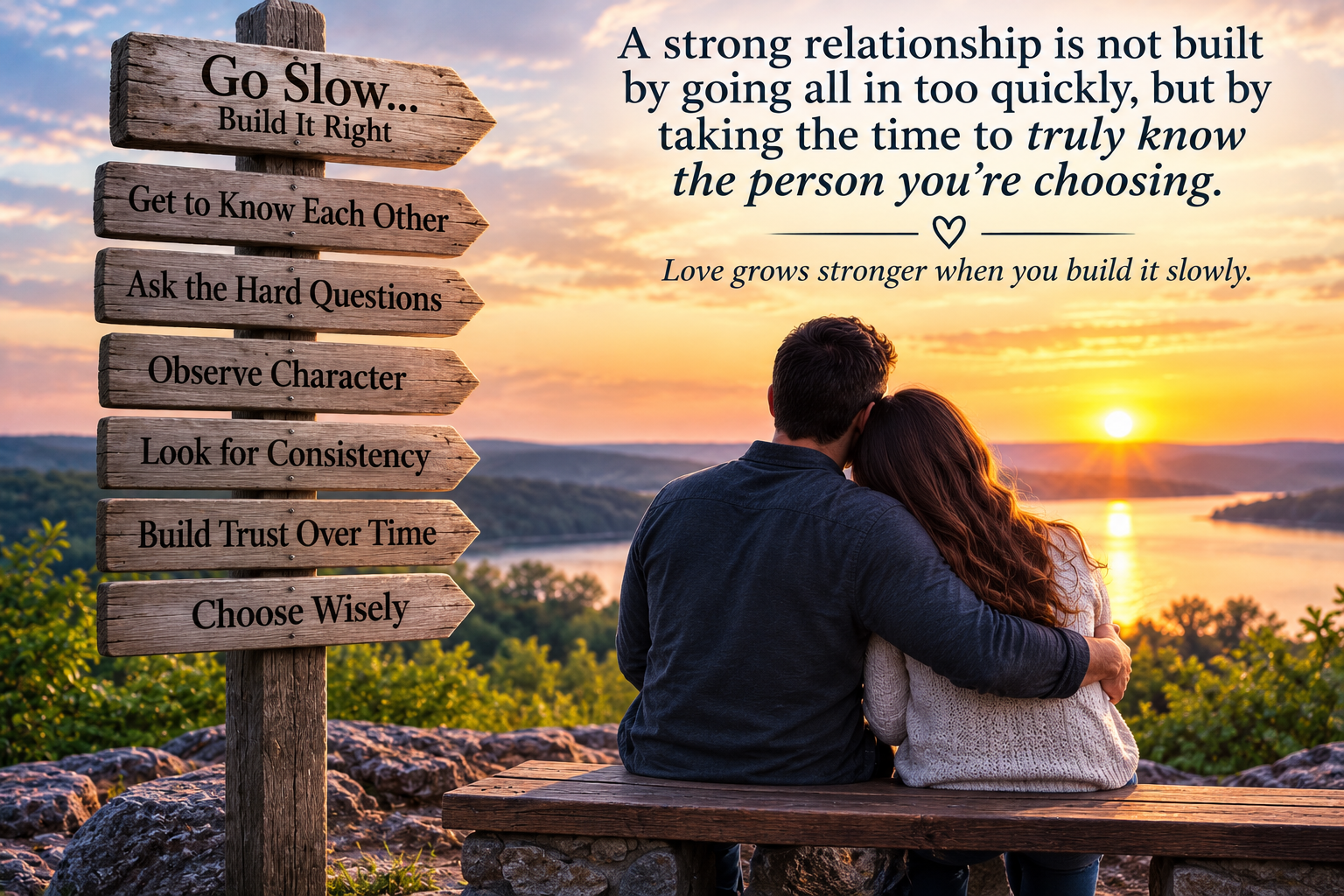
Moving slowly does not mean loving less. It means loving wisely. Healthy relationships are not races.

They are discoveries. Every shared experience reveals another layer of a person’s character. Trust is built 0through repeated consistency. Respect grows through mutual understanding. Love deepens through truth rather than fantasy.

Going “all in” is admirable when it follows genuine knowledge of another person. Going all in before you truly know someone is less an act of courage than a gamble. The strongest relationships are rarely built by those who rushed toward commitment. They are built by two people who allowed time to reveal character, chose honesty over fantasy, and discovered that lasting love is not found by moving faster—it is found by building a foundation strong enough to support a lifetime.


About the Author

John S. Collier, MSW, LCSW-S is a licensed clinical social worker, therapist, author, and educator with extensive experience helping individuals, couples, and families navigate relationship challenges, anxiety, trauma, and emotional well-being. Throughout his career, he has worked with people from diverse backgrounds, combining evidence-based psychological principles with practical, real-world applications that readers can immediately apply to their daily lives.

John’s writing bridges the gap between academic research and everyday experience, making complex psychological concepts understandable and useful. His work emphasizes emotional maturity, healthy communication, personal responsibility, and building relationships founded on trust, authenticity, and mutual respect. Whether writing about mental health, family dynamics, leadership, or personal growth, his goal is to provide readers with insights that encourage lasting change and healthier, more meaningful lives.

References

Fisher, H. (2004). Why We Love: The Nature and Chemistry of Romantic Love. Henry Holt.

Murray, S. L., Holmes, J. G., & Griffin, D. W. (1996). The benefits of positive illusions: Idealization and the construction of satisfaction in close relationships. Journal of Personality and Social Psychology, 70(1), 79–98.

Stanley, S. M., Rhoades, G. K., & Markman, H. J. (2006). Sliding versus deciding: Inertia and the premarital cohabitation effect. Family Relations, 55(4), 499–509.

Gottman, J. M., & Silver, N. (2015). The Seven Principles for Making Marriage Work (Revised ed.). Harmony Books.


When Your Heart Wants Them Back but Your Mind Knows Better:

Understanding the Battle Between Emotion and Logic After Heartbreak

Article Three: Part of the Healing After Heartbreak Series


Your Phone Lights Up

Your phone vibrates. For just a second, your heart races.

“Maybe it’s them.”

You reach for your phone almost before your mind has time to think. But it isn’t. It’s a weather alert. Or a friend. Or an advertisement. Your heart sinks just as quickly as it leaped. Then, almost immediately, another thought appears.

  • “Maybe I should text them.”
  • “Maybe enough time has passed.”
  • “Maybe they’ve changed.”

Your mind quietly reminds you why the relationship ended. Your heart answers, “Yes…but I still miss them.” If you’ve ever felt like your heart and your mind were arguing with each other, you’re not alone. This internal battle is one of the most common experiences after the end of a meaningful relationship.


Why Do I Feel This Way?

Many people believe that if they know a relationship was unhealthy, they shouldn’t miss the other person. Unfortunately, emotions don’t work that way. Love is more than a decision. It is also a collection of memories, routines, hopes, dreams, habits, and emotional bonds that were built over time.

When a relationship ends, those bonds do not disappear overnight. Your logical mind may understand that the relationship needed to end. Your emotional brain is still adjusting to the loss. That isn’t weakness. It’s part of being human.

Research has shown that romantic attachment shares many characteristics with other forms of attachment. When those attachments are broken, the brain often continues seeking closeness even after the relationship has ended (Fisher, Brown, Aron, Strong, & Mashek, 2010).


Your Brain Loves Familiar

Imagine you’ve driven the same road to work every morning for five years. One day, the road closes. Even though you know it is closed, you may still find yourself turning toward it out of habit. Relationships create similar emotional pathways. You became used to hearing their voice. Sharing good news. Sending funny memes. Talking before bed. Planning weekends. Your brain became familiar with that routine.

Now the routine is gone. The longing you feel is not always a sign that the relationship was right. Sometimes it is simply a sign that the relationship was familiar.


Missing Someone Doesn’t Always Mean You Should Go Back

This is one of the hardest truths to accept. You can deeply miss someone……and still know they were not good for you. Both things can be true. Consider these examples:

  • A person may miss someone who constantly criticized them.
  • Someone may long for an ex who repeatedly broke their trust.
  • A person may miss the companionship of a relationship even though they were unhappy most of the time.

Missing someone is evidence that you loved. It is not evidence that returning is the healthiest choice.


A Real-Life Example

Imagine a woman named Sarah who spent eight years with someone she loved deeply. Over time, the relationship became filled with broken promises, constant arguments, and emotional distance. When they finally separated, Sarah knew it was the right decision.

Yet every evening around six o’clock she reached for her phone. Not because anything had changed. Because for eight years, six o’clock was when they talked about their day. Her heart missed the routine. Her mind remembered the reality.

Healing required learning to create a new evening routine rather than returning to an unhealthy relationship simply because the old one felt familiar.


Love Can Leave an Echo

Think about walking through a canyon. You shout once. The sound continues long after you’ve stopped speaking. Relationships can leave emotional echoes. You may hear a song. Drive past a favorite restaurant. See someone wearing their favorite color. Smell a familiar perfume or cologne. Suddenly, your heart feels as if the breakup happened yesterday. That doesn’t mean you’ve failed. It means memories are connected to your senses. Over time, those echoes become quieter.


Signs Your Heart and Mind Are Disagreeing

You might notice thoughts like these:

Your Heart Says:

  • “I miss them.”
  • “I just want one more conversation.”
  • “Maybe this time will be different.”
  • “I still love them.”

Your Mind Says:

  • “Remember why it ended.”
  • “You deserve consistency.”
  • “Love should not require constant suffering.”
  • “Missing someone isn’t the same as needing them.”

Learning to listen to both—and letting wisdom guide your decisions—is part of emotional maturity.


Therapist’s Note

One of the greatest acts of self-respect is refusing to confuse loneliness with compatibility. There are moments when your heart will ask you to go back simply because moving forward feels unfamiliar. Give your heart compassion. But let your values steer your life.


What You Can Do

The next time you feel the urge to reach out to someone you know is unhealthy for you, pause before acting. Ask yourself these questions:

  • Do I miss this person, or do I miss having someone?
  • Am I remembering the whole relationship or only the good moments?
  • If nothing about this person changed, would I still choose this relationship?
  • Am I looking for healing or temporary relief?

Then write your answers down. Sometimes seeing your thoughts on paper helps your emotions catch up with what your mind already knows.


Build a New Routine

One of the healthiest ways to quiet emotional longing is to replace old routines with new ones. Instead of checking your phone every evening:

  • Go for a walk.
  • Read for twenty minutes.
  • Call a friend.
  • Learn a new hobby.
  • Spend time in prayer or meditation.
  • Exercise.
  • Journal about your progress.

You are not simply filling time. You are teaching your brain that life continues.


Final Thoughts

There may come a day when you think about them and smile instead of cry. Not because they came back. But because you finally came back to yourself. Healing is not forgetting someone who mattered. Healing is remembering yourself enough to stop chasing what continues to hurt you. Your heart may take longer than your mind. That’s okay. Walk at the pace of healing, not the pace of loneliness.


About the Author

John S. Collier, MSW, LCSW-S is a Licensed Clinical Social Worker and Executive Director of Southeast Kentucky Behavioral Health, LLC. With more than 25 years of experience in behavioral health, trauma, grief, and relationship counseling, he has helped individuals understand the connection between emotions, thoughts, and healthy decision-making. His goal is to make psychological concepts practical, hopeful, and accessible for people navigating life’s most difficult seasons.


References

Fisher, H. E., Brown, L. L., Aron, A., Strong, G., & Mashek, D. (2010). Reward, addiction, and emotion regulation systems associated with rejection in love. Journal of Neurophysiology, 104(1), 51–60.

Mikulincer, M., & Shaver, P. R. (2016). Attachment in Adulthood: Structure, Dynamics, and Change (2nd ed.). Guilford Press.

Sbarra, D. A. (2015). Love, Loss, and the Space Between: Stop Avoiding Pain and Start Living Your Life. Hay House.


Series Reminder

Healing doesn’t mean forgetting. It means carrying yesterday without letting it steal tomorrow.

When the Door Closes Before the House Collapses: How a Breakup May Have Saved You

Few experiences in life hurt as deeply as the end of a relationship. Whether the relationship lasted months or decades, a breakup often feels less like losing a partner and more like losing the future you had imagined. You don’t just grieve the person—you grieve the vacations that never happened, the holidays you pictured together, the home you imagined building, and the life you believed was just beginning.

In the midst of that pain, it is nearly impossible to consider that the breakup may not have been the worst thing that happened to you. It may have been the best. Not because the relationship meant nothing. Not because your love wasn’t real. But because sometimes the greatest blessing in our lives first arrives disguised as rejection.


We Often Mourn Potential More Than Reality

One of the most painful aspects of heartbreak is that our minds naturally fill in missing pieces with hope. Psychologists refer to this as idealization—a tendency to remember the positive aspects of someone while minimizing or overlooking significant problems (Murray et al., 1996).

After a breakup, our brains frequently replay:

  • The best conversations.
  • The happiest memories.
  • Their smile.
  • Their laugh.
  • The way they looked at us.

What we often forget are:

  • The inconsistent communication.
  • The emotional distance.
  • The broken promises.
  • The anxiety.
  • The uncertainty.
  • The nights spent wondering where we stood.

Our memories become edited highlight reels instead of accurate documentaries.


Love Shouldn’t Require Constant Convincing

Healthy relationships certainly require effort. They require forgiveness. They require compromise. But they should not require someone to repeatedly convince another person to stay. If someone continually leaves you questioning your worth…If you constantly have to prove you’re enough…If your security depends on someone else’s changing emotions…Then the relationship has quietly become survival rather than partnership.

Research consistently shows that secure relationships are characterized by reliability, responsiveness, and emotional safety rather than chronic uncertainty (Mikulincer & Shaver, 2016). Love isn’t supposed to feel like an audition.


Imagine Five More Years

Heartbreak narrows our vision. Instead of asking:

“Why did they leave?”

Ask yourself:

“What if they hadn’t?”

Imagine spending another five years:

  • Walking on eggshells.
  • Wondering whether today would be the day they changed their mind.
  • Ignoring your own needs to preserve the relationship.
  • Accepting less than what you deserved because losing them felt worse than losing yourself.

Many people aren’t grieving because they lost something healthy. They’re grieving because they almost settled for something unhealthy.


The Red Flags You Ignored Become the Lessons You Keep

After enough time passes, many people begin noticing something remarkable. The very behaviors they once excused become obvious warning signs. Perhaps they:

  • Avoided difficult conversations.
  • Refused accountability.
  • Made you responsible for their happiness.
  • Frequently withdrew affection.
  • Used guilt instead of communication.
  • Left you feeling anxious more often than peaceful.

These aren’t simply personality quirks. Many represent patterns associated with lower relationship satisfaction and emotional instability if left unresolved (Gottman & Silver, 2015). Pain has a remarkable ability to remove rose-colored glasses.


Rejection Often Reveals Incompatibility

One of the greatest misconceptions about breakups is believing that if someone leaves, you somehow failed. Sometimes that’s true. Often, it isn’t. Sometimes two good people simply want different lives. Different priorities. Different values. Different levels of commitment. Trying to force compatibility where it doesn’t naturally exist only delays inevitable pain. Compatibility is not measured by chemistry alone. It is measured by whether two people consistently choose each other.


The Relationship Didn’t Fail Overnight

Most breakups don’t begin on the day someone says goodbye. They begin months—or even years—earlier. Communication slowly decreases. Affection changes. Resentment quietly grows. Needs stop being expressed. Small disappointments accumulate into emotional distance. The breakup simply becomes the final chapter of a story already being written. Recognizing this doesn’t erase the pain. It helps explain it.


Sometimes the Person You Miss Isn’t the Person Who Left

This realization is often one of the hardest. You may not actually miss the person who ended the relationship. You may miss:

  • Who they used to be.
  • Who you hoped they’d become.
  • The version of the relationship that existed in your imagination.
  • The future you believed you were building together.

Those aren’t the same thing. Grieving a dream is every bit as painful as grieving a person.


What You Actually Dodged

It’s easy to think:

“I lost the love of my life.”

But perhaps you avoided:

  • A marriage filled with resentment.
  • Years of emotional loneliness.
  • Constant insecurity.
  • Repeated betrayals.
  • Living with someone who was never fully committed.

Imagine discovering those realities after buying a house together. After having children. After twenty years. Sometimes heartbreak isn’t evidence that life is punishing you. Sometimes it’s life protecting you before your roots grow too deep.


Healing Changes the Story

Right now your heart tells you:

“I lost everything.”

Healing eventually whispers:

“I lost someone who wasn’t willing or able to continue building this life with me.”

Those are very different statements. One is despair. The other is acceptance. Acceptance doesn’t erase grief. It simply allows hope to return.


A Final Thought

One day you may look back and realize that the breakup you begged God to prevent became the moment that redirected your life toward something healthier. The relationship ending doesn’t necessarily mean you weren’t enough. It may simply mean the relationship wasn’t. You didn’t dodge love. You dodged years of wondering whether you were loved enough. And while today that feels like loss…

Tomorrow, it may become the greatest act of protection your life has ever received.


About the Author

John S. Collier, MSW, LCSW-S is a Licensed Clinical Social Worker, behavioral health clinician, and Executive Director of Southeast Kentucky Behavioral Health. With more than 25 years of experience helping individuals and families navigate trauma, grief, relationships, and personal growth, he writes to bridge clinical research with real-life emotional experiences. His work encourages readers to find resilience, embrace healthy relationships, and discover hope even in life’s most difficult seasons.


References

Gottman, J. M., & Silver, N. (2015). The Seven Principles for Making Marriage Work (Revised ed.). Harmony Books.

Mikulincer, M., & Shaver, P. R. (2016). Attachment in Adulthood: Structure, Dynamics, and Change (2nd ed.). Guilford Press.

Murray, S. L., Holmes, J. G., & Griffin, D. W. (1996). The benefits of positive illusions: Idealization and the construction of satisfaction in close relationships. Journal of Personality and Social Psychology, 70(1), 79–98. https://doi.org/10.1037/0022-3514.70.1.79

Slotter, E. B., Gardner, W. L., & Finkel, E. J. (2010). Who am I without you? The influence of romantic breakup on the self-concept. Personality and Social Psychology Bulletin, 36(2), 147–160. https://doi.org/10.1177/0146167209352250


When the Truth Keeps Unfolding: Coping with the Discovery That Your Ex Cheated More Than You Realized

Discovering that a partner has been unfaithful can be one of the most painful emotional experiences a person can endure. Yet for many people, the pain does not end when the relationship ends. Sometimes the real shock comes later—when new information surfaces and you realize the infidelity was far more extensive than you originally believed. Each new detail can reopen emotional wounds, triggering feelings of anger, betrayal, humiliation, grief, and confusion. Learning how to process those feelings in a healthy way is an essential step toward healing.

The Emotional Shock of Delayed Discovery

When someone first discovers infidelity, they often experience a traumatic emotional reaction similar to other forms of relational betrayal trauma (Freyd, 1996). The brain struggles to reconcile the person they loved with the reality of deception. When additional information emerges later, the brain may feel as if the betrayal is happening all over again.

Psychologists often refer to this as secondary betrayal trauma—the experience of reliving the pain as new facts come to light. Each new revelation can feel like another emotional blow, even if the relationship has already ended. The mind revisits past memories and begins to reinterpret them through the lens of the new information.

You may find yourself thinking:

“How much of our relationship was real?” “Was anything they told me true?” “Why didn’t I see it sooner?”

These thoughts are normal. They are the mind’s attempt to reconstruct reality after deception has disrupted it.

Understanding the Emotional Responses

When people discover deeper levels of infidelity after a breakup, several emotional responses are common.

Anger. Anger often surfaces when the full scope of deception becomes clear. This anger may be directed toward the ex-partner, the people involved in the affairs, or even oneself.

Humiliation and embarrassment. Many individuals feel ashamed, especially if others knew about the infidelity before they did. However, shame belongs to the person who betrayed the relationship, not the one who was faithful.

Self-doubt. A person may question their judgment or wonder how they missed warning signs. This reaction is a natural consequence of broken trust.

Grief. Even if the relationship has already ended, the new information may cause you to grieve again—this time grieving the illusion of what you believed the relationship was.

Research shows that betrayal in intimate relationships can produce symptoms similar to post-traumatic stress, including intrusive thoughts, emotional numbing, and difficulty trusting others (Gordon, Baucom, & Snyder, 2004).

Accept That the Pain May Come in Waves

One of the most important things to understand is that healing from betrayal is not linear. The discovery of additional cheating can reset the emotional process. You may feel like you are back at the beginning.

This does not mean you have failed in your healing process.

Instead, it means your mind is processing new information. Each wave of emotion is part of integrating that new reality into your understanding of the past.

Allow yourself to feel the emotions without judging them.

Avoid the Trap of Endless Investigation

After discovering additional cheating, many people feel an intense urge to learn every detail. They search social media, read old messages, ask mutual friends questions, or mentally replay the relationship looking for clues.

While some information can help provide closure, obsessively searching for details often prolongs emotional suffering. Studies show that rumination—repeatedly thinking about painful events—can worsen depression and anxiety (Nolen-Hoeksema, 2000).

There comes a point when knowing more details no longer helps healing. Instead, it keeps the betrayal alive in your mind.

Closure rarely comes from knowing everything. It comes from accepting that the relationship ended because trust was broken.

Rebuild the Narrative of Your Relationship

When betrayal is revealed, the mind struggles because the story you believed about your relationship has suddenly changed. Healing often involves reconstructing the narrative of what happened.

Instead of thinking:

“My entire relationship was a lie.”

A healthier narrative may be:

“I loved someone who was capable of deception. Their actions say more about their character than my worth.”

This shift helps separate your identity from their behavior.

Resist Internalizing the Betrayal

One of the most damaging psychological effects of infidelity is when the betrayed partner begins to internalize the blame. People often ask themselves questions like:

“Was I not enough?” “Did I push them away?” “If I had done something differently, would they have stayed faithful?”

While relationships can be complex, cheating is ultimately a decision made by the person who cheats. Research consistently shows that infidelity is more strongly related to individual factors such as impulsivity, entitlement, poor boundaries, or dissatisfaction with oneself rather than simply the partner’s behavior (Fincham & May, 2017).

Your worth was never determined by their choices.

Focus on What the Truth Reveals

As painful as it may be, discovering additional cheating can also provide clarity. It removes any lingering illusion that the relationship could have been saved.

The truth may reveal that the relationship ended for a reason.

Many people eventually realize that the new information, though painful, prevents them from romanticizing the past. It helps them see the relationship more accurately and allows them to move forward without lingering doubts.

Rebuild Trust in Yourself

After betrayal, one of the hardest things to rebuild is not trust in others—it is trust in your own judgment.

You may wonder how you missed the signs. But deception works precisely because it is hidden. People who cheat often lie, manipulate, and conceal their behavior intentionally.

Instead of focusing on what you missed, focus on what you learned.

Each difficult experience strengthens your ability to recognize healthy and unhealthy relationship patterns in the future.

Healthy Ways to Process the Pain

Several strategies can help individuals cope with these difficult emotions.

Talk to trusted people. Sharing your feelings with supportive friends, family, or a therapist can help reduce isolation. Write about your experience. Journaling helps organize emotions and process betrayal in a constructive way. Limit exposure to your ex-partner. Reducing contact prevents new emotional triggers. Focus on personal growth. Engaging in meaningful activities, hobbies, or goals can help restore a sense of identity. Allow time for healing. Emotional recovery after betrayal often takes longer than people expect.

Healing does not mean forgetting what happened. It means learning to live without carrying the emotional weight of it every day.

Moving Forward With Wisdom

Finding out that your ex cheated more than you realized can feel like reopening an old wound. Yet over time, many people discover that the truth ultimately frees them from false hope and unanswered questions.

The betrayal may have been real, but it does not define your future.

The most important truth to hold onto is this: someone else’s inability to honor a commitment does not diminish your ability to love faithfully, build healthy relationships, and live a meaningful life.

Healing is not about understanding why they did what they did.

Healing is about rediscovering who you are without them.

About the Author

John S. Collier, MSW, LCSW is a behavioral health professional with extensive experience helping individuals and families navigate complex emotional challenges, including relationship trauma, betrayal, and life transitions. Through clinical work, writing, and community outreach, he seeks to provide practical insight and compassionate guidance to those working to rebuild their lives after difficult experiences.

References

Fincham, F. D., & May, R. W. (2017). Infidelity in romantic relationships. Current Opinion in Psychology, 13, 70–74.

Freyd, J. J. (1996). Betrayal Trauma: The Logic of Forgetting Childhood Abuse. Harvard University Press.

Gordon, K. C., Baucom, D. H., & Snyder, D. K. (2004). An integrative intervention for promoting recovery from extramarital affairs. Journal of Marital and Family Therapy, 30(2), 213–231.

Nolen-Hoeksema, S. (2000). The role of rumination in depressive disorders and mixed anxiety/depressive symptoms. Journal of Abnormal Psychology, 109(3), 504–511.