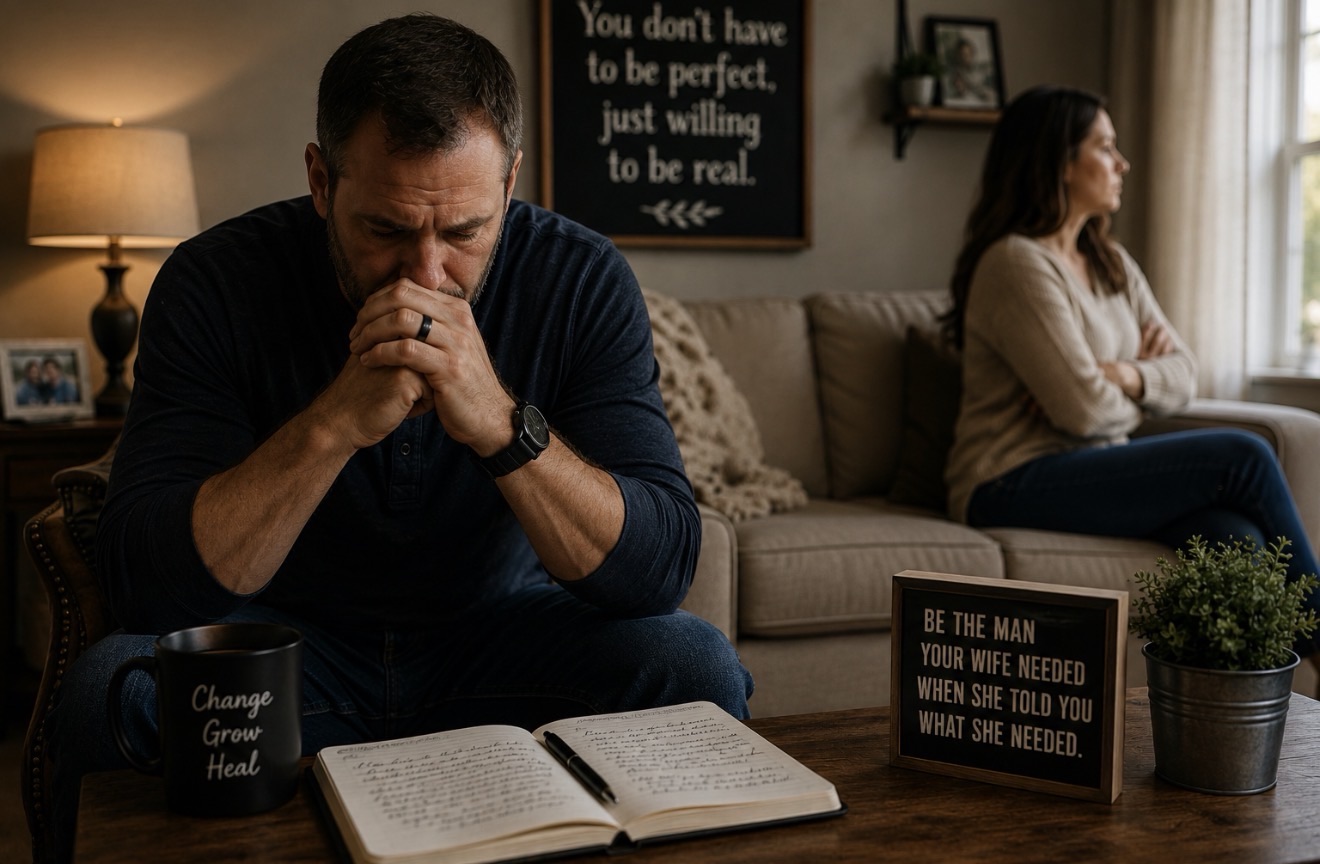
Understanding the Cycle of Relationship Crisis, Temporary Change, Renewed Hope, and Disappointment
Deciding whether to end a marriage is rarely based on one argument, one disappointment, or one difficult season. For many individuals, the desire for divorce develops slowly after months—or even years—of feeling unheard, emotionally neglected, unsupported, dismissed, lonely, or repeatedly disappointed.
The decision may come only after concerns have been expressed many times, promises have been made, opportunities for change have been offered, and hope has repeatedly been restored and lost.
Then something unexpected happens.
When the spouse finally realizes that separation or divorce is no longer an empty possibility—but a genuine decision—they may suddenly begin doing everything their partner had been asking them to do.
They become more attentive.
They communicate.
They show affection.
They help around the home.
They spend more time with the family.
They apologize.
They begin counseling.
They express appreciation.
They make promises.
They become the spouse their partner had needed for years.
Rather than making the decision easier, this sudden improvement may create intense guilt and uncertainty.
The person considering divorce may begin asking:
“How can I leave when they are trying so hard?”
“What if they really have changed this time?”
“What if I am walking away just when our marriage is finally getting better?”
“Am I being selfish?”
“Am I giving up too soon?”
These questions are understandable. However, the current effort cannot be evaluated separately from the history that made divorce feel necessary.
The Relationship Crisis Cycle
In some marriages, the relationship develops a repeating pattern:
Unmet needs → communication of concerns → promises of change → temporary improvement → renewed hope → gradual return to old behaviors → disappointment → emotional exhaustion → discussion of separation or divorce → intense effort → guilt → reconciliation → temporary stability → return to old patterns
Each time the cycle repeats, hope may become more difficult to trust.
The spouse who wants change may initially communicate concerns gently. When little changes, the concerns may be repeated more urgently. Eventually, frustration, emotional distance, resentment, or hopelessness may develop.
Research has identified a related relationship pattern known as demand-withdraw communication. In this pattern, one partner repeatedly seeks discussion, emotional connection, accountability, or change while the other avoids, withdraws, becomes defensive, minimizes the concern, or disengages. Demand-withdraw patterns are associated with relationship distress and other negative individual and relational outcomes. (PMC)
Over time, the partner seeking change may stop asking—not because the problem has been resolved, but because repeated attempts have become emotionally exhausting.
Silence may then be misunderstood as satisfaction.
The other spouse may believe:
“Things have been better lately. We have not been arguing.”
Meanwhile, the emotionally exhausted spouse may be thinking:
“I stopped arguing because I no longer believe anything will change.”
The absence of conflict does not always mean the presence of connection. Sometimes people become quiet because they have lost hope that expressing their needs will make a difference.
Why Does Change Sometimes Begin Only When Divorce Becomes Real?
The possibility of divorce creates an immediate consequence.
Concerns that once seemed distant suddenly become urgent. The spouse may recognize that the marriage, family structure, home, companionship, financial stability, daily routine, identity, or future they assumed would always remain may actually be lost.
This realization can produce fear, grief, regret, urgency, and motivation.
The effort may be sincere.
It is important not to assume that every sudden improvement is intentionally deceptive or manipulative. A spouse may genuinely recognize the seriousness of the situation and sincerely want to change.
However, sincerity in a moment of crisis does not automatically predict consistency after the crisis has passed.
A person can genuinely mean:
“I will do better.”
They may fully believe it when they say it.
The more important question is whether they have developed the insight, accountability, emotional skills, support, and behavioral habits necessary to continue doing better when the immediate fear of divorce decreases.
Fear can motivate action. Fear does not always sustain transformation.
The Difference Between Crisis-Driven Change and Lasting Change
Crisis-driven change often begins with intensity.
There may be dramatic apologies, increased affection, frequent communication, promises, gifts, household involvement, emotional conversations, counseling appointments, or immediate attempts to meet needs that had previously been ignored.
The change may feel powerful because it is so different from the behavior that came before it.
However, intensity and permanence are not the same.
Lasting relationship improvement generally depends less on dramatic gestures and more on repeated habits, communication, accountability, and shared responsibility over time. Relationship improvement is typically built through consistent patterns rather than isolated moments of extraordinary effort. (The Washington Post)
Temporary change often says:
“Tell me what I need to do so you will stay.”
Lasting change asks:
“What have my choices done to you, what do I need to understand, and what must I continue changing whether or not I immediately receive the outcome I want?”
Temporary change may focus primarily on preventing divorce.
Lasting change addresses the patterns that made divorce feel necessary.
Why the Person Considering Divorce May Feel Guilty
Guilt may arise because the current version of the spouse appears different from the version experienced throughout much of the relationship.
The person considering divorce may think:
“They are finally giving me what I asked for. How can I leave now?”
However, this creates an emotional conflict between two realities:
Present reality:
“They are trying very hard.”
Historical reality:
“I have experienced this improvement before, and it did not last.”
Both realities may be true.
The current effort does not erase the previous pain.
The previous pain does not automatically prove that the current effort is false.
The challenge is determining whether the new behavior represents a temporary reaction to loss or the beginning of sustainable change.
Guilt may also develop because the spouse considering divorce is often compassionate. They may see the other person crying, struggling, apologizing, or expressing fear. They may feel responsible for relieving that pain.
However, compassion does not require ignoring one’s own experiences.
A person may care deeply about a spouse’s pain while still acknowledging the pain that led them to consider leaving.
“Why Did It Take Divorce for My Needs to Matter?”
This may be one of the most painful questions within the cycle.
The spouse considering divorce may wonder:
“Why were my tears not enough?”
“Why were years of conversations not enough?”
“Why did I have to become emotionally exhausted before I was heard?”
“Why did losing me become more important than listening to me?”
These questions do not necessarily mean that the other spouse never cared. Some individuals minimize relationship concerns, avoid uncomfortable emotions, resist change, assume the relationship will always remain intact, or fail to understand the seriousness of their partner’s distress.
However, repeated inaction can still cause harm even when harm was not intended.
Intent and impact are different.
A spouse may say:
Caughlin, J. P., & Huston, T. L. (1999). The relationship between the desire for change in one’s partner and marital communication. Communication Monographs, 66(4), 361–378.
“I never intended to make you feel alone.”
The other spouse may truthfully respond:
“But I was still alone.”
Understanding intent may provide context. It does not erase impact.
When Hope Becomes Part of the Cycle
Hope is usually considered positive. In a repeating relationship cycle, however, renewed hope may become one of the reasons the pattern continues.
The spouse improves.
The partner feels hopeful.
The discussion of divorce stops.
The immediate crisis decreases.
Life gradually returns to normal.
The new behaviors become less frequent.
Old habits return.
The same needs remain unmet.
The same pain returns.
Eventually, divorce is discussed again—and the effort begins again.
Each period of improvement may make leaving more difficult because it provides evidence of what the relationship could be.
The painful question becomes:
“If they are capable of being this person now, why could they not continue being this person before?”
Potential can be powerful. However, a relationship cannot survive indefinitely on potential alone.
A person must eventually evaluate the relationship not only by its best moments, but by its most consistent patterns.
Promises Are Not the Same as Patterns
Promises describe intentions.
Patterns demonstrate behavior.
A promise says:
“I will communicate better.”
A pattern demonstrates regular, respectful communication even after conflict decreases.
A promise says:
“I will make you a priority.”
A pattern consistently protects time, connection, emotional presence, and partnership.
A promise says:
“I will go to counseling.”
A pattern attends counseling consistently, participates honestly, accepts feedback, practices new skills, and continues the work when sessions become uncomfortable.
A promise says:
“I will never take you for granted again.”
A pattern expresses appreciation during ordinary life—not only during a relationship emergency.
Words may begin change.
Repeated behavior provides evidence of change.
Questions That May Help Evaluate the Difference
Rather than asking only, “Are they trying?” it may be helpful to consider the following:
- Did the change begin before divorce was mentioned, or only after the possibility of loss became real?
- Has this same period of intense effort occurred before?
- What happened after previous relationship crises ended?
- Is the spouse accepting responsibility without blame, excuses, minimization, or defensiveness?
- Are they interested in understanding the pain they caused, or primarily focused on preventing the divorce?
- Are they making specific behavioral changes rather than offering general promises?
- Are they willing to seek professional help and remain engaged over time?
- Do they respect the other spouse’s need for time, boundaries, or emotional space?
- Does the improvement continue when reassurance is not immediately provided?
- Would the effort likely continue if divorce were no longer being discussed?
- Has enough time passed to distinguish a new pattern from a temporary response?
- Is the relationship becoming emotionally healthier—or merely temporarily calmer?
These questions are not designed to predetermine whether someone should remain married or seek divorce. They are intended to help separate emotional urgency from observable patterns.
What Lasting Change May Look Like
Sustainable change usually becomes visible through consistency.
It may include:
- Accepting responsibility without repeatedly shifting blame
- Listening without immediately becoming defensive
- Demonstrating empathy for the spouse’s experience
- Following through without needing reminders
- Continuing counseling after the immediate crisis has passed
- Changing behavior even when no praise or reassurance is received
- Respecting boundaries
- Developing healthier communication skills
- Addressing underlying issues rather than only reducing immediate conflict
- Recognizing that trust may require time to rebuild
- Understanding that forgiveness does not automatically restore trust
- Continuing the work even when reconciliation is uncertain
Research on distressed relationships emphasizes that recurring communication patterns can become self-reinforcing. Changing the relationship therefore requires more than one partner briefly behaving differently; it requires sustained changes in how both partners communicate, respond, repair conflict, and address unmet needs. (PMC)
Change Does Not Create an Immediate Obligation to Stay
When a spouse begins trying, the other spouse may feel obligated to immediately forgive, trust, reconcile, withdraw the request for divorce, or return emotionally to the marriage.
However, effort does not create an automatic obligation.
The spouse who has been hurt may need time to determine whether the change is sustainable.
Trust is not rebuilt because someone promises that the future will be different.
Trust is rebuilt when repeated experiences gradually provide evidence that the future may be different.
The spouse making changes may say:
“What else do I have to do to prove myself?”
The answer may not be another dramatic action.
The answer may simply be:
“Continue.”
Continue when the fear decreases.
Continue when the divorce conversation is no longer happening every day.
Continue when life becomes ordinary.
Continue when no one is watching.
Continue when change is inconvenient.
Continue after the dust settles.
Consistency is what allows change to become believable.
A Necessary Distinction: Relationship Cycles Are Not Automatically Abuse Cycles
A repeating pattern of neglect, conflict, temporary improvement, and disappointment should not automatically be labeled an “abuse cycle.”
Many distressed relationships involve unhealthy communication, avoidance, emotional disconnection, broken promises, or inconsistent effort without involving abuse.
The cycle of violence is a specific framework associated with abusive relationships and has traditionally included phases involving increasing tension, abusive incidents, and periods of reconciliation or calm. (PMC)
Therefore, relationship disappointment and abuse should not be treated as interchangeable.
However, if the relationship includes intimidation, threats, coercive control, physical violence, sexual coercion, stalking, financial control, isolation, fear, or retaliation for attempting to leave, the situation requires a safety-focused assessment rather than ordinary couples communication strategies. Research indicates that coercive control can significantly influence the severity and impact of intimate partner violence. (PMC)
In those situations, safety should take priority over preserving the relationship.
Couples Counseling May Help Clarify the Pattern
Couples counseling does not have to begin with the assumption that the marriage must remain together.
Therapy may help partners:
- Identify repeating relationship patterns
- Understand unmet emotional needs
- Improve communication
- Examine accountability
- Develop measurable behavioral changes
- Rebuild trust when appropriate
- Determine whether reconciliation is realistic
- Establish healthier boundaries
- Make thoughtful decisions about the future
Counseling may also help couples separate more respectfully when reconciliation is not possible or healthy.
However, couples counseling is not always appropriate when active abuse, coercive control, intimidation, or fear prevents honest participation. Those situations may require specialized individual support and safety planning.
The Question Is Not Only, “Are They Trying Now?”
Current effort matters.
It should not automatically be dismissed.
People can change.
Marriages can heal.
Partners can recognize their failures, develop healthier skills, rebuild trust, and create relationships that are different from what existed before.
But change should not be evaluated only by how intensely someone responds when they are afraid of losing the relationship.
The larger question is:
“Has the pattern changed—or has the fear of consequences temporarily changed the behavior?”
A few good days may provide hope.
A few good weeks may demonstrate effort.
Sustained accountability and consistent behavior over time provide stronger evidence of change.
The spouse considering divorce does not have to ignore present effort.
They also do not have to erase the past in order to acknowledge the present.
Both truths may exist:
“I see that you are trying.”
And:
“I am afraid because I have seen this effort disappear before.”
Ultimately, the decision is not only about who a spouse becomes when the marriage is at risk.
It is also about who they consistently choose to be after the crisis has passed.
Final Thought
Sometimes the most difficult part of considering divorce is not leaving someone who refuses to change.
It is deciding what to do when they finally become everything you needed—but only after you became willing to leave.
The question may no longer be:
“Do I believe they are trying?”
The question may become:
“Has enough changed, for long enough, and with enough accountability for me to safely trust that this time will be different?”
Current effort deserves acknowledgment.
Past experience deserves consideration.
Future trust requires consistency.
About the Author
John S. Collier, MSW, LCSW, is a Licensed Clinical Social Worker with more than 25 years of experience in behavioral health and human services. He is the founder and Executive Director of Southeast Kentucky Behavioral Health, LLC, where he provides clinical leadership and works to improve access to quality behavioral-health services and supports throughout Kentucky.
Throughout his career, John has worked with individuals, couples, families, children, and adults experiencing relationship difficulties, emotional distress, behavioral challenges, significant life transitions, grief, trauma, anxiety, depression, and other complex circumstances. His professional work emphasizes compassion, personal responsibility, healthy communication, emotional awareness, meaningful behavioral change, and the importance of recognizing the difference between intentions, promises, and consistent actions.
As a therapist, writer, educator, and speaker, John seeks to help people better understand the thoughts, emotions, experiences, and relationship patterns that influence their lives. His writing combines professional knowledge with practical insight and personal reflection to encourage readers to examine difficult experiences with honesty, empathy, and hope.
John believes that healthy relationships are not sustained by words spoken during moments of fear or crisis. They are strengthened through accountability, emotional safety, mutual respect, open communication, shared effort, and consistent actions demonstrated during the ordinary moments of everyday life.
His educational articles are intended to encourage reflection, promote meaningful conversations, and help individuals make thoughtful, informed, and values-based decisions regarding their relationships, emotional well-being, and personal growth.
References
Here is a corrected, alphabetized APA 7th edition reference list for the article:
References
Caughlin, J. P., & Vangelisti, A. L. (1999). Desire for change in one’s partner as a predictor of the demand-withdraw pattern of marital communication. Communication Monographs, 66(1), 66–89. doi:10.1080/03637759909376462
Dichter, M. E., Thomas, K. A., Crits-Christoph, P., Ogden, S. N., & Rhodes, K. V. (2018). Coercive control in intimate partner violence: Relationship with women’s experience of violence, use of violence, and danger. Psychology of Violence, 8(5), 596–604. doi:10.1037/vio0000158
Leo, K., Crenshaw, A. O., Hogan, J. N., Bourne, S. V., Baucom, K. J. W., & Baucom, B. R. W. (2021). A replication and extension of the interpersonal process model of demand-withdraw behavior: Incorporating subjective emotional experience. Journal of Family Psychology, 35(4), 534–545. doi:10.1037/fam0000802
Papp, L. M., Kouros, C. D., & Cummings, E. M. (2009). Demand-withdraw patterns in marital conflict in the home. Personal Relationships, 16(2), 285–300. doi:10.1111/j.1475-6811.2009.01223.x
Sangeetha, J., Mohan, S., Hariharasudan, A., & Nawaz, N. (2022). Strategic analysis of intimate partner violence and the cycle of violence in the autobiographical text When I Hit You. Heliyon, 8(6), Article e09727. doi:10.1016/j.heliyon.2022.e09727