Welcome to SOUTHEAST KENTUCKY BEHAVIORAL HEALTH
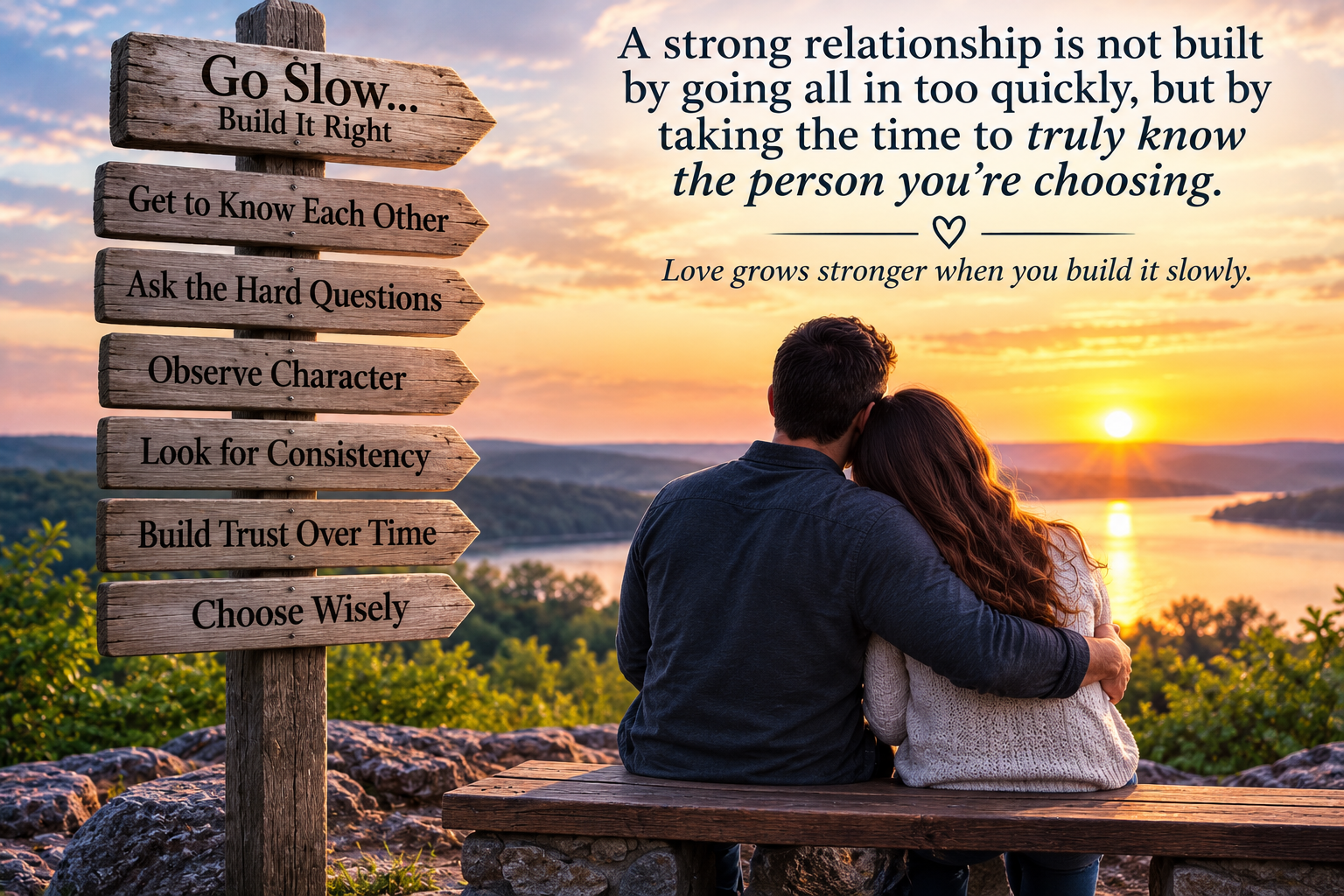
Going All In: The Hidden Risks of Rushing Into a Relationship

There is something undeniably romantic about the phrase “going all in.” Movies celebrate it. Love songs glorify it. Friends often admire people who seem fearless enough to dive headfirst into love. We are told that real love requires vulnerability, commitment, and complete investment.

While commitment is essential for a healthy relationship, there is an important distinction between healthy commitment and premature emotional investment. One is built on knowledge, trust, and experience. The other is often built on hope, attraction, and assumptions.

Many relationships don’t fail because two people were incompatible. They fail because they became emotionally committed long before they truly knew one another.


The Difference Between Attraction and Knowledge

Attraction happens quickly. Knowledge takes time. During the first weeks or months of dating, we naturally see the best version of another person. Psychologists sometimes refer to this as the honeymoon phase, where the brain is flooded with dopamine, oxytocin, and other neurochemicals that create excitement, optimism, and emotional attachment (Fisher, 2004). Unfortunately, these same chemicals can reduce our ability to evaluate a relationship objectively.

When people “go all in” too quickly, they often mistake:

  • Chemistry for compatibility
  • Passion for stability
  • Attention for commitment
  • Potential for reality

Those are not the same things.


We Fall in Love With Who We Think They Are

One of the greatest dangers of rushing a relationship is that we begin filling in the blanks ourselves. Instead of learning who someone truly is, we imagine who they could become. We overlook inconsistencies. We excuse red flags.

We create explanations for behaviors we don’t fully understand. Psychologists call this idealization—seeing another person through the lens of hope rather than reality (Murray, Holmes, & Griffin, 1996). The problem is that relationships are built on reality, not imagination. Eventually, every relationship moves from fantasy to reality. When that happens, many people don’t feel like their partner changed. Instead, they finally see what was there all along.


Emotional Investment Changes Your Judgment

Imagine buying a house. Would you purchase it after walking through the front door for five minutes? Probably not. You would inspect the foundation. Look at the roof. Check for water damage. Review the neighborhood. Ask difficult questions. Relationships deserve at least that much careful consideration. Yet emotionally, many people commit after only a handful of exciting conversations. Once we become emotionally invested, our brains begin protecting that investment.

Instead of asking, “Is this the right person?”

we begin asking, “How can I make this work?”

Those are completely different questions.


The Cost of Ignoring Red Flags

Red flags rarely appear as dramatic warning signs. Most begin as small moments. Perhaps they become irritated when they don’t get their way. Maybe they avoid accountability. Perhaps they speak disrespectfully about former partners. Maybe they struggle with honesty. Perhaps they become controlling in subtle ways. Someone who rushes into commitment often dismisses these concerns because the emotional reward feels greater than the potential risk. Unfortunately, ignored patterns rarely disappear. They usually become stronger. Dating is not primarily about convincing someone to stay. It is about discovering whether staying would be wise.


Love Needs Observation

Healthy relationships require curiosity. Observe how someone handles disappointment. Observe how they manage stress. Observe how they treat people who have nothing to offer them. Observe how they speak about family. Observe whether their words consistently match their actions. Character reveals itself over time. No conversation can replace experience. No promise can replace consistency. No chemistry can replace integrity.


Why Slow Relationships Often Last Longer

Research consistently suggests that relationships built gradually often develop stronger foundations because trust is earned rather than assumed (Stanley, Rhoades, & Markman, 2006). People sometimes fear moving slowly because they worry someone else will “take” the person they’re dating. Ironically, healthy people generally respect appropriate pacing. Individuals who pressure immediate commitment often reveal more about their own insecurity than about their love. Real intimacy grows. It cannot be rushed.


The Difference Between Commitment and Surrender

Healthy commitment says: “I’m choosing you because I know who you are.”

Unhealthy surrender says: “I’m choosing you because I hope you’ll become who I need.”

One is based on evidence. The other is based on emotion. One grows stronger over time. The other becomes increasingly fragile.


Questions Worth Asking Yourself

Before going “all in,” consider asking yourself:

  • What do I actually know about this person’s character?
  • Have I seen them during conflict?
  • How do they respond when they don’t get what they want?
  • Do their actions consistently match their words?
  • Am I attracted to who they are today or who I hope they’ll become?
  • If nothing about this person ever changed, would I still choose this relationship five years from now?

These questions may not feel romantic, but they are deeply loving—because they protect both people from building a relationship on unrealistic expectations.


A Better Way to Love

Moving slowly does not mean loving less. It means loving wisely. Healthy relationships are not races.

They are discoveries. Every shared experience reveals another layer of a person’s character. Trust is built 0through repeated consistency. Respect grows through mutual understanding. Love deepens through truth rather than fantasy.

Going “all in” is admirable when it follows genuine knowledge of another person. Going all in before you truly know someone is less an act of courage than a gamble. The strongest relationships are rarely built by those who rushed toward commitment. They are built by two people who allowed time to reveal character, chose honesty over fantasy, and discovered that lasting love is not found by moving faster—it is found by building a foundation strong enough to support a lifetime.


About the Author

John S. Collier, MSW, LCSW-S is a licensed clinical social worker, therapist, author, and educator with extensive experience helping individuals, couples, and families navigate relationship challenges, anxiety, trauma, and emotional well-being. Throughout his career, he has worked with people from diverse backgrounds, combining evidence-based psychological principles with practical, real-world applications that readers can immediately apply to their daily lives.

John’s writing bridges the gap between academic research and everyday experience, making complex psychological concepts understandable and useful. His work emphasizes emotional maturity, healthy communication, personal responsibility, and building relationships founded on trust, authenticity, and mutual respect. Whether writing about mental health, family dynamics, leadership, or personal growth, his goal is to provide readers with insights that encourage lasting change and healthier, more meaningful lives.

References

Fisher, H. (2004). Why We Love: The Nature and Chemistry of Romantic Love. Henry Holt.

Murray, S. L., Holmes, J. G., & Griffin, D. W. (1996). The benefits of positive illusions: Idealization and the construction of satisfaction in close relationships. Journal of Personality and Social Psychology, 70(1), 79–98.

Stanley, S. M., Rhoades, G. K., & Markman, H. J. (2006). Sliding versus deciding: Inertia and the premarital cohabitation effect. Family Relations, 55(4), 499–509.

Gottman, J. M., & Silver, N. (2015). The Seven Principles for Making Marriage Work (Revised ed.). Harmony Books.


Grieving Someone Who Is Still Alive

When the Person Is Gone from Your Life but Still Walking Through Theirs

Article 4: Part of the Healing After Heartbreak Series


They Didn’t Die. They Just Left.

There is a unique kind of grief that few people talk about. It comes when someone you deeply loved is still alive, still breathing, still going to work, still laughing with friends, still posting pictures online—but they are no longer part of your life.

There was no funeral. No obituary. No gathering where people came together to honor the loss. Instead, there was a text message. A difficult conversation. A signed divorce decree. Or perhaps there was nothing at all except silence.

People around you may expect you to move on quickly because “they’re still alive.” But your heart doesn’t measure loss by whether someone is living. It measures loss by absence. It knows that the person who once shared your mornings, your dreams, your holidays, and your future is suddenly gone from your everyday life. That absence is real. And it deserves to be grieved.


A Different Kind of Grief

Most people understand the grief that follows death. Society has rituals for it. Friends send flowers. Employers offer bereavement leave. Neighbors bring meals. There is an understanding that healing will take time.

Relationship loss is different.

Often, people tell you to “get over it,” “find someone else,” or “everything happens for a reason.” While those words may be well-intentioned, they can unintentionally minimize a very real loss. Psychologist Pauline Boss introduced the concept of ambiguous loss, describing situations in which someone is physically present but psychologically or emotionally absent from our lives (Boss, 1999). Although her work often focused on families dealing with dementia, addiction, or missing loved ones, the concept also helps explain why the end of a significant relationship can feel so confusing. The person still exists, but the relationship you once depended on does not. Your heart struggles because there is no clear ending.

There is simply…absence.


You Aren’t Just Grieving a Person

When relationships end, we often believe we are grieving only the individual. In reality, we are grieving much more than that. You are grieving the future you imagined.

You are grieving the traditions you thought you would build together. The vacations you planned but never took. The anniversaries that will never be celebrated. The conversations you assumed you would have twenty years from now. Sometimes the deepest pain isn’t remembering what happened. It’s realizing what will never happen. That realization can feel overwhelming because it requires letting go of a future that once felt certain.


Imagine This

Imagine spending months planning the home of your dreams. You carefully choose the floor plan, the paint colors, and where the furniture will go. You picture birthdays around the dining room table, Christmas mornings in the living room, and quiet evenings on the back porch. Then, just before construction begins, the project is canceled. The house never exists. Yet you still grieve it.

Why?

Because your mind had already begun living there.

Relationships work the same way. Long before the future arrives, we emotionally move into it. We begin decorating it with hopes, dreams, and expectations. When the relationship ends, it isn’t just today’s happiness that disappears. It is the imagined future that disappears with it.


Why Certain Moments Hurt So Much

One of the most confusing parts of healing is that grief often arrives without warning. You may be doing well for several days, feeling hopeful and optimistic, when suddenly you hear your song playing in a restaurant. A familiar cologne passes by in a crowded store. Someone laughs exactly the way they did.

In an instant, your emotions rush back. Many people interpret these moments as setbacks. They aren’t.

Our brains naturally connect emotions to sights, sounds, smells, and places. Those memories become part of the brain’s filing system. When something familiar appears, it temporarily reopens that file. That doesn’t mean you are moving backward. It simply means your brain remembers. Over time, those emotional reactions usually become less intense, even though the memories remain.


A Story That May Feel Familiar

After twelve years of marriage, Robert found himself eating dinner alone for the first time in decades.

For weeks, he continued setting two plates on the table before catching himself. Every Friday evening he automatically drove toward the neighborhood where they used to meet friends for dinner. He wasn’t consciously trying to relive the past. His life had simply followed those routines for so many years that his mind continued them without asking permission.

One evening, instead of driving to the familiar restaurant, he stopped at a small local café he had never visited before. He brought a book, ordered something different, and sat quietly by the window. It wasn’t a magical moment. He still missed her. He still cried on the drive home. But something important happened that evening.

For the first time since the separation, he created a memory that belonged only to him. Healing often begins that way—not with dramatic breakthroughs, but with small moments that slowly become the foundation of a new life.


Therapist’s Note

One of the greatest misconceptions about grief is believing that healing means you stop loving someone. It doesn’t. You can appreciate what a relationship once meant while also accepting that it no longer belongs in your future. Acceptance is not betrayal. Acceptance is giving yourself permission to keep living.


A Healing Exercise: Saying Goodbye to the Future You Imagined

Tonight, find a quiet place with a journal or a blank sheet of paper. Write a letter—not to the person—but to the future you thought you were going to have. Describe the life you imagined together. Write about the dreams, the plans, the traditions, and the milestones that now feel lost. Don’t worry about grammar or saying the “right” thing. Simply let your heart speak honestly. When you finish, begin a second paragraph with these words:

“Although that future is gone, I still have the opportunity to create a meaningful life, and my next step is…”

Complete the sentence. Don’t try to write the rest of your life story. Just write the next step. Healing rarely requires us to know the entire journey. It simply asks us to take the next faithful step.


Final Thoughts

Perhaps the hardest part of grieving someone who is still alive is accepting that closure rarely arrives the way we hope it will. Sometimes there is no final conversation. No apology. No explanation that suddenly makes everything make sense. Sometimes healing begins when we stop waiting for someone else to provide closure and begin creating it ourselves. Your story did not end because this relationship did. There are still chapters left to write. New friendships to build. New places to explore. New laughter waiting to be discovered. And one day, when you look back, you may realize that while losing them changed your life, it did not define it. Your future is still waiting.


About the Author

John S. Collier, MSW, LCSW-S is a Licensed Clinical Social Worker and Executive Director of Southeast Kentucky Behavioral Health, LLC. With more than 25 years of experience in behavioral health, grief counseling, and relationship therapy, he has helped countless individuals navigate loss, rebuild their lives, and discover hope after heartbreak. His writing combines evidence-based psychology with compassionate, practical guidance to help readers heal one step at a time.


References

Boss, P. (1999). Ambiguous Loss: Learning to Live with Unresolved Grief. Harvard University Press.

Boss, P. (2006). Loss, Trauma, and Resilience: Therapeutic Work with Ambiguous Loss. W. W. Norton & Company.

Neimeyer, R. A. (2016). Techniques of Grief Therapy: Assessment and Intervention. Routledge.

Worden, J. W. (2018). Grief Counseling and Grief Therapy (5th ed.). Springer Publishing.


Series Reminder

Healing doesn’t mean forgetting. It means carrying yesterday without letting it steal tomorrow.

Grieving the Future You Thought You Would Have

Why Losing a Dream Can Hurt as Much as Losing a Person


Imagine This…

Imagine walking into an empty house.

The walls are bare. The rooms are quiet. There are no family pictures. No laughter. No smell of dinner cooking.

But in your mind, the house is full.

You see birthday parties in the living room. Christmas mornings around the tree. Quiet evenings sitting together on the porch. You picture growing old with the person you love.

Then one conversation changes everything. The future you imagined is suddenly gone. Now you are not only grieving the person you loved. You are grieving the life you thought you were going to have. That kind of pain is real.


Why Does This Hurt So Much?

When we fall in love, our minds naturally begin thinking about tomorrow. We imagine holidays together. We talk about places we want to visit. We dream about growing old side by side. We picture birthdays, anniversaries, and family traditions.

Our brain starts treating those dreams like they are already part of our life. When the relationship ends, we lose more than the person. We also lose the future we believed was coming. That is why heartbreak often feels much bigger than people expect.


Your Brain Is Trying to Make Sense of It

Our brains like certainty. They want to know what tomorrow will look like. When we feel safe with someone, our brain begins filling in the blanks. It says things like:

“We’ll always be together.”

“We’ll get married someday.”

“We’ll grow old together.”

Those thoughts feel real because we repeat them over and over. When the relationship ends, our brain suddenly has to erase a future it had already accepted. That takes time.


The Difference Between Reality and the Story We Tell Ourselves

There is an important difference between facts and assumptions. A fact is something that really happened. An assumption is something we believed would happen.

For example:

Fact: You loved someone.

Fact: You spent time planning a future together.

Assumption: Everything would work out exactly as you imagined. Many people spend months grieving the assumptions more than the facts. That does not make them weak. It makes them human.


We Sometimes Fall in Love with Tomorrow

Most people do not realize they are doing it. We begin to love birthdays that have never happened. We miss vacations we never took. We grieve children that were never born. We cry over conversations that never happened.

We mourn a retirement beside someone who may never have been there. Those dreams mattered because they gave us hope. Hope is powerful. When hope is broken, our hearts feel broken too.


Be Careful Not to Rewrite the Past

When we are hurting, we often remember only the good moments. We forget the disagreements. We forget the red flags. We forget the hard conversations. Our mind tries to protect us by showing us only the happiest memories. That is normal. But healing requires us to remember the whole story—not just the parts we wish had lasted forever.


A Simple Exercise

Take out a piece of paper. Draw a line down the middle. On one side write Facts. On the other side write Assumptions.

For example:

Facts

Assumptions

We loved each other.

We would grow old together.

We talked about marriage.

We were guaranteed to marry.

We planned a future.

That future was certain.

The relationship ended.

I will never be happy again.

When you finish, read only the facts.

You may notice that many of the thoughts causing the deepest pain are assumptions, not reality.

That does not make your pain less real.

It simply helps your mind separate what happened from what you feared losing.


Healing Takes Time

You cannot force your heart to stop hurting. You cannot flip a switch and move on. Healing happens one day at a time. Some mornings you will feel strong. Other mornings you may feel like you are starting over. That is okay. Healing is not a straight line. It is a journey. Keep taking the next step.

Eventually, the future you thought you lost will slowly make room for a new future you never expected.


Final Thoughts

One of the hardest parts of heartbreak is realizing that you are not only grieving a person. You are grieving birthdays that never happened. Anniversaries that were never celebrated. Dreams that never became memories. But remember this.

Just because one future ended does not mean your story is over. God is still writing the chapters you have not read yet. And sometimes the pages you never expected become the most beautiful part of the story.


About the Author

John S. Collier, MSW, LCSW-S, is a Licensed Clinical Social Worker Supervisor and Executive Director of Southeast Kentucky Behavioral Health, LLC. With more than 25 years of experience in behavioral health, he has worked with individuals and families facing grief, trauma, anxiety, depression, relationship struggles, and life transitions. His writing combines clinical research with everyday language to help people better understand their emotions, develop healthy coping skills, and find hope during life’s most difficult seasons.


References

American Psychiatric Association. (2022). Diagnostic and statistical manual of mental disorders (5th ed., text rev.; DSM-5-TR). American Psychiatric Association Publishing.

Beck, J. S. (2021). Cognitive behavior therapy: Basics and beyond (3rd ed.). Guilford Press.

Bowlby, J. (1980). Attachment and loss: Vol. 3. Loss: Sadness and depression. Basic Books.

Neimeyer, R. A. (2016). Techniques of grief therapy: Assessment and intervention. Routledge.

Stroebe, M., Schut, H., & Boerner, K. (2017). Cautioning health-care professionals: Bereaved persons are misguided through the stages of grief. Omega: Journal of Death and Dying, 74(4), 455–473.


Are Men Loved Unconditionally? A Balanced Examination of Love, Expectations, and Human Relationships

The statement “men are not loved unconditionally” has gained significant attention in conversations about masculinity, relationships, and emotional health. Many men report feeling valued primarily for what they provide—financial security, emotional stability, protection, problem-solving, or status. At the same time, critics of this viewpoint argue that both men and women experience conditions in relationships and that healthy love is inherently reciprocal rather than unconditional. The truth likely exists somewhere between these extremes. Understanding this issue requires examining psychology, sociology, attachment theory, and cultural expectations surrounding gender.

Understanding Conditional vs. Unconditional Love

Unconditional love refers to caring for another person without requiring them to meet certain standards or expectations to receive affection or acceptance. It is often described in parent-child relationships, particularly between caregivers and infants, where love is ideally offered regardless of performance or achievement (Bowlby, 1988). In adult romantic relationships, however, unconditional love becomes more complex.

Most healthy adult relationships include some level of conditionality. People generally expect mutual respect, trust, emotional availability, faithfulness, and effort. A spouse who becomes abusive, chronically dishonest, or emotionally unavailable may find that love alone is insufficient to sustain the relationship. In this sense, romantic love is often conditional for both men and women because relationships involve boundaries and reciprocal investment (Gottman & Silver, 2015).

However, the question many men ask is not whether relationships have expectations, but whether men are uniquely valued for utility rather than emotional existence.

Why Many Men Feel Loved Conditionally

Many men report feeling that affection and admiration are tied to what they can do rather than who they are. Research suggests men often experience social pressure to fulfill traditional masculine roles such as provider, protector, leader, and emotional stabilizer (Mahalik et al., 2003). These expectations can create the perception that love and respect are dependent on performance.

For example, studies have shown that financial instability and unemployment can affect men’s relationship satisfaction and even marital stability more significantly than women’s in some contexts (Bertrand, Kamenica, & Pan, 2015). Men frequently report internalizing the belief that they must remain strong, productive, and emotionally composed in order to maintain attractiveness or value within relationships.

Socialization may also contribute to this perception. Boys are often encouraged to suppress vulnerable emotions with messages such as “man up,” “don’t cry,” or “be strong.” Over time, this can create emotional isolation and reinforce the idea that their struggles are tolerated only when they do not interfere with functioning (Levant, 2011). As a result, some men may feel emotionally supported only when they are successful or useful.

Psychologist Ronald Levant’s work on traditional masculinity highlights how restrictive emotional norms can lead men to feel disconnected from emotional intimacy, increasing depression, loneliness, and relational dissatisfaction (Levant & Richmond, 2007).

The Counterargument: Love Is Conditional for Everyone

While many men feel conditionally loved, researchers caution against oversimplifying the issue. Women also frequently report pressures tied to appearance, nurturing ability, emotional labor, and caregiving expectations. Many women experience fears of being valued primarily for youth, beauty, or emotional caregiving (Fredrickson & Roberts, 1997).

From a psychological perspective, romantic love generally involves mutual expectations because partnerships require cooperation. Healthy relationships are not typically unconditional in the way parental love ideally aspires to be. Rather, they are based on what researchers describe as secure attachment, where both partners consistently demonstrate trust, responsiveness, and emotional safety (Johnson, 2019).

In securely attached relationships, individuals are valued not merely for what they contribute but for who they are as people. Partners may experience seasons of unemployment, illness, grief, emotional struggle, or personal failure while still receiving love and support. This suggests that although adult love may contain conditions related to behavior and safety, it does not necessarily depend solely on performance or utility.

Additionally, some scholars argue that men may underreport emotional support due to cultural norms discouraging emotional awareness or vulnerability. Because men are less likely to seek emotional connection openly, they may unintentionally miss opportunities for deeper relational intimacy (Addis & Mahalik, 2003).

A More Accurate Question

Perhaps the better question is not “Are men loved unconditionally?” but rather “Do men feel emotionally safe enough to experience love fully?”

Many men long to be accepted during moments of weakness, grief, failure, fear, or uncertainty. They want reassurance that they are valued beyond achievement, income, or strength. Likewise, many women desire to be valued beyond appearance, caregiving, or emotional support. In this way, the human longing may be more universal than gender-specific.

Healthy love often exists somewhere between unconditional acceptance and reasonable expectations. Love may not be unconditional in the literal sense, but it can be deeply compassionate, forgiving, and enduring. Healthy relationships involve mutual grace—where both people are allowed to be imperfect without fearing abandonment at every failure.

Conclusion

The belief that men are not loved unconditionally reflects a real emotional experience for many men, especially those who have felt valued mainly for provision, protection, or performance. Research supports the idea that traditional masculine expectations can contribute to feelings of conditional worth and emotional isolation. However, evidence also suggests that romantic relationships are naturally reciprocal and contain expectations for both genders.

Rather than viewing love as entirely conditional or unconditional, a healthier perspective may recognize that strong relationships thrive when people are valued for both who they are and how they contribute. Men, like women, benefit most from relationships where vulnerability is safe, effort is appreciated, and love persists through hardship—not because someone is perfect, but because they are deeply known.

About the Author

John S. Collier, MSW, LCSW, is a licensed clinical social worker and behavioral health professional with experience helping individuals and families navigate relationships, emotional healing, trauma, communication, and personal growth. His work emphasizes practical insight, emotional honesty, and strengthening healthy interpersonal connections.

References

Addis, M. E., & Mahalik, J. R. (2003). Men, masculinity, and the contexts of help seeking. American Psychologist, 58(1), 5–14.

Bertrand, M., Kamenica, E., & Pan, J. (2015). Gender identity and relative income within households. The Quarterly Journal of Economics, 130(2), 571–614.

Bowlby, J. (1988). A secure base: Parent-child attachment and healthy human development. Basic Books.

Fredrickson, B. L., & Roberts, T. A. (1997). Objectification theory. Psychology of Women Quarterly, 21(2), 173–206.

Gottman, J., & Silver, N. (2015). The seven principles for making marriage work. Harmony Books.

Johnson, S. M. (2019). Attachment theory in practice: Emotionally focused therapy (EFT) with individuals, couples, and families. Guilford Press.

Levant, R. F. (2011). Research in the psychology of men and masculinity using the gender role strain paradigm. American Psychologist, 66(8), 765–776.

Levant, R. F., & Richmond, K. (2007). A review of research on masculinity ideologies. Psychology of Men & Masculinity, 8(3), 130–140.