From author and licensed clinical social worker John S. Collier comes a powerful new series of books exploring love, loss, faith, emotional healing, and personal growth. With honesty shaped by both professional experience and a life marked by hardship, perseverance, and grace, Collier invites readers to examine the hidden places of the heart. Each book blends practical wisdom with vivid metaphor, offering encouragement to those learning to release the past, rebuild their identity, establish healthier relationships, and trust God through uncertain seasons. This is more than a collection of books—it is a journey from merely surviving life’s storms to discovering the strength, purpose, and peace needed to live fully again.
https://a.co/d/0gTmck1t
Expressions from Behind His Silence: Valume 3: Thwe Mercy of Open Hands
Some endings do not arrive with anger. They arrive with open hands.
The Mercy of Open Hands, Volume Three of the Expressions from Behind His Silence series, follows a man through heartbreak, acceptance, forgiveness, and the difficult grace of release.
Through intimate, reflective poetry, John S. Collier explores what it means to love someone without possessing them, to carry grief without becoming bitter, and to let go without denying that the love was real.
These poems speak to the moment when holding on begins to wound more than losing—and to the quiet courage required to choose peace.
This collection is for anyone learning that surrender is not weakness, forgiveness does not erase the past, and sometimes the most loving thing the heart can do is open its hands.
There is a significant difference between wanting a wife and wanting to be a husband.
At first, those two desires may sound almost identical. After all, a man cannot ordinarily become a husband without a wife. Yet from a biblical perspective, the distinction is found in the direction of a man’s attention. One desire can focus primarily on what he hopes to receive from a woman, while the other focuses on the kind of man he must become before God.
A man may want companionship, affection, intimacy, encouragement, children, a home, emotional support, or simply someone with whom to share his life. None of these desires are inherently wrong. Scripture itself recognizes the goodness of companionship. When God looked upon Adam, He said:
“It is not good that man should be alone; I will make him a helper comparable to him.” — Genesis 2:18, NKJV
Marriage is God’s good creation. But Scripture calls a man to something deeper than simply finding the right woman. It calls him to become a man capable of covenant, sacrifice, faithfulness, service, responsibility, and enduring love.
The question, therefore, is not merely:
“What kind of wife do I want?”
A spiritually mature man must also ask:
“What kind of husband am I becoming?”
That difference changes everything.
Wanting a Wife Can Begin With What He Wants to Receive
When a man says, “I want a wife,” he may be thinking about the qualities he hopes to find. He wants
someone loving.
Someone faithful.
Someone attractive.
Someone who respects him.
Someone who encourages him.
Someone who shares his values.
Someone who will build a home with him.
Someone who will remain beside him when life becomes difficult.
Again, these are not necessarily selfish desires. Proverbs declares:
“He who finds a wife finds a good thing, and obtains favor from the Lord.” — Proverbs 18:22, NKJV
A good wife is described as something valuable. Proverbs 31:10 asks, “Who can find a virtuous wife? For her worth is far above rubies.”
But there is a danger when a man’s entire understanding of marriage revolves around what the woman will bring into his life. He may create a long list describing the woman he wants while never creating an equally demanding list describing the man he needs to become.
He wants her to be faithful—but is he practicing faithfulness?
He wants her to communicate—but has he learned to listen?
He wants her to respect him—but does he behave honorably?
He wants her to control her emotions—but has he learned self-control?
He wants her to support his dreams—but is he prepared to support hers?
He wants her to forgive his mistakes—but is he gracious when she makes mistakes?
He wants her to make sacrifices—but is he prepared to sacrifice himself?
It is possible to desire the benefits of marriage without preparing for the responsibilities of marriage. That is the difference.
A Man Who Wants to Be a Husband Looks Inward First
A man who truly wants to become a husband begins asking different questions. Instead of only asking, “Is she ready for marriage?”, he asks, “Am I?” Instead of constantly evaluating her character, he evaluates his own. He understands Jesus’ teaching concerning self-examination:
“And why do you look at the speck in your brother’s eye, but do not consider the plank in your own eye?” — Matthew 7:3, NKJV
Applied to relationships, this principle is powerful. Before demanding maturity from someone else, examine your own maturity. Before demanding loyalty, examine your loyalty. Before demanding respect, examine whether you are living respectably. Before demanding communication, examine how you communicate. Before demanding emotional stability, examine your own emotional responses. The man preparing to become a husband realizes that marriage does not magically produce maturity. Marriage frequently reveals the maturity—or immaturity—that was already present.
A Husband Is Called to Covenant
Modern culture can sometimes approach relationships from a consumer perspective: Does this person still make me happy? Am I getting what I want? Is this relationship meeting my expectations? Biblical marriage uses a different framework.
Covenant.
Malachi describes marriage in covenantal terms:
“Yet she is your companion and your wife by covenant.” — Malachi 2:14, NKJV
A covenant mentality asks something deeper than, “What am I getting?”
It asks, “What have I promised?”
That does not mean tolerating abuse, danger, or every form of destructive behavior. Nor does it eliminate biblical and legal circumstances in which separation may become necessary. Rather, it means that healthy marriage is not designed to operate as a disposable arrangement abandoned whenever inconvenience appears.
A man who wants merely a wife may dream primarily about the wedding.
A man preparing to be a husband thinks about the covenant after the wedding.
He thinks about year five.
Year fifteen. Year thirty. Sickness. Financial pressure. Children. Loss.
Aging parents. Career changes. Disappointment. Conflict. Forgiveness. Growing old together
He understands that marriage is not simply finding someone with whom he can enjoy good days. It is covenanting with someone with whom he intends to walk through difficult ones.
A Husband Is Called to Sacrificial Love
Perhaps Scripture’s strongest instruction to husbands appears in Ephesians:
“Husbands, love your wives, just as Christ also loved the church and gave Himself for her.” — Ephesians 5:25, NKJV
Notice the standard. Paul does not merely say, “Husbands, love your wives when they are easy to love.” He points toward Christ. Christ’s love was demonstrated through sacrifice. Therefore, biblical husbandhood cannot simply mean authority, privilege, or having someone meet a man’s needs. Whatever one’s understanding of marital leadership may be, Ephesians places a staggering responsibility upon the husband: his model is the self-giving love of Jesus Christ.
Biblical leadership is therefore inseparable from service. Jesus taught:
“And whoever desires to be first among you, let him be your slave—just as the Son of Man did not come to be served, but to serve.” — Matthew 20:27–28, NKJV
A husband following Christ does not continually ask:
“How can my wife serve me?”
He also asks:
“How can I serve her?”
That may mean
listening when he would rather speak. Apologizing when pride wants to defend itself. Working when he is tired. Being emotionally present. Protecting time for the marriage.
Encouraging his wife’s gifts. Participating in the responsibilities of the home. Remaining faithful when temptation appears. Choosing gentleness during disagreement.
Sacrificial love is rarely glamorous. Most of the time, it appears in hundreds of small decisions nobody outside the marriage will ever see.
A Husband Understands That Leadership Is Not Domination
Biblical discussions of husbands sometimes become distorted when leadership is separated from Christlike character. Jesus repeatedly rejected domineering models of leadership. He taught His disciples that worldly rulers “lord it over” people, but said:
“Yet it shall not be so among you.” — Matthew 20:26, NKJV
Biblical leadership should never become permission for intimidation, coercion, manipulation, violence, or controlling behavior. A Christian husband should increasingly resemble Christ. That means humility.
Patience.
Truth.
Courage.
Mercy.
Integrity.
Self-control.
Service.
Sacrifice.
Paul instructed husbands:
“Husbands, love your wives and do not be bitter toward them.” — Colossians 3:19, NKJV
Peter likewise instructed husbands to live with their wives “with understanding” and to give them honor (1 Peter 3:7). A husband is therefore not called simply to have authority. He is called to possess the character necessary to handle responsibility faithfully.
A Husband Learns to Love the Woman Who Actually Exists
Sometimes people fall in love with an imagined future version of another person.
She will change after we marry.
She will become more affectionate.
She will become more organized.
She will stop doing that.
She will eventually think like I do.
This mentality can create enormous disappointment. Marriage involves growth, and healthy spouses should encourage one another toward maturity. But there is a difference between encouraging growth and entering marriage intending to remodel another human being. First Corinthians 13 provides one of Scripture’s clearest pictures of mature love:
“Love suffers long and is kind; love does not envy; love does not parade itself, is not puffed up.” — 1 Corinthians 13:4, NKJV
Biblical love requires patience because human beings are imperfect. Your wife will have weaknesses. So will you. She will occasionally misunderstand you. You will misunderstand her. She will disappoint you. You will disappoint her. The man preparing to become a husband understands that marriage requires two imperfect people continually practicing grace, truth, repentance, forgiveness, patience, and commitment.
A Husband Must Learn Faithfulness Before Marriage
Marriage vows do not magically create character. If a man practices dishonesty while dating, a wedding ring will not automatically make him truthful. If he regularly entertains sexual temptation, marriage will not automatically produce purity. If he cannot manage anger while single, marriage will not automatically create patience. If he avoids responsibility before marriage, responsibility will not suddenly become enjoyable afterward. Jesus taught an important principle:
“He who is faithful in what is least is faithful also in much.” — Luke 16:10, NKJV
The habits developed before marriage often enter marriage with us.
Therefore, the season before becoming a husband should be a season of preparation.
Learn honesty now.
Practice sexual integrity now.
Learn financial responsibility now.
Develop self-control now.
Learn to apologize now.
Learn to communicate now.
Learn to pray now.
Learn to serve now.
Become dependable now.
Marriage should not be the beginning of character development. Character development should already be underway.
A Husband Understands That His Wife Is Not Responsible for Completing Him
Another dangerous expectation occurs when a man believes marriage will solve his internal struggles. He thinks:
When I get married, I won’t be lonely.
When I find the right woman, I’ll finally be happy.
She’ll give my life meaning.
She’ll heal the things other people damaged.
Those expectations place a burden on a spouse that no human being can carry. A wife can be a companion, encourager, lover, friend, and partner. But she cannot occupy the place that belongs to God. Jesus taught that the greatest commandment begins with loving God completely (Matthew 22:37–38). Healthy Christian marriage therefore involves two people whose ultimate identity is not found exclusively in each other. A husband should love his wife deeply without requiring her to become his savior.
She cannot heal every childhood wound.
She cannot eliminate every insecurity.
She cannot provide constant validation.
She cannot guarantee perpetual happiness.
Marriage is companionship, but it is not salvation.
A Husband Is Willing to Become One Flesh
Genesis establishes the foundation of biblical marriage:
“Therefore a man shall leave his father and mother and be joined to his wife, and they shall become one flesh.” — Genesis 2:24, NKJV
Notice the movement.
Leave.Join. Become.
Marriage requires transition. A husband recognizes that his primary human covenant relationship has changed. He cannot remain psychologically, emotionally, or practically dependent upon his parents while expecting his wife to occupy a secondary position. The marriage becomes a new family unit.
This does not mean abandoning parents or dishonoring family. Scripture repeatedly teaches honor toward parents. It means establishing appropriate boundaries so the marital covenant can develop its own identity. A man who wants a wife may want to add a woman to his existing life. A man who wants to become a husband understands that marriage will require him to build a new life with her.
A Husband Understands the Power of His Words
Marriage can be strengthened or wounded by language. Proverbs teaches:
“Death and life are in the power of the tongue.” — Proverbs 18:21, NKJV
A mature husband understands that words spoken repeatedly become part of the emotional atmosphere of his home. Sarcasm can wound. Constant criticism can erode confidence. Name-calling can destroy trust. Threats can create fear. Silence used as punishment can become manipulation. But encouragement can strengthen. Gratitude can soften hearts. Apologies can repair damage. Gentleness can de-escalate conflict. Affection can create security. A husband does not have to communicate perfectly. No one does. But he should increasingly learn to communicate in ways consistent with Scripture:
“Let no corrupt word proceed out of your mouth, but what is good for necessary edification.” — Ephesians 4:29, NKJV
A Husband Knows How to Say, “I Was Wrong”
One of the strongest statements a husband can make contains only three words:
I was wrong.
Pride destroys relationships because pride constantly needs to win. Humility seeks restoration. James writes:
“God resists the proud, but gives grace to the humble.” — James 4:6, NKJV
A mature husband does not believe leadership means never admitting mistakes. Quite the opposite. If he speaks harshly, he apologizes. If he makes a poor decision, he acknowledges it. If he misunderstands something, he corrects himself. If he hurts his wife, he listens rather than immediately explaining why she should not feel hurt. Marriage does not need a man pretending to be perfect. It needs a man humble enough to grow.
A Husband Protects the Marriage
Protection involves much more than physical safety. A husband should help protect the marriage from anything capable of slowly destroying intimacy and trust. That includes:
Addiction. Neglect. Constant criticism. Family interference. Digital secrecy. Unchecked anger.
The wise man does not wait until his marriage is collapsing before taking its vulnerabilities seriously. Proverbs 4:23 says:
“Keep your heart with all diligence, for out of it spring the issues of life.”
A husband protects his heart because he understands that what enters his heart eventually affects his marriage.
He Does Not Stop Pursuing Her After the Wedding
Some men work incredibly hard to win a woman’s heart and surprisingly little to continue nurturing it. Before marriage there are conversations, dates, messages, surprises, affection, attention, and curiosity. After marriage, familiarity can slowly become complacency. But a husband should never assume that commitment eliminates the need for intentional love. The woman he married should continue to feel chosen. This does not require expensive vacations or elaborate gifts.
Sometimes pursuit looks like;
turning off the phone and listening.
Planning an evening together.
Holding her hand.
Asking how she is doing—and actually waiting for the answer.
Remembering something important to her.
Expressing appreciation.
Praying with her.
Laughing together.
Marriage is not sustained only by dramatic romantic moments. It is sustained largely through consistent attention.
A Husband Understands That Marriage Requires Work
Ecclesiastes 4:9 teaches: “Two are better than one, because they have a good reward for their labor.” Notice the word labor. Healthy relationships require effort.
There will be seasons when communication feels natural and seasons when conversations require patience. There will be seasons of abundance and seasons of financial pressure. There may be childbirth, infertility, illness, career changes, grief, caregiving, parenting challenges, aging, disappointment, and loss. A man who wants only the enjoyable parts of marriage wants a fantasy. A husband accepts the whole covenant. The laughter and the tears. The romance and the responsibility. The celebration and the sacrifice. The receiving and the giving.
The Difference Can Be Summed Up in the Questions He Asks
The difference between the two mindsets can often be heard in their questions.
The man who merely wants a wife may ask:
The man preparing to be a husband asks:
What can she give me? Will she make me happy? Will she respect me? Will she meet my needs? Is she wife material?
What can we build together? Can I love her faithfully even when life is difficult? Am I becoming a man worthy of trust and respect? Do I understand her needs? Am I husband material?
One primarily searches for the right woman. The other understands that while he searches, he must also become the right kind of man.
Before Looking for a Wife, Prepare to Become a Husband
If you hope to marry someday, there is nothing wrong with praying for a good wife.
Pray for her.
Pray for wisdom in choosing her.
Pray that God protects her.
Pray that God prepares her.
But while you pray for God to prepare your future wife, do not forget another important prayer:
“Lord, prepare me to become her husband.”
Ask God to expose selfishness. Ask Him to strengthen your integrity. Ask Him to teach you patience. Ask Him to help you control anger. Ask Him to teach you communication. Ask Him to deepen your faith. Ask Him to teach you financial stewardship. Ask Him to make you faithful when nobody is watching. Ask Him to teach you how to serve. Ask Him to make you humble enough to apologize and strong enough to forgive. Ask Him to make you more like Christ. Because the greatest preparation for becoming a godly husband is not learning how to find the perfect woman. It is becoming increasingly like the perfect Savior.
Conclusion: There Really Is a Difference
There is a difference between wanting a wife and wanting to be a husband.
Wanting a Wife
Wanting to be a Husband
Wanting a wife may begin with desire. Wanting a wife may focus on companionship. Wanting a wife can emphasize what a woman brings into your life.
Becoming a husband requires development. Being a husband requires covenant. Being a husband forces you to consider what you are bringing into hers.
A man can spend years asking God to send him the right woman while avoiding the work God wants to accomplish within him.
Perhaps the better prayer is not merely:
“God, give me a good wife.”
Perhaps it should also be:
“God, make me a good husband.” Make me faithful before I ask for faithfulness. Make me honest before I ask for honesty. Teach me respect before I demand respect. Teach me patience before I expect patience. Teach me sacrifice before I ask someone to sacrifice for me. Teach me forgiveness before I need to receive it. Teach me how to serve before I attempt to lead. And above all, teach me how to love. The biblical picture of marriage ultimately returns us to Genesis:
“Therefore a man shall leave his father and mother and be joined to his wife, and they shall become one flesh.” — Genesis 2:24, NKJV
A wife is not simply someone a man acquires. A husband is someone a man becomes.
And becoming a godly husband is not accomplished at the altar in a single afternoon. The wedding ceremony may give a man the title husband, but only daily character, covenant faithfulness, sacrificial love, humility, service, repentance, and dependence upon God will teach him how to live like one. Do not spend all your time looking for a woman who is ready to be a wife while neglecting the man God is calling you to become as a husband.
There is a difference.
About the Author
John S. Collier, MSW, LCSW-S, is a licensed clinical social worker, author, and mental health professional whose work focuses on helping individuals, couples, and families better understand the emotional, behavioral, relational, and spiritual factors that shape their lives.
Drawing upon professional social-work training, clinical experience, Christian principles, and an interest in healthy relationships and personal growth, Collier writes about subjects that connect psychological understanding with practical everyday life. His work frequently explores marriage, relationships, communication, emotional wellness, trauma, personal responsibility, faith, resilience, and the development of healthy interpersonal boundaries.
A central theme throughout his writing is that lasting change requires more than recognizing what we want from other people. It requires examining ourselves, accepting personal responsibility, developing healthier patterns, and intentionally becoming the kind of person capable of creating and sustaining meaningful relationships.
In his faith-centered writing, Collier emphasizes that biblical principles are not merely theological concepts to be discussed but truths intended to influence daily behavior—how people speak, forgive, serve, lead, love, resolve conflict, honor commitments, and care for one another.
His approach encourages readers to combine faith with self-examination and practical action, recognizing that strong marriages and families are rarely created accidentally. They are developed through intentional love, consistent communication, humility, accountability, forgiveness, healthy boundaries, and commitment.
References
The Holy Bible, New King James Version. Thomas Nelson.
Primary Biblical References
Genesis 2:18 — God’s declaration that it is not good for man to be alone and the creation of a suitable helper.
Genesis 2:24 — Leaving father and mother, being joined to one’s wife, and becoming one flesh.
Proverbs 4:23 — Guarding the heart diligently.
Proverbs 18:21 — The power of words to bring life or death.
Proverbs 18:22 — Finding a wife described as finding a good thing and obtaining favor from the Lord.
Proverbs 31:10–31 — The biblical portrait of a virtuous wife and woman of character.
Ecclesiastes 4:9–12 — The strength and benefit of companionship.
Malachi 2:14–16 — Marriage described as covenant and the importance of faithfulness.
Matthew 7:3–5 — Self-examination before criticizing another person.
Matthew 20:25–28 — Christ’s model of leadership through service rather than domination.
Matthew 22:37–39 — Loving God first and loving one’s neighbor.
Luke 16:10 — Faithfulness in small things as an indication of faithfulness in greater responsibilities.
1 Corinthians 13:4–7 — Patience, kindness, humility, endurance, and other characteristics of biblical love.
Ephesians 4:29 — Using words that build others up.
Ephesians 5:21–33 — The responsibilities of Christian marriage and the husband’s call to sacrificial love.
Colossians 3:19 — Husbands commanded to love their wives and avoid bitterness toward them.
James 4:6 — God’s grace toward humility and opposition to pride.
1 Peter 3:7 — Husbands instructed to live with their wives with understanding and honor.
Every morning, millions of couples perform the same ritual. One spouse grabs the keys, checks the phone one last time, shouts, “Love you!” over their shoulder, gives a quick peck—or perhaps no kiss at all—and rushes out the door.
The entire interaction lasts only a few seconds.
Then they wonder months or years later why they no longer feel emotionally connected.
Ironically, the issue is rarely a lack of love. More often, it is a lack of intentional moments of connection. Modern life has convinced us that productivity is more valuable than presence. We hurry to work, race to appointments, answer emails before breakfast, and fill every spare moment with obligations. Somewhere in the middle of all that busyness, our marriages slowly become another item on the schedule rather than the relationship from which every other part of life should flourish.
Yet what if the difference between emotional distance and emotional closeness was not measured in hours—but in thirty intentional seconds?
The Thirty-Second Investment
Imagine two different departures.
In the first, a husband rushes toward the door while putting on his jacket.
“See you tonight.”
The door closes.
Nothing is wrong.
Nothing is particularly right either.
Now imagine another husband who stops before leaving. He puts his phone down. He walks over to his wife, wraps both arms around her, gently places his hands on her face, looks directly into her eyes, kisses her slowly, and embraces her for several moments before saying,
“I hope you have a wonderful day. I’ll be thinking about you.”
The entire interaction takes less than thirty seconds.
Yet emotionally, those two departures are worlds apart.
One communicates routine.
The other communicates priority.
One says, “I’m leaving.”
The other says, “Before I leave, I want you to know that you matter.”
That distinction can shape the emotional climate of a marriage.
Affection Is an Emotional Deposit
Dr. John Gottman’s research has repeatedly demonstrated that thriving marriages are built not primarily upon grand romantic vacations or extravagant gifts, but upon countless small moments of emotional connection. He refers to these moments as “bids for connection.” Healthy couples consistently notice and respond positively to these bids, building what he describes as an “emotional bank account.”
Every meaningful hug…
Every intentional kiss…
Every lingering embrace…
Every gentle touch…
is another deposit.
Conflict eventually comes to every marriage. Stress enters every home. Financial pressure, parenting, health concerns, and work responsibilities all test relationships. Couples who have made consistent emotional deposits are far more equipped to weather those storms because affection has continually reinforced security and trust.
Why Six Seconds Matters
One of the simplest yet most powerful practices promoted by the Gottman Institute is the “Six-Second Kiss.”
At first glance, six seconds seems oddly specific.
Why not one second?
Why not two?
Because six seconds requires intentionality.
It is too long to be automatic.
Too long to remain distracted.
Too long to keep thinking about the meeting you’re late for.
During those few seconds, your attention shifts completely toward your spouse. The kiss becomes less about habit and more about connection. The Gottman Institute notes that this brief ritual helps couples build daily habits of affection, strengthen emotional intimacy, and create consistent rituals of connection that accumulate over time.
The point is not mathematical precision.
The point is mindful presence.
More Than Romance
Many people mistakenly believe physical affection exists primarily to initiate sexual intimacy.
Research consistently suggests otherwise.
Nonsexual affectionate behaviors—including hugging, cuddling, kissing, and other expressions of physical closeness—are strongly associated with higher relationship satisfaction, improved partner satisfaction, and easier conflict resolution. Couples who regularly engage in affectionate touch generally report feeling more emotionally connected than couples who reserve physical touch primarily for sexual encounters.
Sometimes the most romantic thing a spouse can do is simply communicate,
“I’m glad you’re here.”
without expecting anything in return.
The Physiology of Connection
Affection is not merely symbolic.
It affects the body.
Warm, loving physical touch is associated with the release of oxytocin, often called the “bonding hormone,” while helping reduce physiological stress responses. Researchers studying married couples have also found that distressed marriages tend to exhibit greater physiological stress and more negative emotional reciprocity during interactions than satisfying marriages.
God designed human beings so that emotional safety is communicated not only through words but also through physical presence.
A hug says,
“I’m with you.”
A kiss says,
“You still matter.”
Holding someone’s face while looking into their eyes says,
“You have my full attention.”
Those messages often reach the heart more deeply than lengthy conversations.
Busyness Is the Enemy of Intimacy
Most marriages do not collapse because couples suddenly stop loving each other.
They slowly drift.
The drift happens one hurried morning…
one distracted evening…
one missed embrace…
one ignored goodbye…
until months later two people realize they have become excellent roommates but poor companions.
The greatest threat to many marriages today is not conflict.
It is chronic distraction.
Technology has trained us to give partial attention to everyone.
Marriage requires giving complete attention to someone, even if only for thirty seconds.
A Daily Ritual Worth Keeping
What if every departure looked something like this?
Put down the phone.
Walk toward your spouse.
Wrap both arms around them.
Pull them close.
Place your hands gently on their face.
Look into their eyes.
Share a meaningful kiss—not a rushed peck.
Whisper something encouraging.
Pray together occasionally before leaving.
Then walk out the door.
Thirty seconds.
That is all.
Thirty seconds that silently declare:
“Before work… before deadlines… before appointments… before everything else… you come first.”
Those thirty seconds may become one of the greatest investments you ever make.
Not because they are dramatic.
But because they are consistent.
Marriages are rarely transformed by occasional spectacular moments.
They are strengthened by ordinary acts of love repeated faithfully over thousands of ordinary days.
As Scripture reminds us:
“Let all that you do be done in love.” (1 Corinthians 16:14, ESV)
Sometimes “all that you do” begins with the way you say goodbye.
About the Author
John S. Collier, MSW, LCSW-S is a licensed clinical social worker, author, educator, and speaker with decades of experience helping individuals, couples, and families build healthier, more meaningful relationships. Throughout his career, he has combined evidence-based psychological principles with timeless biblical truths to provide practical guidance that readers can apply in everyday life.
John has worked extensively with couples navigating communication challenges, marital conflict, emotional disconnection, anxiety, depression, trauma, parenting, and life transitions. His counseling approach emphasizes strengthening relationships through intentional daily habits, emotional awareness, personal responsibility, and compassionate connection. Drawing from both clinical research and real-life experience, he presents complex psychological concepts in a way that is engaging, understandable, and immediately useful.
As a prolific author, John has written extensively on Christian living, marriage enrichment, men’s issues, parenting, mental health, personal growth, leadership, and Freemasonry. His writing reflects a unique ability to bridge faith and science, encouraging readers to cultivate wisdom, resilience, emotional maturity, and lasting hope. Whether addressing newly married couples, seasoned spouses, parents, pastors, or individuals facing personal struggles, his goal remains the same: to provide practical tools that strengthen lives and relationships.
In this piece, John encourages couples to rediscover the extraordinary power found in ordinary moments. He believes that thriving marriages are rarely built through grand romantic gestures alone but through consistent acts of intentional love—moments as simple as a meaningful embrace before leaving for work, a lingering kiss, a heartfelt conversation, or choosing presence over distraction. These seemingly small investments become the foundation upon which trust, intimacy, and lifelong companionship are built.
John’s passion is helping people experience healthier relationships, stronger families, deeper faith, and lives marked by purpose, peace, and genuine connection.
This biography is suitable for the back pages of the book or the “About the Author” section at the end. It can also be shortened for a back cover if needed.
References
Gottman, J. M., & Levenson, R. W. (1983). Marital interaction: Physiological linkage and affective exchange. Journal of Personality and Social Psychology, 45(3), 587–597.
Gottman Institute. (2026). The Six Second Kiss.
Gottman Institute. Marriage and Couples Research.
Gottman Institute. 6 Hours a Week to a Better Relationship.
Gulledge, A. K., Gulledge, M. H., & Stahmann, R. F. (2003). Romantic Physical Affection Types and Relationship Satisfaction.The American Journal of Family Therapy, 31(4), 233–242.
Campbell, J. T., et al. (2025). Women Who Experience More Affectionate Touch Report Better Body Satisfaction and Relationship Outcomes.The Journal of Sex Research.
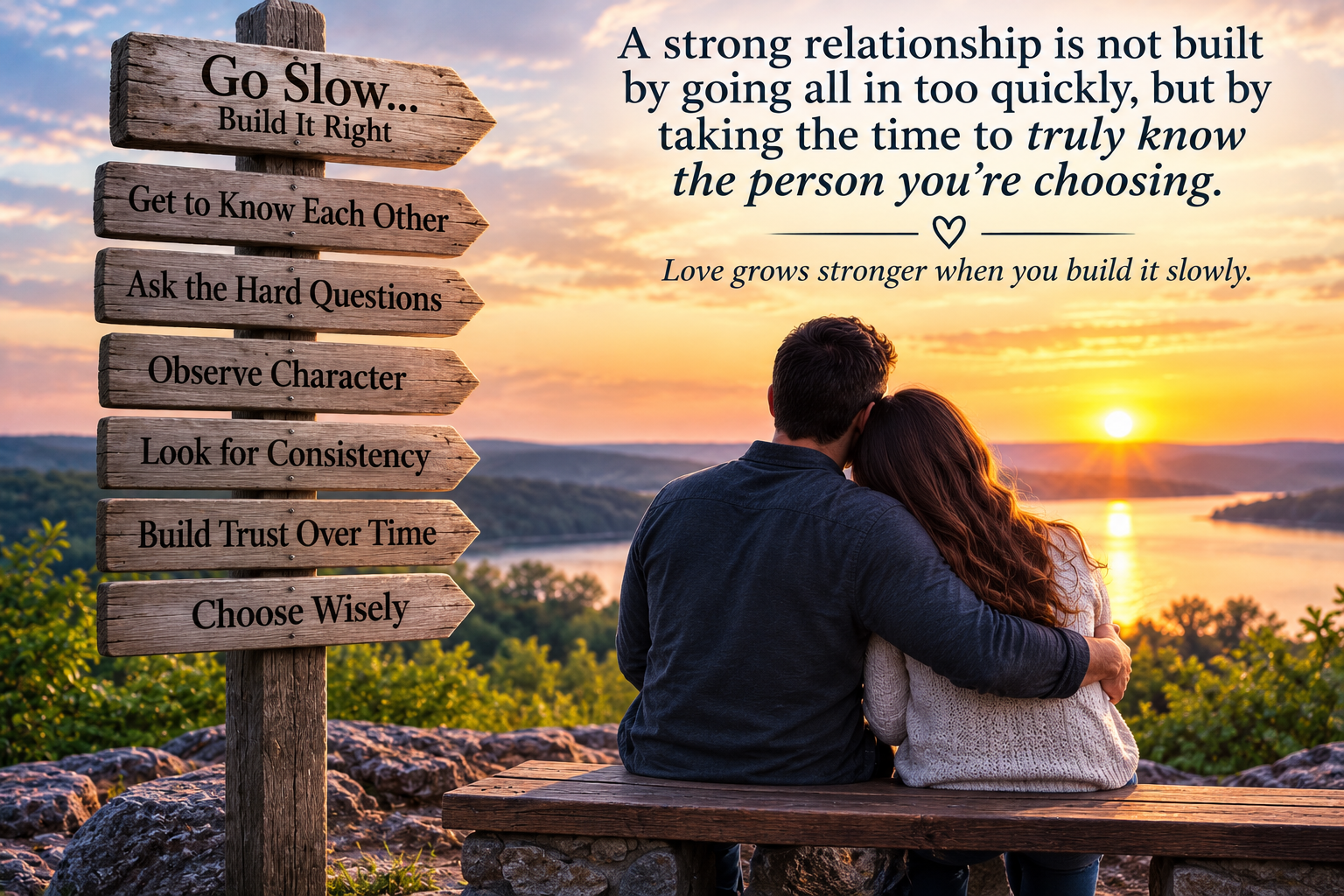
There is something undeniably romantic about the phrase “going all in.” Movies celebrate it. Love songs glorify it. Friends often admire people who seem fearless enough to dive headfirst into love. We are told that real love requires vulnerability, commitment, and complete investment.
While commitment is essential for a healthy relationship, there is an important distinction between healthy commitment and premature emotional investment. One is built on knowledge, trust, and experience. The other is often built on hope, attraction, and assumptions.
Many relationships don’t fail because two people were incompatible. They fail because they became emotionally committed long before they truly knew one another.
The Difference Between Attraction and Knowledge
Attraction happens quickly. Knowledge takes time. During the first weeks or months of dating, we naturally see the best version of another person. Psychologists sometimes refer to this as the honeymoon phase, where the brain is flooded with dopamine, oxytocin, and other neurochemicals that create excitement, optimism, and emotional attachment (Fisher, 2004). Unfortunately, these same chemicals can reduce our ability to evaluate a relationship objectively.
When people “go all in” too quickly, they often mistake:
Chemistry for compatibility
Passion for stability
Attention for commitment
Potential for reality
Those are not the same things.
We Fall in Love With Who We Think They Are
One of the greatest dangers of rushing a relationship is that we begin filling in the blanks ourselves. Instead of learning who someone truly is, we imagine who they could become. We overlook inconsistencies. We excuse red flags.
We create explanations for behaviors we don’t fully understand. Psychologists call this idealization—seeing another person through the lens of hope rather than reality (Murray, Holmes, & Griffin, 1996). The problem is that relationships are built on reality, not imagination. Eventually, every relationship moves from fantasy to reality. When that happens, many people don’t feel like their partner changed. Instead, they finally see what was there all along.
Emotional Investment Changes Your Judgment
Imagine buying a house. Would you purchase it after walking through the front door for five minutes? Probably not. You would inspect the foundation. Look at the roof. Check for water damage. Review the neighborhood. Ask difficult questions. Relationships deserve at least that much careful consideration. Yet emotionally, many people commit after only a handful of exciting conversations. Once we become emotionally invested, our brains begin protecting that investment.
Instead of asking, “Is this the right person?”
we begin asking, “How can I make this work?”
Those are completely different questions.
The Cost of Ignoring Red Flags
Red flags rarely appear as dramatic warning signs. Most begin as small moments. Perhaps they become irritated when they don’t get their way. Maybe they avoid accountability. Perhaps they speak disrespectfully about former partners. Maybe they struggle with honesty. Perhaps they become controlling in subtle ways. Someone who rushes into commitment often dismisses these concerns because the emotional reward feels greater than the potential risk. Unfortunately, ignored patterns rarely disappear. They usually become stronger. Dating is not primarily about convincing someone to stay. It is about discovering whether staying would be wise.
Love Needs Observation
Healthy relationships require curiosity. Observe how someone handles disappointment. Observe how they manage stress. Observe how they treat people who have nothing to offer them. Observe how they speak about family. Observe whether their words consistently match their actions. Character reveals itself over time. No conversation can replace experience. No promise can replace consistency. No chemistry can replace integrity.
Why Slow Relationships Often Last Longer
Research consistently suggests that relationships built gradually often develop stronger foundations because trust is earned rather than assumed (Stanley, Rhoades, & Markman, 2006). People sometimes fear moving slowly because they worry someone else will “take” the person they’re dating. Ironically, healthy people generally respect appropriate pacing. Individuals who pressure immediate commitment often reveal more about their own insecurity than about their love. Real intimacy grows. It cannot be rushed.
The Difference Between Commitment and Surrender
Healthy commitment says: “I’m choosing you because I know who you are.”
Unhealthy surrender says: “I’m choosing you because I hope you’ll become who I need.”
One is based on evidence. The other is based on emotion. One grows stronger over time. The other becomes increasingly fragile.
Questions Worth Asking Yourself
Before going “all in,” consider asking yourself:
What do I actually know about this person’s character?
Have I seen them during conflict?
How do they respond when they don’t get what they want?
Do their actions consistently match their words?
Am I attracted to who they are today or who I hope they’ll become?
If nothing about this person ever changed, would I still choose this relationship five years from now?
These questions may not feel romantic, but they are deeply loving—because they protect both people from building a relationship on unrealistic expectations.
A Better Way to Love
Moving slowly does not mean loving less. It means loving wisely. Healthy relationships are not races.
They are discoveries. Every shared experience reveals another layer of a person’s character. Trust is built 0through repeated consistency. Respect grows through mutual understanding. Love deepens through truth rather than fantasy.
Going “all in” is admirable when it follows genuine knowledge of another person. Going all in before you truly know someone is less an act of courage than a gamble. The strongest relationships are rarely built by those who rushed toward commitment. They are built by two people who allowed time to reveal character, chose honesty over fantasy, and discovered that lasting love is not found by moving faster—it is found by building a foundation strong enough to support a lifetime.
About the Author
John S. Collier, MSW, LCSW-S is a licensed clinical social worker, therapist, author, and educator with extensive experience helping individuals, couples, and families navigate relationship challenges, anxiety, trauma, and emotional well-being. Throughout his career, he has worked with people from diverse backgrounds, combining evidence-based psychological principles with practical, real-world applications that readers can immediately apply to their daily lives.
John’s writing bridges the gap between academic research and everyday experience, making complex psychological concepts understandable and useful. His work emphasizes emotional maturity, healthy communication, personal responsibility, and building relationships founded on trust, authenticity, and mutual respect. Whether writing about mental health, family dynamics, leadership, or personal growth, his goal is to provide readers with insights that encourage lasting change and healthier, more meaningful lives.
References
Fisher, H. (2004). Why We Love: The Nature and Chemistry of Romantic Love. Henry Holt.
Murray, S. L., Holmes, J. G., & Griffin, D. W. (1996). The benefits of positive illusions: Idealization and the construction of satisfaction in close relationships. Journal of Personality and Social Psychology, 70(1), 79–98.
Stanley, S. M., Rhoades, G. K., & Markman, H. J. (2006). Sliding versus deciding: Inertia and the premarital cohabitation effect. Family Relations, 55(4), 499–509.
Gottman, J. M., & Silver, N. (2015). The Seven Principles for Making Marriage Work (Revised ed.). Harmony Books.