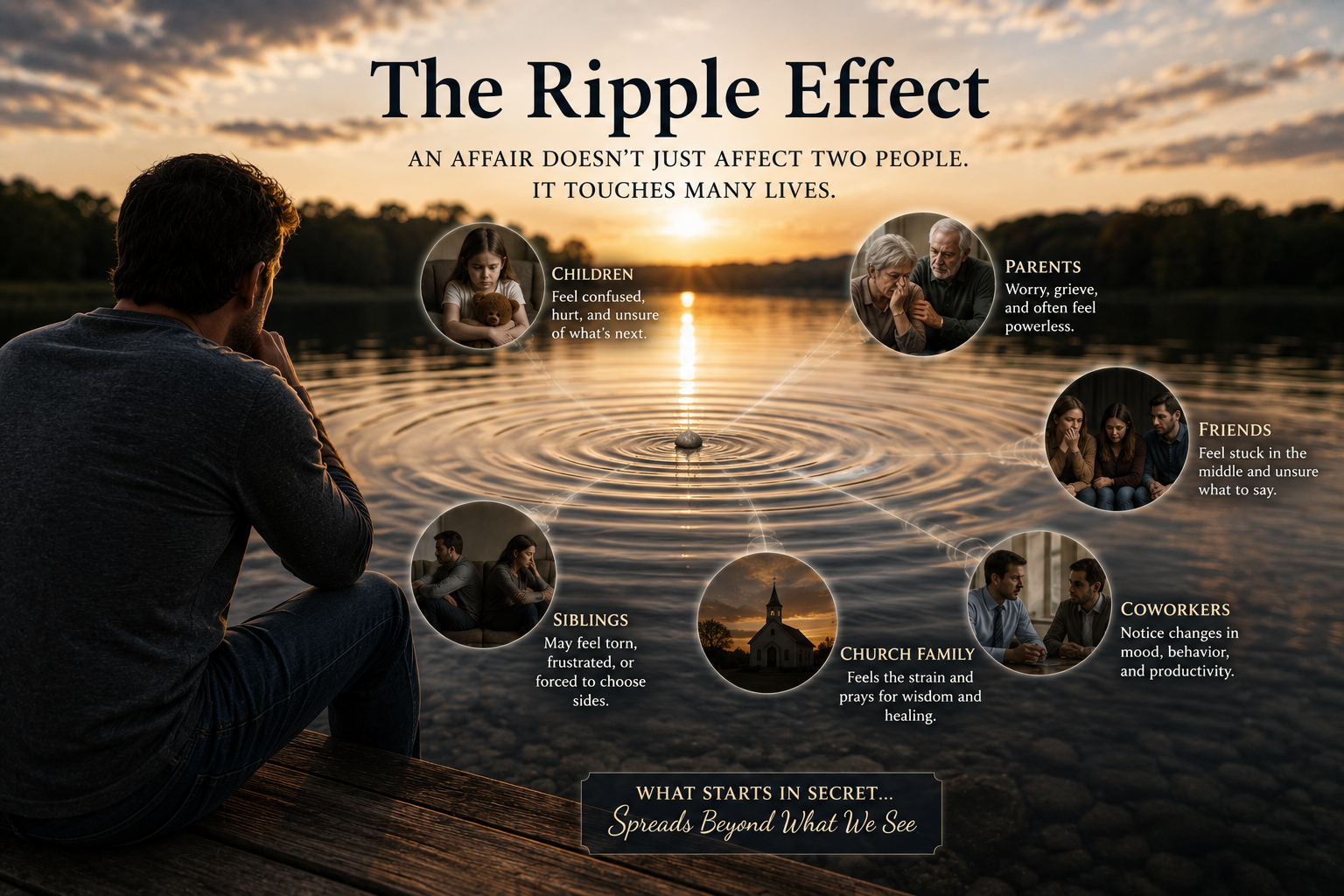
There Should Be No One You Side With Against Your Spouse
Marriage, Loyalty, Boundaries, and the Difference Between Protecting Your Spouse and Blindly Defending Them
Marriage does not require you to believe your spouse is always right. It does require something deeper: your spouse should never have to wonder whether you and someone outside the marriage have formed an alliance against them.
Parents matter. Children matter. Brothers and sisters matter. Friends matter.
But marriage creates a relationship that is different from all of them.
When two people choose marriage, they are saying, in effect, We are going to build a life together. When trouble comes, we will face it from the same side of the table.
That does not mean covering up wrongdoing. It does not mean tolerating abuse. It does not mean agreeing with every decision your spouse makes.
It means that disagreements should be handled within the marriage rather than by recruiting outsiders to fight against the person you married.
You may disagree with your spouse without becoming their enemy.
That distinction can determine whether a marriage becomes stronger through conflict or slowly fractures beneath it.
Your Spouse Is Supposed to Be Your Teammate
One of the most important shifts in marriage is moving from an individual mindset toward a shared identity.
Before marriage, your parents, siblings, or close friends may have been the people you automatically turned toward when something went wrong. Marriage changes that structure.
The field of family psychology recognizes that intimate relationships exist within larger family and social systems. Couple relationships are affected by family influences, individual differences, developmental changes, and broader social relationships. This means healthy marriage does not require abandoning the people you love.
It requires establishing appropriate boundaries around the marriage.
The Gottman Institute explains that healthy boundaries identify what we will and will not tolerate and help protect well-being within relationships. Boundaries are not primarily about controlling someone else’s behavior. They involve deciding how we ourselves will respond. That distinction is important.
Marriage should not say:
“Nobody else matters anymore.”
It should say:
“Other people matter, but they do not get to divide us.”
The Dangerous Triangle
Imagine a husband and wife have an argument.
The husband calls his mother.
He tells her everything his wife said, perhaps emphasizing her worst words and minimizing his own.
His mother becomes angry with his wife.
He feels validated.
Later, the husband and wife reconcile.
There is only one problem.
His mother didn’t reconcile with his wife.
She remembers everything.
Or reverse the roles.
A wife becomes angry with her husband and immediately begins texting a friend.
“You won’t believe what he did.”
The friend confirms what the wife already believes.
“He’s wrong.”
“I wouldn’t tolerate that.”
“You deserve better.”
Now the original marital problem has changed.
It is no longer simply:
Husband and wife versus a problem.
It has become:
Husband versus wife and friend.
Or:
Wife versus husband and family.
That difference matters.
When “Getting Advice” Becomes Building an Alliance
Seeking wise counsel is not wrong.
Sometimes it is necessary.
A trusted minister, therapist, mentor, family member, or mature friend may help us recognize something we cannot see ourselves.
The question is not simply:
“Did I talk to someone?”
The better question is:
“Why did I talk to them?”
Was I seeking wisdom?
Or was I gathering ammunition?
Was I genuinely asking:
“Help me understand my spouse’s perspective.”
Or was I really asking:
“Tell me I’m right and my spouse is wrong.”
Those are completely different conversations.
Healthy counsel should move us toward honesty, accountability, safety, and constructive communication, not deeper into resentment.
What Loyalty Does Not Mean
This deserves emphasis.
Loyalty is not blindness.
Your spouse can be wrong.
You can tell them so.
You can establish boundaries.
You can refuse to participate in destructive behavior.
You can seek professional guidance.
And situations involving abuse, threats, coercion, serious addiction, criminal behavior, or immediate danger require a different response. Protecting yourself or another person from harm is not betraying a marriage.
Healthy boundaries help people identify what is acceptable and respond when those limits are crossed. The Gottman Institute specifically distinguishes boundaries from attempts to control another person’s behavior and describes boundaries as important to healthy relationships and personal well-being. So saying:
“Never side against your spouse”
should not mean:
“Defend your spouse no matter what they do.”
I believe a healthier principle is:
Never allow another person to turn you and your spouse into opposing teams.
You can tell your spouse:
“I love you, but I believe you were wrong.”
That is different from telling someone else:
“You’re right about my spouse. Let’s confront them together.”
One is accountability inside a relationship.
The other can become an alliance against it.
Parents Should Not Be Placed Above the Marriage
This can be one of the hardest transitions for married adults.
A person can deeply love and honor their parents while recognizing that marriage establishes a new primary partnership.
Problems arise when a parent continues to carry veto power over marital decisions.
Maybe your mother thinks your spouse spends money incorrectly.
Maybe your father thinks your spouse is raising the children incorrectly.
Maybe your family criticizes where you live, how you spend holidays, whose family you visit, or how you handle your household.
You can listen respectfully.
But eventually you must be capable of saying:
“I love you, but this is something my spouse and I must decide together.”
Healthy boundaries do not require hostility toward family. In fact, boundaries can preserve relationships by making expectations clearer. The Gottman Institute describes boundaries as limits that help people protect what works for them while recognizing that they cannot control what other people say or do. Sometimes loving your parents means having the courage to disappoint them.
Your Friends Should Not Become a Jury
Friendship can be invaluable during difficult times.
But friends hear the version of your marriage you give them.
If every time you become angry you tell your friends everything your spouse has done wrong, you may unknowingly create a jury that hears only the prosecution.
Then months later you forgive your spouse.
Your friends may not.
You remember the apology.
They remember the story.
You remember the reconciliation.
They remember watching you cry.
You remember your spouse’s growth.
They remember your description of your spouse at their worst.
Be careful about giving people permanent pictures of the person you love based on temporary moments in your marriage.
There is a difference between seeking support and building a case.
Do Not Embarrass Your Spouse to Win an Argument
There is another form of siding against your spouse that happens publicly.
You are with friends or family.
Your spouse says something.
Someone criticizes them.
And you join in.
Everyone laughs.
Perhaps you say:
“I’ve been telling her that forever.”
Or:
“You should try living with him.”
Everyone laughs again.
Except your spouse.
Sometimes these comments are dismissed as jokes.
But repeated public humiliation can communicate something painful:
“When other people are here, I am willing to sacrifice your dignity for their approval.”
Marriage should be one of the places where people’s vulnerabilities are safest.
A spouse should not constantly fear becoming the punchline when friends or relatives arrive.
Correct Privately Whenever Possible
There will be times when your spouse is wrong in front of other people.
You do not have to pretend otherwise.
But unless immediate intervention is necessary, many disagreements can wait.
You can say:
“Let’s talk about this when we get home.”
Then actually talk about it.
Privately you may say:
“I love you, but I think you handled that badly.”
That is not betrayal.
That is honest marriage.
Loyalty and accountability can live in the same house.
In fact, they should.
The Goal Is Not “You Versus Me”
Healthy marital conflict should eventually become:
Us versus the problem.
Not:
Me versus you.
And certainly not:
Me and my mother versus you.
Me and my best friend versus you.
Me and the children versus you.
Me and your family versus you.
When outsiders become soldiers in marital disagreements, everybody can lose.
The marriage becomes a battlefield instead of a partnership.
Children Should Not Be Recruited Either
This principle becomes even more important when children are involved.
A child should not become a messenger, spy, referee, counselor, or emotional ally in an adult marital dispute.
Statements such as:
“You know how your mother is.”
or
“Your father only thinks about himself.”
invite children into adult conflict.
Whatever frustration exists between spouses should, whenever safely possible, remain an adult responsibility.
Children should be free to love both parents without feeling that loving one means betraying the other.
Family Systems Matter
Family psychology does not view marriages in isolation. Couple relationships exist inside broader systems involving parents, children, extended relatives, culture, developmental history, and social relationships. American Psychological Association’s Journal of Family Psychology specifically describes family psychology as incorporating systems, developmental, cultural, and relationship perspectives. Research has also examined Bowen’s concepts of differentiation and individuation in married couples, including emotional reactivity involving parents. That helps explain why these conflicts can feel so powerful.
You can be 45 years old and suddenly feel 15 again when your parent disapproves of you.
You can love your spouse while still desperately wanting your family’s approval.
Maturity does not require cutting your family off.
It requires learning how to remain connected to people without allowing those relationships to control your marriage.
Before You Tell Someone About Your Spouse, Ask Yourself Five Questions
1. Am I seeking wisdom or validation?
Do I genuinely want guidance, or do I want someone to tell me I’m right?
2. Would I say this if my spouse were sitting beside me?
If not, consider why.
3. Will telling this person help repair my marriage?
Or will it simply make another person dislike my spouse?
4. Am I telling the whole story?
Have I included my own mistakes?
5. Is this person for our marriage?
Good advisers do not automatically take your side.
Sometimes the best friend says:
“I understand you’re angry, but you need to go home and talk to your spouse.”
That is friendship.
A Good Friend Protects the Marriage Too
Perhaps we also need to rethink what friendship looks like when someone comes to us complaining about their spouse.
Instead of immediately agreeing with them, perhaps we should ask:
“Have you talked to your spouse about this?”
“What do you think your spouse would say happened?”
“Is there something you could have done differently?”
“Do you want me to listen, or do you honestly want my opinion?”
Sometimes loyalty to a friend means refusing to help them destroy something important in a moment of anger.
Your Spouse Should Not Have to Compete for Your Loyalty
There are few feelings more painful in marriage than believing everyone else’s voice carries more weight than yours.
Your spouse should not have to defeat your mother, father, brother, sister, best friend, adult child, coworker, or social circle just to feel heard by you.
That does not mean your spouse always wins.
It means the marriage gets its own room to work things out.
When there is disagreement, talk.
When there is hurt, address it.
When there is confusion, ask questions.
When there is resentment, speak before the resentment becomes contempt.
When you need help, seek wise and trustworthy counsel.
But do not turn the people around you into an army against the person beside you.
Marriage Is Choosing “Us” Again and Again
The deepest promises of marriage are rarely lived out during weddings.
They are lived out afterward.
They happen around kitchen tables.
In hospital rooms.
During arguments.
During financial trouble.
When families disagree.
When children are struggling.
When somebody hurts somebody.
When pride whispers:
“Make them pay.”
When your friend says:
“You’re completely right.”
When your family says:
“We told you so.”
Those are the moments when marriage asks a harder question:
Are we still a team?
Sometimes the answer sounds like:
“I think you’re wrong, but I’m going to talk to you about it, not everybody else.”
Sometimes it sounds like:
“Mom, I love you, but this is between my spouse and me.”
Sometimes:
“Please don’t speak about my husband that way.”
Or:
“Please don’t disrespect my wife.”
And sometimes it is simply:
“Let’s go home and figure this out together.”
The strongest marriages are not marriages without disagreement. They are marriages where disagreement does not automatically destroy loyalty.
Conclusion
Your spouse does not need you to believe they are perfect.
They need to know you are committed.
There should not be a family member, friend, coworker, or acquaintance with whom you regularly form an alliance against your spouse.
That does not prevent accountability.
It makes healthy accountability possible.
Love says:
“I will tell you the truth.”
Loyalty says:
“I will protect what we have.”
Maturity says:
“I can disagree with you without humiliating you.”
Wisdom says:
“We may need help, but I will seek help that moves us toward health rather than deeper division.”
And marriage says:
“When problems come, I want us standing shoulder to shoulder looking at the problem, rather than standing across the room looking at each other as the enemy.”
Family will have opinions.
Friends will have opinions.
The world will have opinions.
Listen when wisdom is present.
Accept correction when correction is deserved.
Protect yourself when safety requires it.
But never forget the person with whom you decided to build your life.
You do not have to agree on everything to remain on the same team.
About the Author
John S. Collier, MSW, LCSW-S
John S. Collier is a Licensed Clinical Social Worker Supervisor and the Executive Director of Southeast Kentucky Behavioral Health, LLC. His professional career in social work and behavioral health has included years of working with individuals and families navigating trauma, relationships, emotional struggles, behavioral challenges, personal growth, and major life transitions.

John is also the author of The Mind’s Trestle Board, where he writes about mental health, relationships, marriage, family, morality, faith, personal responsibility, and the difficult work of becoming a better version of ourselves. His writing often explores the place where professional understanding meets the realities of everyday life.
At the center of his work is a simple belief: growth does not require perfection. It requires honesty, humility, accountability, compassion, and the willingness to keep working on ourselves.
References
American Psychological Association. (n.d.). Journal of Family Psychology. American Psychological Association.
Gottman Institute. (2022). The truth about boundaries. The Gottman Institute.
Gottman Institute. (2024). Setting boundaries with others. The Gottman Institute.
Gottman Institute. (2025). The Gottman guide to setting and enforcing boundaries.
Skowron, E. A., Stanley, K. L., & Shapiro, M. D. (2009). A longitudinal perspective on differentiation of self, interpersonal and psychological well-being in young adulthood. Contemporary Family Therapy, 31, 3–18.
Related research literature on differentiation and married couples is indexed through Springer.