Every relationship has arguments. No matter how deeply two people love each other, there will be moments of frustration, misunderstanding, disappointment, and hurt. The difference between healthy relationships and unhealthy ones is not whether conflict exists. The difference is how conflict is handled.
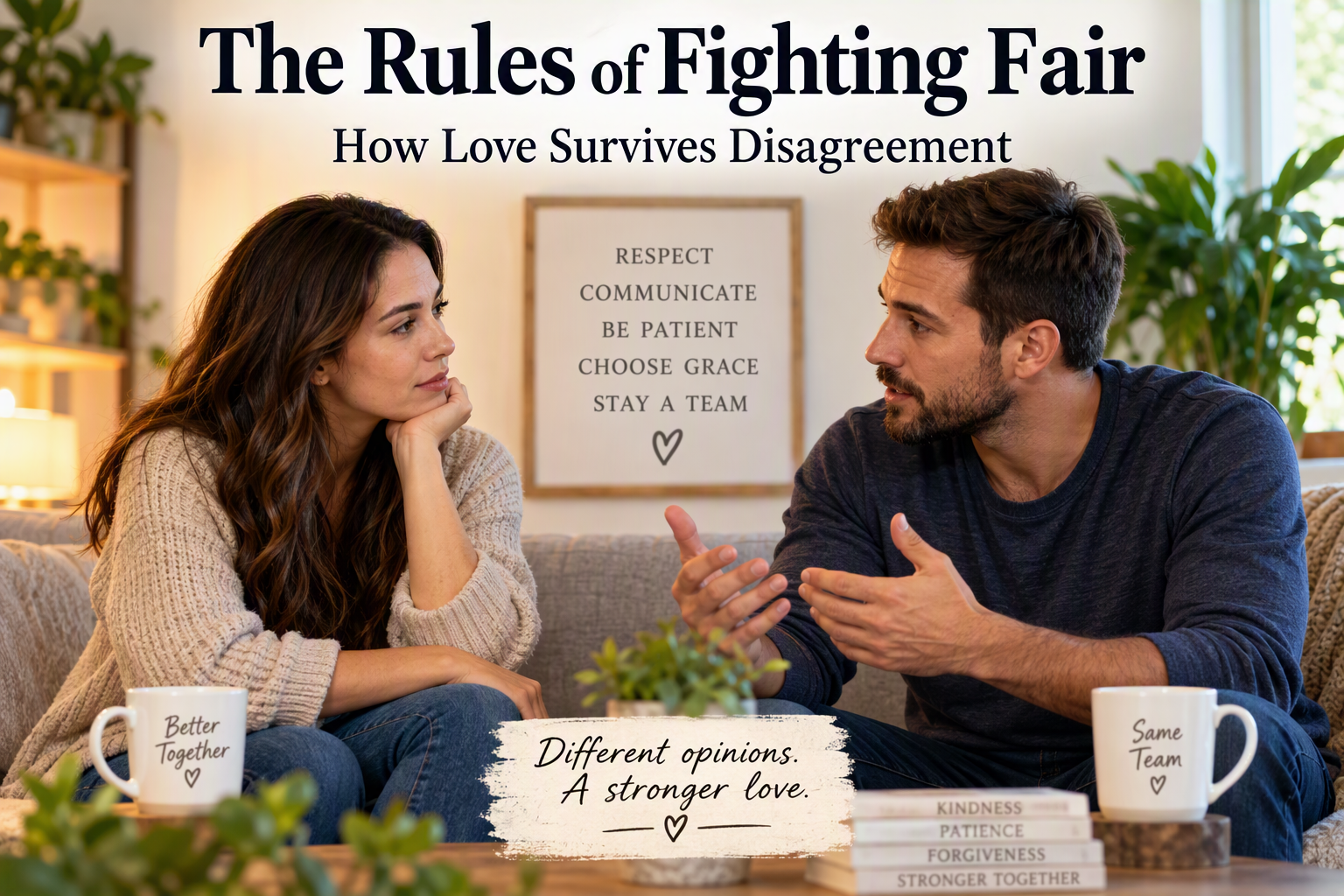
The image above presents five simple but powerful rules for couples during arguments. At first glance, they seem obvious. Yet these principles address some of the most common mistakes that damage trust and intimacy. They remind us that being angry with someone is not a license to stop loving them.
Research consistently shows that conflict itself is not the greatest threat to a relationship. Rather, it is destructive communication patterns, contempt, criticism, stonewalling, and defensiveness that place relationships at risk (Gottman & Silver, 2015).
Rule #1: Be Mad at Me, But Don’t Insult Me
“Anger is not a ticket to speak carelessly.”
When emotions run high, words often become weapons. People say things they never truly mean because they want the other person to feel the same pain they are feeling.
The problem is that arguments eventually end, but hurtful words often remain.
You may forget what the disagreement was about, but you rarely forget being called worthless, stupid, selfish, or unlovable. According to relationship researcher John Gottman, contempt and personal attacks are among the strongest predictors of relationship dissatisfaction and eventual separation (Gottman & Silver, 2015).
Healthy couples understand an important truth: attack the problem, not the person.
You can say:
“That hurt me.”
“I am disappointed.”
“I feel ignored.”
Without saying:
“You’re pathetic.”
“You never do anything right.”
“You’re just like your mother.”
Respect should not disappear simply because peace has.
Anger can be temporary. The damage caused by contempt can be permanent.
Rule #2: Be Mad at Me, But Tell Me Why
“Don’t assume I know.”
One of the greatest relationship myths is that people should automatically know what is wrong.
The truth is that nobody can read minds.
Many arguments grow larger because one partner believes the other should already understand the issue. Meanwhile, the other person is confused and becomes frustrated trying to guess.
Clear communication is one of the strongest predictors of relationship success. Research by Markman, Stanley, and Blumberg (2010) found that couples who communicate concerns directly and clearly are better able to resolve conflict and maintain emotional intimacy.
Instead of saying:
“You know exactly what you did.”
Try saying:
“When this happened, it made me feel unimportant.”
People cannot fix problems they do not understand.
Love requires communication, not telepathy.
As marriage and family therapist Virginia Satir observed, communication is to relationships what breathing is to life. Without it, connection slowly deteriorates (Satir, 1988).
Rule #3: Be Mad at Me, But Don’t Broadcast It
Conflict belongs between the people involved.
Too often people rush to social media, group texts, friends, family members, or coworkers to discuss relationship problems before discussing them with their partner.
While outside support can sometimes be helpful, publicly shaming a partner almost never improves the relationship.
Once private details become public, they cannot easily be taken back.
Strong relationships protect each other’s dignity, even during difficult moments. Maintaining emotional safety and mutual respect helps partners feel secure enough to resolve disagreements constructively (Tatkin, 2012).
This does not mean remaining silent about abuse, manipulation, or situations involving safety concerns. Those circumstances require outside support and intervention. However, ordinary relationship disagreements generally benefit from privacy, maturity, and direct communication.
A couple should be teammates solving a problem together, not opponents recruiting spectators.
Rule #4: Be Mad at Me, But Don’t Forget My Good Qualities
Conflict has a way of shrinking our perspective.
When we are hurt, our minds naturally focus on the thing causing the pain. Suddenly one mistake feels larger than a thousand acts of kindness.
Psychologists often describe this tendency as negative filtering, where attention becomes focused on a person’s flaws while overlooking their strengths.
A healthy relationship requires balance.
Remember:
The person who forgot an anniversary may also be the person who supported you through difficult times.
The person who made a mistake may also be the person who loves you deeply.
The person frustrating you today may be the person who has stood beside you for years.
Research from the Gottman Institute has found that successful couples maintain a strong ratio of positive interactions to negative interactions, even during periods of conflict (The Gottman Institute, 2024).
A moment of failure should not erase a history of goodness.
Rule #5: Be Mad at Me, But Remember Grace
“Remember all the times I’ve forgiven you.”
This final point may be the most powerful.
Every person who has been in a long-term relationship has needed forgiveness. No one is perfect. No one gets everything right.
Healthy couples recognize that relationships are not scoreboards.
Love is strengthened when both people remember that they have received grace as often as they have given it.
Research from the Greater Good Science Center at the University of California, Berkeley indicates that forgiveness is associated with stronger relationships, better emotional health, reduced stress, and greater overall well-being (Greater Good Science Center, 2023).
Forgiveness does not excuse harmful behavior or remove accountability. Instead, it acknowledges that human beings are flawed and that lasting relationships require compassion.
The question is not whether your partner will eventually disappoint you.
They will.
The question is whether there is enough humility, understanding, and forgiveness to move forward together.
The Real Secret Behind Healthy Arguments
Many people believe successful couples avoid conflict. The truth is quite the opposite.
Successful couples argue.
They disagree.
They become frustrated.
They occasionally hurt one another.
What separates them from struggling couples is that they continue fighting for the relationship while addressing the problem.
They remember that the person sitting across from them is not the enemy.
The problem is the enemy.
Relationship experts consistently emphasize that couples who approach conflict as a shared challenge rather than a battle to be won are more likely to experience long-term satisfaction and stability (Markman et al., 2010; Gottman & Silver, 2015).
The argument should never become a contest about who wins. It should become a conversation about how both people can heal, learn, and grow.
Because at the end of the day, the healthiest relationships are not those free from anger.
They are the relationships where love remains present even when anger arrives.
“Being angry with someone is not the opposite of loving them. Treating them without respect is.”
About the Author
John S. Collier, MSW, LCSW-S is the Executive Director of Southeast Kentucky Behavioral Health, LLC and author of The Mind’s Trestle Board. Through his writing, he explores relationships, personal growth, emotional wellness, morality, and the challenges people face as they seek meaningful connections with others. His work blends professional behavioral health experience with practical life lessons intended to encourage reflection, healing, and personal development.
References
Chapman, G. (2015). The 5 Love Languages: The Secret to Love That Lasts. Northfield Publishing.
Gottman, J. M., & Silver, N. (2015). The Seven Principles for Making Marriage Work (Revised ed.). Harmony Books.
Greater Good Science Center. (2023). The Science of Forgiveness. University of California, Berkeley.
Harvard Health Publishing. (2022). Communication and Conflict Resolution in Relationships. Harvard Medical School.
Markman, H. J., Stanley, S. M., & Blumberg, S. L. (2010). Fighting for Your Marriage (3rd ed.). Jossey-Bass.
Mayo Clinic Staff. (2023). Healthy Communication and Relationship Wellness. Mayo Clinic.
Satir, V. (1988). The New Peoplemaking. Science and Behavior Books.
Tatkin, S. (2012). Wired for Love: How Understanding Your Partner’s Brain and Attachment Style Can Help You Defuse Conflict and Build a Secure Relationship. New Harbinger Publications.
The Gottman Institute. (2024). Managing Conflict in Relationships.
There is a significant difference between wanting a wife and wanting to be a husband.
At first, those two desires may sound almost identical. After all, a man cannot ordinarily become a husband without a wife. Yet from a biblical perspective, the distinction is found in the direction of a man’s attention. One desire can focus primarily on what he hopes to receive from a woman, while the other focuses on the kind of man he must become before God.
A man may want companionship, affection, intimacy, encouragement, children, a home, emotional support, or simply someone with whom to share his life. None of these desires are inherently wrong. Scripture itself recognizes the goodness of companionship. When God looked upon Adam, He said:
“It is not good that man should be alone; I will make him a helper comparable to him.” — Genesis 2:18, NKJV
Marriage is God’s good creation. But Scripture calls a man to something deeper than simply finding the right woman. It calls him to become a man capable of covenant, sacrifice, faithfulness, service, responsibility, and enduring love.
The question, therefore, is not merely:
“What kind of wife do I want?”
A spiritually mature man must also ask:
“What kind of husband am I becoming?”
That difference changes everything.
Wanting a Wife Can Begin With What He Wants to Receive
When a man says, “I want a wife,” he may be thinking about the qualities he hopes to find. He wants
someone loving.
Someone faithful.
Someone attractive.
Someone who respects him.
Someone who encourages him.
Someone who shares his values.
Someone who will build a home with him.
Someone who will remain beside him when life becomes difficult.
Again, these are not necessarily selfish desires. Proverbs declares:
“He who finds a wife finds a good thing, and obtains favor from the Lord.” — Proverbs 18:22, NKJV
A good wife is described as something valuable. Proverbs 31:10 asks, “Who can find a virtuous wife? For her worth is far above rubies.”
But there is a danger when a man’s entire understanding of marriage revolves around what the woman will bring into his life. He may create a long list describing the woman he wants while never creating an equally demanding list describing the man he needs to become.
He wants her to be faithful—but is he practicing faithfulness?
He wants her to communicate—but has he learned to listen?
He wants her to respect him—but does he behave honorably?
He wants her to control her emotions—but has he learned self-control?
He wants her to support his dreams—but is he prepared to support hers?
He wants her to forgive his mistakes—but is he gracious when she makes mistakes?
He wants her to make sacrifices—but is he prepared to sacrifice himself?
It is possible to desire the benefits of marriage without preparing for the responsibilities of marriage. That is the difference.
A Man Who Wants to Be a Husband Looks Inward First
A man who truly wants to become a husband begins asking different questions. Instead of only asking, “Is she ready for marriage?”, he asks, “Am I?” Instead of constantly evaluating her character, he evaluates his own. He understands Jesus’ teaching concerning self-examination:
“And why do you look at the speck in your brother’s eye, but do not consider the plank in your own eye?” — Matthew 7:3, NKJV
Applied to relationships, this principle is powerful. Before demanding maturity from someone else, examine your own maturity. Before demanding loyalty, examine your loyalty. Before demanding respect, examine whether you are living respectably. Before demanding communication, examine how you communicate. Before demanding emotional stability, examine your own emotional responses. The man preparing to become a husband realizes that marriage does not magically produce maturity. Marriage frequently reveals the maturity—or immaturity—that was already present.
A Husband Is Called to Covenant
Modern culture can sometimes approach relationships from a consumer perspective: Does this person still make me happy? Am I getting what I want? Is this relationship meeting my expectations? Biblical marriage uses a different framework.
Covenant.
Malachi describes marriage in covenantal terms:
“Yet she is your companion and your wife by covenant.” — Malachi 2:14, NKJV
A covenant mentality asks something deeper than, “What am I getting?”
It asks, “What have I promised?”
That does not mean tolerating abuse, danger, or every form of destructive behavior. Nor does it eliminate biblical and legal circumstances in which separation may become necessary. Rather, it means that healthy marriage is not designed to operate as a disposable arrangement abandoned whenever inconvenience appears.
A man who wants merely a wife may dream primarily about the wedding.
A man preparing to be a husband thinks about the covenant after the wedding.
He thinks about year five.
Year fifteen. Year thirty. Sickness. Financial pressure. Children. Loss.
Aging parents. Career changes. Disappointment. Conflict. Forgiveness. Growing old together
He understands that marriage is not simply finding someone with whom he can enjoy good days. It is covenanting with someone with whom he intends to walk through difficult ones.
A Husband Is Called to Sacrificial Love
Perhaps Scripture’s strongest instruction to husbands appears in Ephesians:
“Husbands, love your wives, just as Christ also loved the church and gave Himself for her.” — Ephesians 5:25, NKJV
Notice the standard. Paul does not merely say, “Husbands, love your wives when they are easy to love.” He points toward Christ. Christ’s love was demonstrated through sacrifice. Therefore, biblical husbandhood cannot simply mean authority, privilege, or having someone meet a man’s needs. Whatever one’s understanding of marital leadership may be, Ephesians places a staggering responsibility upon the husband: his model is the self-giving love of Jesus Christ.
Biblical leadership is therefore inseparable from service. Jesus taught:
“And whoever desires to be first among you, let him be your slave—just as the Son of Man did not come to be served, but to serve.” — Matthew 20:27–28, NKJV
A husband following Christ does not continually ask:
“How can my wife serve me?”
He also asks:
“How can I serve her?”
That may mean
listening when he would rather speak. Apologizing when pride wants to defend itself. Working when he is tired. Being emotionally present. Protecting time for the marriage.
Encouraging his wife’s gifts. Participating in the responsibilities of the home. Remaining faithful when temptation appears. Choosing gentleness during disagreement.
Sacrificial love is rarely glamorous. Most of the time, it appears in hundreds of small decisions nobody outside the marriage will ever see.
A Husband Understands That Leadership Is Not Domination
Biblical discussions of husbands sometimes become distorted when leadership is separated from Christlike character. Jesus repeatedly rejected domineering models of leadership. He taught His disciples that worldly rulers “lord it over” people, but said:
“Yet it shall not be so among you.” — Matthew 20:26, NKJV
Biblical leadership should never become permission for intimidation, coercion, manipulation, violence, or controlling behavior. A Christian husband should increasingly resemble Christ. That means humility.
Patience.
Truth.
Courage.
Mercy.
Integrity.
Self-control.
Service.
Sacrifice.
Paul instructed husbands:
“Husbands, love your wives and do not be bitter toward them.” — Colossians 3:19, NKJV
Peter likewise instructed husbands to live with their wives “with understanding” and to give them honor (1 Peter 3:7). A husband is therefore not called simply to have authority. He is called to possess the character necessary to handle responsibility faithfully.
A Husband Learns to Love the Woman Who Actually Exists
Sometimes people fall in love with an imagined future version of another person.
She will change after we marry.
She will become more affectionate.
She will become more organized.
She will stop doing that.
She will eventually think like I do.
This mentality can create enormous disappointment. Marriage involves growth, and healthy spouses should encourage one another toward maturity. But there is a difference between encouraging growth and entering marriage intending to remodel another human being. First Corinthians 13 provides one of Scripture’s clearest pictures of mature love:
“Love suffers long and is kind; love does not envy; love does not parade itself, is not puffed up.” — 1 Corinthians 13:4, NKJV
Biblical love requires patience because human beings are imperfect. Your wife will have weaknesses. So will you. She will occasionally misunderstand you. You will misunderstand her. She will disappoint you. You will disappoint her. The man preparing to become a husband understands that marriage requires two imperfect people continually practicing grace, truth, repentance, forgiveness, patience, and commitment.
A Husband Must Learn Faithfulness Before Marriage
Marriage vows do not magically create character. If a man practices dishonesty while dating, a wedding ring will not automatically make him truthful. If he regularly entertains sexual temptation, marriage will not automatically produce purity. If he cannot manage anger while single, marriage will not automatically create patience. If he avoids responsibility before marriage, responsibility will not suddenly become enjoyable afterward. Jesus taught an important principle:
“He who is faithful in what is least is faithful also in much.” — Luke 16:10, NKJV
The habits developed before marriage often enter marriage with us.
Therefore, the season before becoming a husband should be a season of preparation.
Learn honesty now.
Practice sexual integrity now.
Learn financial responsibility now.
Develop self-control now.
Learn to apologize now.
Learn to communicate now.
Learn to pray now.
Learn to serve now.
Become dependable now.
Marriage should not be the beginning of character development. Character development should already be underway.
A Husband Understands That His Wife Is Not Responsible for Completing Him
Another dangerous expectation occurs when a man believes marriage will solve his internal struggles. He thinks:
When I get married, I won’t be lonely.
When I find the right woman, I’ll finally be happy.
She’ll give my life meaning.
She’ll heal the things other people damaged.
Those expectations place a burden on a spouse that no human being can carry. A wife can be a companion, encourager, lover, friend, and partner. But she cannot occupy the place that belongs to God. Jesus taught that the greatest commandment begins with loving God completely (Matthew 22:37–38). Healthy Christian marriage therefore involves two people whose ultimate identity is not found exclusively in each other. A husband should love his wife deeply without requiring her to become his savior.
She cannot heal every childhood wound.
She cannot eliminate every insecurity.
She cannot provide constant validation.
She cannot guarantee perpetual happiness.
Marriage is companionship, but it is not salvation.
A Husband Is Willing to Become One Flesh
Genesis establishes the foundation of biblical marriage:
“Therefore a man shall leave his father and mother and be joined to his wife, and they shall become one flesh.” — Genesis 2:24, NKJV
Notice the movement.
Leave.Join. Become.
Marriage requires transition. A husband recognizes that his primary human covenant relationship has changed. He cannot remain psychologically, emotionally, or practically dependent upon his parents while expecting his wife to occupy a secondary position. The marriage becomes a new family unit.
This does not mean abandoning parents or dishonoring family. Scripture repeatedly teaches honor toward parents. It means establishing appropriate boundaries so the marital covenant can develop its own identity. A man who wants a wife may want to add a woman to his existing life. A man who wants to become a husband understands that marriage will require him to build a new life with her.
A Husband Understands the Power of His Words
Marriage can be strengthened or wounded by language. Proverbs teaches:
“Death and life are in the power of the tongue.” — Proverbs 18:21, NKJV
A mature husband understands that words spoken repeatedly become part of the emotional atmosphere of his home. Sarcasm can wound. Constant criticism can erode confidence. Name-calling can destroy trust. Threats can create fear. Silence used as punishment can become manipulation. But encouragement can strengthen. Gratitude can soften hearts. Apologies can repair damage. Gentleness can de-escalate conflict. Affection can create security. A husband does not have to communicate perfectly. No one does. But he should increasingly learn to communicate in ways consistent with Scripture:
“Let no corrupt word proceed out of your mouth, but what is good for necessary edification.” — Ephesians 4:29, NKJV
A Husband Knows How to Say, “I Was Wrong”
One of the strongest statements a husband can make contains only three words:
I was wrong.
Pride destroys relationships because pride constantly needs to win. Humility seeks restoration. James writes:
“God resists the proud, but gives grace to the humble.” — James 4:6, NKJV
A mature husband does not believe leadership means never admitting mistakes. Quite the opposite. If he speaks harshly, he apologizes. If he makes a poor decision, he acknowledges it. If he misunderstands something, he corrects himself. If he hurts his wife, he listens rather than immediately explaining why she should not feel hurt. Marriage does not need a man pretending to be perfect. It needs a man humble enough to grow.
A Husband Protects the Marriage
Protection involves much more than physical safety. A husband should help protect the marriage from anything capable of slowly destroying intimacy and trust. That includes:
Addiction. Neglect. Constant criticism. Family interference. Digital secrecy. Unchecked anger.
The wise man does not wait until his marriage is collapsing before taking its vulnerabilities seriously. Proverbs 4:23 says:
“Keep your heart with all diligence, for out of it spring the issues of life.”
A husband protects his heart because he understands that what enters his heart eventually affects his marriage.
He Does Not Stop Pursuing Her After the Wedding
Some men work incredibly hard to win a woman’s heart and surprisingly little to continue nurturing it. Before marriage there are conversations, dates, messages, surprises, affection, attention, and curiosity. After marriage, familiarity can slowly become complacency. But a husband should never assume that commitment eliminates the need for intentional love. The woman he married should continue to feel chosen. This does not require expensive vacations or elaborate gifts.
Sometimes pursuit looks like;
turning off the phone and listening.
Planning an evening together.
Holding her hand.
Asking how she is doing—and actually waiting for the answer.
Remembering something important to her.
Expressing appreciation.
Praying with her.
Laughing together.
Marriage is not sustained only by dramatic romantic moments. It is sustained largely through consistent attention.
A Husband Understands That Marriage Requires Work
Ecclesiastes 4:9 teaches: “Two are better than one, because they have a good reward for their labor.” Notice the word labor. Healthy relationships require effort.
There will be seasons when communication feels natural and seasons when conversations require patience. There will be seasons of abundance and seasons of financial pressure. There may be childbirth, infertility, illness, career changes, grief, caregiving, parenting challenges, aging, disappointment, and loss. A man who wants only the enjoyable parts of marriage wants a fantasy. A husband accepts the whole covenant. The laughter and the tears. The romance and the responsibility. The celebration and the sacrifice. The receiving and the giving.
The Difference Can Be Summed Up in the Questions He Asks
The difference between the two mindsets can often be heard in their questions.
The man who merely wants a wife may ask:
The man preparing to be a husband asks:
What can she give me? Will she make me happy? Will she respect me? Will she meet my needs? Is she wife material?
What can we build together? Can I love her faithfully even when life is difficult? Am I becoming a man worthy of trust and respect? Do I understand her needs? Am I husband material?
One primarily searches for the right woman. The other understands that while he searches, he must also become the right kind of man.
Before Looking for a Wife, Prepare to Become a Husband
If you hope to marry someday, there is nothing wrong with praying for a good wife.
Pray for her.
Pray for wisdom in choosing her.
Pray that God protects her.
Pray that God prepares her.
But while you pray for God to prepare your future wife, do not forget another important prayer:
“Lord, prepare me to become her husband.”
Ask God to expose selfishness. Ask Him to strengthen your integrity. Ask Him to teach you patience. Ask Him to help you control anger. Ask Him to teach you communication. Ask Him to deepen your faith. Ask Him to teach you financial stewardship. Ask Him to make you faithful when nobody is watching. Ask Him to teach you how to serve. Ask Him to make you humble enough to apologize and strong enough to forgive. Ask Him to make you more like Christ. Because the greatest preparation for becoming a godly husband is not learning how to find the perfect woman. It is becoming increasingly like the perfect Savior.
Conclusion: There Really Is a Difference
There is a difference between wanting a wife and wanting to be a husband.
Wanting a Wife
Wanting to be a Husband
Wanting a wife may begin with desire. Wanting a wife may focus on companionship. Wanting a wife can emphasize what a woman brings into your life.
Becoming a husband requires development. Being a husband requires covenant. Being a husband forces you to consider what you are bringing into hers.
A man can spend years asking God to send him the right woman while avoiding the work God wants to accomplish within him.
Perhaps the better prayer is not merely:
“God, give me a good wife.”
Perhaps it should also be:
“God, make me a good husband.” Make me faithful before I ask for faithfulness. Make me honest before I ask for honesty. Teach me respect before I demand respect. Teach me patience before I expect patience. Teach me sacrifice before I ask someone to sacrifice for me. Teach me forgiveness before I need to receive it. Teach me how to serve before I attempt to lead. And above all, teach me how to love. The biblical picture of marriage ultimately returns us to Genesis:
“Therefore a man shall leave his father and mother and be joined to his wife, and they shall become one flesh.” — Genesis 2:24, NKJV
A wife is not simply someone a man acquires. A husband is someone a man becomes.
And becoming a godly husband is not accomplished at the altar in a single afternoon. The wedding ceremony may give a man the title husband, but only daily character, covenant faithfulness, sacrificial love, humility, service, repentance, and dependence upon God will teach him how to live like one. Do not spend all your time looking for a woman who is ready to be a wife while neglecting the man God is calling you to become as a husband.
There is a difference.
About the Author
John S. Collier, MSW, LCSW-S, is a licensed clinical social worker, author, and mental health professional whose work focuses on helping individuals, couples, and families better understand the emotional, behavioral, relational, and spiritual factors that shape their lives.
Drawing upon professional social-work training, clinical experience, Christian principles, and an interest in healthy relationships and personal growth, Collier writes about subjects that connect psychological understanding with practical everyday life. His work frequently explores marriage, relationships, communication, emotional wellness, trauma, personal responsibility, faith, resilience, and the development of healthy interpersonal boundaries.
A central theme throughout his writing is that lasting change requires more than recognizing what we want from other people. It requires examining ourselves, accepting personal responsibility, developing healthier patterns, and intentionally becoming the kind of person capable of creating and sustaining meaningful relationships.
In his faith-centered writing, Collier emphasizes that biblical principles are not merely theological concepts to be discussed but truths intended to influence daily behavior—how people speak, forgive, serve, lead, love, resolve conflict, honor commitments, and care for one another.
His approach encourages readers to combine faith with self-examination and practical action, recognizing that strong marriages and families are rarely created accidentally. They are developed through intentional love, consistent communication, humility, accountability, forgiveness, healthy boundaries, and commitment.
References
The Holy Bible, New King James Version. Thomas Nelson.
Primary Biblical References
Genesis 2:18 — God’s declaration that it is not good for man to be alone and the creation of a suitable helper.
Genesis 2:24 — Leaving father and mother, being joined to one’s wife, and becoming one flesh.
Proverbs 4:23 — Guarding the heart diligently.
Proverbs 18:21 — The power of words to bring life or death.
Proverbs 18:22 — Finding a wife described as finding a good thing and obtaining favor from the Lord.
Proverbs 31:10–31 — The biblical portrait of a virtuous wife and woman of character.
Ecclesiastes 4:9–12 — The strength and benefit of companionship.
Malachi 2:14–16 — Marriage described as covenant and the importance of faithfulness.
Matthew 7:3–5 — Self-examination before criticizing another person.
Matthew 20:25–28 — Christ’s model of leadership through service rather than domination.
Matthew 22:37–39 — Loving God first and loving one’s neighbor.
Luke 16:10 — Faithfulness in small things as an indication of faithfulness in greater responsibilities.
1 Corinthians 13:4–7 — Patience, kindness, humility, endurance, and other characteristics of biblical love.
Ephesians 4:29 — Using words that build others up.
Ephesians 5:21–33 — The responsibilities of Christian marriage and the husband’s call to sacrificial love.
Colossians 3:19 — Husbands commanded to love their wives and avoid bitterness toward them.
James 4:6 — God’s grace toward humility and opposition to pride.
1 Peter 3:7 — Husbands instructed to live with their wives with understanding and honor.
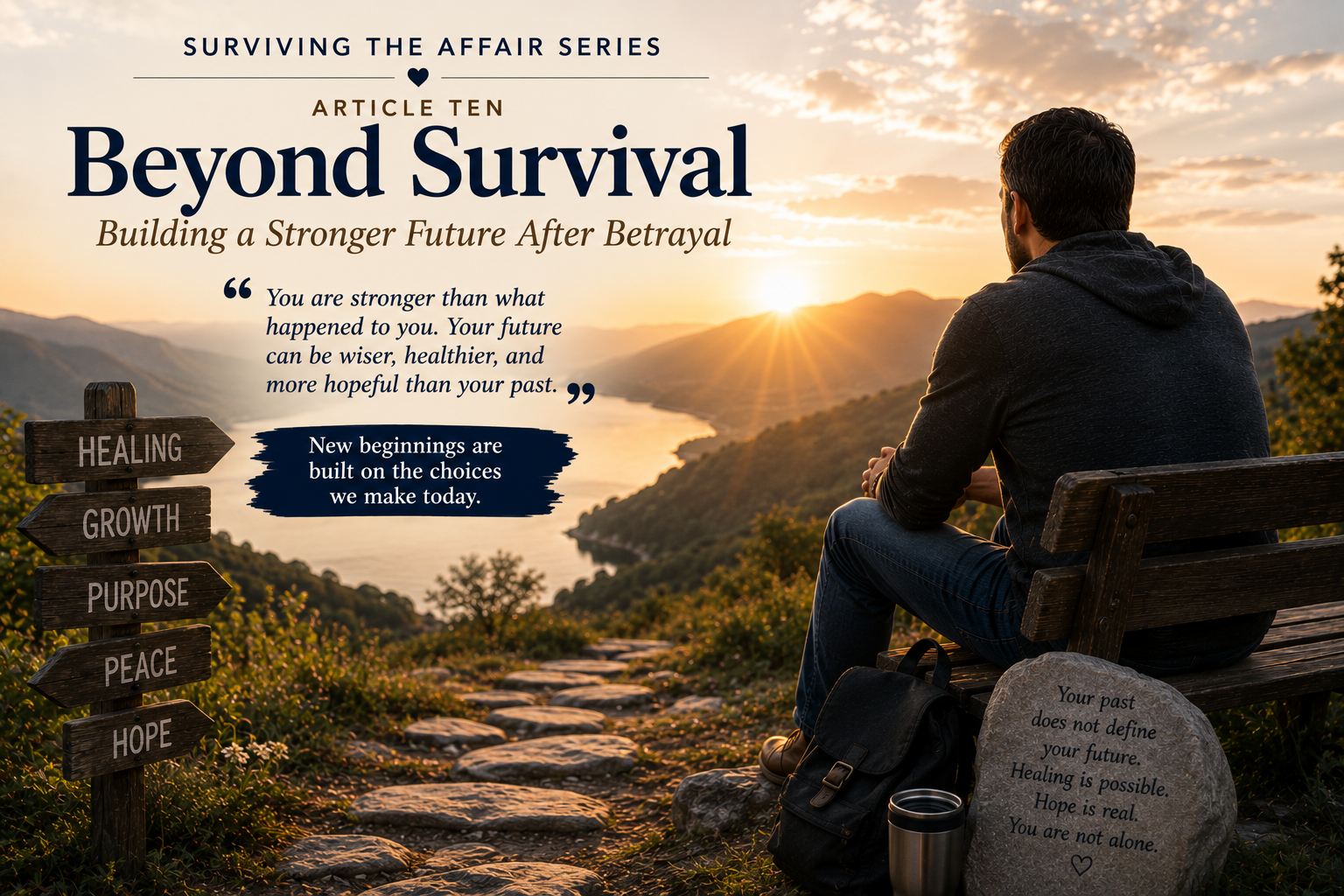
Part Ten: Building a Stronger Future After Betrayal
At some point, nearly every person recovering from an affair asks the same question:
“Will I ever feel normal again?”
It is a deeply human question. After months—or sometimes years—of emotional turmoil, counseling appointments, difficult conversations, sleepless nights, and painful decisions, people naturally long for the day when life no longer revolves around the affair. They want peace. They want joy. They want to stop measuring every conversation against the past. They want to wake up without immediately remembering what happened.
The encouraging truth is this:
For many people, that day does come. Not because the affair is forgotten. Not because the pain never existed. But because healing gradually becomes stronger than the wound. Recovery is not simply about surviving betrayal. It is about becoming someone healthier, wiser, and emotionally stronger than you were before the crisis began. This final chapter is not about ending a painful story. It is about beginning a new one.
Healing Changes You
Many people begin counseling hoping to become the person they were before the affair. Ironically, the healthiest outcome is often something different. Healthy recovery does not recreate the past. It creates growth. People frequently discover strengths they never knew they possessed. They become better communicators. They establish healthier boundaries. They learn emotional regulation. They become more intentional in relationships. They deepen their spiritual lives.
While no one would choose the pain of betrayal, many eventually recognize that the healing process transformed them into someone more emotionally mature than they had ever been before. This is what psychologists often describe as post-traumatic growth—positive psychological change that emerges from successfully navigating profound adversity. Growth does not justify suffering. It demonstrates that suffering does not have the final word.
If You Rebuild the Marriage
Some marriages survive infidelity. A smaller number become healthier than they were before. Not because the affair improved the relationship. Rather, because the crisis forced both spouses to confront unhealthy patterns that had existed long before the affair occurred. Healthy reconciled marriages often develop:
Honest communication.
Emotional transparency.
Greater empathy.
Consistent accountability.
Shared spiritual growth.
Intentional quality time.
Renewed commitment to protecting the relationship.
Trust returns slowly. Sometimes over several years. Each truthful conversation becomes another brick in rebuilding the foundation. Eventually, trust becomes less about forgetting the past and more about confidence in today’s choices.
If the Marriage Ends
For others, healing continues outside the marriage. Divorce does not automatically mean failure. Sometimes it reflects the difficult reality that one or both partners were unwilling or unable to rebuild a healthy relationship. Life after divorce often begins with grief. Then comes adjustment. Eventually, many discover hope. New routines develop. Children adapt. Friendships deepen. Purpose returns. Life begins to feel possible again. Although the family structure has changed, healing remains available. Your future is not cancelled because your marriage ended.
Learning to Trust Again
One of the greatest fears after betrayal is trusting another person. Some decide they will never become vulnerable again. While understandable, emotional isolation often prolongs suffering. Healthy trust develops gradually. It begins with yourself. Can I recognize unhealthy patterns? Can I communicate honestly? Can I establish healthy boundaries? Can I respond to red flags instead of ignoring them? Confidence grows as these questions receive healthier answers. Eventually, trusting others becomes less frightening because you trust your own wisdom.
Your Identity Is More Than Your Pain
Perhaps the greatest danger after an affair is allowing the betrayal to become your identity. Some introduce themselves internally as:
“I am the one who was cheated on.”
“I am the one who destroyed my marriage.”
“I am the affair partner.”
Those descriptions may explain part of your story. They should never define your entire life. You are more than your worst decision. You are more than someone else’s worst decision. Healing allows identity to shift from victimhood toward purpose. From shame toward dignity. From regret toward wisdom. From survival toward flourishing.
Choosing Healthy Relationships Going Forward
Whether you remain married, remarry someday, or remain single, healthy relationships share common characteristics. They include:
Mutual respect.
Honest communication.
Emotional safety.
Shared responsibility.
Healthy conflict resolution.
Appropriate boundaries.
Genuine friendship.
Spiritual and emotional intimacy.
Healthy love is not built upon perfection. It is built upon consistency.
Your Story Can Help Someone Else
Many people initially want to hide every part of their experience. Over time, some discover that their greatest pain becomes one of their greatest opportunities to serve. Their story encourages another struggling couple. Their wisdom comforts someone newly betrayed. Their experience offers hope to someone who believes healing is impossible. Scars often become testimonies. Not because suffering was good. But because healing became visible.
Tools for Living Beyond Betrayal
As you continue moving forward, these practices support lasting emotional health:
Continue investing in personal growth long after the crisis has passed.
Prioritize honest communication in every important relationship.
Maintain healthy emotional and physical boundaries.
Practice forgiveness without abandoning wisdom.
Develop consistent spiritual disciplines through prayer and Scripture.
Stay connected to supportive family, friends, and community.
Celebrate progress rather than expecting perfection.
Seek counseling whenever new challenges arise.
Remember that healing is ongoing, not a destination.
Live intentionally rather than reactively.
A Christian Perspective
Scripture repeatedly reminds us that God specializes in restoration. Joel 2:25 contains one of the Bible’s most hopeful promises:
“I will restore to you the years that the locusts have eaten…” (ESV)
Restoration does not always mean restoring the same marriage. Sometimes it means restoring the same person. Sometimes it means restoring hope. Sometimes it means restoring purpose. Sometimes it means restoring faith. God’s greatest work often begins after our greatest heartbreak. No matter how your story concludes, His invitation remains the same:
Walk forward with Him.
A Therapist’s Reflection
If I could leave every reader with one final thought, it would be this:
Do not measure your life by the day the affair happened.
Measure it by the person you are becoming because you refused to stay there. Healing is rarely dramatic. It is usually quiet. It is choosing honesty one conversation at a time. Forgiveness one day at a time. Healthy boundaries one decision at a time. Faith one prayer at a time. Eventually, those small choices become a transformed life. The affair may always be one chapter of your story. It does not have to be the title. Your future is still unwritten. Your relationships can still be healthy. Your heart can still know peace. Your family can still experience joy. And your life can still reflect hope. You have survived. Now it is time to live.
About the Author
John S. Collier, MSW, LCSW-S is a licensed clinical social worker, psychotherapist, author, educator, and speaker with decades of experience helping individuals, couples, and families navigate life’s most difficult emotional challenges. Throughout his career, he has worked extensively with people struggling with relationship conflict, betrayal, anxiety, depression, trauma, grief, addiction, and life transitions. His counseling approach combines evidence-based psychological practices with practical wisdom, compassion, and a deep respect for each person’s unique journey.
John has devoted much of his professional life to understanding the complexities of human relationships. He has counseled couples working to rebuild trust after infidelity, individuals recovering from betrayal, and families seeking healing after painful life events. His clinical experience has reinforced one enduring truth: while relationships can be profoundly wounded, people possess an extraordinary capacity for growth, resilience, forgiveness, and transformation when they are equipped with the right tools and support.
As an author, John seeks to bridge the gap between professional mental health knowledge and everyday life. His writing translates complex psychological concepts into practical guidance that readers can understand and apply immediately. Whether addressing marriage, parenting, emotional wellness, trauma recovery, or spiritual growth, his goal is to provide resources that are both clinically sound and personally encouraging.
Surviving the Affair reflects John’s commitment to approaching infidelity with both honesty and compassion. Rather than reducing people to labels or stereotypes, he explores the emotional realities experienced by everyone affected—the betrayed spouse, the unfaithful partner, the affair partner, and the families whose lives are forever changed. Drawing upon years of therapeutic experience, he emphasizes accountability without condemnation, healing without minimizing pain, and hope without offering unrealistic promises.
John believes that healing begins when people are willing to face the truth with courage. While not every relationship can or should be restored, every individual has the capacity to grow beyond betrayal, rediscover integrity, and build a healthier future. His passion is helping readers move from surviving life’s greatest wounds to living with renewed purpose, emotional strength, and hope.
Through his books, speaking engagements, and counseling work, John continues to encourage others to pursue emotional health, healthy relationships, personal responsibility, and lasting transformation—one step at a time.ountability, and restoration. Through his clinical work and writing, he equips readers with practical tools to build emotionally healthy relationships, strengthen resilience, and discover hope after life’s most difficult experiences.
References
American Psychological Association. (2023). Clinical Practice Guideline for the Treatment of Posttraumatic Stress Disorder.
Calhoun, L. G., & Tedeschi, R. G. (2014). Handbook of Posttraumatic Growth: Research and Practice. Routledge.
Gottman, J. M., & Gottman, J. S. (2015). 10 Principles for Doing Effective Couples Therapy. W. W. Norton & Company.
Snyder, D. K., Baucom, D. H., & Gordon, K. C. (2007). Getting Past the Affair. Guilford Press.
Spring, J. A. (2012). After the Affair (2nd ed.). Harper.
Tedeschi, R. G., & Calhoun, L. G. (2004). “Posttraumatic Growth: Conceptual Foundations and Empirical Evidence.” Psychological Inquiry, 15(1), 1–18.
The Holy Bible, English Standard Version. Crossway.
This series has been written for every person whose life has been altered by an affair. Each article focuses on one unique perspective because healing looks different depending upon where someone stands.
Part Five: The Long Road Home Understanding genuine remorse, rebuilding trust, transparency, and becoming trustworthy again.
Part Six: Loving Somone You Cannot Keep Exploring attachment, hope, grief, and accepting that loving someone does not always justify continuing the relationship.
Part Ten: Beyond Survival Whether the marriage survives or ends, discovering how people rebuild identity, hope, purpose, and healthy relationships again.
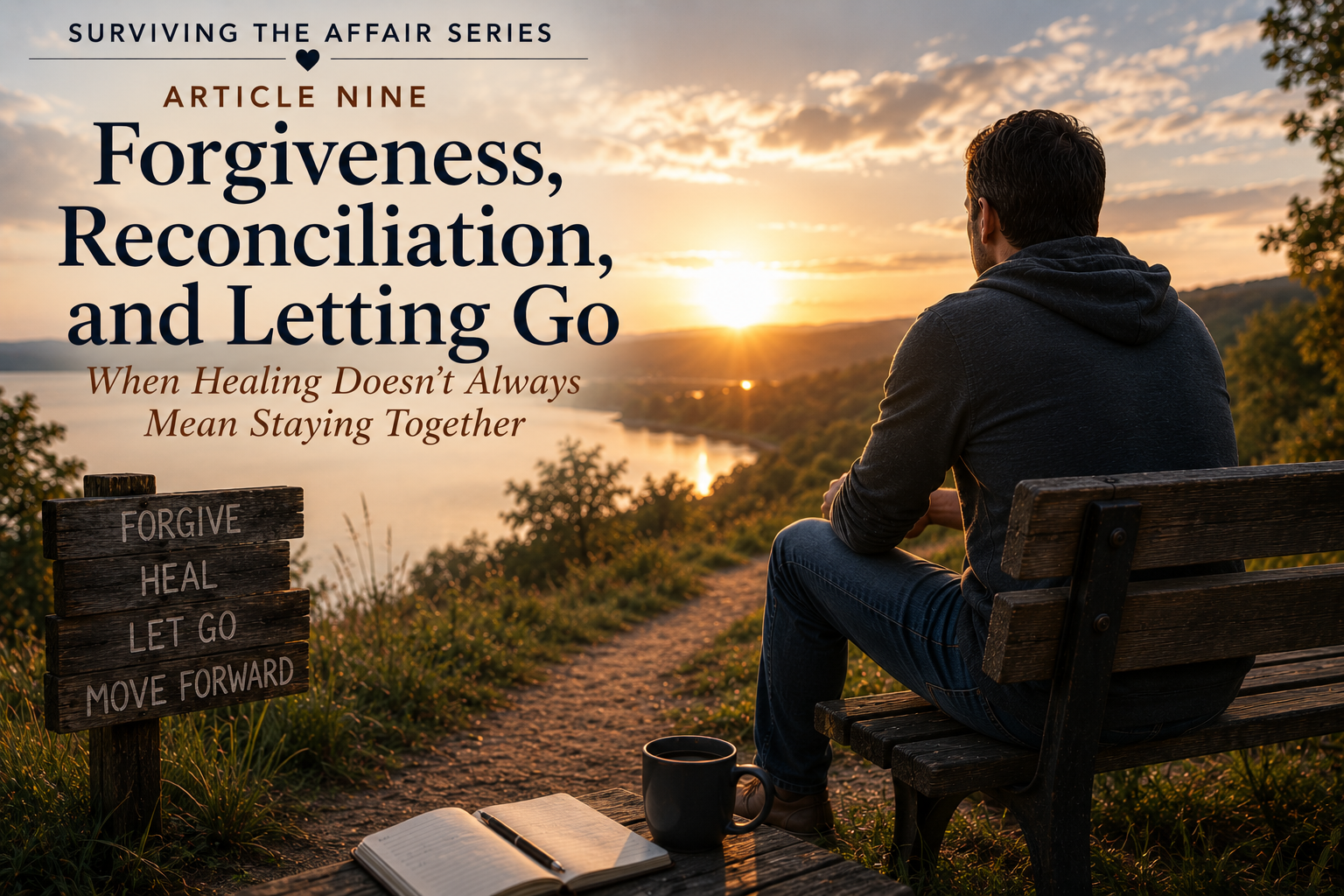
Part Nine: When Healing Doesn’t Always Mean Staying Together
Perhaps no word creates more confusion after an affair than the word forgiveness. Some people believe forgiveness means forgetting. Others believe it means trusting again. Some think it requires reconciliation. Others refuse to forgive because they believe doing so somehow excuses what happened.
In my years of counseling individuals and couples after infidelity, I have discovered that very few people actually struggle with the idea of forgiveness. They struggle with what they think forgiveness means. If we misunderstand forgiveness, we either demand it too quickly or avoid it altogether. Neither response promotes healing. Forgiveness is one of the most misunderstood concepts in psychology, relationships, and Christianity. Understanding it correctly often becomes one of the most important turning points in recovery.
Forgiveness Is Not Saying It Didn’t Matter
Some wounds permanently change a person’s life. An affair may result in divorce. Children may experience years of emotional pain. Friendships may end. Financial stability may disappear. Trust may never fully return. Acknowledging these realities does not mean forgiveness is impossible. It means forgiveness begins with honesty. Real forgiveness never minimizes the seriousness of betrayal. It fully recognizes the depth of the wound. Only then can healing begin.
Forgiveness Is Not Reconciliation
This distinction cannot be overstated. Forgiveness and reconciliation are related. They are not identical. Forgiveness is something one person can choose. Reconciliation requires two people. One person can forgive. Both people must rebuild trust. Reconciliation requires:
Genuine repentance.
Radical honesty.
Transparency.
Accountability.
Emotional safety.
Consistent trustworthy behavior.
Mutual willingness to rebuild the relationship.
Without these elements, reconciliation becomes unsafe. Forgiveness may still occur. Reconciliation may not.
Forgiveness Is Not Trust
One of the most painful mistakes couples make is expecting forgiveness to immediately restore trust. Trust is earned. Forgiveness is given. Trust grows through repeated demonstrations of honesty. Forgiveness grows through emotional healing. A spouse may forgive today. Trust may require months—or years—to return. That is normal. Healthy forgiveness never ignores wisdom.
Bitterness Is a Heavy Burden
Many people refuse forgiveness because they believe it protects them. “If I stay angry, I’ll never be hurt again.” Unfortunately, bitterness rarely protects. It imprisons. Bitterness quietly occupies emotional space that could otherwise be filled with peace. It influences future relationships. It affects physical health. It changes the way we see ourselves. It changes the way we see others. Eventually, bitterness begins hurting the person carrying it more than the person who caused it. Forgiveness is not setting someone else free. It is refusing to remain emotionally chained to what they did.
What If They Never Apologize?
One of the most difficult realities is that some people never receive the apology they deserve. The unfaithful spouse may deny responsibility. The affair partner may never acknowledge the harm. Some people simply disappear. Waiting for another person’s remorse before healing often leaves us emotionally dependent upon someone who has already demonstrated unreliability. Healing cannot depend upon another person’s choices. Your recovery belongs to you.
Forgiveness Is a Process, Not a Moment
Many people expect forgiveness to happen all at once. Instead, it often unfolds gradually. One day you notice the anger feels slightly less intense. Months later, the memories no longer dominate every conversation. Years later, you discover the affair has become part of your history rather than your identity. Forgiveness usually grows quietly. Like physical healing, it often happens so gradually that we fail to notice until we compare where we are today with where we once were.
When Reconciliation Isn’t Healthy
Not every marriage should continue. Repeated affairs. Abuse. Manipulation. Addiction without treatment. Chronic dishonesty. Refusal to accept responsibility. These situations may make reconciliation unsafe. Choosing divorce in such circumstances is not necessarily evidence of unforgiveness. Sometimes healthy boundaries require ending the relationship. God values truth and safety as much as He values reconciliation. Wisdom requires knowing the difference.
What Letting Go Really Means
Letting go does not mean pretending the affair never happened. It means releasing your need to control what cannot be changed. You cannot rewrite yesterday. You can choose how yesterday influences tomorrow. Letting go means:
Releasing revenge.
Releasing constant rumination.
Releasing the need to make the other person suffer.
Releasing unrealistic expectations.
Choosing emotional freedom instead of emotional captivity.
That process rarely happens overnight. It is practiced one decision at a time.
Tools for Moving Forward
Whether your marriage survives or ends, these practices encourage emotional healing:
Work with a therapist experienced in betrayal trauma.
Journal your thoughts and emotional progress.
Practice mindfulness when intrusive memories arise.
Establish healthy emotional and physical boundaries.
Learn the difference between forgiveness and trust.
Invest in supportive friendships.
Develop daily spiritual practices through prayer and Scripture.
Focus on becoming emotionally healthy rather than emotionally vindicated.
Celebrate progress rather than demanding perfection.
Give yourself permission to heal at your own pace.
A Christian Perspective
When Jesus taught about forgiveness, He never suggested that wrongdoing should be ignored. Rather, He demonstrated that forgiveness is an act of surrender to God rather than an approval of sin. Ephesians 4:31–32 encourages believers:
“Get rid of all bitterness, rage and anger… Be kind and compassionate to one another, forgiving each other, just as in Christ God forgave you.”
Biblical forgiveness is rooted in freedom. Freedom from bitterness. Freedom from revenge. Freedom to trust God’s justice rather than carrying the burden yourself. Forgiveness is not weakness. It is spiritual strength.
A Therapist’s Reflection
One question I frequently ask clients is this:
“If the affair could no longer control your emotional life, what kind of person would you become?”
At first, many struggle to answer. Their identity has become intertwined with the betrayal. Over time, however, something beautiful begins to happen. They stop defining themselves by what someone did to them. They begin defining themselves by who they are becoming. That is healing. Forgiveness does not erase scars. It changes what those scars represent. Instead of reminders of permanent defeat…They become evidence that you survived. Whether your marriage continues or ends… Whether the apology comes or never arrives…Whether trust is rebuilt or permanently broken…Your future is still yours to write.
Do not allow another person’s choices to become the author of the rest of your life. Healing is possible. Freedom is possible. And forgiveness—properly understood—may become one of the greatest gifts you ever give yourself.
About the Author
John S. Collier, MSW, LCSW-S is a licensed clinical social worker, psychotherapist, author, educator, and speaker with decades of experience helping individuals, couples, and families navigate life’s most difficult emotional challenges. Throughout his career, he has worked extensively with people struggling with relationship conflict, betrayal, anxiety, depression, trauma, grief, addiction, and life transitions. His counseling approach combines evidence-based psychological practices with practical wisdom, compassion, and a deep respect for each person’s unique journey.
John has devoted much of his professional life to understanding the complexities of human relationships. He has counseled couples working to rebuild trust after infidelity, individuals recovering from betrayal, and families seeking healing after painful life events. His clinical experience has reinforced one enduring truth: while relationships can be profoundly wounded, people possess an extraordinary capacity for growth, resilience, forgiveness, and transformation when they are equipped with the right tools and support.
As an author, John seeks to bridge the gap between professional mental health knowledge and everyday life. His writing translates complex psychological concepts into practical guidance that readers can understand and apply immediately. Whether addressing marriage, parenting, emotional wellness, trauma recovery, or spiritual growth, his goal is to provide resources that are both clinically sound and personally encouraging.
Surviving the Affair reflects John’s commitment to approaching infidelity with both honesty and compassion. Rather than reducing people to labels or stereotypes, he explores the emotional realities experienced by everyone affected—the betrayed spouse, the unfaithful partner, the affair partner, and the families whose lives are forever changed. Drawing upon years of therapeutic experience, he emphasizes accountability without condemnation, healing without minimizing pain, and hope without offering unrealistic promises.
John believes that healing begins when people are willing to face the truth with courage. While not every relationship can or should be restored, every individual has the capacity to grow beyond betrayal, rediscover integrity, and build a healthier future. His passion is helping readers move from surviving life’s greatest wounds to living with renewed purpose, emotional strength, and hope.
Through his books, speaking engagements, and counseling work, John continues to encourage others to pursue emotional health, healthy relationships, personal responsibility, and lasting transformation—one step at a time.onal pain toward lives marked by integrity, resilience, and hope. Through his writing and counseling, he encourages readers to embrace accountability while believing that lasting personal transformation is always possible. with practical tools for healing, resilience, and lasting personal growth.
References
American Psychiatric Association. (2022). Diagnostic and Statistical Manual of Mental Disorders (5th ed., text rev.). American Psychiatric Association Publishing.
Baucom, D. H., Snyder, D. K., & Gordon, K. C. (2009). Helping Couples Get Past the Affair: A Clinician’s Guide. Guilford Press.
Enright, R. D. (2001). Forgiveness Is a Choice: A Step-by-Step Process for Resolving Anger and Restoring Hope. American Psychological Association.
Glass, S. P. (2003). Not “Just Friends”: Rebuilding Trust and Recovering Your Sanity After Infidelity. Free Press.
Spring, J. A. (2012). After the Affair: Healing the Pain and Rebuilding Trust When a Partner Has Been Unfaithful (2nd ed.). Harper.
Worthington, E. L. (2006). Forgiveness and Reconciliation: Theory and Application. Routledge.
Worthington, E. L. (2013). Moving Forward: Six Steps to Forgiving Yourself and Breaking Free from the Past. WaterBrook.
The Holy Bible, New International Version. (2011). Zondervan.
This series has been written for every person whose life has been altered by an affair. Each article focuses on one unique perspective because healing looks different depending upon where someone stands.
Part Five: The Long Road Home Understanding genuine remorse, rebuilding trust, transparency, and becoming trustworthy again.
Part Six: Loving Somone You Cannot Keep Exploring attachment, hope, grief, and accepting that loving someone does not always justify continuing the relationship.
Part Ten: Beyond Survival Whether the marriage survives or ends, discovering how people rebuild identity, hope, purpose, and healthy relationships again.