Why Building Love Primarily on How Someone Makes You Feel Can Be Dangerous
By John S. Collier, MSW, LCSW-S
There is a phrase we hear often when people talk about falling in love:
“I love the way you make me feel.”
It sounds beautiful.
And there is nothing wrong with feeling good around the person you love. We should hope our relationships bring happiness, comfort, affection, peace, laughter, attraction, safety, and belonging.
But there is a danger hidden inside those words when they become the reason we love someone.
Because feelings change.
People change.
Life changes.
And if I love you primarily because of what loving you does for me, what happens when you can no longer make me feel that way?
Maybe real love has to begin somewhere deeper.
Maybe I should not love you simply because you make me feel loved.
Maybe I should love you because you are worth loving.
Because you deserve to be loved.
And because, when the feelings rise and fall as feelings inevitably do, I still choose to love you.
“Love that depends entirely upon a feeling is in danger whenever the feeling changes.”
Feelings Are Powerful, but They Are Not Permanent
Our feelings are real, but they are also remarkably fluid.
A single conversation can change our mood. Stress can change it. Exhaustion can change it. Grief can change it. Financial pressure, parenting problems, illness, work, disappointment, aging, anxiety, and depression can all influence what we feel.
Romantic love itself has biological and psychological components. Research discussed by the American Psychological Association describes how early romantic love engages reward and motivational systems within the brain. That helps explain something many of us already know from experience.
Falling in love can feel incredible.
But a lifelong relationship cannot depend upon continually recreating the emotional intensity of falling in love.
Psychologist Robert Sternberg’s well-known triangular theory describes love through three components: intimacy, passion, and decision/commitment. Notice that last word:
Commitment.
There is emotion in love.
There is attraction in love.
There is intimacy in love.
But there is also decision.
That distinction matters.
The Problem With “I Love How You Make Me Feel”
There is a subtle difference between saying:
“I love you, and being loved by you makes me happy.”
and saying:
“I love you because you make me happy.”
Those statements may sound almost identical, but they can represent very different foundations.
In the first, happiness is a fruit of the relationship.
In the second, happiness can become a condition of the relationship.
If your primary value to me is your ability to make me feel good about myself, secure, wanted, important, admired, attractive, understood, or happy, I may gradually stop seeing you and begin seeing what you provide for me.
Without realizing it, love can become transactional:
You give me this feeling, and in return, I give you my love.
That is a dangerous bargain because neither person can maintain it forever.
No Person Can Carry the Responsibility for Your Happiness
There will be seasons when the person you love simply does not have much left to give.
They may be grieving.
They may become sick.
They may lose a parent.
They may struggle emotionally.
They may have problems at work.
They may become overwhelmed by raising children.
They may become frightened, tired, discouraged, irritable, or quiet.
They may need you far more than they are capable of giving to you.
And there is an important question hidden inside those difficult seasons:
Can I continue loving you when you are temporarily unable to make me feel the way you once did?
That may be one of the tests separating love as an emotion from love as a commitment.
If my love depends on what you supply emotionally, then your difficult season becomes my relationship crisis.
Instead of asking,
“What does the person I love need from me?”
I begin asking,
“Why aren’t you making me happy anymore?”
Those are completely different questions.
When Love Becomes About Me
There is a paradox here.
We can become very focused on another person while actually being preoccupied with ourselves.
I need your attention.
I need your reassurance.
I need you to respond a certain way.
I need you to make me feel important.
I need you to make me feel secure.
I need you to demonstrate that you love me.
There is nothing wrong with having relational needs. Healthy relationships require reciprocity, communication, respect, affection, trust, and appropriate boundaries.
The danger comes when another human being becomes responsible for constantly regulating our sense of worth.
At that point, we may not be asking:
“Who are you?”
We may really be asking:
“Who am I when I am reflected in your eyes?”
And those questions are worlds apart.
Love the Person, Not Just the Experience of the Person
There is something I think we should ask ourselves occasionally:
If this person stopped making me feel extraordinary, would I still believe they were extraordinary?
That question can be uncomfortable.
But it gets to the heart of mature love.
The person you love is more than an experience you are having.
They are a whole human being.
They have hopes you did not create.
Fears you did not cause.
Dreams that existed before you.
Wounds you may never completely understand.
Weaknesses.
Strengths.
Insecurities.
Failures.
Convictions.
Responsibilities.
And a life that possesses value apart from what it contributes to yours.
Research on motivations for romantic relationships also suggests that people enter relationships for different reasons, including love and care, family and children, status and resources, and other motivations. Those motivations are associated with people’s broader values and the qualities they seek in partners. So it is worth examining not simply whom we love, but why we love them.
“You Make Me Happy” Is a Gift, Not a Job Description
I hope the person you love makes you happy.
But happiness should be received as a gift rather than imposed as a job description.
Think about the difference.
Gift:
“Your presence brings happiness into my life, and I am grateful for it.”
Demand:
“Your responsibility is to keep me happy, and something is wrong with you whenever you don’t.”
The first produces gratitude.
The second can produce resentment.
The person you love should not have to wake every morning wondering whether they are successfully maintaining your emotional state.
That burden eventually becomes exhausting.
Feelings Are Weather. Commitment Is the House.
Feelings remind me of weather.
Some mornings are warm and clear.
Some evenings bring storms.
Occasionally the wind howls against the windows.
Sometimes rain seems to last for days.
But we don’t tear down the house every time the weather changes.
We build something capable of standing through changing weather.
Relationships need that kind of architecture.
Attraction may help bring two people together.
Emotion may deepen their connection.
Shared experiences may strengthen their bond.
But eventually love has to become something capable of surviving a rainy season.
Feelings are weather. Commitment is the house we build so love has somewhere to live when the storm comes.
Love Is Not Blind
Choosing love does not mean tolerating cruelty, abuse, manipulation, chronic betrayal, coercion, or dangerous behavior.
Commitment should never be used as justification for remaining unsafe.
Healthy love includes boundaries.
Healthy love can say no.
Healthy love can confront harmful behavior.
Healthy love can require change.
And sometimes loving someone does not mean continuing a particular relationship.
The idea that love involves choice should never become an excuse for mistreatment.
Choosing love means recognizing another person’s humanity and worth. It does not require abandoning your own.
There Will Be Days When Love Feels Different
Long relationships inevitably have ordinary days.
Nobody writes songs about Tuesday evening when both people are exhausted, the kitchen needs cleaning, someone forgot to pay a bill, and neither person has much interesting to say.
But those moments matter.
Because much of love is lived there.
Not on anniversaries.
Not during vacations.
Not inside perfect photographs.
But in kitchens.
Hospital rooms.
Cars.
Waiting rooms.
Grocery stores.
School parking lots.
Funerals.
Bad mornings.
Long nights.
And thousands of completely ordinary Tuesdays.
The intensity of emotion may change over time. Sternberg’s framework is useful precisely because love is not reduced to passion alone. Intimacy and commitment are distinct parts of the larger relationship. Sometimes love feels like fireworks.
Sometimes love feels like sitting beside someone who has nothing left to say and quietly letting them know:
You don’t have to entertain me.
You don’t have to impress me.
You don’t have to make me feel anything right now.
I’m still here.
The Question Changes
Immature love often asks:
“What am I getting from you?”
Mature love increasingly learns to ask:
“What can I give to this relationship without losing myself in the process?”
That doesn’t mean becoming a martyr.
It means learning reciprocity rather than keeping score.
There will be times when I carry more.
There will be times when you carry more.
And perhaps there will be moments when neither of us feels particularly strong, so we simply carry what we can together.
Love Is Also a Choice
This may be one of the least romantic sounding things we can say about love, yet I believe it is one of the most beautiful:
Sometimes love is a decision.
Sternberg’s theory explicitly incorporates decision and commitment as part of love. That does not make love cold.
It makes love dependable.
“I choose you” may ultimately mean more than “I feel something for you.”
Because feelings happen to us.
Choices require something from us.
There are mornings when you wake up feeling deeply connected to the person beside you.
There may be other mornings when frustration or hurt is sitting between you.
The question then becomes:
What will I do with the love I promised when love doesn’t feel effortless?
Love Someone Because They Are Worth Loving
Perhaps we need to change some of our language.
Instead of:
“I love you because you make me feel special.”
Try:
“I love you, and I am grateful that you make me feel special.”
Instead of:
“I love you because you make me happy.”
Try:
“I love you, and sharing my life with you brings me happiness.”
Instead of:
“I love you because of what you do for me.”
Try:
“I love who you are, not merely what you provide for me.”
Then perhaps arrive at something even deeper:
“I love you because I have come to know you. I see something worthy in you. I respect the human being you are. And I choose to participate in loving you.”
That kind of love has roots.
Love Them When They Cannot Perform for You
One day the person you love may not look the way they once did.
Neither will you.
Their body may change.
Their health may change.
Their career may change.
Their confidence may disappear for a while.
Perhaps their laughter will become harder to find.
Perhaps life will humble them.
And you might be given the extraordinary responsibility of loving someone during a season when they do not even feel very lovable themselves.
That is when love may become less glamorous but more meaningful.
Because then you are no longer saying:
“I love what I experience when I am with you.”
You are saying:
“I love you.”
Period.
And Let Them Love You the Same Way
There is another side to this.
You deserve a love that does not require you to perform happiness for someone else.
You should be able to have a bad day.
To grieve.
To struggle.
To get something wrong.
To need reassurance.
To grow.
To age.
To change.
To become tired.
To occasionally have very little to give.
Healthy relationships still require responsibility, repair, communication, and mutual effort. Love is not permission to stop caring for the relationship.
But you should not have to constantly prove your value by producing a particular emotional experience for somebody else.
You are not an emotional vending machine.
Neither is the person you love.
Conclusion: I Choose to Love You
Maybe love begins with a feeling.
A glance.
A conversation.
A smile.
Something inexplicable that draws two lives toward one another.
There is nothing wrong with that.
But if love becomes mature, eventually it must become more than what I feel when you walk into the room.
Because feelings rise.
Feelings fall.
Bodies change.
Circumstances change.
People disappoint each other.
Life interrupts our plans.
Storms arrive.
And eventually every relationship encounters a moment when feelings alone are not enough.
That is when love gets the opportunity to become something deeper.
I don’t want to love you merely because you make me feel important.
I want to recognize that you are important.
I don’t want to love you only because you make me feel worthy.
I want to remember that you have worth of your own.
I don’t want my love to disappear simply because life becomes difficult and the emotional reward feels smaller for a season.
I want to love you because I have looked carefully at the human being standing before me and decided:
You are worth loving.
You deserve love.
And today, I choose to love you.
Tomorrow, I want to make that choice again.
And the next day, again.
Perhaps that is one of the quiet secrets of lasting love.
It isn’t one enormous choice made at an altar, on an anniversary, or during some perfect moment.
It is thousands of ordinary choices.
I see you.
I value you.
I respect you.
I will not make you responsible for every emotion inside me.
And even when love feels different than it did yesterday, I will remember why I chose to love you in the first place.
The deepest love may not be, “I love you because of how you make me feel.” It may be, “I know who you are, I believe you are worth loving, and I choose to love you.”
About the Author
John S. Collier, MSW, LCSW-S is a Licensed Clinical Social Worker Supervisor and the Executive Director of Southeast Kentucky Behavioral Health, LLC. His career in social work and behavioral health has given him the opportunity to work with individuals and families facing trauma, mental health challenges, relationship difficulties, major life transitions, and the everyday struggles that shape human growth.
John writes The Mind’s Trestle Board as a place to explore the intersection of mental health, relationships, personal responsibility, faith, morality, fatherhood, emotional development, and the lifelong work of becoming a better human being.
His writing is grounded in the belief that growth does not require perfection. It requires honesty, humility, reflection, responsibility, and a willingness to keep working on ourselves. Through both his professional experience and personal reflections, he encourages readers to look beneath their immediate emotions and consider the values, choices, commitments, and relationships upon which a meaningful life is built.
References
American Psychological Association. (2023). What happens in your brain when you’re in love? The article discusses neuroscience research concerning romantic love, motivation, and the brain’s reward systems. Myers, E. /
Simply Psychology. (2026). Sternberg’s triangular theory of love. Overview of Robert Sternberg’s model of intimacy, passion, and decision/commitment.
Psych Central. The psychology of love: Theories and facts. Overview of psychological perspectives on love, attachment, and Sternberg’s triangular theory.
Tartakovsky, E. (2023). The psychology of romantic relationships: motivations and mate preferences. Frontiers in Psychology, 14, 1273607. The study examined romantic motivations, personal values, and partner preferences among 1,121 young adults.
PsyPost. (2024). The psychology of love: 10 groundbreaking insights into the science of relationships. Discussion of research concerning relationship quality and psychological well-being.
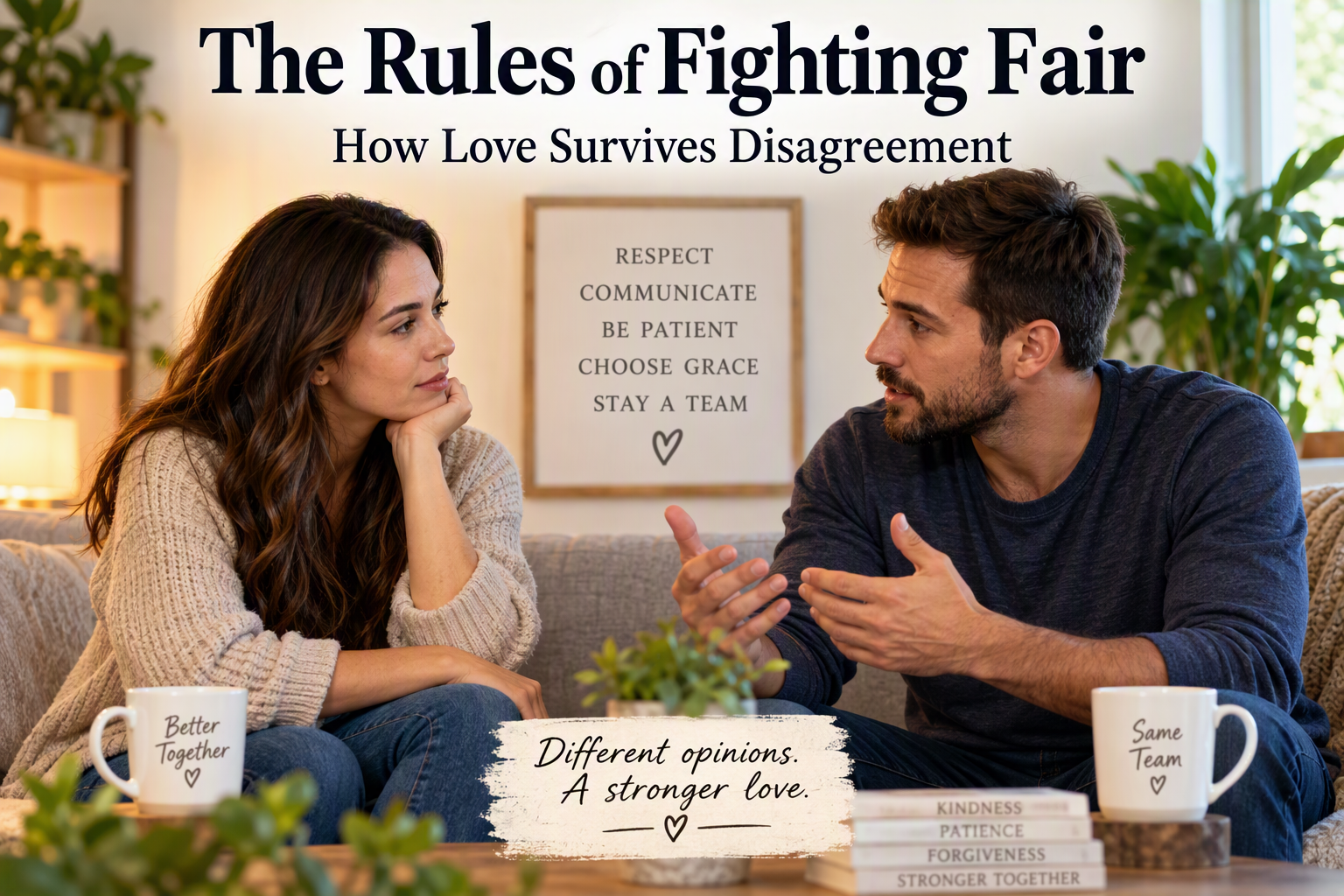
Every relationship has arguments. No matter how deeply two people love each other, there will be moments of frustration, misunderstanding, disappointment, and hurt. The difference between healthy relationships and unhealthy ones is not whether conflict exists. The difference is how conflict is handled.
The image above presents five simple but powerful rules for couples during arguments. At first glance, they seem obvious. Yet these principles address some of the most common mistakes that damage trust and intimacy. They remind us that being angry with someone is not a license to stop loving them.
Research consistently shows that conflict itself is not the greatest threat to a relationship. Rather, it is destructive communication patterns, contempt, criticism, stonewalling, and defensiveness that place relationships at risk (Gottman & Silver, 2015).
Rule #1: Be Mad at Me, But Don’t Insult Me
“Anger is not a ticket to speak carelessly.”
When emotions run high, words often become weapons. People say things they never truly mean because they want the other person to feel the same pain they are feeling.
The problem is that arguments eventually end, but hurtful words often remain.
You may forget what the disagreement was about, but you rarely forget being called worthless, stupid, selfish, or unlovable. According to relationship researcher John Gottman, contempt and personal attacks are among the strongest predictors of relationship dissatisfaction and eventual separation (Gottman & Silver, 2015).
Healthy couples understand an important truth: attack the problem, not the person.
You can say:
“That hurt me.”
“I am disappointed.”
“I feel ignored.”
Without saying:
“You’re pathetic.”
“You never do anything right.”
“You’re just like your mother.”
Respect should not disappear simply because peace has.
Anger can be temporary. The damage caused by contempt can be permanent.
Rule #2: Be Mad at Me, But Tell Me Why
“Don’t assume I know.”
One of the greatest relationship myths is that people should automatically know what is wrong.
The truth is that nobody can read minds.
Many arguments grow larger because one partner believes the other should already understand the issue. Meanwhile, the other person is confused and becomes frustrated trying to guess.
Clear communication is one of the strongest predictors of relationship success. Research by Markman, Stanley, and Blumberg (2010) found that couples who communicate concerns directly and clearly are better able to resolve conflict and maintain emotional intimacy.
Instead of saying:
“You know exactly what you did.”
Try saying:
“When this happened, it made me feel unimportant.”
People cannot fix problems they do not understand.
Love requires communication, not telepathy.
As marriage and family therapist Virginia Satir observed, communication is to relationships what breathing is to life. Without it, connection slowly deteriorates (Satir, 1988).
Rule #3: Be Mad at Me, But Don’t Broadcast It
Conflict belongs between the people involved.
Too often people rush to social media, group texts, friends, family members, or coworkers to discuss relationship problems before discussing them with their partner.
While outside support can sometimes be helpful, publicly shaming a partner almost never improves the relationship.
Once private details become public, they cannot easily be taken back.
Strong relationships protect each other’s dignity, even during difficult moments. Maintaining emotional safety and mutual respect helps partners feel secure enough to resolve disagreements constructively (Tatkin, 2012).
This does not mean remaining silent about abuse, manipulation, or situations involving safety concerns. Those circumstances require outside support and intervention. However, ordinary relationship disagreements generally benefit from privacy, maturity, and direct communication.
A couple should be teammates solving a problem together, not opponents recruiting spectators.
Rule #4: Be Mad at Me, But Don’t Forget My Good Qualities
Conflict has a way of shrinking our perspective.
When we are hurt, our minds naturally focus on the thing causing the pain. Suddenly one mistake feels larger than a thousand acts of kindness.
Psychologists often describe this tendency as negative filtering, where attention becomes focused on a person’s flaws while overlooking their strengths.
A healthy relationship requires balance.
Remember:
The person who forgot an anniversary may also be the person who supported you through difficult times.
The person who made a mistake may also be the person who loves you deeply.
The person frustrating you today may be the person who has stood beside you for years.
Research from the Gottman Institute has found that successful couples maintain a strong ratio of positive interactions to negative interactions, even during periods of conflict (The Gottman Institute, 2024).
A moment of failure should not erase a history of goodness.
Rule #5: Be Mad at Me, But Remember Grace
“Remember all the times I’ve forgiven you.”
This final point may be the most powerful.
Every person who has been in a long-term relationship has needed forgiveness. No one is perfect. No one gets everything right.
Healthy couples recognize that relationships are not scoreboards.
Love is strengthened when both people remember that they have received grace as often as they have given it.
Research from the Greater Good Science Center at the University of California, Berkeley indicates that forgiveness is associated with stronger relationships, better emotional health, reduced stress, and greater overall well-being (Greater Good Science Center, 2023).
Forgiveness does not excuse harmful behavior or remove accountability. Instead, it acknowledges that human beings are flawed and that lasting relationships require compassion.
The question is not whether your partner will eventually disappoint you.
They will.
The question is whether there is enough humility, understanding, and forgiveness to move forward together.
The Real Secret Behind Healthy Arguments
Many people believe successful couples avoid conflict. The truth is quite the opposite.
Successful couples argue.
They disagree.
They become frustrated.
They occasionally hurt one another.
What separates them from struggling couples is that they continue fighting for the relationship while addressing the problem.
They remember that the person sitting across from them is not the enemy.
The problem is the enemy.
Relationship experts consistently emphasize that couples who approach conflict as a shared challenge rather than a battle to be won are more likely to experience long-term satisfaction and stability (Markman et al., 2010; Gottman & Silver, 2015).
The argument should never become a contest about who wins. It should become a conversation about how both people can heal, learn, and grow.
Because at the end of the day, the healthiest relationships are not those free from anger.
They are the relationships where love remains present even when anger arrives.
“Being angry with someone is not the opposite of loving them. Treating them without respect is.”
About the Author
John S. Collier, MSW, LCSW-S is the Executive Director of Southeast Kentucky Behavioral Health, LLC and author of The Mind’s Trestle Board. Through his writing, he explores relationships, personal growth, emotional wellness, morality, and the challenges people face as they seek meaningful connections with others. His work blends professional behavioral health experience with practical life lessons intended to encourage reflection, healing, and personal development.
References
Chapman, G. (2015). The 5 Love Languages: The Secret to Love That Lasts. Northfield Publishing.
Gottman, J. M., & Silver, N. (2015). The Seven Principles for Making Marriage Work (Revised ed.). Harmony Books.
Greater Good Science Center. (2023). The Science of Forgiveness. University of California, Berkeley.
Harvard Health Publishing. (2022). Communication and Conflict Resolution in Relationships. Harvard Medical School.
Markman, H. J., Stanley, S. M., & Blumberg, S. L. (2010). Fighting for Your Marriage (3rd ed.). Jossey-Bass.
Mayo Clinic Staff. (2023). Healthy Communication and Relationship Wellness. Mayo Clinic.
Satir, V. (1988). The New Peoplemaking. Science and Behavior Books.
Tatkin, S. (2012). Wired for Love: How Understanding Your Partner’s Brain and Attachment Style Can Help You Defuse Conflict and Build a Secure Relationship. New Harbinger Publications.
The Gottman Institute. (2024). Managing Conflict in Relationships.
Understanding the Difference Between Responsibility, Partnership, and Control in Relationships
Many women have found themselves saying:
“I need him to step up a
nd be the man I need him to be.”
Sometimes, that statement comes from a place of genuine exhaustion. A woman may feel as though she is carrying the home, the children, the appointments, the bills, the emotional concerns, and the future of the relationship by herself. She may not be asking for perfection. She may simply be asking for a partner.
That is a reasonable need. However, there is another possibility that deserves honest thought. Sometimes, “I need him to step up” slowly becomes:
“I need him to do things the way I would do them.”
Those are not the same request. Asking a man to take responsibility is part of a healthy relationship. Expecting him to think, plan, communicate, parent, clean, organize, and solve problems exactly as you would may turn partnership into control. The key question is not simply whether he is doing things your way. The better questions are:
Is he carrying a fair share of the responsibility?
Is he dependable?
Is he acting with integrity?
Is he considering the needs of the family?
Is his method harmful, or is it simply different from yours?
Are you asking for partnership, or are you asking for compliance?
Understanding the difference can reduce resentment, improve communication, and make room for both people to grow.
“A man who steps up does not have to become a copy of you. He must become a responsible version of himself.”
What Does “Step Up” Really Mean?
When many women say they want a man to step up, they mean they want a man who is:
Dependable
Responsible
Emotionally present
Involved with the children
Willing to make decisions
Able to follow through
Financially accountable
Committed to the relationship
Aware of what is happening in the home
Willing to share the physical and mental workload
These are not unfair expectations.
Research on household labor shows that the division of responsibilities can be important to relationship quality. Research has also found that shared cognitive household work, including planning, remembering, anticipating needs, and monitoring tasks, is associated with greater relationship satisfaction for both mothers and fathers (Petts, Carlson, & Wong, 2025). [richardpetts.com]
A woman should not have to carry every responsibility while a capable partner waits to be given instructions.
There is a difference, however, between asking a man to take ownership and giving him a task while continuing to control every part of it.
Healthy responsibility sounds like:
“We both need to be responsible for keeping the house running.”
Control may sound like:
“You can help, but you must do it exactly the way I would do it.”
That difference may appear small, but it can shape the emotional climate of the entire relationship.
The Mental Load Is Real
Before discussing control, it is important to acknowledge something many women experience: the mental load.
The mental load is more than physically completing chores. It includes noticing what needs to be done, keeping track of it, making decisions, reminding others, and checking that everything was completed.
It may involve:
Remembering medical appointments
Watching school deadlines
Planning meals
Monitoring household supplies
Scheduling activities
Remembering birthdays
Preparing for holidays
Tracking children’s clothing sizes
Managing family relationships
Making sure bills are paid
Noticing emotional needs before anyone says something
Recent research distinguishes this cognitive and emotional work from visible household chores. A 2026 study found that women reported greater relationship satisfaction when male partners contributed more to the mental load, especially its emotional parts. The study also reported that mental load was a stronger predictor of women’s satisfaction than physical housework in the samples examined (Klein et al., 2026). [journals.sagepub.com]
Therefore, a woman may not be controlling simply because she is tired of having to tell a man what to do.
If she has to recognize the problem, develop the plan, assign the task, explain the task, remind him about the task, and check the completed task, she is still carrying much of the responsibility.
The goal of this article is not to dismiss women’s exhaustion. It is to help separate two different problems:
Helping Is Not the Same as Owning
A man who asks, “What do you need me to do?” may be willing to help. A man who notices what needs to be done and takes care of it is sharing ownership.
Healthy partnership requires more than waiting for assignments.
A partner who truly is not carrying his share.
A partner who is contributing, but doing so differently than she would.
Responsibility Is Not the Same as Method
Imagine that a couple agrees the kitchen needs to be cleaned.
The man washes the dishes, wipes the counters, takes out the trash, and sweeps the floor. The kitchen is clean.
However, he puts some dishes in different cabinets. He uses a different cleaner. He completes the work in a different order.
Did he fail?
Not necessarily.
If the goal was to clean the kitchen and the kitchen is clean, the responsibility may have been fulfilled even though his method was different.
Now imagine that he says he will clean the kitchen, but leaves food on the counters, dirty dishes in the sink, and trash on the floor.
That is not merely a different method. The task was not completed.
This distinction matters.
Ask yourself:
Was the agreed goal reached?
Was the result safe and reasonable?
Did he follow through?
Is my concern about the result, or about his method?
Would I consider the work acceptable if I had not watched him do it?
Does my preferred method truly matter, or does it simply feel more familiar?
“Different does not automatically mean careless, incompetent, or wrong.”
A healthy relationship needs room for different approaches. Two people can reach the same good outcome by taking different paths.
One Person’s Standard Is Not Automatically the Universal Standard
Every person enters a relationship with an idea of how life is “supposed” to work.
Those ideas come from:
Childhood experiences
Family traditions
Past relationships
Religious or cultural beliefs
Personal preferences
Anxiety about uncertainty
Previous disappointments
The need for order or predictability
One person may believe laundry must be folded immediately.
One person may believe every purchase should be discussed first. Another may believe clean clothes can remain in a basket until later. Another may believe small purchases do not require a conversation.
One parent may use detailed schedules. The other may be more flexible. These differences require negotiation. They do not automatically prove that one partner is mature and the other is irresponsible. It is easy to mistake what is familiar for what is correct. The fact that something was done a certain way in your childhood home does not make that method the only healthy method. Likewise, your partner’s family traditions do not automatically determine how your shared household should operate. A couple must create a new system together.
The Difference Between a Standard and a Preference
A useful way to reduce conflict is to place concerns into two categories.
A true relationship standard involves:
A true relationship standard involves:
A personal preference may involve:
Safety Honesty Fidelity Financial responsibility Respect Child welfare Keeping important promises Substance use boundaries Legal obligations Health needs Protection from abuse or neglect
How towels are folded Which route is taken The order in which chores are completed How a dishwasher is loaded How items are arranged Whether a task is completed in the morning or evening Which reasonable parenting technique is used How a meal is prepared How a problem is discussed How free time is organized
These issues deserve serious discussion and clear boundaries.
Preferences are not meaningless. They still matter. However, a preference should not always be presented as a moral requirement.
Preferences are not meaningless. They still matter. However, a preference should not always be presented as a moral requirement.
Callout Box: A Helpful Question
Before correcting your partner, ask:
“Is this about safety, integrity, and responsibility, or is this about my personal preference?”
If it is a preference, consider whether there is room for another acceptable method.
Micromanagement Can Quietly Weaken a Relationship
Micromanagement happens when one person gives another responsibility but continues to control nearly every detail.
It may look like:
Repeatedly correcting him while he works
Redoing tasks after he completes them
Questioning every decision
Giving long instructions for simple responsibilities
Watching closely to catch mistakes
Reminding him before he has had time to act
Treating his judgment as less trustworthy
Taking the task back because his method feels unfamiliar
Criticizing the process even when the result is acceptable
Micromanagement may come from anxiety rather than disrespect. A woman may believe that if she does not monitor everything, something will go wrong.
However, even when the intent is to prevent mistakes, the message received may be:
“I do not trust you.”
Over time, a man who feels constantly criticized may become defensive, hesitant, or withdrawn. A demand-withdraw pattern occurs when one partner pressures, criticizes, or demands change while the other partner avoids, defends, or ends the discussion. Research has connected this pattern with negative interactions and lower levels of conflict resolution (Papp, Kouros, & Cummings, 2009). [pmc.ncbi.nlm.nih.gov]
This does not mean the person who withdraws bears no responsibility. Withdrawing, refusing to communicate, or using silence as punishment is also unhealthy.
It means that both partners may be helping create a cycle:
She feels unsupported.
She pushes harder.
He feels criticized or controlled.
He pulls away.
She sees his withdrawal as proof that he does not care.
She pushes even harder.
He withdraws even more.
Soon, both people feel misunderstood. The relationship becomes a struggle between pursuit and escape.
Why Constant Correction Can Lead to Disengagement
Imagine being asked to complete a project but being corrected through every step. You choose a method. It is questioned. You make a decision. It is revised. You finish the work. It is redone. Eventually, you may decide that there is little reason to take initiative because your contribution will not be accepted anyway.
This is sometimes called learned helplessness in everyday conversation, but couples should be careful about loosely applying clinical terms. The more practical point is that repeated criticism can reduce motivation and confidence.
Some men eventually begin saying:
“Just tell me what you want.”
“You are going to redo it anyway.”
“Nothing I do is good enough.”
“Why ask me if you have already decided?”
“It is easier if you handle it.”
That response is not ideal. Adults remain responsible for contributing, even when they feel criticized. Still, the couple should examine the full pattern rather than placing all blame on one person.
“If you want initiative, there must be room for independent judgment.”
Asking Him to Lead While Rejecting Every Decision
Some women say they want a man who can lead. Yet when he makes a decision, they may challenge it because it is not the decision they would have made. This creates a contradiction. Leadership requires judgment. Judgment requires the freedom to consider options and make choices. A person cannot meaningfully lead if the correct answer has already been decided by someone else.
This does not mean that a man should dominate the relationship.
Healthy leadership is not:
Healthy leadership may involve:
Control Intimidation Silencing a partner Making every decision alone Using money as power Demanding obedience Ignoring a woman’s knowledge or concerns Claiming authority without accepting responsibility
Taking initiative Listening carefully Making decisions when a decision is needed Accepting accountability Protecting the relationship Considering the needs of the entire family Admitting mistakes Sharing power appropriately Following through
leadership and partnership are not opposites.
A healthy man can lead in areas where he is strong while also respecting his partner’s voice. A healthy woman can lead in areas where she is strong without belittling him. The goal is not to decide who is superior. The goal is to build a life where both people’s strengths are used.
Partnership Requires Autonomy
Autonomy means having room to act according to your values and judgment rather than feeling forced, controlled, or manipulated. Autonomy does not mean selfishness. It does not mean doing whatever you want without considering your partner. It means remaining a whole person within the relationship.
Research has associated relationship autonomy with supportive behavior and lower intrusiveness. Across three studies, Hadden and colleagues found that relationship autonomy was associated with greater supportiveness toward a partner and less intrusive behavior (Hadden et al., 2015). [link.springer.com]
A newer study also reported that feeling able to be one’s true self within a long-term relationship was connected with greater relationship satisfaction, both in daily experience and over time (Genesse et al., 2025). [onlinelibr….wiley.com] A loving relationship should allow both people to say:
“I matter.”
“You matter.”
“My thoughts are welcome.”
“Your thoughts are welcome.”
“We can disagree without becoming enemies.”
“We can be different without threatening the relationship.”
“We can make decisions together without erasing either person.”
Partnership Is Not Compliance
Compliance says, “I will do it your way so you do not become upset.”
Partnership says, “We will talk about what matters, agree on the goal, and respect each other’s reasonable judgment.”
Not Every Difference Is a Problem
Couples often spend too much energy trying to remove harmless differences. One partner may process thoughts by talking. The other may need quiet time before responding. One may plan months ahead. The other may manage shorter periods more Effectively. One may be highly detailed. The other may quickly see the larger picture. One may show love through words. The other may show love through action.
Differences can become strengths when couples stop using them as evidence against each other. The important question is whether the difference causes harm.
A difference may require intervention when it leads to:
Broken promises
Unsafe conditions
Financial instability
Neglect of children
Repeated emotional injury
Deception
Chronic avoidance
Unequal burdens
Fear or intimidation
Loss of trust
A difference may simply require acceptance when:
The goal is still achieved
No one is being harmed
The partner remains dependable
The method is reasonable
The outcome is acceptable
The conflict is mainly about preference
Maturity includes knowing when to speak up and when to let go.
Accountability Must Go Both Ways
This discussion should not become an excuse for men to avoid responsibility. A man cannot demand freedom from criticism while refusing to contribute. He should not say:
“You are too controlling,” when he repeatedly breaks promises.
“You expect too much,” when she carries nearly everything.
“My way is different,” when the task remains unfinished.
“You should trust me,” when he consistently acts irresponsibly.
“Stop nagging,” when she has made clear and reasonable requests that he continues to ignore.
Different methods are acceptable. Chronic neglect is not a method. Failing to follow through is not independence. Forgetting every responsibility is not leadership. Leaving one partner to carry the entire mental load is not teamwork. Research on household labor has consistently examined the connection between the division of domestic work and relationship quality. One study found that the shared performance of routine household tasks was positively related to relationship satisfaction among more recent groups of couples. The relationship was especially notable for sharing dishwashing responsibilities (Carlson, Miller, & Sassler, 2018). [journals.sagepub.com]
Both partners need accountability.
Women should examine:
Women should examine:
Men should examine:
Am I asking for responsibility or sameness? Do I allow him to use his judgment? Do I communicate clearly? Do I criticize more often than I appreciate? Do I redo acceptable work because it is not done my way? Have I turned preferences into rules? Am I expecting him to read my mind?
Do I notice what needs to be done? Do I take responsibility without waiting for instructions? Do I keep my promises? Do I leave the planning and emotional work to her? Do I use her frustration as an excuse to withdraw? Have I earned trust through consistent action? Am I truly contributing, or am I simply defending myself?
“A woman should not have to mother her partner, and a man should not have to become an employee in his own home.”
Stop Expecting Mind Reading
A woman may believe her needs should be obvious. She may think:
“He should know I need help.”
“He should know what matters to me.”
“He should know why I am upset.”
“If he cared, I would not have to ask.”
Wanting to be noticed and understood is deeply human. However, even caring partners do not always recognize unspoken needs. Empathic accuracy refers to how well partners understand each other’s thoughts and feelings during interactions. Research recognizes that understanding a partner’s inner experience is difficult and that motivation plays a role in how accurately partners understand each other (Hinnekens et al., 2016). [pmc.ncbi.nlm.nih.gov]
Love does not create mind-reading abilities. Clear communication is not a sign that the relationship has failed. It is one of the tools that helps a relationship work. Instead of saying:
“You should already know.”
Try saying:
“I am feeling overwhelmed by managing the appointments, meals, and school responsibilities. I need you to completely take ownership of two of those areas.”
That request is clear, specific, and measurable.
A Better Way to Ask Him to Step Up
The phrase “step up” is broad. A man may hear criticism without understanding the actual need. Try replacing a general complaint with a specific request.
Instead of:
Instead of:
Try:
“You need to be more of a man.”
“I need to know that I can depend on you to follow through when you make a commitment.”
“You never help me.”
I am carrying most of the planning for the children. I need us to divide both the planning and the tasks.”
You do everything wrong.”
The outcome I need is for this to be completed safely by Friday. I am open to your method.”
Why can’t you just do it the way I told you?”
Can you help me understand your approach? I want to make sure we agree on the goal.”
“If you cared, you would know.”
This is important to me, and I need to explain why.”
Specific communication gives a partner something meaningful to respond to.
Agree on Outcomes Before Arguing About Methods
Couples often argue about methods because they never clearly agreed on the desired outcome.
For example, “help more with the children” is unclear.
A clearer agreement may be:
One parent handles school transportation.
One parent manages medical appointments.
Both attend important school meetings when possible.
Each parent has full responsibility for bedtime on assigned evenings.
Schedule changes are placed on a shared calendar.
Concerns about discipline are discussed privately rather than in front of the children.
Once the outcome and responsibilities are clear, each person can have reasonable freedom in how the work is completed.
A useful four-step conversation
1. Name the shared goal “We both want the children to be prepared for school.”
2. Identify the responsibilities. “That includes clean clothes, completed homework, packed lunches, and getting there on time.”
3. Decide who owns each responsibility “You will handle lunches and transportation. I will handle clothing and homework review.”
4. Allow reasonable independence “We agree on the outcome, but we do not have to complete each task in exactly the same way.”
This reduces confusion and helps prevent one partner from becoming the permanent household supervisor.
Appreciation Is Not the Same as Applause for Basic Responsibility
Some women resist showing appreciation because they believe a man should not need to be praised for fulfilling ordinary responsibilities. That concern is understandable. An adult should not expect a celebration for parenting his children, cleaning his home, or keeping his promises. Still, appreciation is valuable in both directions.
Appreciation does not mean:
Appreciation does not mean:
Healthy appreciation can sound like:
Treating him like a child Ignoring poor behavior Lowering expectations Praising incomplete work Pretending that unfairness is acceptable
“Thank you for handling that.” “I noticed you took care of it without being asked.” “That helped me feel less alone.” “I appreciate that you followed through.” “Your approach was different from mine, but it worked.”
It means noticing sincere effort and acknowledging contribution.
Men should offer the same recognition to women. No one should be treated as though their daily labor is invisible.
When You May Truly Need Him to Change
Acceptance does not mean tolerating harmful behavior. There are times when a woman is not asking for control. She is asking for basic responsibility, safety, or respect. Serious change may be needed when a partner:
Repeatedly lies
Refuses to work despite being able to do so
Misuses family money
Neglects the children
Breaks commitments without concern
Uses substances in dangerous ways
Engages in threatening or abusive behavior
Refuses necessary communication
Leaves all household labor to the other partner
Uses silence or withdrawal as punishment
Blames everyone else for his decisions
Rejects accountability
Expects the woman to act as his mother
In those situations, the issue is not that he loads the dishwasher differently.
The issue is trust, safety, or responsibility.
A woman is not controlling simply because she has standards. Boundaries are not the same as control.
A boundary says:
“I will not remain in a situation where I am threatened or mistreated.”
Control says:
“You must think, speak, and act exactly as I prefer so that I never feel uncomfortable.”
A boundary explains what you will do to protect your well-being.
Control attempts to manage another person’s identity, choices, and behavior.
When the Desire for Control Comes From Fear
Control is often driven by fear. A woman may have learned that if she does not manage everything, she will be disappointed. She may have experienced:
An unreliable parent
A previous unfaithful partner
Financial instability
Abandonment
Betrayal
Chaos during childhood
A relationship in which she was forced to carry everything
Her nervous system may associate control with safety.
She may believe:
“If I can make sure everything is done correctly, I cannot be hurt again.”
That response deserves compassion. However, past pain should be understood rather than allowed to quietly govern the present relationship. A current partner should be held accountable for current behavior. He should not automatically be treated as though he will repeat the actions of someone from the past. Healing may involve learning to tolerate reasonable differences, communicate needs openly, and allow another trustworthy person to carry responsibility.
A Quick Self-Check Before Correcting Him
Before stepping in, correcting, or redoing a task, pause and ask:
Is anyone unsafe?
Is an important promise being broken?
Is the agreed outcome not being reached?
Have I clearly communicated what is needed?
Did we agree on the standard together?
Am I reacting to a genuine problem or an unfamiliar method?
Am I leaving room for his judgment?
Would I want to be spoken to the way I am about to speak to him?
Am I asking for partnership, or am I seeking relief from anxiety through control?
Can I allow this to be done well without requiring it to be done perfectly?
These questions are not meant to silence women.
They are meant to make communication more accurate.
Signs of Healthy “Stepping Up”
A man is likely stepping up when he:
Takes initiative
Follows through consistently
Notices needs without always being told
Accepts responsibility for mistakes
Shares physical and mental labor
Participates in difficult conversations
Makes thoughtful decisions
Considers his partner’s needs
Protects the family’s financial and emotional stability
Remains open to feedback
Respects boundaries
Changes harmful patterns
Acts with integrity even when no one is watching
He does not have to complete every task exactly as his partner would. He does need to show that his partner is not alone.
Signs That “Stepping Up” May Actually Mean “Doing It My Way”
The request may have shifted toward control when:
His acceptable work is repeatedly redone.
Every independent decision is criticized.
Differences are described as character flaws.
He is allowed responsibility but not authority.
Preferences are treated as moral rules.
He is expected to know needs that have not been communicated.
Mistakes are used as proof that he cannot be trusted with anything.
His strengths are ignored because they look different.
Agreement is valued more than honest discussion.
Peace depends on his compliance.
He is expected to lead but punished for making decisions.
Callout Box: The Central Question
Do you want him to become more responsible, or do you want him to become more like you?
The first request can strengthen a relationship. The second may slowly erase the person you say you want beside you.
What Healthy Partnership Looks Like
Healthy partnership is not one person giving orders while the other follows them. It is also not two people doing whatever they want without concern for each other. Healthy partnership includes:
Shared responsibility
Clear expectations
Mutual respect
Honest communication
Room for differences
Accountability
Appreciation
Negotiation
Repair after conflict
Freedom without neglect
Leadership without domination
Standards without constant criticism
Trust that is supported by consistent behavior
Both partners should influence the relationship. Both partners should be willing to learn. Both partners should be able to admit: “My way is not the only way.”
Conclusion
Wanting a man to step up is not wrong. A woman deserves a partner who contributes, follows through, communicates, shares the mental load, and takes responsibility for the life they are building together. However, responsibility should not be confused with imitation. A man does not have to fold every towel the same way, solve every problem using the same process, or make every decision exactly as his partner would.
He must be dependable.
He must be engaged.
He must be accountable.
He must be willing to listen and grow.
But he must also be allowed to remain a person with his own judgment, strengths, methods, and voice. The goal of a relationship is not for one person to train the other into perfect compliance. The goal is for two imperfect people to create a life in which neither person carries everything, neither person controls everything, and both people are treated with dignity.
Sometimes, asking him to step up means expecting more. Sometimes, loving him well means stepping back enough to let him do it.
“The strongest relationships are not built by two people doing everything the same way. They are built by two people sharing responsibility, respecting differences, and walking toward the same destination.”
About the Author
John S. Collier, MSW, LCSW-S
John S. Collier, MSW, LCSW-S is a Licensed Clinical Social Worker Supervisor, behavioral health executive, writer, and advocate for stronger individuals, healthier relationships, and more compassionate communities. John S. Collier, MSW, LCSW-S serves as Executive Director of Southeast Kentucky Behavioral Health, LLC, where he provides organizational leadership and supports the development of behavioral health, psychiatric, counseling, community-based, and disability-related services. Enterprise records confirm John S. Collier, MSW, LCSW-S as Executive Director of Southeast Kentucky Behavioral Health, LLC. [Southeast…ral Health | Word], [New Oupati…icy Manual | Word]
With extensive experience in clinical social work, behavioral intervention, organizational leadership, and community mental health, John S. Collier, MSW, LCSW-S brings both professional understanding and practical insight to topics involving emotional wellness, relationships, communication, accountability, grief, personal growth, and human behavior.
John S. Collier, MSW, LCSW-S is the author of The Mind’s Trestle Board, a reflective writing platform that encourages readers to examine the beliefs, emotional patterns, relationships, and life experiences that shape who they are. His writing blends behavioral health knowledge with plain language, personal reflection, and practical guidance that readers can apply to everyday life.
Through his clinical work, leadership, and writing, John S. Collier, MSW, LCSW-S encourages people to approach themselves and others with honesty, accountability, compassion, and a willingness to grow.
References
Carlson, D. L., Miller, A. J., & Sassler, S. (2018). Stalled for whom? Change in the division of particular housework tasks and their consequences for middle- to low-income couples. Socius, 4, 1–17. Read the study. [journals.sagepub.com]
Genesse, D., Brassard, A., Vaillancourt-Morel, M. P., Muise, A., Raposo, S., & Péloquin, K. (2025). Being me while loving you: The role of autonomy in the association between insecure attachment and relationship satisfaction. Journal of Marital and Family Therapy. Read the study. [onlinelibr….wiley.com]
Hadden, B. W., Rodriguez, L. M., Knee, C. R., & Porter, B. (2015). Relationship autonomy and support provision in romantic relationships. Motivation and Emotion, 39, 359–373. Read the study. [link.springer.com]
Hinnekens, C., Vanhee, G., De Schryver, M., Ickes, W., & Verhofstadt, L. L. (2016). Empathic accuracy and observed demand behavior in couples. Frontiers in Psychology, 7, 1370. Read the study. [pmc.ncbi.nlm.nih.gov]
Klein, V., Ascigil, E., Oschatz, T., & Kahalon, R. (2026). Unequal burdens, unequal benefits: Housework, mental load, and gendered satisfaction in heterosexual relationships. Personality and Social Psychology Bulletin. Read the study. [journals.sagepub.com]
Leo, K., Crenshaw, A. O., Hogan, J. N., Bourne, S. V., Baucom, K. J. W., & Baucom, B. R. W. (2021). A replication and extension of the interpersonal process model of demand/withdraw behavior: Incorporating subjective emotional experience. Journal of Family Psychology, 35(4), 534–545. Read the study. [pmc.ncbi.nlm.nih.gov]
Papp, L. M., Kouros, C. D., & Cummings, E. M. (2009). Demand-withdraw patterns in marital conflict in the home. Personal Relationships, 16(2), 285–300. Read the study. [pmc.ncbi.nlm.nih.gov]
Petts, R. J., Carlson, D. L., & Wong, J. S. (2025). Cognitive housework and parents’ relationship satisfaction. Journal of Marriage and Family. Read the accepted manuscript. [richardpetts.com]
Many couples spend months planning a wedding but very little time planning a marriage. At the beginning of a relationship, people work hard to connect. They make plans, have meaningful conversations, laugh together, and look forward to spending time with one another.
Then life happens.
Work becomes demanding. Children need attention. Bills need to be paid. Household responsibilities pile up. Without realizing it, many couples begin spending more time managing life than nurturing their relationship. The truth is simple:
A healthy marriage requires ongoing attention, not just a wedding day commitment.
Research suggests that couples who regularly spend intentional one-on-one time together report greater relationship satisfaction, stronger commitment, better communication, and increased marital happiness. [nationalma…roject.org], [wheatley.byu.edu], [nationalma…roject.org]
Why Dating Should Continue After Marriage
Many couples unknowingly stop doing the things that helped them fall in love. While dating, they often:
Prioritize time together
Ask questions
Share experiences
Laugh frequently
Show appreciation
Engage in meaningful conversations
After marriage, many people assume these things will naturally continue. Unfortunately, that rarely happens without intentional effort. Marriage does not automatically create connection. Connection is created through shared experiences and quality time.
The habits that helped you fall in love are often the same habits that help you stay in love.
📦 Key Takeaway
Your spouse should not receive the least intentional version of you simply because they received the most permanent commitment from you.
Date Nights Strengthen Marriages
Research from the National Marriage Project found that couples who regularly participate in date nights report significantly higher levels of marital happiness and commitment than couples who rarely spend dedicated time together. [nationalma…roject.org], [nationalma…roject.org]
The report found that spouses who regularly went on date nights were more likely to report:
Dating your spouse is not about spending money. It is about investing time. Sometimes the most meaningful date is simply sitting on a porch together, enjoying a cup of coffee, and having an uninterrupted conversation.
📦 Important Reminder
Connection grows where attention goes.
If a marriage consistently receives leftover time, it often produces leftover results.
Dating Builds Emotional Intimacy
One of the biggest threats to marriage is not conflict. It is emotional distance. According to relationship researchers at the Gottman Institute, successful couples intentionally “turn toward” one another during everyday interactions, creating a stronger emotional connection over time. [gottman.com], [gottman.com]
Dating creates opportunities to:
Discuss goals
Share concerns
Celebrate successes
Talk about dreams
Strengthen trust
Maintain emotional closeness
Couples who regularly spend quality time together often feel more understood, appreciated, and connected.
“The strongest marriages are often built one conversation at a time.”
Dating Keeps Friendship Alive
Many relationship experts have observed that friendship forms the foundation of lasting marriages. [gottman.com], [gottman.com]
Your spouse is constantly growing and changing.
Their interests change.
Their goals change.
Their fears change.
Their dreams change.
Dating helps you continue learning about the person you married. Ask yourself:
What is my spouse currently excited about?
What challenge is my spouse facing?
What goal is my spouse working toward?
What would make my spouse feel supported this week?
The answers to these questions create connection.
📦 Marriage Challenge
Schedule one dedicated date with your spouse during the next seven days. Put it on the calendar and protect that time as seriously as any other important appointment.
Dating Demonstrates Value
Time is one of the most valuable gifts that exists. When you intentionally spend time with your spouse, you communicate several important messages:
You matter to me.
I enjoy being with you.
Our relationship is important.
I want us to stay connected.
You are a priority in my life.
People often feel most loved when they feel seen, heard, and valued. Dating provides opportunities to communicate all three.
Simple Date Ideas for Married Couples
Dating does not require expensive vacations or elaborate plans. Consider:
Taking a walk together
Going out for coffee
Watching a sunset
Cooking a meal together
Visiting a local bookstore
Having a picnic
Taking a scenic drive
Exploring a nearby town
Playing a board game
Attending a community event
The goal is not entertainment. The goal is connection.
The Example It Sets for Children
When children witness healthy affection, respect, communication, and quality time between parents, they learn important lessons about relationships. Parents who prioritize their marriage are not taking away from their children. Instead, they are demonstrating:
Healthy communication
Mutual respect
Commitment
Affection
Emotional support
Children benefit from seeing what a healthy relationship looks like.
Conclusion
Marriage was never meant to run on autopilot. It thrives when two people continue choosing one another over and over again. The wedding day is not the finish line. It is the starting line. Dating your spouse creates opportunities to maintain friendship, strengthen intimacy, improve communication, and build memories together. These moments do not have to be extravagant. They simply need to be intentional. The strongest marriages are often built through thousands of small moments where spouses say through their actions:
“I still choose you.”
Never stop pursuing the person you promised to love.
About the Author
John S. Collier, MSW, LCSW-S is a Licensed Clinical Social Worker Supervisor and the Executive Director of Southeast Kentucky Behavioral Health, LLC. With extensive experience in behavioral health, trauma-informed care, child and adolescent mental health, family systems, and organizational leadership, Mr. Collier has dedicated his career to helping children, adolescents, adults, and families navigate life’s challenges while building healthier and more resilient communities.
Throughout his clinical career, Mr. Collier has worked with children and adolescents experiencing emotional and behavioral difficulties, including anxiety, depression, trauma-related disorders, attention-deficit/hyperactivity disorder (ADHD), oppositional behaviors, anger management concerns, and family relationship challenges. His approach emphasizes understanding the underlying causes of behavior rather than focusing solely on symptoms, helping families develop practical strategies that strengthen communication, emotional regulation, and healthy relationships.
As a clinical supervisor, educator, and advocate for quality behavioral healthcare, Mr. Collier is committed to translating complex psychological and developmental concepts into practical guidance that parents and caregivers can readily understand and implement. His work reflects a belief that informed, supported, and empowered families play a critical role in promoting positive outcomes for children and adolescents.
In addition to his clinical practice and leadership responsibilities, Mr. Collier is the author of The Mind’s Trestle Board, where he regularly writes about mental health, personal growth, resilience, grief, family relationships, child development, and behavioral health topics. His writing combines evidence-based research with real-world clinical experience to provide readers with meaningful insights and actionable strategies.
Through his work, Mr. Collier continues to advocate for compassionate, person-centered care while helping individuals and families build the skills necessary to thrive through life.
References
Dew, J., & Wilcox, W. B. (2023). The Date Night Opportunity: What Does Couple Time Tell Us About the Potential Value of Date Nights? National Marriage Project. [nationalma…roject.org], [nationalma…roject.org]
Gottman, J. M., & Gottman, J. S. (2024). Relationship Resources for Couples. The Gottman Institute. [gottman.com], [gottman.com]
Stanley, S. M., Rhoades, G. K., & Markman, H. J. (2006). Sliding Versus Deciding: Inertia and the Premarital Cohabitation Effect. Family Relations, 55(4), 499-509.
Hawkins, A. J., Blanchard, V. L., Baldwin, S. A., & Fawcett, E. B. (2008). Does Marriage and Relationship Education Work? Journal of Consulting and Clinical Psychology, 76(5), 723-734.
Nielsen, L. (2017). The Power of Us: The Path to Discovering the Best Relationship You. Tyndale House Publishers.