From author and licensed clinical social worker John S. Collier comes a powerful new series of books exploring love, loss, faith, emotional healing, and personal growth. With honesty shaped by both professional experience and a life marked by hardship, perseverance, and grace, Collier invites readers to examine the hidden places of the heart. Each book blends practical wisdom with vivid metaphor, offering encouragement to those learning to release the past, rebuild their identity, establish healthier relationships, and trust God through uncertain seasons. This is more than a collection of books—it is a journey from merely surviving life’s storms to discovering the strength, purpose, and peace needed to live fully again.
https://a.co/d/0gTmck1t
Expressions from Behind His Silence: Valume 3: Thwe Mercy of Open Hands
Some endings do not arrive with anger. They arrive with open hands.
The Mercy of Open Hands, Volume Three of the Expressions from Behind His Silence series, follows a man through heartbreak, acceptance, forgiveness, and the difficult grace of release.
Through intimate, reflective poetry, John S. Collier explores what it means to love someone without possessing them, to carry grief without becoming bitter, and to let go without denying that the love was real.
These poems speak to the moment when holding on begins to wound more than losing—and to the quiet courage required to choose peace.
This collection is for anyone learning that surrender is not weakness, forgiveness does not erase the past, and sometimes the most loving thing the heart can do is open its hands.
Human beings possess a remarkable ability to think, reason, and seek understanding. One of the most common responses to unexpected, unpleasant, or confusing situations is the question, “Why?” Whether faced with disappointing news, organizational changes, personal loss, conflict, or circumstances beyond our control, many people experience a strong desire to understand the reasoning behind events. While seeking understanding is often beneficial, the persistent need for explanations can sometimes prevent us from accepting reality and moving forward.
Psychological research suggests that individuals naturally seek certainty because uncertainty creates discomfort. Our minds are wired to search for patterns, causes, and explanations that help us make sense of our experiences. However, there are situations where no explanation will fully satisfy us, and our continued search for answers can become an obstacle to healing, growth, and resilience (Kruglanski & Webster, 1996; American Psychological Association, 2018).
The Human Need for Closure
Social psychologist Arie Kruglanski introduced the concept of the Need for Cognitive Closure, which refers to an individual’s desire for a firm answer and an aversion to ambiguity and uncertainty. People with a high need for closure often feel uncomfortable when questions remain unanswered and may seek explanations even when those explanations do not change the outcome (Kruglanski & Webster, 1996).
The American Psychological Association defines the need for closure as the motivation to achieve finality and certainty in decisions, judgments, and life events. Individuals with a strong need for closure often struggle to tolerate situations where information is incomplete or unavailable (APA Dictionary of Psychology, 2018).
From an evolutionary perspective, this tendency makes sense. Early humans benefited from quickly identifying threats and predicting outcomes. The ability to understand cause and effect increased survival. Today, however, our brains often apply the same instincts to complex social and emotional situations where certainty may not be possible.
Why We Resist Accepting What We Do Not Understand
When we hear information that challenges our beliefs, expectations, or desires, accepting it without explanation can feel emotionally threatening. Several psychological processes contribute to this reaction.
Cognitive Dissonance
Leon Festinger’s theory of cognitive dissonance suggests that individuals experience psychological discomfort when they hold conflicting beliefs or when reality contradicts their expectations. Seeking an explanation allows a person to reduce that discomfort by creating a coherent narrative (Festinger, 1957).
For example, if an employee is informed that a policy has changed, they may immediately ask why. While the explanation may provide useful context, the deeper motivation is often the desire to reduce the tension created by the unexpected change.
Intolerance of Uncertainty
Research indicates that uncertainty itself can trigger anxiety and emotional distress. When individuals do not understand the reasons behind an event, they may imagine alternative explanations, repeatedly analyze the situation, or engage in rumination. Ironically, this often increases emotional suffering rather than reducing it (Anderson et al., 2019).
The Illusion of Control
People frequently believe that understanding “why” gives them greater control over circumstances. While knowledge can certainly enhance decision-making, many life events remain beyond our influence regardless of how thoroughly we understand them. In these circumstances, seeking more information may create the illusion of control while delaying acceptance.
When Understanding Is Helpful
This article is not suggesting that people should never ask questions or seek clarification. Understanding is often essential.
Knowing why can:
Improve decision-making.
Promote learning and growth.
Strengthen communication.
Prevent misunderstandings.
Increase trust and transparency.
Reduce unnecessary anxiety.
In healthcare, counseling, leadership, and education, providing a rationale often increases cooperation and engagement. Individuals are more likely to embrace change when they understand its purpose.
Therefore, the goal is not to eliminate the question “why,” but to recognize when seeking additional explanations ceases to be productive.
The Cost of Excessive Explanation-Seeking
Problems arise when individuals become emotionally dependent on obtaining explanations before they can move forward.
Common signs include:
Repeatedly revisiting the same issue.
Obsessing over unanswered questions.
Refusing to accept decisions without complete agreement.
Delaying action until every detail is understood.
Seeking reassurance from multiple sources without relief.
In counseling, many clients discover that even after receiving explanations, they continue searching for more answers. What they truly desire is not information but emotional comfort.
Unfortunately, explanations cannot always provide peace. Peace often comes from acceptance.
The Power of Acceptance
Acceptance does not mean approval, agreement, or surrender. Acceptance simply means acknowledging reality as it exists.
Psychological approaches such as Acceptance and Commitment Therapy (ACT) emphasize that emotional well-being improves when individuals stop fighting reality and begin focusing on actions aligned with their values (Hayes, Strosahl, & Wilson, 1999).
Acceptance allows us to shift from questions such as:
“Why did this happen?”
“Why did they do that?”
“Why wasn’t this fair?”
to more productive questions such as:
“What can I learn from this?”
“How should I respond?”
“What is within my control?”
These questions move us from passive reflection to active growth.
Learning to Move Forward Without All the Answers
Maturity often involves developing the ability to tolerate uncertainty.
Life presents many situations where explanations are incomplete, unavailable, or unsatisfying:
Organizational decisions.
Relationship endings.
Loss and grief.
Medical diagnoses.
Economic hardships.
Personal disappointments.
Waiting for perfect understanding before moving forward can leave a person emotionally stuck.
Instead, emotional resilience develops when individuals recognize that acceptance does not require full understanding.
Some of life’s greatest growth occurs when we choose to move forward despite unanswered questions.
Conclusion
The desire to know “why” is a normal and deeply human response. It reflects our need for certainty, predictability, and understanding. In many situations, seeking explanations is valuable and necessary. However, there comes a point when the endless pursuit of answers becomes more harmful than helpful.
The healthiest individuals are not necessarily those who always find explanations. They are often those who have learned to distinguish between what can be understood and what must simply be accepted.
Sometimes the most powerful words we can say are:
“I may never fully understand this, but I can still move forward.”
That mindset transforms uncertainty from an obstacle into an opportunity for growth.
—
About the Author
John S. Collier, MSW, LCSW-S is a licensed clinical social worker supervisor, behavioral health executive, and mental health professional with extensive experience in psychotherapy, community mental health, behavioral support services, and organizational leadership. He serves as Executive Director of Southeast Kentucky Behavioral Health, LLC, where he oversees multidisciplinary behavioral health programs serving individuals and families throughout Kentucky.
Mr. Collier specializes in clinical assessment, treatment planning, behavioral intervention, cognitive-behavioral approaches, acceptance-based interventions, and leadership development within behavioral healthcare organizations. His writing focuses on the intersection of psychology, human behavior, resilience, personal growth, and practical applications of evidence-based mental health principles.
Drawing from both clinical practice and organizational leadership, John seeks to translate complex psychological concepts into meaningful insights that help individuals, families, and professionals navigate life’s challenges with greater understanding and purpose.
—
References
American Psychological Association. (2018). Need for closure. APA Dictionary of Psychology. Retrieved from https://dictionary.apa.org/need-for-closure
Anderson, E. C., Carleton, R. N., Diefenbach, M., & Han, P. K. J. (2019). The relationship between uncertainty and affect. Frontiers in Psychology, 10, 2504.
Festinger, L. (1957). A Theory of Cognitive Dissonance. Stanford University Press.
Hayes, S. C., Strosahl, K. D., & Wilson, K. G. (1999). Acceptance and Commitment Therapy: An Experiential Approach to Behavior Change. Guilford Press.
Kruglanski, A. W., & Webster, D. M. (1996). Motivated closing of the mind: Seizing and freezing. Psychological Review, 103(2), 263-283.
Waite, L. J., & Gallagher, M. (2000). The Case for Marriage. Doubleday.
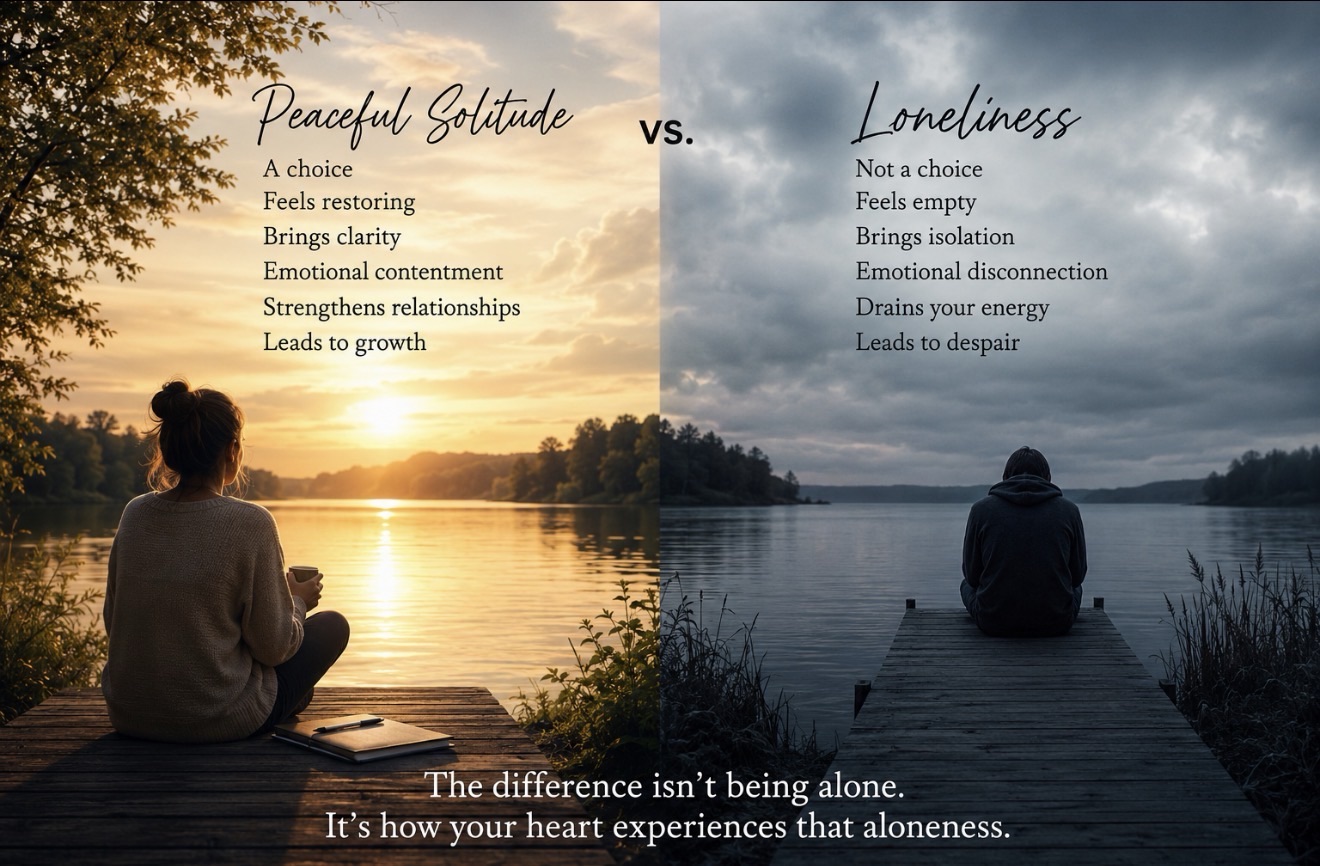
Many people think that a busy life is a happy life. We often hear that we should always be doing something, talking to people, or staying connected online. Because of this, when life becomes quiet, we may wonder if something is wrong. We might ask ourselves, “Am I feeling peaceful, or am I just lonely?”
Many people confuse peace with loneliness because both can happen when we are alone. Even though they may look the same on the outside, they feel very different on the inside. Learning the difference can help us enjoy quiet times, build healthier relationships, and take better care of our mental health.
What Is Peaceful Solitude?
Peaceful solitude means choosing to spend time alone and feeling happy and calm while doing it. Instead of feeling sad, people often feel rested, creative, and refreshed.
Psychologist Anthony Storr (1988) believed that spending time alone can help people think clearly, solve problems, and learn more about themselves. Many artists, writers, scientists, and spiritual leaders have spent quiet time alone to help them grow and create new ideas.
People who enjoy peaceful solitude often:
Feel safe while they are alone.
Enjoy hobbies and interests.
Take time to think and reflect.
Feel calm inside.
Keep healthy friendships.
Feel free instead of trapped.
The biggest difference is that they choose to be alone.
What Is Loneliness?
Loneliness is very different from peaceful solitude.
Researcher John Cacioppo said that loneliness happens when people feel they do not have enough close or meaningful relationships (Cacioppo & Patrick, 2008).
A person can feel lonely even if they are surrounded by people.
Someone can:
Be married and still feel lonely.
Have many followers on social media and still feel alone.
Go to church every week and still feel disconnected.
Work around many people and still feel like no one understands them.
Loneliness is not about being by yourself.
It is about feeling disconnected from others.
How Peace Feels
When people experience peaceful solitude, they often feel:
Calm
Thankful
Free
Relaxed
Happy
Hopeful
Confident
Clear-minded
They may say things like:
“I enjoy having time to myself.”
“I finally have time to think.”
“Life feels simple.”
“I don’t feel like I’m missing anything.”
How Loneliness Feels
Loneliness often brings feelings like:
Sadness
Emptiness
Restlessness
Feeling forgotten
Wanting someone to talk to
Worry
Depression
Hopelessness
People may think:
“Nobody understands me.”
“I wish someone would call me.”
“No one notices me.”
“I don’t matter.”
These feelings are very different from the peace that comes from healthy solitude.
What Happens in the Brain?
Research shows that quiet time can actually help your brain. WWhen people spend peaceful time alone, their brains have time to organize memories, solve problems, think creatively, and plan for the future (Raichle, 2015). But long-lasting loneliness affects the body in a different way.
Studies show that loneliness can increase:
Stress hormones
High blood pressure
Trouble sleeping
Anxiety
Depression
Heart disease
The risk of dying earlier (Holt-Lunstad et al., 2015)
Our bodies react differently depending on whether we feel peaceful or rejected.
The Power of Choice
One of the biggest differences between peace and loneliness is choice. Peace is something we choose. Loneliness often feels like something that happens to us. Imagine two people sitting alone on a Saturday afternoon. One person is reading a favorite book and enjoying the quiet. The other person wishes someone would visit or call. Both people are alone. But only one feels lonely.
Self-Worth Matters
People who feel good about themselves are usually more comfortable spending time alone. Researchers Ryan and Deci (2020) explain that people need three important things:
To feel capable.
To have some independence.
To have healthy relationships.
Peaceful solitude helps people become more independent while still staying connected to others. Loneliness happens when those important relationships are missing.
Why We Confuse Peace with Loneliness
Busy Culture
Today’s world tells us that being busy means being successful. If someone spends a Friday night at home, others may think they have no friends. But many healthy people enjoy quiet evenings to relax, read, pray, or spend time with family.
Social Media
Social media usually shows people’s best moments. We see vacations, parties, birthdays, and celebrations. This can make us believe everyone else is happier than we are. Research shows that spending too much time comparing ourselves to others on social media can actually increase loneliness (Primack et al., 2017).
Fear of Missing Out
Many people experience something called Fear of Missing Out (FOMO). They worry that everyone else is having more fun. Peace says,
“I’m happy where I am.”
FOMO says,
“I wonder if everyone else is happier than me.”
Signs You Are Feeling Peace
You may be experiencing peace if:
You enjoy quiet time.
You like your hobbies.
You have healthy friendships.
You feel safe and calm.
You are thankful.
Your alone time helps you feel rested.
You can call friends when you want to, but you don’t depend on them to feel happy.
Signs You May Be Lonely
You may be lonely if:
Silence feels painful.
You always need distractions.
You feel forgotten.
You feel empty inside.
You stop spending time with people.
You feel hopeless.
You feel alone even when others are around.
Your anxiety gets worse when you are by yourself.
Peace Helps You Grow
Research shows that learning to enjoy quiet time can make people stronger emotionally. Healthy solitude helps people:
Control their emotions.
Become more creative.
Grow spiritually.
Learn about themselves.
Make better decisions.
Become more independent.
Stay calmer during stressful times.
This is one reason why people have practiced prayer, meditation, journaling, and quiet reflection for thousands of years.
When Peace Turns into Isolation
Even healthy solitude can become unhealthy if it lasts too long. Warning signs include:
Avoiding everyone.
Turning down every invitation.
Feeling more depressed.
Losing motivation.
Not taking care of yourself.
Feeling emotionally numb.
Feeling sad for many weeks.
If these problems continue, it is important to talk with a mental health professional.
A Christian View
The Bible shows that spending quiet time alone can help people grow closer to God. Jesus often went away by Himself to pray (Luke 5:16). Moses met with God on Mount Sinai (Exodus 24). Elijah heard God’s gentle voice while he was alone (1 Kings 19:11–13). Paul also spent time alone after becoming a Christian before beginning his ministry (Galatians 1:17–18).
These times alone helped them listen to God and prepare for what He wanted them to do. But they did not stay alone forever. They returned to help and serve other people. ĎGod created us to spend time with Him and to have healthy relationships with others.
Questions to Ask Yourself
If you are not sure whether you are feeling peace or loneliness, ask yourself:
Do I enjoy this quiet time?
Am I choosing to be alone?
Do I feel happy inside?
Can I reach out to friends when I want to?
Does my quiet time give me energy?
Do I want healthy friendships, or am I hiding from people?
Is this season helping me grow?
Being honest with yourself can help you understand what you are really feeling.
Conclusion
The difference between peace and loneliness is not about how many people are around you. It is about how you feel inside. Peace means you are comfortable with yourself. You enjoy quiet moments, grow in your faith, and stay connected to people who care about you.
Loneliness is the painful feeling that you need connection but do not have it.
Learning the difference can help you enjoy healthy quiet time while also building strong and meaningful relationships. A peaceful life is not an empty life. Sometimes, the quiet moments are where we find healing, hope, purpose, and a deeper relationship with God.
About the Author
John S. Collier, MSW, LCSW, is a Licensed Clinical Social Worker, behavioral health executive, author, and speaker with more than 25 years of experience helping individuals, couples, and families navigate life’s most difficult emotional challenges. As the founder and Clinical Director of Southeast Kentucky Behavioral Health, LLC, he has dedicated his career to helping people build healthier relationships, strengthen emotional resilience, and find lasting hope through evidence-based therapeutic practices integrated with timeless biblical principles. His clinical work focuses on trauma, attachment, anxiety, depression, emotional regulation, and relationship dynamics, allowing him to translate complex psychological concepts into practical tools that readers can apply in everyday life. Through his books, articles, and presentations, John writes with compassion, authenticity, and a deep belief that healing is possible when truth, grace, and intentional growth come together. His mission is to equip readers with both the scientific understanding and spiritual encouragement needed to cultivate lives marked by peace, purpose, and meaningful connection.
References
Cacioppo, J. T., & Patrick, W. (2008). Loneliness: Human nature and the need for social connection. W. W. Norton.
Hawkley, L. C., & Cacioppo, J. T. (2010). Loneliness matters: A theoretical and empirical review of consequences and mechanisms. Annals of Behavioral Medicine, 40(2), 218–227. https://doi.org/10.1007/s12160-010-9210-8
Holt-Lunstad, J., Smith, T. B., Baker, M., Harris, T., & Stephenson, D. (2015). Loneliness and social isolation as risk factors for mortality: A meta-analytic review. Perspectives on Psychological Science, 10(2), 227–237. https://doi.org/10.1177/1745691614568352
Primack, B. A., Shensa, A., Sidani, J. E., et al. (2017). Social media use and perceived social isolation among young adults in the United States. American Journal of Preventive Medicine, 53(1), 1–8. https://doi.org/10.1016/j.amepre.2017.01.010
Ryan, R. M., & Deci, E. L. (2020). Intrinsic and extrinsic motivation from a self-determination theory perspective: Definitions, theory, practices, and future directions. Contemporary Educational Psychology, 61, 101860. https://doi.org/10.1016/j.cedpsych.2020.101860
Storr, A. (1988). Solitude: A return to the self. Free Press.
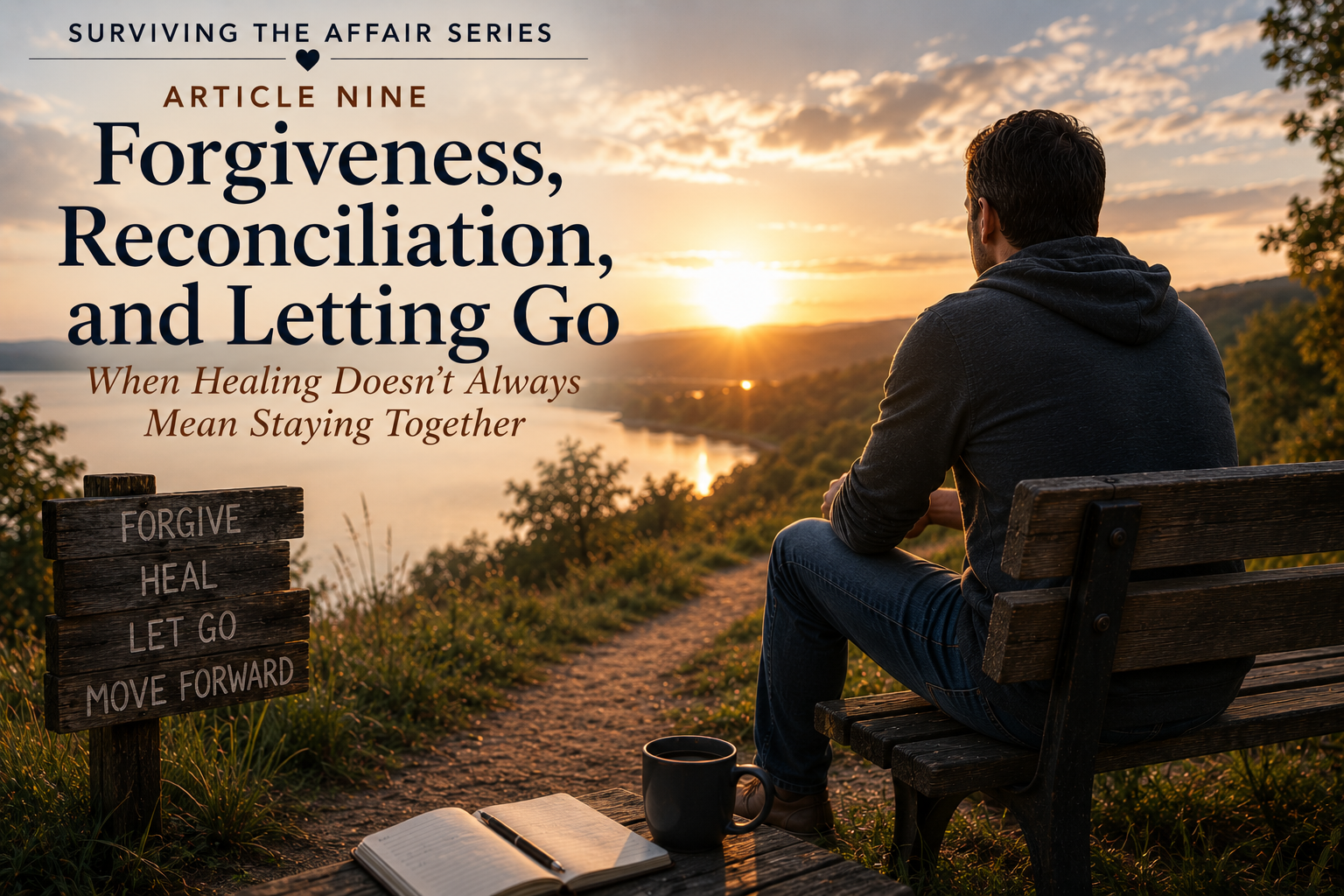
Part Nine: When Healing Doesn’t Always Mean Staying Together
Perhaps no word creates more confusion after an affair than the word forgiveness. Some people believe forgiveness means forgetting. Others believe it means trusting again. Some think it requires reconciliation. Others refuse to forgive because they believe doing so somehow excuses what happened.
In my years of counseling individuals and couples after infidelity, I have discovered that very few people actually struggle with the idea of forgiveness. They struggle with what they think forgiveness means. If we misunderstand forgiveness, we either demand it too quickly or avoid it altogether. Neither response promotes healing. Forgiveness is one of the most misunderstood concepts in psychology, relationships, and Christianity. Understanding it correctly often becomes one of the most important turning points in recovery.
Forgiveness Is Not Saying It Didn’t Matter
Some wounds permanently change a person’s life. An affair may result in divorce. Children may experience years of emotional pain. Friendships may end. Financial stability may disappear. Trust may never fully return. Acknowledging these realities does not mean forgiveness is impossible. It means forgiveness begins with honesty. Real forgiveness never minimizes the seriousness of betrayal. It fully recognizes the depth of the wound. Only then can healing begin.
Forgiveness Is Not Reconciliation
This distinction cannot be overstated. Forgiveness and reconciliation are related. They are not identical. Forgiveness is something one person can choose. Reconciliation requires two people. One person can forgive. Both people must rebuild trust. Reconciliation requires:
Genuine repentance.
Radical honesty.
Transparency.
Accountability.
Emotional safety.
Consistent trustworthy behavior.
Mutual willingness to rebuild the relationship.
Without these elements, reconciliation becomes unsafe. Forgiveness may still occur. Reconciliation may not.
Forgiveness Is Not Trust
One of the most painful mistakes couples make is expecting forgiveness to immediately restore trust. Trust is earned. Forgiveness is given. Trust grows through repeated demonstrations of honesty. Forgiveness grows through emotional healing. A spouse may forgive today. Trust may require months—or years—to return. That is normal. Healthy forgiveness never ignores wisdom.
Bitterness Is a Heavy Burden
Many people refuse forgiveness because they believe it protects them. “If I stay angry, I’ll never be hurt again.” Unfortunately, bitterness rarely protects. It imprisons. Bitterness quietly occupies emotional space that could otherwise be filled with peace. It influences future relationships. It affects physical health. It changes the way we see ourselves. It changes the way we see others. Eventually, bitterness begins hurting the person carrying it more than the person who caused it. Forgiveness is not setting someone else free. It is refusing to remain emotionally chained to what they did.
What If They Never Apologize?
One of the most difficult realities is that some people never receive the apology they deserve. The unfaithful spouse may deny responsibility. The affair partner may never acknowledge the harm. Some people simply disappear. Waiting for another person’s remorse before healing often leaves us emotionally dependent upon someone who has already demonstrated unreliability. Healing cannot depend upon another person’s choices. Your recovery belongs to you.
Forgiveness Is a Process, Not a Moment
Many people expect forgiveness to happen all at once. Instead, it often unfolds gradually. One day you notice the anger feels slightly less intense. Months later, the memories no longer dominate every conversation. Years later, you discover the affair has become part of your history rather than your identity. Forgiveness usually grows quietly. Like physical healing, it often happens so gradually that we fail to notice until we compare where we are today with where we once were.
When Reconciliation Isn’t Healthy
Not every marriage should continue. Repeated affairs. Abuse. Manipulation. Addiction without treatment. Chronic dishonesty. Refusal to accept responsibility. These situations may make reconciliation unsafe. Choosing divorce in such circumstances is not necessarily evidence of unforgiveness. Sometimes healthy boundaries require ending the relationship. God values truth and safety as much as He values reconciliation. Wisdom requires knowing the difference.
What Letting Go Really Means
Letting go does not mean pretending the affair never happened. It means releasing your need to control what cannot be changed. You cannot rewrite yesterday. You can choose how yesterday influences tomorrow. Letting go means:
Releasing revenge.
Releasing constant rumination.
Releasing the need to make the other person suffer.
Releasing unrealistic expectations.
Choosing emotional freedom instead of emotional captivity.
That process rarely happens overnight. It is practiced one decision at a time.
Tools for Moving Forward
Whether your marriage survives or ends, these practices encourage emotional healing:
Work with a therapist experienced in betrayal trauma.
Journal your thoughts and emotional progress.
Practice mindfulness when intrusive memories arise.
Establish healthy emotional and physical boundaries.
Learn the difference between forgiveness and trust.
Invest in supportive friendships.
Develop daily spiritual practices through prayer and Scripture.
Focus on becoming emotionally healthy rather than emotionally vindicated.
Celebrate progress rather than demanding perfection.
Give yourself permission to heal at your own pace.
A Christian Perspective
When Jesus taught about forgiveness, He never suggested that wrongdoing should be ignored. Rather, He demonstrated that forgiveness is an act of surrender to God rather than an approval of sin. Ephesians 4:31–32 encourages believers:
“Get rid of all bitterness, rage and anger… Be kind and compassionate to one another, forgiving each other, just as in Christ God forgave you.”
Biblical forgiveness is rooted in freedom. Freedom from bitterness. Freedom from revenge. Freedom to trust God’s justice rather than carrying the burden yourself. Forgiveness is not weakness. It is spiritual strength.
A Therapist’s Reflection
One question I frequently ask clients is this:
“If the affair could no longer control your emotional life, what kind of person would you become?”
At first, many struggle to answer. Their identity has become intertwined with the betrayal. Over time, however, something beautiful begins to happen. They stop defining themselves by what someone did to them. They begin defining themselves by who they are becoming. That is healing. Forgiveness does not erase scars. It changes what those scars represent. Instead of reminders of permanent defeat…They become evidence that you survived. Whether your marriage continues or ends… Whether the apology comes or never arrives…Whether trust is rebuilt or permanently broken…Your future is still yours to write.
Do not allow another person’s choices to become the author of the rest of your life. Healing is possible. Freedom is possible. And forgiveness—properly understood—may become one of the greatest gifts you ever give yourself.
About the Author
John S. Collier, MSW, LCSW-S is a licensed clinical social worker, psychotherapist, author, educator, and speaker with decades of experience helping individuals, couples, and families navigate life’s most difficult emotional challenges. Throughout his career, he has worked extensively with people struggling with relationship conflict, betrayal, anxiety, depression, trauma, grief, addiction, and life transitions. His counseling approach combines evidence-based psychological practices with practical wisdom, compassion, and a deep respect for each person’s unique journey.
John has devoted much of his professional life to understanding the complexities of human relationships. He has counseled couples working to rebuild trust after infidelity, individuals recovering from betrayal, and families seeking healing after painful life events. His clinical experience has reinforced one enduring truth: while relationships can be profoundly wounded, people possess an extraordinary capacity for growth, resilience, forgiveness, and transformation when they are equipped with the right tools and support.
As an author, John seeks to bridge the gap between professional mental health knowledge and everyday life. His writing translates complex psychological concepts into practical guidance that readers can understand and apply immediately. Whether addressing marriage, parenting, emotional wellness, trauma recovery, or spiritual growth, his goal is to provide resources that are both clinically sound and personally encouraging.
Surviving the Affair reflects John’s commitment to approaching infidelity with both honesty and compassion. Rather than reducing people to labels or stereotypes, he explores the emotional realities experienced by everyone affected—the betrayed spouse, the unfaithful partner, the affair partner, and the families whose lives are forever changed. Drawing upon years of therapeutic experience, he emphasizes accountability without condemnation, healing without minimizing pain, and hope without offering unrealistic promises.
John believes that healing begins when people are willing to face the truth with courage. While not every relationship can or should be restored, every individual has the capacity to grow beyond betrayal, rediscover integrity, and build a healthier future. His passion is helping readers move from surviving life’s greatest wounds to living with renewed purpose, emotional strength, and hope.
Through his books, speaking engagements, and counseling work, John continues to encourage others to pursue emotional health, healthy relationships, personal responsibility, and lasting transformation—one step at a time.onal pain toward lives marked by integrity, resilience, and hope. Through his writing and counseling, he encourages readers to embrace accountability while believing that lasting personal transformation is always possible. with practical tools for healing, resilience, and lasting personal growth.
References
American Psychiatric Association. (2022). Diagnostic and Statistical Manual of Mental Disorders (5th ed., text rev.). American Psychiatric Association Publishing.
Baucom, D. H., Snyder, D. K., & Gordon, K. C. (2009). Helping Couples Get Past the Affair: A Clinician’s Guide. Guilford Press.
Enright, R. D. (2001). Forgiveness Is a Choice: A Step-by-Step Process for Resolving Anger and Restoring Hope. American Psychological Association.
Glass, S. P. (2003). Not “Just Friends”: Rebuilding Trust and Recovering Your Sanity After Infidelity. Free Press.
Spring, J. A. (2012). After the Affair: Healing the Pain and Rebuilding Trust When a Partner Has Been Unfaithful (2nd ed.). Harper.
Worthington, E. L. (2006). Forgiveness and Reconciliation: Theory and Application. Routledge.
Worthington, E. L. (2013). Moving Forward: Six Steps to Forgiving Yourself and Breaking Free from the Past. WaterBrook.
The Holy Bible, New International Version. (2011). Zondervan.
Articles in this Series:
This series has been written for every person whose life has been altered by an affair. Each article focuses on one unique perspective because healing looks different depending upon where someone stands.
Part Five: The Long Road Home Understanding genuine remorse, rebuilding trust, transparency, and becoming trustworthy again.
Part Six: Loving Somone You Cannot Keep Exploring attachment, hope, grief, and accepting that loving someone does not always justify continuing the relationship.
Part Ten: Beyond Survival Whether the marriage survives or ends, discovering how people rebuild identity, hope, purpose, and healthy relationships again.