Welcome to SOUTHEAST KENTUCKY BEHAVIORAL HEALTH
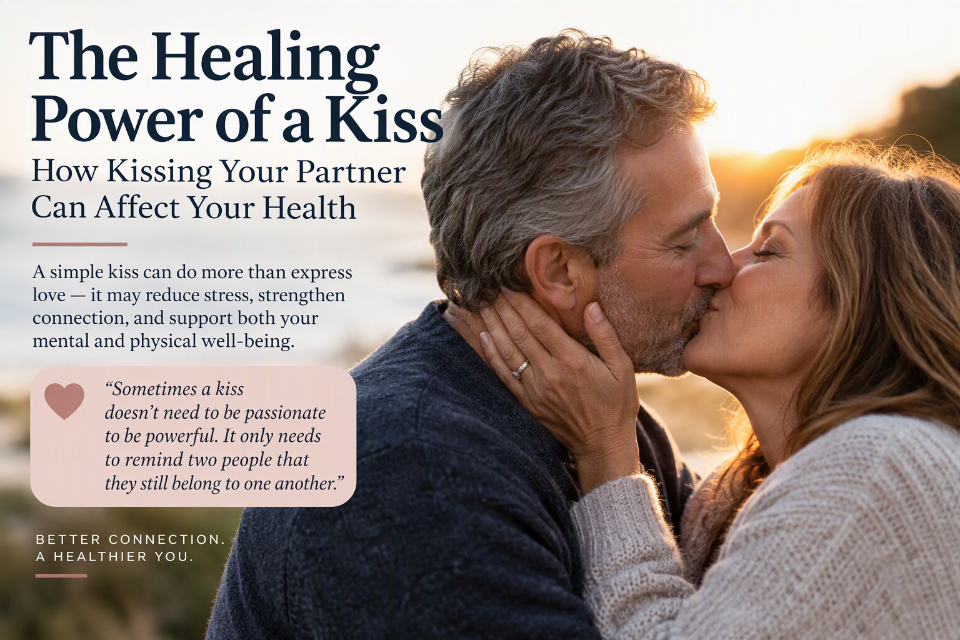
The Healing Power of a Kiss: How Kissing Your Partner Can Affect Your Health

A kiss can last only a few seconds, but the experience can communicate something much larger: I see you. I am here. You matter to me.

Between committed partners, kissing does not always have to lead somewhere else. Sometimes it is simply affection. A goodbye kiss before work, a kiss after a difficult day, or a quiet kiss before going to sleep can become part of the language through which two people maintain their connection.

Interestingly, research suggests that affectionate behaviors such as kissing may affect more than the relationship itself. They can also interact with the body’s stress response and may be associated with certain measures of physical health.

A Kiss and the Stress Response

One of the better-supported potential health effects of affectionate kissing involves stress.

Kissing and other forms of affectionate touch have been associated with changes in hormones involved in attachment and stress, including oxytocin and cortisol. Cortisol is an important part of the body’s stress-response system, while oxytocin is associated with social bonding and attachment. That does not mean a kiss magically removes the problems of the day.

The bills still have to be paid.
The children still need attention.
Work may still be stressful.
The disagreement may still need to be resolved.

But affection can communicate something powerful in the middle of those circumstances:

“Whatever is happening around us, we are still connected.”

That feeling of connection can matter.

Kissing May Affect More Than Emotions

Researchers have also examined whether kissing is associated with physical health markers.

In a study using data from 863 U.S. adults, researcher Kory Floyd examined relationships among kissing frequency, stress, and blood lipids. The study found significant indirect associations between kissing frequency and triglycerides and HDL cholesterol among participants reporting seven or more kisses during the previous month, with stress serving as a mediating factor. That’s fascinating, but it requires an important word of caution.

This does not mean kissing should be considered a treatment for high cholesterol or cardiovascular disease. The healthier interpretation is that affectionate relationships and reduced stress may interact with physical health in ways researchers are continuing to understand.

A kiss isn’t medicine. But affection may be one of the small ways our relationships interact with our physical well-being.

Your Brain Notices Affection

Affection is not merely an abstract emotional experience.

The brain and body respond to it.

Kissing has been associated with neurochemicals involved in reward, bonding, and mood, including dopamine, oxytocin, and serotonin, while affectionate contact has also been associated with reductions in cortisol. That helps explain something couples often understand intuitively.

Sometimes your partner doesn’t need you to solve anything.

They need you to stop.

Look at them.

Put down the phone.

Give them your attention.

Give them a kiss.

And remind them that they are not carrying everything alone.

The Relationship May Benefit Too

Perhaps one of the most meaningful effects of kissing has nothing to do with laboratory numbers.

It is communication.

A kiss can mean:

Good morning.

I missed you.

I’m proud of you.

Thank you.

I’m sorry.

I’m glad you’re here.

We’re okay.

Goodnight.

Physical affection can reinforce feelings of attachment and closeness between partners, and oxytocin is closely associated with bonding. Over years together, these little rituals may become especially meaningful.

Grand romantic gestures are memorable. Daily affection, however, is often what fills the enormous spaces between those moments.

But Let’s Not Turn Kissing Into a Miracle Cure

The internet is filled with dramatic claims about kissing.

Some articles claim it burns significant calories, prevents cavities, boosts immunity, eliminates allergies, cures headaches, or provides cardiovascular exercise.

Those claims deserve caution.

Current evidence is much stronger for stress reduction, emotional connection, bonding, and relationship-related benefits than for portraying kissing as a medical treatment. Even recent health-oriented reviews caution that many of its physical benefits are modest and that kissing should not substitute for medical treatment or exercise. That’s actually a more interesting conclusion.

Kissing doesn’t have to cure anything to matter.

It’s more nuanced:

Affectionate kissing between healthy, consenting partners can be part of emotional connection and stress regulation, but it isn’t risk-free or a replacement for healthcare.

Maybe the Small Things Aren’t So Small

We tend to look for complicated solutions to complicated lives.

Better diets.

Exercise programs.

Supplements.

Vacations.

Meditation.

Therapy.

All of those can have their place.

But somewhere in our pursuit of health, we shouldn’t overlook the human need for affection and meaningful connection.

After years together, couples can gradually become very good business partners.

Who is picking up the kids?

Did you pay the electric bill?

What’s for dinner?

Who has the appointment tomorrow?

Did you call the insurance company?

We can become so busy managing a life together that we forget to experience one another.

A kiss interrupts that routine.

For a moment, there isn’t a mortgage, schedule, deadline, diagnosis, argument, or overflowing laundry basket.

There are simply two people acknowledging one another.

Perhaps that is the most important health lesson contained in something as ordinary as a kiss.

Sometimes a kiss doesn’t need to be passionate to be powerful. It only needs to remind two people that beneath everything they have to do, they still belong to one another.

Conclusion

Science should not be exaggerated. Kissing isn’t going to replace exercise, medication, good nutrition, sleep, or appropriate mental and physical healthcare.

But neither should we dismiss affection as insignificant.

Research gives us good reason to believe that kissing and other forms of affectionate communication can interact with stress, bonding, emotional well-being, and potentially some physiological measures. Maybe the lesson isn’t that everyone needs to kiss more because it will magically make them healthier.

Maybe it is simpler than that.

Human beings need connection.

And sometimes one of the simplest ways two partners say “I’m still here with you” doesn’t require words at all.

About the Author

John S. Collier, MSW, LCSW-S

John S. Collier, MSW, LCSW-S, is a Licensed Clinical Social Worker Supervisor, behavioral health professional, writer, and Executive Director of Southeast Kentucky Behavioral Health, LLC. His career in social work and behavioral health has given him the opportunity to work with individuals, families, professionals, and communities while developing a deeper understanding of the many factors that shape emotional health, relationships, personal growth, and human behavior.

John began his professional journey in social work after earning his bachelor’s degree and becoming a Certified Social Worker in 2004. He later advanced his education and clinical training, ultimately becoming a Licensed Clinical Social Worker in 2010 and earning the credentials to provide clinical supervision to other social workers.

Today, as Executive Director of Southeast Kentucky Behavioral Health, LLC, John works in the behavioral health field in southeastern Kentucky, with particular attention to improving access to quality mental health services in rural communities. His professional interests include clinical social work, mental health, Positive Behavior Support, family relationships, human development, organizational leadership, and the ways that relationships and life experiences influence emotional well-being.

John is also the author of The Mind’s Trestle Board, where his writing moves beyond the walls of the counseling office. He explores marriage, relationships, parenting, masculinity, faith, grief, trust, morality, personal responsibility, emotional growth, forgiveness, and the difficult process of becoming a better version of ourselves.

His writing is shaped not only by professional education and clinical experience, but also by the belief that some of life’s most important lessons are found in ordinary moments. A conversation between spouses, an argument with someone we love, a parent’s interaction with a child, a mistake we regret, an act of forgiveness, or even something as simple as a kiss goodbye can reveal something meaningful about attachment, connection, character, and the human need to belong.

Through The Mind’s Trestle Board, John encourages readers to slow down long enough to examine those moments rather than simply pass through them. Drawing upon behavioral science, social-work principles, life experience, and personal reflection, he seeks to translate complicated ideas about mental health and relationships into language that ordinary people can understand and apply to everyday life.

A recurring theme in his writing is that growth is not the same as perfection. People make mistakes. Relationships become strained. Families face difficult seasons. Individuals sometimes discover uncomfortable truths about themselves. What matters is whether we are willing to examine ourselves honestly, accept responsibility when responsibility belongs to us, learn from experience, seek wisdom, and continue becoming better people.

His work also reflects the importance of faith, family, commitment, compassion, accountability, and service to others. Rather than presenting himself as someone who has mastered those principles, John writes from the perspective of someone who continues to wrestle with what they mean in real life.

Ultimately, The Mind’s Trestle Board is built around a simple idea: our minds, relationships, choices, failures, successes, and experiences are constantly shaping the people we are becoming.

John’s hope is that his writing gives readers a reason to pause, think, talk with the people they love, question old assumptions, and perhaps look at an ordinary part of life from a different perspective.
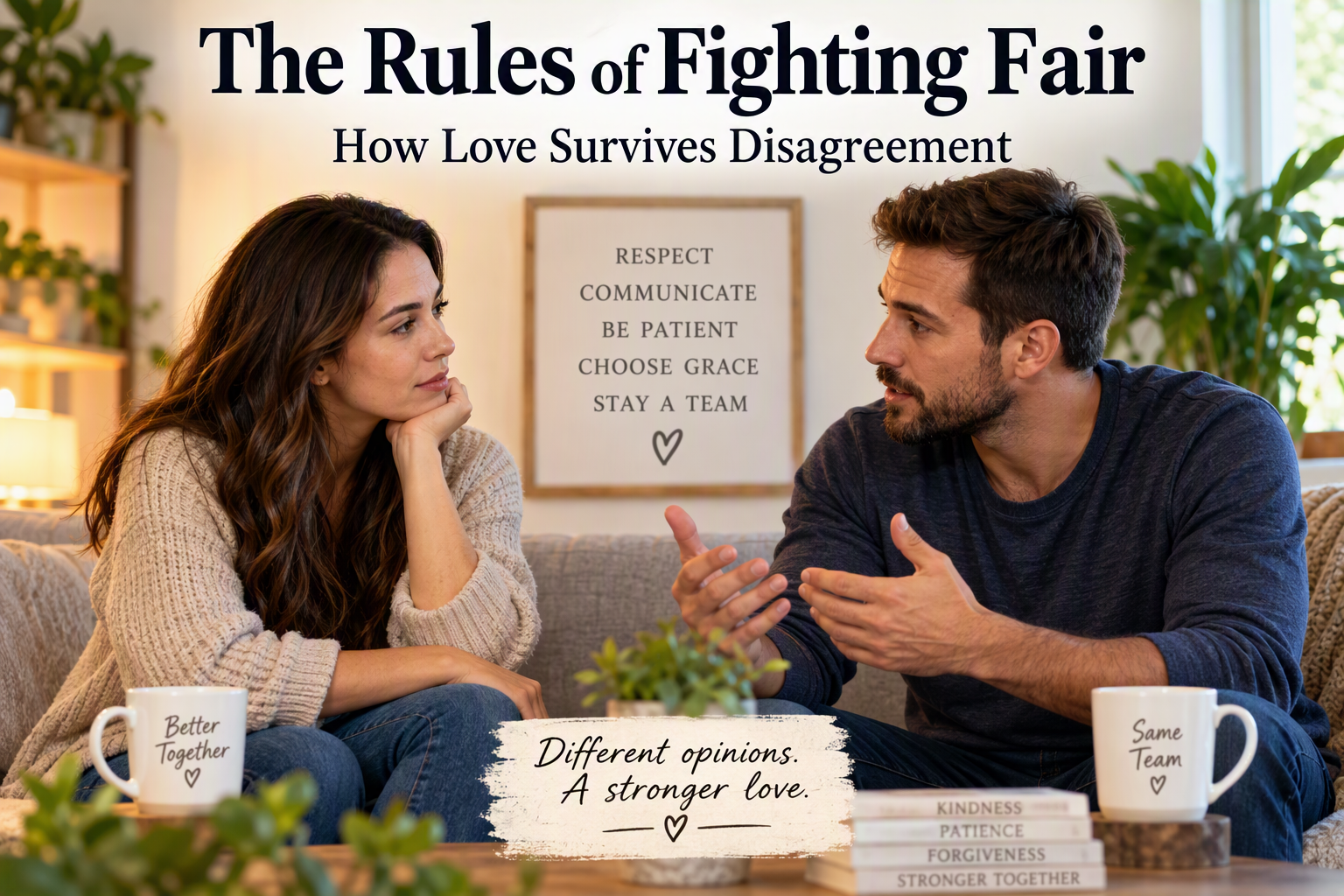

The Rules of Fighting Fair: How Love Survives Disagreement

Every relationship has arguments. No matter how deeply two people love each other, there will be moments of frustration, misunderstanding, disappointment, and hurt. The difference between healthy relationships and unhealthy ones is not whether conflict exists. The difference is how conflict is handled.

The image above presents five simple but powerful rules for couples during arguments. At first glance, they seem obvious. Yet these principles address some of the most common mistakes that damage trust and intimacy. They remind us that being angry with someone is not a license to stop loving them.

Research consistently shows that conflict itself is not the greatest threat to a relationship. Rather, it is destructive communication patterns, contempt, criticism, stonewalling, and defensiveness that place relationships at risk (Gottman & Silver, 2015).

Rule #1: Be Mad at Me, But Don’t Insult Me

“Anger is not a ticket to speak carelessly.”

When emotions run high, words often become weapons. People say things they never truly mean because they want the other person to feel the same pain they are feeling.

The problem is that arguments eventually end, but hurtful words often remain.

You may forget what the disagreement was about, but you rarely forget being called worthless, stupid, selfish, or unlovable. According to relationship researcher John Gottman, contempt and personal attacks are among the strongest predictors of relationship dissatisfaction and eventual separation (Gottman & Silver, 2015).

Healthy couples understand an important truth: attack the problem, not the person.

You can say:

  • “That hurt me.”
  • “I am disappointed.”
  • “I feel ignored.”

Without saying:

  • “You’re pathetic.”
  • “You never do anything right.”
  • “You’re just like your mother.”

Respect should not disappear simply because peace has.

Anger can be temporary. The damage caused by contempt can be permanent.

Rule #2: Be Mad at Me, But Tell Me Why

“Don’t assume I know.”

One of the greatest relationship myths is that people should automatically know what is wrong.

The truth is that nobody can read minds.

Many arguments grow larger because one partner believes the other should already understand the issue. Meanwhile, the other person is confused and becomes frustrated trying to guess.

Clear communication is one of the strongest predictors of relationship success. Research by Markman, Stanley, and Blumberg (2010) found that couples who communicate concerns directly and clearly are better able to resolve conflict and maintain emotional intimacy.

Instead of saying:

  • “You know exactly what you did.”

Try saying:

  • “When this happened, it made me feel unimportant.”

People cannot fix problems they do not understand.

Love requires communication, not telepathy.

As marriage and family therapist Virginia Satir observed, communication is to relationships what breathing is to life. Without it, connection slowly deteriorates (Satir, 1988).

Rule #3: Be Mad at Me, But Don’t Broadcast It

Conflict belongs between the people involved.

Too often people rush to social media, group texts, friends, family members, or coworkers to discuss relationship problems before discussing them with their partner.

While outside support can sometimes be helpful, publicly shaming a partner almost never improves the relationship.

Once private details become public, they cannot easily be taken back.

Strong relationships protect each other’s dignity, even during difficult moments. Maintaining emotional safety and mutual respect helps partners feel secure enough to resolve disagreements constructively (Tatkin, 2012).

This does not mean remaining silent about abuse, manipulation, or situations involving safety concerns. Those circumstances require outside support and intervention. However, ordinary relationship disagreements generally benefit from privacy, maturity, and direct communication.

A couple should be teammates solving a problem together, not opponents recruiting spectators.

Rule #4: Be Mad at Me, But Don’t Forget My Good Qualities

Conflict has a way of shrinking our perspective.

When we are hurt, our minds naturally focus on the thing causing the pain. Suddenly one mistake feels larger than a thousand acts of kindness.

Psychologists often describe this tendency as negative filtering, where attention becomes focused on a person’s flaws while overlooking their strengths.

A healthy relationship requires balance.

Remember:

  • The person who forgot an anniversary may also be the person who supported you through difficult times.
  • The person who made a mistake may also be the person who loves you deeply.
  • The person frustrating you today may be the person who has stood beside you for years.

Research from the Gottman Institute has found that successful couples maintain a strong ratio of positive interactions to negative interactions, even during periods of conflict (The Gottman Institute, 2024).

A moment of failure should not erase a history of goodness.

Rule #5: Be Mad at Me, But Remember Grace

“Remember all the times I’ve forgiven you.”

This final point may be the most powerful.

Every person who has been in a long-term relationship has needed forgiveness. No one is perfect. No one gets everything right.

Healthy couples recognize that relationships are not scoreboards.

Love is strengthened when both people remember that they have received grace as often as they have given it.

Research from the Greater Good Science Center at the University of California, Berkeley indicates that forgiveness is associated with stronger relationships, better emotional health, reduced stress, and greater overall well-being (Greater Good Science Center, 2023).

Forgiveness does not excuse harmful behavior or remove accountability. Instead, it acknowledges that human beings are flawed and that lasting relationships require compassion.

The question is not whether your partner will eventually disappoint you.

They will.

The question is whether there is enough humility, understanding, and forgiveness to move forward together.

The Real Secret Behind Healthy Arguments

Many people believe successful couples avoid conflict. The truth is quite the opposite.

Successful couples argue.

They disagree.

They become frustrated.

They occasionally hurt one another.

What separates them from struggling couples is that they continue fighting for the relationship while addressing the problem.

They remember that the person sitting across from them is not the enemy.

The problem is the enemy.

Relationship experts consistently emphasize that couples who approach conflict as a shared challenge rather than a battle to be won are more likely to experience long-term satisfaction and stability (Markman et al., 2010; Gottman & Silver, 2015).

The argument should never become a contest about who wins. It should become a conversation about how both people can heal, learn, and grow.

Because at the end of the day, the healthiest relationships are not those free from anger.

They are the relationships where love remains present even when anger arrives.


“Being angry with someone is not the opposite of loving them. Treating them without respect is.”


About the Author

John S. Collier, MSW, LCSW-S is the Executive Director of Southeast Kentucky Behavioral Health, LLC and author of The Mind’s Trestle Board. Through his writing, he explores relationships, personal growth, emotional wellness, morality, and the challenges people face as they seek meaningful connections with others. His work blends professional behavioral health experience with practical life lessons intended to encourage reflection, healing, and personal development.


References

Chapman, G. (2015). The 5 Love Languages: The Secret to Love That Lasts. Northfield Publishing.

Gottman, J. M., & Silver, N. (2015). The Seven Principles for Making Marriage Work (Revised ed.). Harmony Books.

Greater Good Science Center. (2023). The Science of Forgiveness. University of California, Berkeley.

Harvard Health Publishing. (2022). Communication and Conflict Resolution in Relationships. Harvard Medical School.

Markman, H. J., Stanley, S. M., & Blumberg, S. L. (2010). Fighting for Your Marriage (3rd ed.). Jossey-Bass.

Mayo Clinic Staff. (2023). Healthy Communication and Relationship Wellness. Mayo Clinic.

Satir, V. (1988). The New Peoplemaking. Science and Behavior Books.

Tatkin, S. (2012). Wired for Love: How Understanding Your Partner’s Brain and Attachment Style Can Help You Defuse Conflict and Build a Secure Relationship. New Harbinger Publications.

The Gottman Institute. (2024). Managing Conflict in Relationships.


Couple laughing over wine at a restaurant beside sign reading “NEVER STOP DATING YOUR SPOUSE.”
Dating Your Spouse: Why the Best Marriages Never Stop Dating

Many couples spend months planning a wedding but very little time planning a marriage. At the beginning of a relationship, people work hard to connect. They make plans, have meaningful conversations, laugh together, and look forward to spending time with one another.

Then life happens.

Work becomes demanding. Children need attention. Bills need to be paid. Household responsibilities pile up. Without realizing it, many couples begin spending more time managing life than nurturing their relationship. The truth is simple:

A healthy marriage requires ongoing attention, not just a wedding day commitment.

Research suggests that couples who regularly spend intentional one-on-one time together report greater relationship satisfaction, stronger commitment, better communication, and increased marital happiness. [nationalma…roject.org], [wheatley.byu.edu], [nationalma…roject.org]


Why Dating Should Continue After Marriage

Many couples unknowingly stop doing the things that helped them fall in love. While dating, they often:

  • Prioritize time together
  • Ask questions
  • Share experiences
  • Laugh frequently
  • Show appreciation
  • Engage in meaningful conversations

After marriage, many people assume these things will naturally continue. Unfortunately, that rarely happens without intentional effort. Marriage does not automatically create connection. Connection is created through shared experiences and quality time.

The habits that helped you fall in love are often the same habits that help you stay in love.


📦 Key Takeaway

Your spouse should not receive the least intentional version of you simply because they received the most permanent commitment from you.


Date Nights Strengthen Marriages

Research from the National Marriage Project found that couples who regularly participate in date nights report significantly higher levels of marital happiness and commitment than couples who rarely spend dedicated time together. [nationalma…roject.org], [nationalma…roject.org]

The report found that spouses who regularly went on date nights were more likely to report:

Dating your spouse is not about spending money. It is about investing time. Sometimes the most meaningful date is simply sitting on a porch together, enjoying a cup of coffee, and having an uninterrupted conversation.


📦 Important Reminder

Connection grows where attention goes.

If a marriage consistently receives leftover time, it often produces leftover results.


Dating Builds Emotional Intimacy

One of the biggest threats to marriage is not conflict. It is emotional distance. According to relationship researchers at the Gottman Institute, successful couples intentionally “turn toward” one another during everyday interactions, creating a stronger emotional connection over time. [gottman.com], [gottman.com]

Dating creates opportunities to:

  • Discuss goals
  • Share concerns
  • Celebrate successes
  • Talk about dreams
  • Strengthen trust
  • Maintain emotional closeness

Couples who regularly spend quality time together often feel more understood, appreciated, and connected.

“The strongest marriages are often built one conversation at a time.”


Dating Keeps Friendship Alive

Many relationship experts have observed that friendship forms the foundation of lasting marriages. [gottman.com], [gottman.com]

Your spouse is constantly growing and changing.

  • Their interests change.
  • Their goals change.
  • Their fears change.
  • Their dreams change.

Dating helps you continue learning about the person you married. Ask yourself:

  • What is my spouse currently excited about?
  • What challenge is my spouse facing?
  • What goal is my spouse working toward?
  • What would make my spouse feel supported this week?

The answers to these questions create connection.


📦 Marriage Challenge

Schedule one dedicated date with your spouse during the next seven days. Put it on the calendar and protect that time as seriously as any other important appointment.


Dating Demonstrates Value

Time is one of the most valuable gifts that exists. When you intentionally spend time with your spouse, you communicate several important messages:

  • You matter to me.
  • I enjoy being with you.
  • Our relationship is important.
  • I want us to stay connected.
  • You are a priority in my life.

People often feel most loved when they feel seen, heard, and valued. Dating provides opportunities to communicate all three.


Simple Date Ideas for Married Couples

Dating does not require expensive vacations or elaborate plans. Consider:

  • Taking a walk together
  • Going out for coffee
  • Watching a sunset
  • Cooking a meal together
  • Visiting a local bookstore
  • Having a picnic
  • Taking a scenic drive
  • Exploring a nearby town
  • Playing a board game
  • Attending a community event

The goal is not entertainment. The goal is connection.


The Example It Sets for Children

When children witness healthy affection, respect, communication, and quality time between parents, they learn important lessons about relationships. Parents who prioritize their marriage are not taking away from their children. Instead, they are demonstrating:

  • Healthy communication
  • Mutual respect
  • Commitment
  • Affection
  • Emotional support

Children benefit from seeing what a healthy relationship looks like.


Conclusion

Marriage was never meant to run on autopilot. It thrives when two people continue choosing one another over and over again. The wedding day is not the finish line. It is the starting line. Dating your spouse creates opportunities to maintain friendship, strengthen intimacy, improve communication, and build memories together. These moments do not have to be extravagant. They simply need to be intentional. The strongest marriages are often built through thousands of small moments where spouses say through their actions:

“I still choose you.”

Never stop pursuing the person you promised to love.


About the Author

John S. Collier, MSW, LCSW-S is a Licensed Clinical Social Worker Supervisor and the Executive Director of Southeast Kentucky Behavioral Health, LLC. With extensive experience in behavioral health, trauma-informed care, child and adolescent mental health, family systems, and organizational leadership, Mr. Collier has dedicated his career to helping children, adolescents, adults, and families navigate life’s challenges while building healthier and more resilient communities.

Throughout his clinical career, Mr. Collier has worked with children and adolescents experiencing emotional and behavioral difficulties, including anxiety, depression, trauma-related disorders, attention-deficit/hyperactivity disorder (ADHD), oppositional behaviors, anger management concerns, and family relationship challenges. His approach emphasizes understanding the underlying causes of behavior rather than focusing solely on symptoms, helping families develop practical strategies that strengthen communication, emotional regulation, and healthy relationships.

As a clinical supervisor, educator, and advocate for quality behavioral healthcare, Mr. Collier is committed to translating complex psychological and developmental concepts into practical guidance that parents and caregivers can readily understand and implement. His work reflects a belief that informed, supported, and empowered families play a critical role in promoting positive outcomes for children and adolescents.

In addition to his clinical practice and leadership responsibilities, Mr. Collier is the author of The Mind’s Trestle Board, where he regularly writes about mental health, personal growth, resilience, grief, family relationships, child development, and behavioral health topics. His writing combines evidence-based research with real-world clinical experience to provide readers with meaningful insights and actionable strategies.

Through his work, Mr. Collier continues to advocate for compassionate, person-centered care while helping individuals and families build the skills necessary to thrive through life.


References

Dew, J., & Wilcox, W. B. (2023). The Date Night Opportunity: What Does Couple Time Tell Us About the Potential Value of Date Nights? National Marriage Project. [nationalma…roject.org], [nationalma…roject.org]

Gottman, J. M., & Gottman, J. S. (2024). Relationship Resources for Couples. The Gottman Institute. [gottman.com], [gottman.com]

Stanley, S. M., Rhoades, G. K., & Markman, H. J. (2006). Sliding Versus Deciding: Inertia and the Premarital Cohabitation Effect. Family Relations, 55(4), 499-509.

Hawkins, A. J., Blanchard, V. L., Baldwin, S. A., & Fawcett, E. B. (2008). Does Marriage and Relationship Education Work? Journal of Consulting and Clinical Psychology, 76(5), 723-734.

Nielsen, L. (2017). The Power of Us: The Path to Discovering the Best Relationship You. Tyndale House Publishers.

Wilcox, W. B., & Dew, J. (2023). The Date Night Opportunity Report. Wheatley Institute. [wheatley.byu.edu], [wheatley.byu.edu]


Husbands, What Does It Mean to “Show Up” for Your Wife?

“Showing up” for your wife means being present, reliable, and caring in everyday life. It is not about grand gestures. It is about small, steady actions that build trust and safety over time.

To show up, a husband pays attention. He listens when his wife talks. He notices stress, joy, and changes in mood. Research shows that feeling heard and understood is strongly linked to relationship satisfaction (Gottman & Silver, 2015).

Showing up also means sharing responsibility. This includes chores, parenting, finances, and emotional support. Studies have found that couples who feel household work is fair report higher happiness and lower conflict (Pew Research Center, 2023).

Emotional presence is just as important. Support during hard times reduces stress and strengthens the bond between partners (Reis, Clark, & Holmes, 2004). A husband who shows empathy, patience, and kindness helps create emotional security.

Consistency matters. Trust grows when words and actions match. According to long-term marital research, dependability and responsiveness are key predictors of stable, healthy marriages (Gottman, 1999).

Showing up can look like:

Keeping promises Helping without being asked Listening without interrupting Offering comfort during stress Spending quality time together

In simple terms, showing up means saying through actions: “You are not alone. I am here with you.”

Conclusion

Showing up for your wife is about presence, effort, and care. It is built through daily habits, not occasional moments. When a husband is attentive, supportive, and dependable, the marriage becomes stronger, safer, and more connected.

About the Author

John S. Collier, MSW, LCSW, is a behavioral health therapist and writer who focuses on relationships, emotional wellness, and personal growth. He works with individuals and families to improve communication, strengthen bonds, and build healthier lives.

References

Gottman, J. M. (1999). The Marriage Clinic: A Scientifically Based Marital Therapy. New York, NY: W. W. Norton & Company.

Gottman, J., & Silver, N. (2015). The Seven Principles for Making Marriage Work. New York, NY: Harmony Books.

Pew Research Center. (2023). Sharing Chores and Responsibilities in Marriage.

Reis, H. T., Clark, M. S., & Holmes, J. G. (2004). Perceived partner responsiveness as an organizing construct in the study of intimacy. Handbook of Closeness and Intimacy.