Welcome to SOUTHEAST KENTUCKY BEHAVIORAL HEALTH
Surviving the Affair: The Ripple Effect

Part Eight: When Children, Family, and Friends Are Caught in the Middle

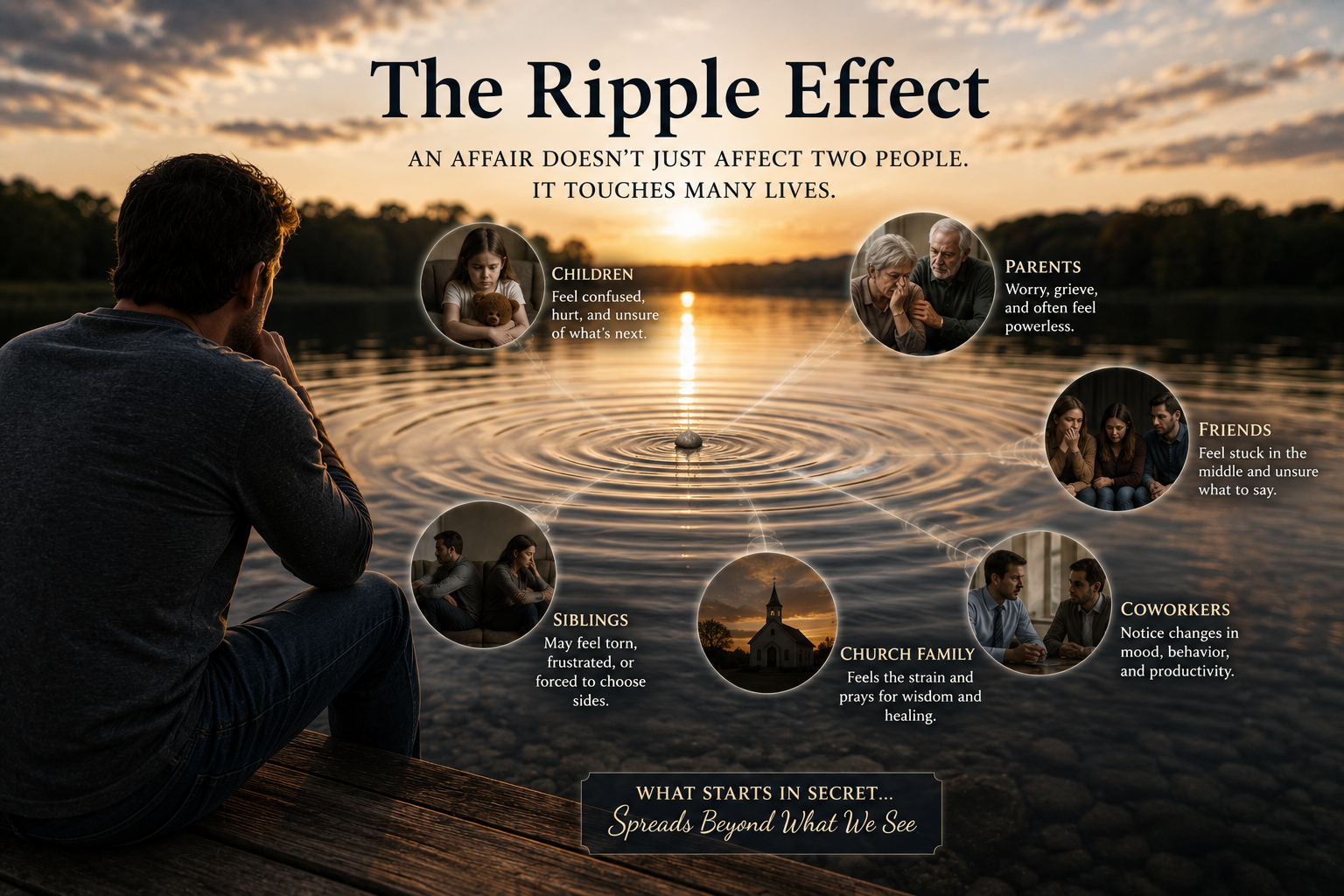
One of the greatest misconceptions about an affair is that it affects only the people directly involved. It does not.

An affair begins between a few people, but its consequences often spread far beyond them. Children lose their sense of security. Parents struggle to watch their adult children suffer. Brothers and sisters are forced to choose sides. Close friends become uncomfortable. Church families become divided. Coworkers notice changes in mood and productivity. Even grandparents often find themselves grieving a family they no longer recognize.

Like a stone thrown into still water, the affair creates ripples that continue long after the initial impact. Most people focus on whether the marriage survives. Few stop to consider everyone else who must learn how to survive it as well. Whether reconciliation occurs or divorce becomes inevitable, the choices made during this season will shape many lives for years to come. The encouraging news is that while an affair creates widespread pain, wise decisions afterward can also create widespread healing.


Children Feel More Than Parents Realize

Many parents believe they have successfully hidden the affair from their children. Sometimes they have. More often, they have hidden only the details. Children notice changes long before they understand them. They notice silence replacing laughter. They notice separate bedrooms.

They notice tension at the dinner table. They notice tears behind closed doors. They notice parents becoming emotionally unavailable. Children may not know what happened. They almost always know something has happened.

When parents avoid honest, age-appropriate conversations, children often create their own explanations. Many blame themselves.

  • “Maybe Mom and Dad fight because I misbehave.”
  • “Maybe if I were better, things would go back to normal.”

Children were never responsible for the affair. They should never carry its emotional burden.


Protecting Children from Adult Problems

One of the greatest gifts parents can give their children during marital crisis is emotional protection. Children need parents. They do not need detectives. They do not need therapists. They do not need messengers. They do not need judges. Avoid placing children in situations where they feel responsible for managing adult emotions. That includes:

  • Asking children to keep secrets.
  • Criticizing the other parent in front of them.
  • Using children to gather information.
  • Expecting children to comfort an emotionally overwhelmed parent.
  • Asking children to choose sides.

Children deserve permission to love both parents. Even when one parent has made serious mistakes.


Family Members Often Grieve Too

Parents often feel helpless. They watch their son or daughter suffer. They wonder what they should say. How much should they become involved? Should they encourage reconciliation? Should they support divorce? Should they remain neutral? Family members frequently experience what psychologists call secondary trauma.

Although they were not directly betrayed, they suffer because someone they deeply love is hurting. Their instinct is to protect. Unfortunately, protection sometimes becomes pressure. Healthy support sounds like:

  • “I’m here for you.”
  • “Whatever decision you make, I want it to be a healthy one.”
  • Unhealthy support often sounds like:
  • “If you stay, I’ll never respect you again.” or “You have to forgive them.”

Neither statement allows healing.


Friends Often Don’t Know What to Do

Affairs place friendships in awkward positions. Mutual friends wonder whether they should remain connected to both spouses. Some withdraw completely because they fear saying the wrong thing. Others unintentionally make things worse by offering simplistic advice.

  • “Just move on.”
  • “Once a cheater, always a cheater.”
  • “Everything happens for a reason.”

People in deep emotional pain rarely need quick answers. They need compassionate listeners. Sometimes the greatest gift a friend can offer is quiet presence.


The Church Can Become Either a Hospital or a Courtroom

For people of faith, an affair often creates a second crisis. The spiritual crisis. Some individuals fear judgment. Others fear rejection. Some stop attending church entirely because they feel embarrassed. Healthy faith communities understand an important truth. Grace never eliminates accountability. Accountability should never eliminate grace.

Churches become places of healing when they speak truth with compassion, encourage repentance where needed, support healthy boundaries, and refuse to reduce people to the worst decision they have ever made. Every person involved needs wisdom. Every person involved needs hope.


Holidays, Birthdays, and Family Traditions Change

Families rarely anticipate how many ordinary moments become emotionally complicated after an affair.

  • Birthdays.
  • Christmas.
  • Thanksgiving.
  • Graduations.
  • Weddings.
  • Vacations.
  • Children’s sporting events.

Questions suddenly emerge. Who will attend? Who will sit where? Who should be invited? The healthiest families focus less on old expectations and more on creating emotionally safe experiences for everyone involved. Flexibility often becomes an expression of maturity.


Forgiveness Does Not Mean Ignoring Healthy Boundaries

Extended family members sometimes misunderstand forgiveness. Forgiveness does not require pretending everything is normal. Trust often returns gradually. Relationships sometimes need time before old traditions resume. Healthy boundaries communicate safety—not punishment. Families heal best when grace and wisdom work together.


Tools for Helping Families Heal

Whether the marriage survives or not, these practices help reduce long-term emotional harm:

  • Keep children out of adult conflicts.
  • Speak respectfully about one another in front of family members.
  • Encourage counseling for both adults and children when needed.
  • Create predictable routines to restore emotional stability.
  • Allow children to ask questions appropriate to their age.
  • Build healthy co-parenting communication if separation occurs.
  • Seek support from trusted friends, pastors, or counselors.
  • Be patient with extended family members as they process their own grief.
  • Protect family gatherings from unnecessary conflict.
  • Focus on long-term healing rather than short-term emotional victories.

A Christian Perspective

Throughout Scripture, God continually works through broken families. Abraham’s family struggled. Jacob’s family struggled. David’s family struggled. Yet God’s redemptive work continued.

An affair may change a family’s story. It does not remove God from the story. Colossians 3:13 reminds believers:

“Bear with each other and forgive one another if any of you has a grievance against someone. Forgive as the Lord forgave you.”

Forgiveness, patience, and grace do not erase painful consequences. They create the possibility of healing despite them. Families that practice truth, humility, and love often discover that while life may never return to what it once was, it can still become healthy again.


A Therapist’s Reflection

One of the most heartbreaking moments in counseling occurs when a child quietly asks, “Is this my fault?” The answer is always the same. “No.” Children did not create the affair. They cannot fix it. They should never be expected to carry it. Adults have the responsibility to protect children—not only physically, but emotionally. When parents choose maturity over revenge… When grandparents choose support over criticism…When friends choose listening over judgment…When churches choose restoration over condemnation…Healing spreads through the family just as surely as pain once did.

Affairs create ripples. So does grace. So does wisdom. So does love. The choices made after betrayal will become part of the legacy your family remembers. Choose the kind of legacy that leads toward healing.


About the Author

John S. Collier, MSW, LCSW-S is a licensed clinical social worker, psychotherapist, author, educator, and speaker with decades of experience helping individuals, couples, and families navigate life’s most difficult emotional challenges. Throughout his career, he has worked extensively with people struggling with relationship conflict, betrayal, anxiety, depression, trauma, grief, addiction, and life transitions. His counseling approach combines evidence-based psychological practices with practical wisdom, compassion, and a deep respect for each person’s unique journey.

John has devoted much of his professional life to understanding the complexities of human relationships. He has counseled couples working to rebuild trust after infidelity, individuals recovering from betrayal, and families seeking healing after painful life events. His clinical experience has reinforced one enduring truth: while relationships can be profoundly wounded, people possess an extraordinary capacity for growth, resilience, forgiveness, and transformation when they are equipped with the right tools and support.

As an author, John seeks to bridge the gap between professional mental health knowledge and everyday life. His writing translates complex psychological concepts into practical guidance that readers can understand and apply immediately. Whether addressing marriage, parenting, emotional wellness, trauma recovery, or spiritual growth, his goal is to provide resources that are both clinically sound and personally encouraging.

Surviving the Affair reflects John’s commitment to approaching infidelity with both honesty and compassion. Rather than reducing people to labels or stereotypes, he explores the emotional realities experienced by everyone affected—the betrayed spouse, the unfaithful partner, the affair partner, and the families whose lives are forever changed. Drawing upon years of therapeutic experience, he emphasizes accountability without condemnation, healing without minimizing pain, and hope without offering unrealistic promises.

John believes that healing begins when people are willing to face the truth with courage. While not every relationship can or should be restored, every individual has the capacity to grow beyond betrayal, rediscover integrity, and build a healthier future. His passion is helping readers move from surviving life’s greatest wounds to living with renewed purpose, emotional strength, and hope.

Through his books, speaking engagements, and counseling work, John continues to encourage others to pursue emotional health, healthy relationships, personal responsibility, and lasting transformation—one step at a time.h his counseling, writing, and educational work, John equips individuals and families with practical tools to strengthen relationships, heal emotional wounds, and build resilient futures.

References

American Academy of Pediatrics. (2016). Helping Children Cope with Divorce and Family Stress.

American Association for Marriage and Family Therapy. (2015). Infidelity. https://www.aamft.org

Bowen, M. (1978). Family Therapy in Clinical Practice. Jason Aronson.

Gottman, J. M., & Gottman, J. S. (2015). 10 Principles for Doing Effective Couples Therapy. W. W. Norton & Company.

Nichols, M. P., & Davis, S. D. (2020). Family Therapy: Concepts and Methods (12th ed.). Pearson.

Snyder, D. K., Baucom, D. H., & Gordon, K. C. (2007). Getting Past the Affair. Guilford Press.

The Holy Bible, New International Version. (2011). Zondervan.


Surviving the Affair: Choosing Hope After Betrayal

Part Three: Choosing Hope After Betrayal

The Betrayed Spouse Who Wants to Save the Marriage

For many people, the greatest surprise after discovering an affair is not the depth of their anger—it is the realization that, despite everything that has happened, they still love their spouse. That realization often brings confusion. Friends may tell you to leave. Family members may never trust your spouse again. Your own emotions may change from hour to hour. Yet somewhere beneath the heartbreak remains a quiet thought:

“I still want to save my marriage.”

Wanting to reconcile does not mean you are weak. It does not mean you approve of what happened. It does not mean you lack self-respect. It simply means you believe that one terrible chapter does not always have to become the final chapter. Choosing reconciliation is one of the most courageous decisions a betrayed spouse can make—but it is also one of the hardest. Rebuilding trust after betrayal requires honesty, patience, humility, accountability, and an unwavering commitment from both spouses. One person cannot repair a marriage alone.


Reconciliation Is Not Returning to the Old Marriage

Many couples believe their goal is to “get back to the way things were.” Ironically, that should never be the goal. The marriage that existed before the affair contained vulnerabilities, unhealthy patterns, unmet needs, or broken boundaries that allowed betrayal to become possible. While those factors never excuse infidelity, they do reveal that simply returning to the past would leave the relationship vulnerable again. Healthy reconciliation means building an entirely new marriage—one characterized by greater honesty, emotional safety, communication, transparency, and mutual respect.


Trust Is Rebuilt in Inches, Not Miles

Trust does not return because someone apologizes. Trust grows when words and actions become consistently aligned over time. Every kept promise becomes another brick in rebuilding the foundation. Every truthful conversation repairs another crack. Every act of transparency communicates safety. Eventually the betrayed spouse begins noticing something remarkable. They are no longer checking because they are afraid. They are beginning to believe again.


What Genuine Remorse Looks Like

There is a significant difference between regret and remorse.

Regret says: “I’m sorry I got caught.”

Remorse says: “I’m devastated by what my choices have done to you.”

A spouse who truly desires reconciliation accepts responsibility without defensiveness. They answer difficult questions honestly. They understand that healing occurs on the betrayed spouse’s timetable rather than their own. Real remorse remains patient even when forgiveness has not yet arrived.


Four Foundations for Rebuilding a Marriage

Healthy reconciliation is built upon four essential foundations:

  • Radical honesty. Secrets must end completely.
  • Complete transparency. Phones, schedules, finances, and communication become open rather than hidden.
  • Emotional accountability. Both spouses learn healthier ways of expressing hurt, fear, disappointment, and needs.
  • Mutual commitment. Both partners actively participate in rebuilding the relationship.

Without these foundations, reconciliation becomes little more than wishful thinking.


Healing Is Not Linear

Many couples become discouraged because healing does not happen in a straight line. There will be good weeks. Then difficult days. There will be moments of laughter followed by unexpected tears. Triggers may appear months after the affair. This does not mean reconciliation has failed. Healing is often like recovering from a serious physical injury. Some days the wound barely hurts. Other days it aches unexpectedly. Progress should be measured over months, not moments.


Healthy Boundaries Protect Love

Many people mistakenly believe boundaries push people apart. Healthy boundaries actually protect intimacy. Examples include:

  • Complete no-contact with the affair partner.
  • Open access to electronic devices when rebuilding trust.
  • Honest discussions about emotional needs.
  • Clear expectations regarding friendships with others.
  • Immediate disclosure of situations that could threaten trust.

Boundaries are not punishments. They are safeguards.


When Hope Feels Fragile

There will be days when you question whether reconciliation is worth the effort. During those moments, remember that hope is rarely a feeling. Hope is often a decision. It is choosing to continue today’s work without demanding tomorrow’s certainty. Hope says:

“I cannot change yesterday, but I can influence what happens next.”


Tools for Healing

  • Participate in couples therapy with a clinician experienced in affair recovery.
  • Maintain individual counseling to process betrayal trauma.
  • Schedule weekly conversations focused on emotional connection rather than conflict.
  • Develop healthy communication skills using active listening and empathy.
  • Establish accountability practices that build trust.
  • Journal progress rather than focusing only on setbacks.
  • Pray together, even when conversations feel difficult.
  • Celebrate small victories as trust gradually returns.

A Christian Perspective

Scripture never minimizes the seriousness of betrayal. At the same time, it repeatedly demonstrates God’s ability to redeem broken lives and broken relationships.

Ephesians 4:32 reminds believers: “Be kind and compassionate to one another, forgiving each other, just as in Christ God forgave you.”

Forgiveness does not erase consequences. Grace does not eliminate accountability. Instead, both create the possibility for transformation. Marriage restoration is not guaranteed. But where humility, repentance, truth, and sacrificial love exist, remarkable healing can occur.


A Therapist’s Reflection

Some of the strongest marriages I have witnessed are not those that never experienced crisis. They are the marriages that refused to let crisis become the final word. These couples learned to communicate more honestly than ever before. They became emotionally safer than they had ever been. They developed deeper compassion because they had walked together through profound pain. Not every marriage survives an affair. Some should not. But when two emotionally healthy people become fully committed to truth, accountability, and growth, reconciliation becomes more than possible.

It becomes a testimony that broken things can sometimes become stronger where they were once fractured. The affair may always be remembered. It does not have to define the remainder of your marriage.


About the Author

John S. Collier, MSW, LCSW-S is a licensed clinical social worker, psychotherapist, author, educator, and speaker with decades of experience helping individuals, couples, and families navigate life’s most difficult emotional challenges. Throughout his career, he has worked extensively with people struggling with relationship conflict, betrayal, anxiety, depression, trauma, grief, addiction, and life transitions. His counseling approach combines evidence-based psychological practices with practical wisdom, compassion, and a deep respect for each person’s unique journey.

John has devoted much of his professional life to understanding the complexities of human relationships. He has counseled couples working to rebuild trust after infidelity, individuals recovering from betrayal, and families seeking healing after painful life events. His clinical experience has reinforced one enduring truth: while relationships can be profoundly wounded, people possess an extraordinary capacity for growth, resilience, forgiveness, and transformation when they are equipped with the right tools and support.

As an author, John seeks to bridge the gap between professional mental health knowledge and everyday life. His writing translates complex psychological concepts into practical guidance that readers can understand and apply immediately. Whether addressing marriage, parenting, emotional wellness, trauma recovery, or spiritual growth, his goal is to provide resources that are both clinically sound and personally encouraging.

Surviving the Affair reflects John’s commitment to approaching infidelity with both honesty and compassion. Rather than reducing people to labels or stereotypes, he explores the emotional realities experienced by everyone affected—the betrayed spouse, the unfaithful partner, the affair partner, and the families whose lives are forever changed. Drawing upon years of therapeutic experience, he emphasizes accountability without condemnation, healing without minimizing pain, and hope without offering unrealistic promises.

John believes that healing begins when people are willing to face the truth with courage. While not every relationship can or should be restored, every individual has the capacity to grow beyond betrayal, rediscover integrity, and build a healthier future. His passion is helping readers move from surviving life’s greatest wounds to living with renewed purpose, emotional strength, and hope.

Through his books, speaking engagements, and counseling work, John continues to encourage others to pursue emotional health, healthy relationships, personal responsibility, and lasting transformation—one step at a time.


References

Baucom, D. H., Snyder, D. K., & Gordon, K. C. (2009). Helping Couples Get Past the Affair: A Clinician’s Guide. Guilford Press.

Glass, S. P. (2003). Not “Just Friends”: Rebuilding Trust and Recovering Your Sanity After Infidelity. Free Press.

Gordon, K. C., Baucom, D. H., & Snyder, D. K. (2004). An integrative intervention for promoting recovery from extramarital affairs. Journal of Marital and Family Therapy, 30(2), 213–231.

Gottman, J. M., & Gottman, J. S. (2015). 10 Principles for Doing Effective Couples Therapy. W. W. Norton.

Johnson, S. M. (2019). Attachment Theory in Practice. Guilford Press.

Snyder, D. K., Baucom, D. H., & Gordon, K. C. (2007). Getting Past the Affair. Guilford Press.

Spring, J. A. (2012). After the Affair (2nd ed.). Harper.

The Holy Bible, New International Version. (2011). Zondervan.


Going All In: The Hidden Risks of Rushing Into a Relationship

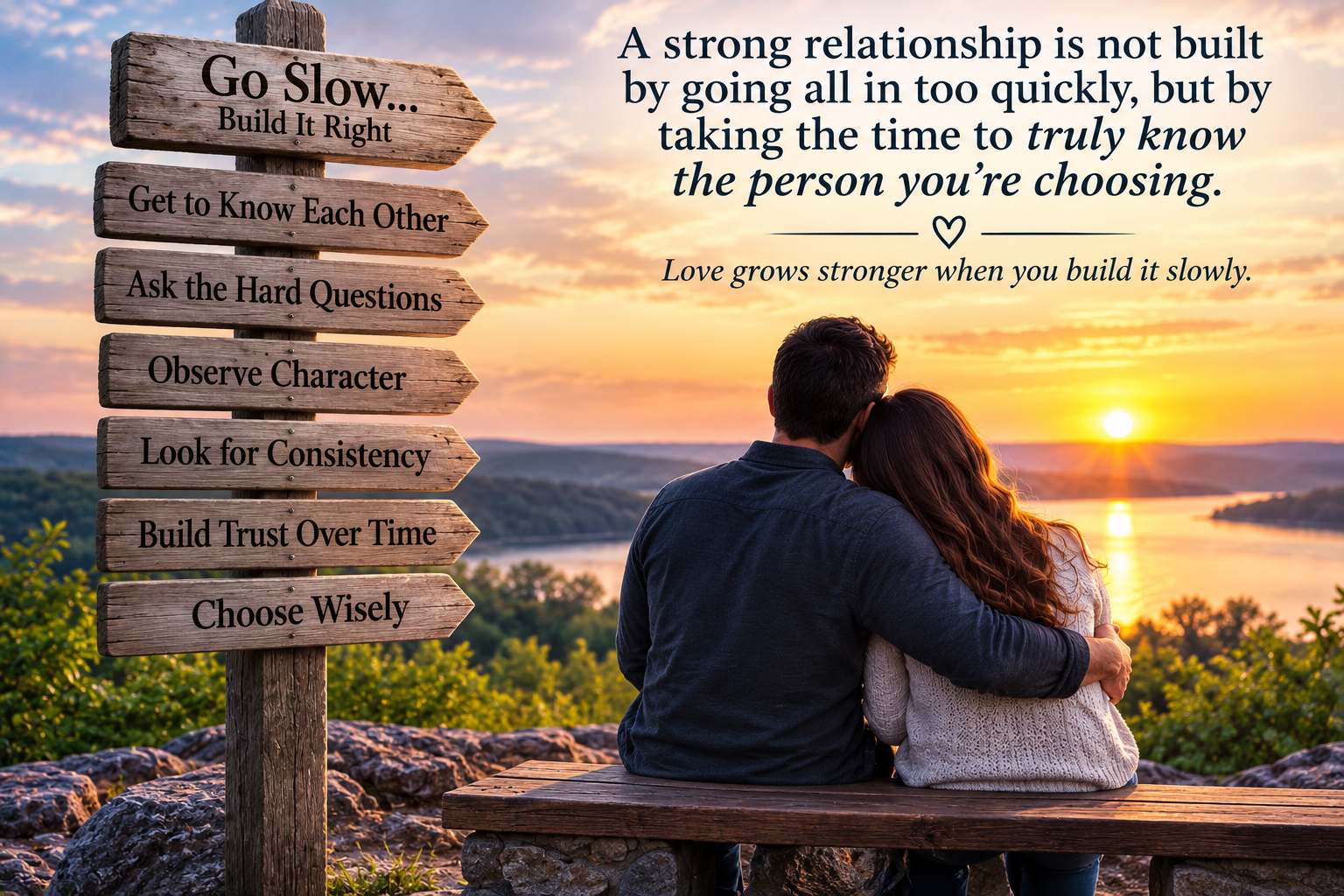
There is something undeniably romantic about the phrase “going all in.” Movies celebrate it. Love songs glorify it. Friends often admire people who seem fearless enough to dive headfirst into love. We are told that real love requires vulnerability, commitment, and complete investment.

While commitment is essential for a healthy relationship, there is an important distinction between healthy commitment and premature emotional investment. One is built on knowledge, trust, and experience. The other is often built on hope, attraction, and assumptions.

Many relationships don’t fail because two people were incompatible. They fail because they became emotionally committed long before they truly knew one another.


The Difference Between Attraction and Knowledge

Attraction happens quickly. Knowledge takes time. During the first weeks or months of dating, we naturally see the best version of another person. Psychologists sometimes refer to this as the honeymoon phase, where the brain is flooded with dopamine, oxytocin, and other neurochemicals that create excitement, optimism, and emotional attachment (Fisher, 2004). Unfortunately, these same chemicals can reduce our ability to evaluate a relationship objectively.

When people “go all in” too quickly, they often mistake:

  • Chemistry for compatibility
  • Passion for stability
  • Attention for commitment
  • Potential for reality

Those are not the same things.


We Fall in Love With Who We Think They Are

One of the greatest dangers of rushing a relationship is that we begin filling in the blanks ourselves. Instead of learning who someone truly is, we imagine who they could become. We overlook inconsistencies. We excuse red flags.

We create explanations for behaviors we don’t fully understand. Psychologists call this idealization—seeing another person through the lens of hope rather than reality (Murray, Holmes, & Griffin, 1996). The problem is that relationships are built on reality, not imagination. Eventually, every relationship moves from fantasy to reality. When that happens, many people don’t feel like their partner changed. Instead, they finally see what was there all along.


Emotional Investment Changes Your Judgment

Imagine buying a house. Would you purchase it after walking through the front door for five minutes? Probably not. You would inspect the foundation. Look at the roof. Check for water damage. Review the neighborhood. Ask difficult questions. Relationships deserve at least that much careful consideration. Yet emotionally, many people commit after only a handful of exciting conversations. Once we become emotionally invested, our brains begin protecting that investment.

Instead of asking, “Is this the right person?”

we begin asking, “How can I make this work?”

Those are completely different questions.


The Cost of Ignoring Red Flags

Red flags rarely appear as dramatic warning signs. Most begin as small moments. Perhaps they become irritated when they don’t get their way. Maybe they avoid accountability. Perhaps they speak disrespectfully about former partners. Maybe they struggle with honesty. Perhaps they become controlling in subtle ways. Someone who rushes into commitment often dismisses these concerns because the emotional reward feels greater than the potential risk. Unfortunately, ignored patterns rarely disappear. They usually become stronger. Dating is not primarily about convincing someone to stay. It is about discovering whether staying would be wise.


Love Needs Observation

Healthy relationships require curiosity. Observe how someone handles disappointment. Observe how they manage stress. Observe how they treat people who have nothing to offer them. Observe how they speak about family. Observe whether their words consistently match their actions. Character reveals itself over time. No conversation can replace experience. No promise can replace consistency. No chemistry can replace integrity.


Why Slow Relationships Often Last Longer

Research consistently suggests that relationships built gradually often develop stronger foundations because trust is earned rather than assumed (Stanley, Rhoades, & Markman, 2006). People sometimes fear moving slowly because they worry someone else will “take” the person they’re dating. Ironically, healthy people generally respect appropriate pacing. Individuals who pressure immediate commitment often reveal more about their own insecurity than about their love. Real intimacy grows. It cannot be rushed.


The Difference Between Commitment and Surrender

Healthy commitment says: “I’m choosing you because I know who you are.”

Unhealthy surrender says: “I’m choosing you because I hope you’ll become who I need.”

One is based on evidence. The other is based on emotion. One grows stronger over time. The other becomes increasingly fragile.


Questions Worth Asking Yourself

Before going “all in,” consider asking yourself:

  • What do I actually know about this person’s character?
  • Have I seen them during conflict?
  • How do they respond when they don’t get what they want?
  • Do their actions consistently match their words?
  • Am I attracted to who they are today or who I hope they’ll become?
  • If nothing about this person ever changed, would I still choose this relationship five years from now?

These questions may not feel romantic, but they are deeply loving—because they protect both people from building a relationship on unrealistic expectations.


A Better Way to Love

Moving slowly does not mean loving less. It means loving wisely. Healthy relationships are not races.

They are discoveries. Every shared experience reveals another layer of a person’s character. Trust is built 0through repeated consistency. Respect grows through mutual understanding. Love deepens through truth rather than fantasy.

Going “all in” is admirable when it follows genuine knowledge of another person. Going all in before you truly know someone is less an act of courage than a gamble. The strongest relationships are rarely built by those who rushed toward commitment. They are built by two people who allowed time to reveal character, chose honesty over fantasy, and discovered that lasting love is not found by moving faster—it is found by building a foundation strong enough to support a lifetime.


About the Author

John S. Collier, MSW, LCSW-S is a licensed clinical social worker, therapist, author, and educator with extensive experience helping individuals, couples, and families navigate relationship challenges, anxiety, trauma, and emotional well-being. Throughout his career, he has worked with people from diverse backgrounds, combining evidence-based psychological principles with practical, real-world applications that readers can immediately apply to their daily lives.

John’s writing bridges the gap between academic research and everyday experience, making complex psychological concepts understandable and useful. His work emphasizes emotional maturity, healthy communication, personal responsibility, and building relationships founded on trust, authenticity, and mutual respect. Whether writing about mental health, family dynamics, leadership, or personal growth, his goal is to provide readers with insights that encourage lasting change and healthier, more meaningful lives.

References

Fisher, H. (2004). Why We Love: The Nature and Chemistry of Romantic Love. Henry Holt.

Murray, S. L., Holmes, J. G., & Griffin, D. W. (1996). The benefits of positive illusions: Idealization and the construction of satisfaction in close relationships. Journal of Personality and Social Psychology, 70(1), 79–98.

Stanley, S. M., Rhoades, G. K., & Markman, H. J. (2006). Sliding versus deciding: Inertia and the premarital cohabitation effect. Family Relations, 55(4), 499–509.

Gottman, J. M., & Silver, N. (2015). The Seven Principles for Making Marriage Work (Revised ed.). Harmony Books.


Grieving Someone Who Is Still Alive

When the Person Is Gone from Your Life but Still Walking Through Theirs

Article 4: Part of the Healing After Heartbreak Series


They Didn’t Die. They Just Left.

There is a unique kind of grief that few people talk about. It comes when someone you deeply loved is still alive, still breathing, still going to work, still laughing with friends, still posting pictures online—but they are no longer part of your life.

There was no funeral. No obituary. No gathering where people came together to honor the loss. Instead, there was a text message. A difficult conversation. A signed divorce decree. Or perhaps there was nothing at all except silence.

People around you may expect you to move on quickly because “they’re still alive.” But your heart doesn’t measure loss by whether someone is living. It measures loss by absence. It knows that the person who once shared your mornings, your dreams, your holidays, and your future is suddenly gone from your everyday life. That absence is real. And it deserves to be grieved.


A Different Kind of Grief

Most people understand the grief that follows death. Society has rituals for it. Friends send flowers. Employers offer bereavement leave. Neighbors bring meals. There is an understanding that healing will take time.

Relationship loss is different.

Often, people tell you to “get over it,” “find someone else,” or “everything happens for a reason.” While those words may be well-intentioned, they can unintentionally minimize a very real loss. Psychologist Pauline Boss introduced the concept of ambiguous loss, describing situations in which someone is physically present but psychologically or emotionally absent from our lives (Boss, 1999). Although her work often focused on families dealing with dementia, addiction, or missing loved ones, the concept also helps explain why the end of a significant relationship can feel so confusing. The person still exists, but the relationship you once depended on does not. Your heart struggles because there is no clear ending.

There is simply…absence.


You Aren’t Just Grieving a Person

When relationships end, we often believe we are grieving only the individual. In reality, we are grieving much more than that. You are grieving the future you imagined.

You are grieving the traditions you thought you would build together. The vacations you planned but never took. The anniversaries that will never be celebrated. The conversations you assumed you would have twenty years from now. Sometimes the deepest pain isn’t remembering what happened. It’s realizing what will never happen. That realization can feel overwhelming because it requires letting go of a future that once felt certain.


Imagine This

Imagine spending months planning the home of your dreams. You carefully choose the floor plan, the paint colors, and where the furniture will go. You picture birthdays around the dining room table, Christmas mornings in the living room, and quiet evenings on the back porch. Then, just before construction begins, the project is canceled. The house never exists. Yet you still grieve it.

Why?

Because your mind had already begun living there.

Relationships work the same way. Long before the future arrives, we emotionally move into it. We begin decorating it with hopes, dreams, and expectations. When the relationship ends, it isn’t just today’s happiness that disappears. It is the imagined future that disappears with it.


Why Certain Moments Hurt So Much

One of the most confusing parts of healing is that grief often arrives without warning. You may be doing well for several days, feeling hopeful and optimistic, when suddenly you hear your song playing in a restaurant. A familiar cologne passes by in a crowded store. Someone laughs exactly the way they did.

In an instant, your emotions rush back. Many people interpret these moments as setbacks. They aren’t.

Our brains naturally connect emotions to sights, sounds, smells, and places. Those memories become part of the brain’s filing system. When something familiar appears, it temporarily reopens that file. That doesn’t mean you are moving backward. It simply means your brain remembers. Over time, those emotional reactions usually become less intense, even though the memories remain.


A Story That May Feel Familiar

After twelve years of marriage, Robert found himself eating dinner alone for the first time in decades.

For weeks, he continued setting two plates on the table before catching himself. Every Friday evening he automatically drove toward the neighborhood where they used to meet friends for dinner. He wasn’t consciously trying to relive the past. His life had simply followed those routines for so many years that his mind continued them without asking permission.

One evening, instead of driving to the familiar restaurant, he stopped at a small local café he had never visited before. He brought a book, ordered something different, and sat quietly by the window. It wasn’t a magical moment. He still missed her. He still cried on the drive home. But something important happened that evening.

For the first time since the separation, he created a memory that belonged only to him. Healing often begins that way—not with dramatic breakthroughs, but with small moments that slowly become the foundation of a new life.


Therapist’s Note

One of the greatest misconceptions about grief is believing that healing means you stop loving someone. It doesn’t. You can appreciate what a relationship once meant while also accepting that it no longer belongs in your future. Acceptance is not betrayal. Acceptance is giving yourself permission to keep living.


A Healing Exercise: Saying Goodbye to the Future You Imagined

Tonight, find a quiet place with a journal or a blank sheet of paper. Write a letter—not to the person—but to the future you thought you were going to have. Describe the life you imagined together. Write about the dreams, the plans, the traditions, and the milestones that now feel lost. Don’t worry about grammar or saying the “right” thing. Simply let your heart speak honestly. When you finish, begin a second paragraph with these words:

“Although that future is gone, I still have the opportunity to create a meaningful life, and my next step is…”

Complete the sentence. Don’t try to write the rest of your life story. Just write the next step. Healing rarely requires us to know the entire journey. It simply asks us to take the next faithful step.


Final Thoughts

Perhaps the hardest part of grieving someone who is still alive is accepting that closure rarely arrives the way we hope it will. Sometimes there is no final conversation. No apology. No explanation that suddenly makes everything make sense. Sometimes healing begins when we stop waiting for someone else to provide closure and begin creating it ourselves. Your story did not end because this relationship did. There are still chapters left to write. New friendships to build. New places to explore. New laughter waiting to be discovered. And one day, when you look back, you may realize that while losing them changed your life, it did not define it. Your future is still waiting.


About the Author

John S. Collier, MSW, LCSW-S is a Licensed Clinical Social Worker and Executive Director of Southeast Kentucky Behavioral Health, LLC. With more than 25 years of experience in behavioral health, grief counseling, and relationship therapy, he has helped countless individuals navigate loss, rebuild their lives, and discover hope after heartbreak. His writing combines evidence-based psychology with compassionate, practical guidance to help readers heal one step at a time.


References

Boss, P. (1999). Ambiguous Loss: Learning to Live with Unresolved Grief. Harvard University Press.

Boss, P. (2006). Loss, Trauma, and Resilience: Therapeutic Work with Ambiguous Loss. W. W. Norton & Company.

Neimeyer, R. A. (2016). Techniques of Grief Therapy: Assessment and Intervention. Routledge.

Worden, J. W. (2018). Grief Counseling and Grief Therapy (5th ed.). Springer Publishing.


Series Reminder

Healing doesn’t mean forgetting. It means carrying yesterday without letting it steal tomorrow.