
Welcome to SOUTHEAST KENTUCKY BEHAVIORAL HEALTH
From Victim to Survivor: Reclaiming the Life That Was Never Theirs to Take

By John S. Collier, MSW, LCSW-S

There is a difference between being a victim and living permanently from the frame of mind of a victim.

If someone abused you, betrayed you, abandoned you, assaulted you, neglected you, manipulated you, or harmed you, you may have truly been a victim.

That is a fact.

Calling yourself a survivor does not change the facts. It does not make what happened smaller. It does not excuse the person who hurt you.

It changes something else.

It changes who gets to write the next chapter.

A victim asks:

“Look what they did to me.”

A survivor eventually learns to ask:

“What am I going to do with my life now?”

That may sound like a small difference.

It isn’t.

It may be one of the most important changes that happens during healing.


First, There Is No Shame in Being a Victim

Before talking about a “victim mindset,” we need to be extraordinarily careful with our words.

A person who has experienced trauma may feel afraid, angry, powerless, suspicious, overwhelmed, or emotionally numb. These responses should not automatically be interpreted as weakness or a character problem.

SAMHSA describes trauma as experiences that can have lasting effects on a person’s mental, physical, social, emotional, or spiritual well-being. It also emphasizes that people respond to traumatic experiences differently. Strong support and resilient qualities can influence how someone responds. Likewise, the American Psychological Association recognizes that trauma can have long-lasting psychological and physical consequences, including PTSD, depression, anxiety, sleep problems, dissociation, and other difficulties. So when someone has been badly hurt, telling them to “stop acting like a victim” can be cruel and clinically misguided.

There are times when surviving is enough.

Getting through the day is enough.

Staying safe is enough.

Getting out of bed is enough.

But there may eventually come a point when survival asks something more of us.

The question changes from:

“What happened to me?”

to:

“What happens next?”


The Victim Frame of Mind

The victim frame of mind is not simply sadness about something painful.

It occurs when the injury becomes the lens through which a person begins interpreting much of life.

Something terrible happened to me.

Therefore:

  • I am powerless.
  • People cannot be trusted.
  • My life will always be this way.
  • There is nothing I can do.
  • Someone else must change before I can heal.
  • My past determines my future.
  • What was taken from me can never be rebuilt.
  • Because I was hurt, I will always be broken.

These beliefs are understandable after trauma.

But understandable does not necessarily mean helpful forever.

One particularly important example is avoidance. VA National Center for PTSD explains that wanting to avoid reminders of trauma is common, but relying heavily on avoidance can worsen PTSD symptoms and make moving forward more difficult. A coping strategy that once helped you survive can eventually become the wall preventing you from living.

That is one of trauma’s cruel contradictions.


The Survivor Frame of Mind

The survivor does not pretend the wound never happened.

The survivor learns to carry the scar without allowing the scar to become an identity.

The survivor can say:

Yes, that happened.

Yes, it hurt me.

Yes, I have wounds from it.

No, it was not fair.

No, I did not deserve it.

And yes, I still have a life to live.

Research on resilience after trauma examines precisely this question: how people adapt following profoundly difficult experiences and how resilience can be fostered after trauma. Survival is therefore not denial.

It is not saying:

“It didn’t hurt.”

It is saying:

“It hurt, and I am still here.”


Victim Thinking Says, “They Have the Power.”

Survivor thinking says:

“I have choices.”

Perhaps you could not choose what happened.

You can choose what you do today.

You can choose whether to ask for help.

You can choose your boundaries.

You can choose whom you allow close to you.

You can choose whether to continue treatment.

You can choose whether the people who wounded your past are permitted to control your future.

Trauma-informed care itself recognizes the importance of safety, trust, collaboration, empowerment, voice, and choice in recovery. SAMHSA identifies these ideas among the central principles of trauma-informed approaches. That word matters:

Choice.

Trauma frequently involves losing control.

Recovery often involves discovering where control still exists.


“Why Did This Happen to Me?”

Nearly everyone who has suffered deeply has asked some version of this question.

Why me?

Why did they do it?

Why didn’t someone protect me?

Why didn’t I see it?

Why didn’t I leave sooner?

Why didn’t anyone believe me?

Those questions deserve compassion.

But there is another question that can eventually become more useful:

“Given that this happened, who do I want to become now?”

That question cannot rewrite yesterday.

It can begin changing tomorrow.


Survivors Learn the Difference Between Responsibility and Blame

This may be the hardest concept in the entire journey.

You are not necessarily responsible for what happened to you.

But you eventually become responsible for what you do with what happened to you.

Those are completely different statements.

If someone injured you, responsibility for that action belongs to that person.

Healing belongs to you.

That may feel terribly unfair.

It often is.

Sometimes another person creates the wound while you are left doing the work of repairing it.

But refusing to heal until the person who hurt you makes everything right can leave your future tied to the very person who harmed your past.

Your healing does not need their permission.

Your recovery does not require their understanding.

Your future does not require their apology.

Accountability matters. Justice matters. Acknowledgment matters. In fact, the American Psychological Association recognizes the potential importance of acknowledgment, apology, redress, and restitution in trauma recovery. But your life cannot always remain suspended while waiting for those things.


How Do You Become the Survivor?

There is no switch that suddenly changes someone from victim to survivor.

Healing tends to be a process.

Some days you may feel strong.

The next day, something may trigger an old wound and make you feel as though you have gone backward.

You haven’t necessarily failed.

Here are several places to begin.


1. Tell the Truth About What Happened

Survivorship doesn’t begin by minimizing the past.

It begins with truth.

It happened.

It hurt.

It affected me.

You do not have to defend the person who hurt you.

You do not have to rewrite history to make other people comfortable.

Healing requires honesty.

And sometimes that honesty needs to happen with a qualified mental health professional rather than alone.


2. Stop Making the Wound Your Identity

Notice the enormous difference between these statements:

“I experienced abuse.”

and

“I am damaged.”

Or:

“Someone betrayed me.”

and

“I am unlovable.”

An event is not an identity.

Trauma can influence identity development, and researchers continue to study the relationship between trauma exposure and identity. What happened may always be part of your story.

It does not have to become your entire definition.

You are more than the worst thing someone ever did to you.


3. Identify What You Still Control

Take a sheet of paper and make two columns.

I Cannot Control

  • What happened yesterday
  • What another person thinks
  • Whether someone admits wrongdoing
  • Whether someone apologizes
  • Whether everyone understands my story
  • Another person’s choices

I Can Influence or Control

  • What I do today
  • Whether I ask for help
  • My boundaries
  • Many of my daily choices
  • Whose advice I seek
  • Whether I participate in treatment
  • How I respond when old patterns appear
  • What kind of person I am trying to become

Spend less energy fighting the first list.

Invest more energy in the second.

That is where your power lives.


4. Recognize Avoidance

Avoidance can feel like safety.

Sometimes it is appropriate to avoid genuine danger. But avoiding every thought, emotion, place, relationship, or reminder associated with what happened is different.

The VA National Center for PTSD notes that emotional and behavioral avoidance can interfere with recovery and that effective PTSD treatments can help people learn to cope with trauma-related thoughts and feelings. The U.S. Department of Veterans Affairs has similarly developed recovery materials specifically focused on identifying problematic avoidance behaviors and gradually changing behaviors that keep people stuck in trauma recovery. Courage does not mean never being afraid.

Sometimes courage is simply deciding:

“Fear is present, but fear is no longer making every decision.”


5. Build Boundaries Instead of Walls

Trauma may teach:

Never trust anybody again.

Healing teaches something more sophisticated:

Learn who has earned your trust.

A wall keeps everyone outside.

A boundary has a gate.

A survivor learns when to open it, when to close it, and who receives a key.


6. Allow Yourself to Receive Help

Being a survivor does not mean doing everything alone.

Actually, refusing every form of help can sometimes keep people isolated.

SAMHSA emphasizes safety, peer support, trust, collaboration, and empowerment as important elements within trauma-informed approaches. Help may include professional counseling, trusted friends and family, support groups, medical care, community resources, or spiritual support according to your beliefs and circumstances.

Strength isn’t proving that you need nobody.

Sometimes strength is finally admitting:

“I don’t have to carry all of this by myself.”


7. Give Yourself Permission to Have a Future

Trauma keeps pulling the mind backward.

Healing gradually teaches it to look forward again.

Make plans.

Set a goal.

Learn something.

Build something.

Reconnect carefully.

Create new routines.

Find something meaningful enough that tomorrow becomes more than another day spent thinking about yesterday.

This does not dishonor what happened.

It demonstrates that what happened did not win.


Forgiveness Is Not the Price of Admission

People are sometimes told that they cannot heal unless they forgive the person who hurt them.

I would be careful with that message.

Forgiveness may be deeply meaningful for some people, especially within their spiritual beliefs. But forgiveness should not be confused with denying harm, restoring an unsafe relationship, abandoning boundaries, or removing accountability.

You can heal while still saying:

“What you did was wrong.”

You can move forward without pretending it never happened.

You can have compassion and boundaries at the same time.


Survival Is Not Becoming Who You Were Before

Perhaps this is where we sometimes misunderstand recovery.

After something profound happens, you may never become exactly the person you were before.

That doesn’t automatically mean something has been lost forever.

Perhaps the goal isn’t to go backward.

Perhaps it is to move forward.

Wiser.

More discerning.

More compassionate.

Better acquainted with your boundaries.

More aware of your strength.

More intentional about the life you build.

Resilience research has increasingly examined not merely whether people endure trauma, but how resilience may be fostered following it. The goal isn’t to become untouched.

It is to become unowned by what touched you.


The Day You Become a Survivor

There may never be a ceremony.

Nobody hands you a certificate.

You probably won’t wake up one morning completely free from every painful memory.

Instead, the transformation may happen quietly.

One day you realize you haven’t thought about it for several hours.

Then perhaps an entire day.

You recognize a trigger and choose a different response.

You establish a boundary you once believed you couldn’t establish.

You stop explaining yourself to somebody committed to misunderstanding you.

You ask for help.

You laugh again without feeling guilty.

You make plans.

You love again.

You hope again.

And somewhere along the way, your vocabulary changes.

You stop saying:

“This is who I am because of what they did.”

And begin saying:

“This is who I am becoming despite what happened.”

That is the difference.

The victim’s story is centered around what was done.

The survivor’s story acknowledges what was done but slowly turns toward what comes next.


Conclusion: Take Back the Pen

You cannot erase pages that have already been written.

Some pages may contain things you wish had never happened.

Some contain loss.

Others contain betrayal, fear, grief, humiliation, abandonment, or pain.

There is no wisdom in pretending those pages aren’t there.

Read them when you need to.

Grieve them.

Talk about them.

Learn from them.

Get professional help working through them when necessary.

But eventually, remember something extraordinarily important:

There are blank pages after them.

And those pages still belong to you.

Being a survivor does not mean saying, “It didn’t hurt me.”

It means being able to say:

“It hurt me. It changed me. There were days when I didn’t know whether I could carry it anymore. But I am still here, and what happened to me will not be given the authority to decide everything that happens next.”

You didn’t choose every chapter.

But you can still take back the pen.


About the Author

John S. Collier, MSW, LCSW-S

John S. Collier is a Licensed Clinical Social Worker Supervisor and the Executive Director of Southeast Kentucky Behavioral Health, LLC. His career in social work and behavioral health has included years of work with individuals and families experiencing mental health concerns, trauma, behavioral challenges, relationship difficulties, developmental disabilities, and complicated life transitions.

He earned his bachelor’s degree and became a Certified Social Worker in 2004 before continuing his education and professional development in clinical social work. He became a Licensed Clinical Social Worker in 2010 and later earned the credential of Licensed Clinical Social Worker Supervisor.

As Executive Director of Southeast Kentucky Behavioral Health, Collier works in behavioral health leadership, clinical services, organizational development, community-based behavioral supports, and advocacy for individuals and families throughout southeastern Kentucky.

He is also the author of The Mind’s Trestle Board, where he writes about mental health, relationships, masculinity, family, morality, personal responsibility, faith, emotional growth, and the difficult process of becoming a better version of ourselves. His writing often draws from the intersection of clinical experience, human behavior, personal reflection, and the belief that people should never be reduced to the worst moment of their lives.


References

American Psychological Association. (2024). Individual, collective, and intergenerational trauma recovery: Considering the restorative roles of restitution and reparations.

American Psychological Association. Nugent, N. R., Sumner, J. A., & Amstadter, A. B. (2014). Resilience after trauma: From surviving to thriving. European Journal of Psychotraumatology, 5.

PubMed Central. Substance Abuse and Mental Health Services Administration. (2026). Trauma and violence: What is trauma and its effects? SAMHSA.

Substance Abuse and Mental Health Services Administration. (2023). Practical guide for implementing a trauma-informed approach. SAMHSA.

Truskauskaite-Kuneviciene, I., Brailovskaia, J., Kamite, Y., Petrauskaite, G., Margraf, J., & Kazlauskas, E. (2020). Does trauma shape identity? Exploring the links between lifetime trauma exposure and identity status in emerging adulthood. Frontiers in Psychology, 11, 570644.

PubMed Central. U.S. Department of Veterans Affairs, National Center for PTSD. (2026). Avoidance. National Center for PTSD. U.S. Department of Veterans Affairs, South Central MIRECC. (2022). An active approach to recovering from trauma: Breaking the cycle of safety aids and avoidance. U.S. Department of Veterans Affairs.
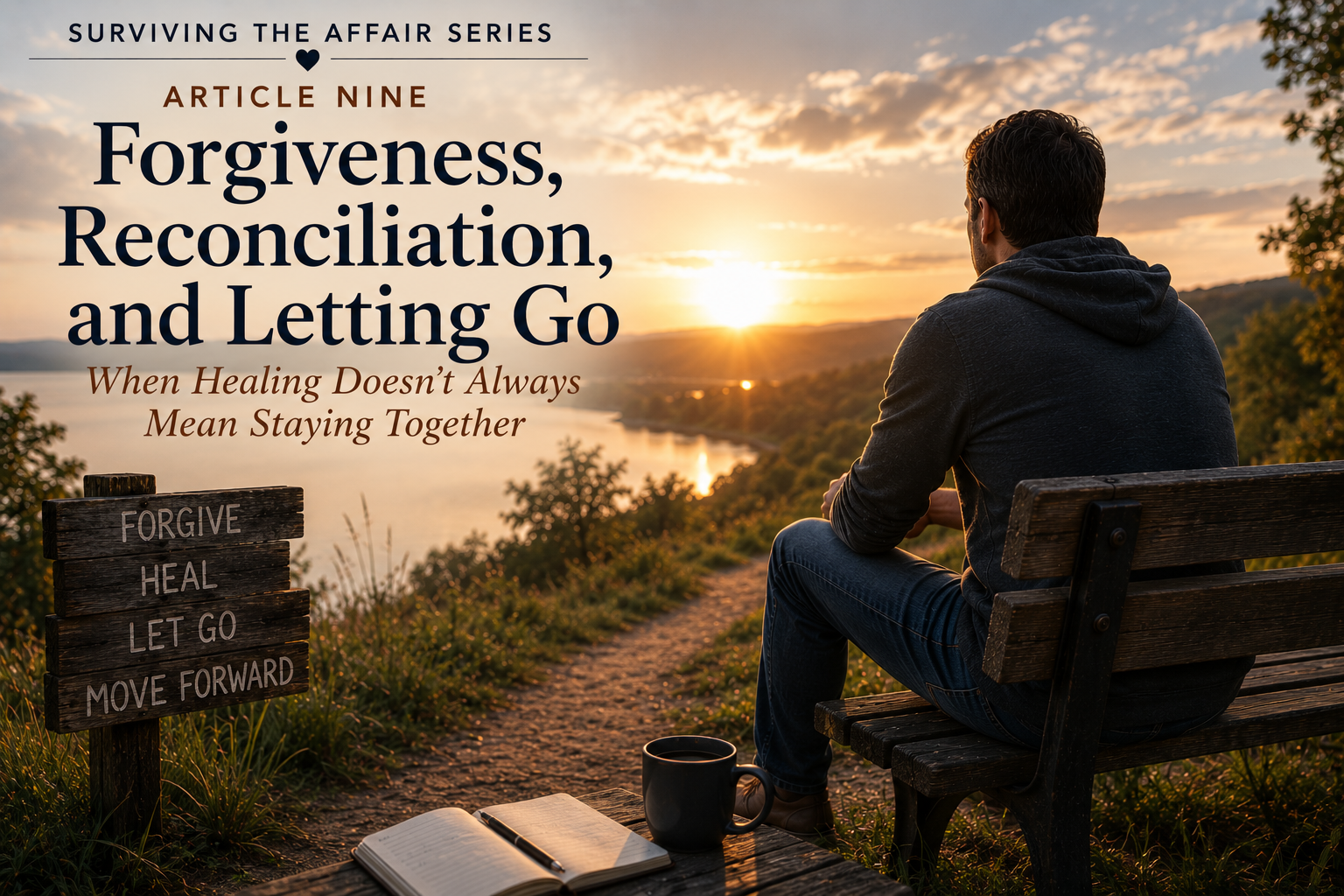

Surviving the Affair: Forgiveness, Reconciliation, and Letting Go

Part Nine: When Healing Doesn’t Always Mean Staying Together

Perhaps no word creates more confusion after an affair than the word forgiveness. Some people believe forgiveness means forgetting. Others believe it means trusting again. Some think it requires reconciliation. Others refuse to forgive because they believe doing so somehow excuses what happened.

In my years of counseling individuals and couples after infidelity, I have discovered that very few people actually struggle with the idea of forgiveness. They struggle with what they think forgiveness means. If we misunderstand forgiveness, we either demand it too quickly or avoid it altogether. Neither response promotes healing. Forgiveness is one of the most misunderstood concepts in psychology, relationships, and Christianity. Understanding it correctly often becomes one of the most important turning points in recovery.


Forgiveness Is Not Saying It Didn’t Matter

Some wounds permanently change a person’s life. An affair may result in divorce. Children may experience years of emotional pain. Friendships may end. Financial stability may disappear. Trust may never fully return. Acknowledging these realities does not mean forgiveness is impossible. It means forgiveness begins with honesty. Real forgiveness never minimizes the seriousness of betrayal. It fully recognizes the depth of the wound. Only then can healing begin.


Forgiveness Is Not Reconciliation

This distinction cannot be overstated. Forgiveness and reconciliation are related. They are not identical. Forgiveness is something one person can choose. Reconciliation requires two people. One person can forgive. Both people must rebuild trust. Reconciliation requires:

  • Genuine repentance.
  • Radical honesty.
  • Transparency.
  • Accountability.
  • Emotional safety.
  • Consistent trustworthy behavior.
  • Mutual willingness to rebuild the relationship.

Without these elements, reconciliation becomes unsafe. Forgiveness may still occur. Reconciliation may not.


Forgiveness Is Not Trust

One of the most painful mistakes couples make is expecting forgiveness to immediately restore trust. Trust is earned. Forgiveness is given. Trust grows through repeated demonstrations of honesty. Forgiveness grows through emotional healing. A spouse may forgive today. Trust may require months—or years—to return. That is normal. Healthy forgiveness never ignores wisdom.


Bitterness Is a Heavy Burden

Many people refuse forgiveness because they believe it protects them. “If I stay angry, I’ll never be hurt again.” Unfortunately, bitterness rarely protects. It imprisons. Bitterness quietly occupies emotional space that could otherwise be filled with peace. It influences future relationships. It affects physical health. It changes the way we see ourselves. It changes the way we see others. Eventually, bitterness begins hurting the person carrying it more than the person who caused it. Forgiveness is not setting someone else free. It is refusing to remain emotionally chained to what they did.


What If They Never Apologize?

One of the most difficult realities is that some people never receive the apology they deserve. The unfaithful spouse may deny responsibility. The affair partner may never acknowledge the harm. Some people simply disappear. Waiting for another person’s remorse before healing often leaves us emotionally dependent upon someone who has already demonstrated unreliability. Healing cannot depend upon another person’s choices. Your recovery belongs to you.


Forgiveness Is a Process, Not a Moment

Many people expect forgiveness to happen all at once. Instead, it often unfolds gradually. One day you notice the anger feels slightly less intense. Months later, the memories no longer dominate every conversation. Years later, you discover the affair has become part of your history rather than your identity. Forgiveness usually grows quietly. Like physical healing, it often happens so gradually that we fail to notice until we compare where we are today with where we once were.


When Reconciliation Isn’t Healthy

Not every marriage should continue. Repeated affairs. Abuse. Manipulation. Addiction without treatment. Chronic dishonesty. Refusal to accept responsibility. These situations may make reconciliation unsafe. Choosing divorce in such circumstances is not necessarily evidence of unforgiveness. Sometimes healthy boundaries require ending the relationship. God values truth and safety as much as He values reconciliation. Wisdom requires knowing the difference.


What Letting Go Really Means

Letting go does not mean pretending the affair never happened. It means releasing your need to control what cannot be changed. You cannot rewrite yesterday. You can choose how yesterday influences tomorrow. Letting go means:

  • Releasing revenge.
  • Releasing constant rumination.
  • Releasing the need to make the other person suffer.
  • Releasing unrealistic expectations.
  • Choosing emotional freedom instead of emotional captivity.

That process rarely happens overnight. It is practiced one decision at a time.


Tools for Moving Forward

Whether your marriage survives or ends, these practices encourage emotional healing:

  • Work with a therapist experienced in betrayal trauma.
  • Journal your thoughts and emotional progress.
  • Practice mindfulness when intrusive memories arise.
  • Establish healthy emotional and physical boundaries.
  • Learn the difference between forgiveness and trust.
  • Invest in supportive friendships.
  • Develop daily spiritual practices through prayer and Scripture.
  • Focus on becoming emotionally healthy rather than emotionally vindicated.
  • Celebrate progress rather than demanding perfection.
  • Give yourself permission to heal at your own pace.

A Christian Perspective

When Jesus taught about forgiveness, He never suggested that wrongdoing should be ignored. Rather, He demonstrated that forgiveness is an act of surrender to God rather than an approval of sin. Ephesians 4:31–32 encourages believers:

“Get rid of all bitterness, rage and anger… Be kind and compassionate to one another, forgiving each other, just as in Christ God forgave you.”

Biblical forgiveness is rooted in freedom. Freedom from bitterness. Freedom from revenge. Freedom to trust God’s justice rather than carrying the burden yourself. Forgiveness is not weakness. It is spiritual strength.


A Therapist’s Reflection

One question I frequently ask clients is this:

“If the affair could no longer control your emotional life, what kind of person would you become?”

At first, many struggle to answer. Their identity has become intertwined with the betrayal. Over time, however, something beautiful begins to happen. They stop defining themselves by what someone did to them. They begin defining themselves by who they are becoming. That is healing. Forgiveness does not erase scars. It changes what those scars represent. Instead of reminders of permanent defeat…They become evidence that you survived. Whether your marriage continues or ends… Whether the apology comes or never arrives…Whether trust is rebuilt or permanently broken…Your future is still yours to write.

Do not allow another person’s choices to become the author of the rest of your life. Healing is possible. Freedom is possible. And forgiveness—properly understood—may become one of the greatest gifts you ever give yourself.


About the Author

John S. Collier, MSW, LCSW-S is a licensed clinical social worker, psychotherapist, author, educator, and speaker with decades of experience helping individuals, couples, and families navigate life’s most difficult emotional challenges. Throughout his career, he has worked extensively with people struggling with relationship conflict, betrayal, anxiety, depression, trauma, grief, addiction, and life transitions. His counseling approach combines evidence-based psychological practices with practical wisdom, compassion, and a deep respect for each person’s unique journey.

John has devoted much of his professional life to understanding the complexities of human relationships. He has counseled couples working to rebuild trust after infidelity, individuals recovering from betrayal, and families seeking healing after painful life events. His clinical experience has reinforced one enduring truth: while relationships can be profoundly wounded, people possess an extraordinary capacity for growth, resilience, forgiveness, and transformation when they are equipped with the right tools and support.

As an author, John seeks to bridge the gap between professional mental health knowledge and everyday life. His writing translates complex psychological concepts into practical guidance that readers can understand and apply immediately. Whether addressing marriage, parenting, emotional wellness, trauma recovery, or spiritual growth, his goal is to provide resources that are both clinically sound and personally encouraging.

Surviving the Affair reflects John’s commitment to approaching infidelity with both honesty and compassion. Rather than reducing people to labels or stereotypes, he explores the emotional realities experienced by everyone affected—the betrayed spouse, the unfaithful partner, the affair partner, and the families whose lives are forever changed. Drawing upon years of therapeutic experience, he emphasizes accountability without condemnation, healing without minimizing pain, and hope without offering unrealistic promises.

John believes that healing begins when people are willing to face the truth with courage. While not every relationship can or should be restored, every individual has the capacity to grow beyond betrayal, rediscover integrity, and build a healthier future. His passion is helping readers move from surviving life’s greatest wounds to living with renewed purpose, emotional strength, and hope.

Through his books, speaking engagements, and counseling work, John continues to encourage others to pursue emotional health, healthy relationships, personal responsibility, and lasting transformation—one step at a time.onal pain toward lives marked by integrity, resilience, and hope. Through his writing and counseling, he encourages readers to embrace accountability while believing that lasting personal transformation is always possible. with practical tools for healing, resilience, and lasting personal growth.

References

American Psychiatric Association. (2022). Diagnostic and Statistical Manual of Mental Disorders (5th ed., text rev.). American Psychiatric Association Publishing.

Baucom, D. H., Snyder, D. K., & Gordon, K. C. (2009). Helping Couples Get Past the Affair: A Clinician’s Guide. Guilford Press.

Enright, R. D. (2001). Forgiveness Is a Choice: A Step-by-Step Process for Resolving Anger and Restoring Hope. American Psychological Association.

Glass, S. P. (2003). Not “Just Friends”: Rebuilding Trust and Recovering Your Sanity After Infidelity. Free Press.

Spring, J. A. (2012). After the Affair: Healing the Pain and Rebuilding Trust When a Partner Has Been Unfaithful (2nd ed.). Harper.

Worthington, E. L. (2006). Forgiveness and Reconciliation: Theory and Application. Routledge.

Worthington, E. L. (2013). Moving Forward: Six Steps to Forgiving Yourself and Breaking Free from the Past. WaterBrook.

The Holy Bible, New International Version. (2011). Zondervan.


Articles in this Series:

This series has been written for every person whose life has been altered by an affair. Each article focuses on one unique perspective because healing looks different depending upon where someone stands.

Turbulent ocean waves crashing under dark storm clouds with sunset light
Surviving the Affair

Part Two: When Forgiveness Feels Impossible

The Betrayed Spouse Who Cannot Forgive

There are few moments in life that permanently divide time into “before” and “after.” The discovery of an affair is one of them.

Many betrayed spouses remember the exact moment they found out. It becomes etched into memory with remarkable clarity. They remember where they were standing, the expression on their spouse’s face, the phone call, the text message, the photograph, the receipt, or the confession that forever changed their world. The details become frozen in time because betrayal is not simply painful—it is traumatic.

For many people, the greatest struggle after an affair is not deciding whether to stay or leave. It is the overwhelming realization that they cannot forgive. They may desperately want to forgive. Their faith may tell them they should forgive. Friends may encourage forgiveness. Their spouse may plead for forgiveness.

Yet every time they attempt it, the memories return. The images replay. The questions begin again. The anger resurfaces. Forgiveness seems to disappear as quickly as it came. If this describes your experience, you are not abnormal. You are traumatized. Understanding the difference is the first step toward healing.


Betrayal Is More Than Heartbreak

When someone you trust violates the foundation of your relationship, the injury reaches far beyond hurt feelings. An affair attacks several of our deepest psychological needs simultaneously:

  • Safety
  • Trust
  • Identity
  • Security
  • Self-worth
  • Emotional attachment
  • Future expectations

The person who once represented comfort suddenly becomes the source of fear. The person who promised protection becomes the one who caused the injury. This contradiction places the brain into survival mode.

Researchers have increasingly recognized betrayal trauma as a unique form of psychological injury because the source of comfort becomes the source of danger. This creates confusion that often resembles post-traumatic stress disorder (PTSD).


The What-If Loop

One of the most exhausting symptoms of betrayal is what therapists often call the “What-If Loop.” The mind searches endlessly for answers.

What if I had noticed sooner?
What if I had been more affectionate?
What if I had worked less?
What if I had looked different?
What if they loved the other person more?

The questions become relentless. Unfortunately, the human brain mistakenly believes that if it can answer every question, it will somehow eliminate the pain. It rarely does. Instead, each answer usually creates three new questions. Healing begins when we recognize that certainty is not always available. Sometimes recovery requires learning to live without complete explanations. (For more on the What If Loop, Click Here)


The Mind Replays What the Eyes Never Saw

Many betrayed spouses become haunted by mental movies. They imagine conversations. Hotel rooms. Vacations. Private messages. Laughter. Physical intimacy. These images may never have actually been witnessed, yet they feel vividly real. This is how trauma attempts to fill in missing information. The brain dislikes incomplete stories. It creates them. Unfortunately, the stories are usually worse than reality. This explains why intrusive thoughts continue months or even years after disclosure. They are symptoms of trauma—not weakness.


Anger Is Often Love’s Last Defense

People frequently apologize for being angry.

“I know I shouldn’t still be this angry.”
“I’ve prayed about it.”
“I’ve tried to let it go.”
“I don’t want to feel this way anymore.”

Anger often protects something much more vulnerable. Beneath the anger is grief. Beneath the grief is love. Beneath the love is loss. When we understand anger as protection instead of failure, we stop fighting our emotions and begin listening to them. Anger asks important questions:

“Am I safe?”
“Can I trust again?”
“Will this happen again?”

These questions deserve honest answers.


Why Forgiveness Cannot Be Forced

Forgiveness is one of the most misunderstood concepts in both psychology and Christianity. Forgiveness is not pretending it didn’t happen. It is not forgetting. It is not excusing betrayal. It is not immediately trusting again. It is not removing consequences. Forgiveness is gradually releasing the desire to remain emotionally imprisoned by another person’s actions. That process often takes considerable time. When people pressure themselves into premature forgiveness, they frequently experience what psychologists call pseudo-forgiveness. Outwardly they say, “I forgive you.” Internally, nothing has healed. The resentment simply becomes hidden. Authentic forgiveness grows naturally from healing. It rarely precedes it.


The Difference Between Forgiveness and Reconciliation

Many betrayed spouses fear that forgiving means they must remain in the marriage. It does not. Forgiveness concerns your heart. Reconciliation concerns the relationship. The two are related but not identical. Reconciliation requires:

  • Genuine remorse
  • Complete honesty
  • Transparency
  • Consistent trustworthy behavior
  • Patience
  • Accountability
  • Mutual commitment

One person can forgive. Two people must reconcile.


Common Triggers

Recovery rarely follows a straight line. Many seemingly ordinary experiences suddenly reopen emotional wounds. Common triggers include:

  • Anniversary dates
  • Holidays
  • Love songs
  • Hotel advertisements
  • Social media
  • Text notification sounds
  • Unexpected schedule changes
  • Certain perfumes or colognes
  • Particular restaurants
  • Movies involving infidelity

Triggers do not mean healing has failed. They simply remind us that the nervous system remembers what the mind wishes it could forget.


Tools for Healing

Healing requires more than waiting for time to pass. Intentional practices help the brain regain emotional stability. Consider these strategies:

  • Work with a therapist trained in betrayal trauma or couples counseling.
  • Practice grounding exercises when intrusive thoughts become overwhelming.
  • Develop healthy sleep, nutrition, and exercise routines.
  • Limit repetitive questioning that no longer produces useful information.
  • Build a support system of emotionally healthy people.
  • Journal difficult emotions rather than suppressing them.
  • Establish boundaries that increase emotional safety.
  • Pray honestly rather than pretending to be spiritually stronger than you feel.

Healing rarely happens accidentally. It happens intentionally.


A Christian Perspective on Forgiveness

Jesus calls believers to forgive. He also never minimizes sin. Throughout Scripture we see both mercy and justice. Repentance and restoration. Truth and grace. Forgiveness does not require pretending evil never occurred. Rather, forgiveness entrusts justice to God while refusing to allow bitterness to define one’s future.

Romans 12:19 reminds believers: “Do not take revenge, my dear friends, but leave room for God’s wrath…”

Forgiveness becomes possible not because betrayal was small. It becomes possible because Christ has shown us that even great wounds can be redeemed. That redemption, however, is often a journey—not a single moment.


A Therapist’s Reflection

One of the most common statements I hear in my office is this:

“I don’t know if I’ll ever forgive them.”

My response often surprises people. I tell them not to make forgiveness today’s assignment. Today’s assignment is breathing. Sleeping. Eating. Staying emotionally safe. Understanding what happened. Learning that trauma changes the brain. Finding healthy support. Forgiveness may come months later. Sometimes years later.

Sometimes forgiveness arrives quietly—not because the memories disappeared, but because the memories no longer control your life. Healing is rarely about forgetting. It is about remembering differently. The affair may always remain part of your story. It does not have to remain the author of your future.


About the Author

John S. Collier, MSW, LCSW-S is a licensed clinical social worker, psychotherapist, author, educator, and speaker with decades of experience helping individuals, couples, and families navigate life’s most difficult emotional challenges. Throughout his career, he has worked extensively with people struggling with relationship conflict, betrayal, anxiety, depression, trauma, grief, addiction, and life transitions. His counseling approach combines evidence-based psychological practices with practical wisdom, compassion, and a deep respect for each person’s unique journey.

John has devoted much of his professional life to understanding the complexities of human relationships. He has counseled couples working to rebuild trust after infidelity, individuals recovering from betrayal, and families seeking healing after painful life events. His clinical experience has reinforced one enduring truth: while relationships can be profoundly wounded, people possess an extraordinary capacity for growth, resilience, forgiveness, and transformation when they are equipped with the right tools and support.

As an author, John seeks to bridge the gap between professional mental health knowledge and everyday life. His writing translates complex psychological concepts into practical guidance that readers can understand and apply immediately. Whether addressing marriage, parenting, emotional wellness, trauma recovery, or spiritual growth, his goal is to provide resources that are both clinically sound and personally encouraging.

Surviving the Affair reflects John’s commitment to approaching infidelity with both honesty and compassion. Rather than reducing people to labels or stereotypes, he explores the emotional realities experienced by everyone affected—the betrayed spouse, the unfaithful partner, the affair partner, and the families whose lives are forever changed. Drawing upon years of therapeutic experience, he emphasizes accountability without condemnation, healing without minimizing pain, and hope without offering unrealistic promises.

John believes that healing begins when people are willing to face the truth with courage. While not every relationship can or should be restored, every individual has the capacity to grow beyond betrayal, rediscover integrity, and build a healthier future. His passion is helping readers move from surviving life’s greatest wounds to living with renewed purpose, emotional strength, and hope.

Through his books, speaking engagements, and counseling work, John continues to encourage others to pursue emotional health, healthy relationships, personal responsibility, and lasting transformation—one step at a time.healing and growth. His writing combines psychological research, clinical experience, and Christian principles to provide readers with hope, insight, and realistic pathways toward emotional recovery and healthier relationships.

References

American Psychiatric Association. (2022). Diagnostic and Statistical Manual of Mental Disorders (5th ed., text rev.). American Psychiatric Association Publishing.

Baucom, D. H., Snyder, D. K., & Gordon, K. C. (2009). Helping Couples Get Past the Affair: A Clinician’s Guide. Guilford Press.

Glass, S. P. (2003). Not “Just Friends”: Rebuilding Trust and Recovering Your Sanity After Infidelity. Free Press.

Gordon, K. C., Baucom, D. H., & Snyder, D. K. (2004). An integrative intervention for promoting recovery from extramarital affairs. Journal of Marital and Family Therapy, 30(2), 213–231.

Johnson, S. M. (2019). Attachment Theory in Practice. Guilford Press.

Snyder, D. K., Baucom, D. H., & Gordon, K. C. (2007). Getting Past the Affair. Guilford Press.

Spring, J. A. (2012). After the Affair (2nd ed.). Harper.

The Holy Bible, New International Version. (2011). Zondervan.

Part One

The Wounds No One Sees
An overview of betrayal, trauma, grief, and the emotional complexity of affairs.

Part Two (This Article)

The Betrayed Spouse Who Cannot Forgive
Understanding intrusive memories, resentment, trauma, and why forgiveness cannot be forced.

Part Three

The Betrayed Spouse Who Wants to Save the Marriage
Learning how trust is rebuilt, boundaries are established, and reconciliation becomes possible.

Part Four

The Betrayer Who Does Not Want to Stay
Navigating honesty, responsibility, guilt, and ending a marriage with integrity rather than continued deception.

Part Five

The Betrayer Who Wants to Reconcile
Understanding genuine remorse, rebuilding trust, transparency, and becoming trustworthy again.

Part Six

The Affair Partner Who Doesn’t Want the Relationship to End
Exploring attachment, hope, grief, and accepting that loving someone does not always justify continuing the relationship.

Part Seven

The Affair Partner Who Ends the Relationship Because It Is Morally Wrong
Examining grief, guilt, loneliness, moral conflict, and healing after choosing integrity over desire.

Part Eight

When Children, Families, and Friends Are Caught in the Middle
Understanding the wider ripple effects of infidelity and protecting those who never chose to be part of the story.

Part Nine

When Forgiveness Comes…and When It Doesn’t
Separating forgiveness from reconciliation and understanding what emotional freedom truly means.

Part Ten

Life After the Affair
Whether the marriage survives or ends, discovering how people rebuild identity, hope, purpose, and healthy relationships again.