
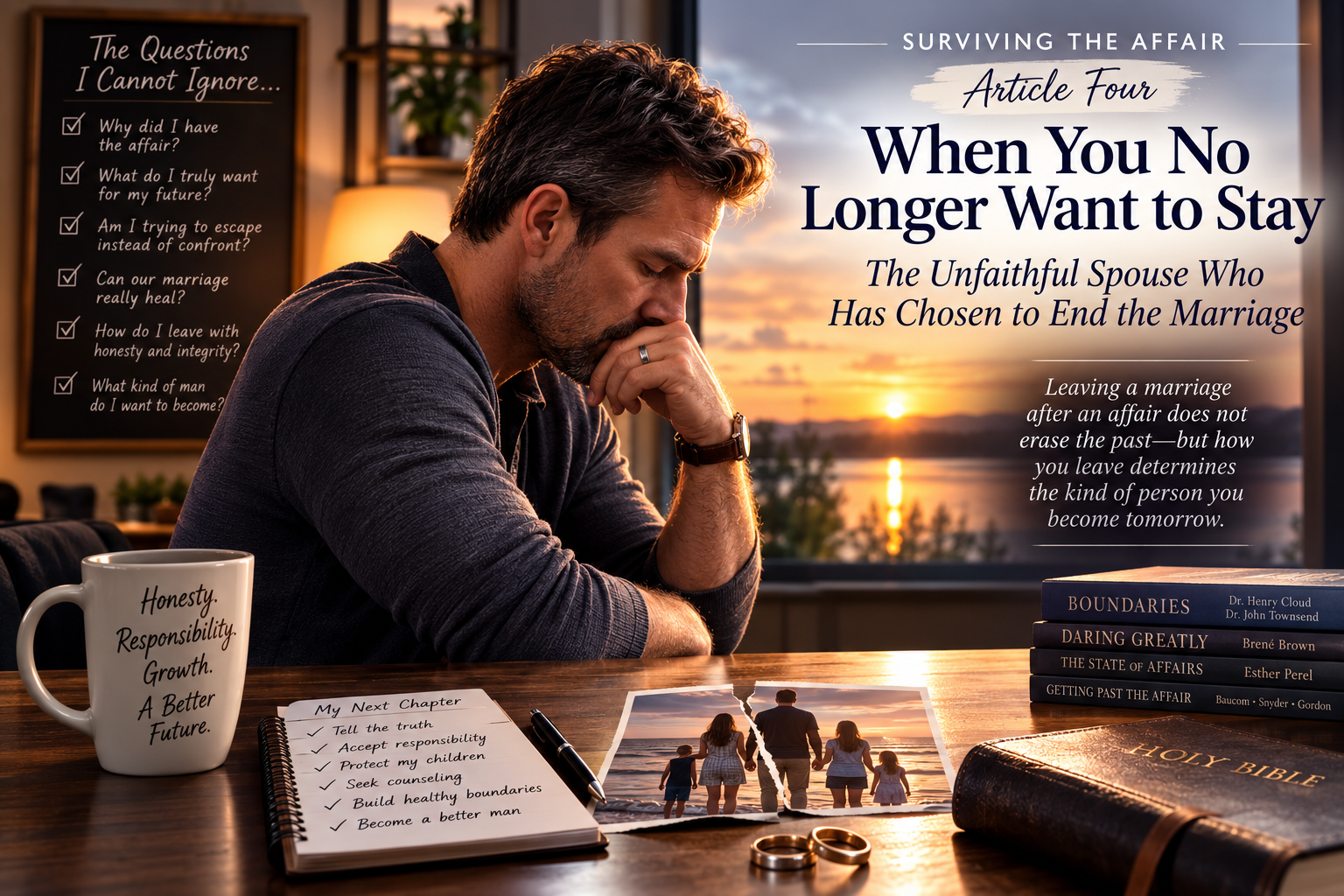

Surviving the Affair: When You No Longer want to Stay
Part Four: The Unfaithful Spouse Who Has Chosen to End the Marriage
Walking away from a marriage after having an affair is one of the most painful and misunderstood experiences in relationship counseling. Society often assumes that the spouse who was unfaithful has found happiness while everyone else is left with pain. While that is occasionally true, the emotional reality is usually far more complicated. Many unfaithful spouses discover that ending the marriage does not bring the peace they expected. Instead, they find themselves carrying overwhelming guilt, grief, confusion, and the weight of knowing that their decisions have permanently altered the lives of the people they once promised to love and protect.
Some have genuinely fallen in love with another person. Some realize they emotionally left the marriage years before the affair ever began. Others recognize that their marriage had become unhealthy long before infidelity occurred, and the affair simply accelerated a decision they had been avoiding.
None of these realities excuse unfaithfulness. An affair is never an ethical way to end a marriage. However, understanding why an unfaithful spouse no longer wants to remain married is essential if healing is ever going to occur—for everyone involved. This article is not written to defend infidelity. It is written to help those who have chosen not to reconcile leave their marriage with honesty, responsibility, compassion, and integrity rather than continuing deception and emotional destruction.
The Affair Was Not the Beginning
Many unfaithful spouses eventually admit something difficult. The affair was not the beginning of the end. It was the symptom. For months—or sometimes years—they had emotionally disconnected from the marriage. They stopped sharing their fears. They buried resentment. They avoided conflict. They convinced themselves that things would somehow improve without difficult conversations.
Instead, emotional distance became loneliness. Loneliness became vulnerability. Vulnerability became secrecy. Secrecy became infidelity. Recognizing this progression does not remove responsibility. Instead, it provides an opportunity to understand what happened so the same pattern is not repeated in future relationships. If you do not understand how you arrived here, you are far more likely to repeat the same mistakes.
Honesty Is Painful for a Moment. Deception Is Painful for a Lifetime.
Many people remain emotionally trapped because they cannot bear the thought of hurting their spouse. Ironically, prolonged deception almost always creates greater pain than difficult honesty. Remaining emotionally unavailable while pretending to work on the marriage prolongs false hope. False hope delays healing. If you have truly decided that your marriage is over, one of the most compassionate gifts you can give your spouse is complete honesty. That honesty should never be harsh. It should never become an attempt to justify the affair. It should never shift responsibility onto your spouse. But it must be truthful. People deserve the dignity of making life-changing decisions based upon reality—not illusion.
Accept Responsibility Without Rewriting History
One of the greatest temptations after an affair is rewriting the history of the marriage to reduce feelings of guilt. Statements such as:
- “We were never happy.”
- “I never really loved you.”
- “Our marriage was always terrible.”
often become attempts to justify leaving rather than honest descriptions of reality. Most marriages contain beautiful memories alongside painful struggles. Acknowledging the good does not require remaining married. Acknowledging the problems does not justify becoming unfaithful. Healthy accountability sounds different. It says:
“Our marriage had serious problems, but I chose an unhealthy and dishonest way to respond to those problems.”
That statement accepts responsibility without distorting history.
Guilt Can Become Your Greatest Teacher
Healthy guilt serves an important purpose. It reminds us that our behavior violated our own values.
Shame says: “I am a terrible person.”
Healthy guilt says: “I made terrible decisions.”
The distinction matters. People who become trapped in shame often become defensive, withdrawn, or emotionally paralyzed. People who embrace healthy guilt often become teachable. Personal growth begins when accountability replaces self-protection.
Ending a Marriage With Integrity
If reconciliation is no longer possible—or no longer desired—there are healthier ways to move forward. Ending a marriage with integrity means:
- Being completely truthful.
- Taking full responsibility for your choices.
- Refusing to blame your spouse for your decision to be unfaithful.
- Protecting your children from adult conflict.
- Treating your spouse with dignity throughout the separation or divorce.
- Avoiding unnecessary public humiliation.
- Honoring financial and parental responsibilities.
- Speaking respectfully, even when emotions remain intense.
Integrity after failure does not erase the past. It does determine the kind of person you become afterward.
What About the New Relationship?
Many affairs do not survive once secrecy disappears. The excitement of hidden meetings often fades beneath the realities of everyday life. Even when the new relationship continues, unresolved guilt frequently follows. Questions begin to emerge.
- “Will they ever truly trust me?”
- “Can I fully trust someone who entered a relationship with me this way?”
- “Did we build our relationship on a foundation of deception?”
These are not questions to avoid. They are questions to confront honestly. Every healthy relationship is ultimately built upon trust, openness, and integrity. Without those qualities, history has a way of repeating itself.
Children Are Watching More Than They Hear
When children are involved, they learn far more from your behavior than your explanations. They notice:
- How conflict is handled.
- How parents speak about one another.
- Whether responsibility is accepted.
- Whether apologies are sincere.
- Whether respect survives disappointment.
Your marriage may end. Your influence as a parent does not. The character you demonstrate during this season may become one of the greatest lessons your children carry into their own future relationships.
Tools for Moving Forward
If you have chosen to end your marriage, consider these practical steps:
- Participate in individual therapy to understand the emotional needs and vulnerabilities that contributed to the affair.
- End all deception immediately.
- Accept responsibility without minimizing your choices.
- Resist the urge to defend yourself through blame.
- Communicate respectfully with your spouse.
- Protect your children from adult conflict.
- Establish healthy emotional boundaries.
- Delay entering another serious relationship until you have processed your own growth.
- Surround yourself with people who encourage accountability rather than excuses.
- Practice regular self-reflection, humility, and personal growth.
A Christian Perspective
Scripture teaches both truth and grace. It never minimizes the seriousness of infidelity. Neither does it suggest that failure places a person beyond God’s redemption. King David committed adultery. Peter denied Christ. The Apostle Paul persecuted believers before becoming one of Christianity’s greatest missionaries. Each experienced profound failure. Each also experienced genuine repentance and transformation. If your marriage cannot be restored, your character still can.
God’s forgiveness never removes earthly consequences. It does, however, offer the opportunity to become someone different from the person who made those destructive choices. Psalm 51 reminds us that authentic repentance begins not with excuses but with honest confession and a sincere desire for a transformed heart.
A Therapist’s Reflection
One of the saddest statements I hear in my office comes from unfaithful spouses who quietly say,
“I wish I had ended my marriage before I ever had the affair.”
Those words are rarely spoken with relief. They are usually spoken with tears. Not because divorce would have been painless. But because deception made an already painful situation infinitely more destructive. If reconciliation is no longer your desire, choose honesty today instead of another month—or another year—of pretending.
Do not spend your energy defending what cannot be defended. Invest that same energy in becoming someone who lives with greater honesty, humility, courage, and integrity. The affair does not have to define the rest of your life. But your response to it will shape the person you become. Choose responsibility. Choose truth. Choose humility. Choose growth. Even after profound failure, those choices remain available.
About the Author

John S. Collier, MSW, LCSW-S is a licensed clinical social worker, psychotherapist, author, educator, and speaker with decades of experience helping individuals, couples, and families navigate life’s most difficult emotional challenges. Throughout his career, he has worked extensively with people struggling with relationship conflict, betrayal, anxiety, depression, trauma, grief, addiction, and life transitions. His counseling approach combines evidence-based psychological practices with practical wisdom, compassion, and a deep respect for each person’s unique journey.
John has devoted much of his professional life to understanding the complexities of human relationships. He has counseled couples working to rebuild trust after infidelity, individuals recovering from betrayal, and families seeking healing after painful life events. His clinical experience has reinforced one enduring truth: while relationships can be profoundly wounded, people possess an extraordinary capacity for growth, resilience, forgiveness, and transformation when they are equipped with the right tools and support.
As an author, John seeks to bridge the gap between professional mental health knowledge and everyday life. His writing translates complex psychological concepts into practical guidance that readers can understand and apply immediately. Whether addressing marriage, parenting, emotional wellness, trauma recovery, or spiritual growth, his goal is to provide resources that are both clinically sound and personally encouraging.
Surviving the Affair reflects John’s commitment to approaching infidelity with both honesty and compassion. Rather than reducing people to labels or stereotypes, he explores the emotional realities experienced by everyone affected—the betrayed spouse, the unfaithful partner, the affair partner, and the families whose lives are forever changed. Drawing upon years of therapeutic experience, he emphasizes accountability without condemnation, healing without minimizing pain, and hope without offering unrealistic promises.
John believes that healing begins when people are willing to face the truth with courage. While not every relationship can or should be restored, every individual has the capacity to grow beyond betrayal, rediscover integrity, and build a healthier future. His passion is helping readers move from surviving life’s greatest wounds to living with renewed purpose, emotional strength, and hope.
Through his books, speaking engagements, and counseling work, John continues to encourage others to pursue emotional health, healthy relationships, personal responsibility, and lasting transformation—one step at a time.ountability, emotional healing, evidence-based therapeutic practices, and Christian principles of grace, truth, and personal transformation. Through his writing and counseling, John seeks to help people understand the complexities of human relationships, rebuild lives after failure, and discover hope beyond their greatest challenges.
References
American Association for Marriage and Family Therapy. (2015). Infidelity. https://www.aamft.org
Baucom, D. H., Snyder, D. K., & Gordon, K. C. (2009). Helping Couples Get Past the Affair: A Clinician’s Guide. Guilford Press.
Brown, B. (2012). Daring Greatly. Gotham Books.
Glass, S. P. (2003). Not “Just Friends”: Rebuilding Trust and Recovering Your Sanity After Infidelity. Free Press.
Gordon, K. C., Baucom, D. H., & Snyder, D. K. (2004). An integrative intervention for promoting recovery from extramarital affairs. Journal of Marital and Family Therapy, 30(2), 213–231.
Perel, E. (2017). The State of Affairs: Rethinking Infidelity. Harper.
Snyder, D. K., Baucom, D. H., & Gordon, K. C. (2007). Getting Past the Affair. Guilford Press.
The Holy Bible, New International Version. (2011). Zondervan.
- Part One: The Wounds No One Sees
An overview of betrayal, trauma, grief, and the emotional complexity of affairs. - Part Two: When Forgiveness Feels Impossible
Understanding intrusive memories, resentment, trauma, and why forgiveness cannot be forced. - Part Three: Choosing Hope
Learning how trust is rebuilt, boundaries are established, and reconciliation becomes possible. - Part Four: When You No Longer Want to Stay
Navigating honesty, responsibility, guilt, and ending a marriage with integrity rather than continued deception. - Part Five: The Long Road Home
Understanding genuine remorse, rebuilding trust, transparency, and becoming trustworthy again. - Part Six: Loving Somone You Cannot Keep
Exploring attachment, hope, grief, and accepting that loving someone does not always justify continuing the relationship. - Part Seven: Choosing Integrity Over Desire
Examining grief, guilt, loneliness, moral conflict, and healing after choosing integrity over desire. - Part Eight: The Ripple Affect
Understanding the wider ripple effects of infidelity and protecting those who never chose to be part of the story. - Article Nine: Forgiveness, Reconciliation, and Letting Go
Separating forgiveness from reconciliation and understanding what emotional freedom truly means. - Part Ten: Beyond Survival
Whether the marriage survives or ends, discovering how people rebuild identity, hope, purpose, and healthy relationships again.