Surviving the Affair: Loving Someone You Cannot Keep
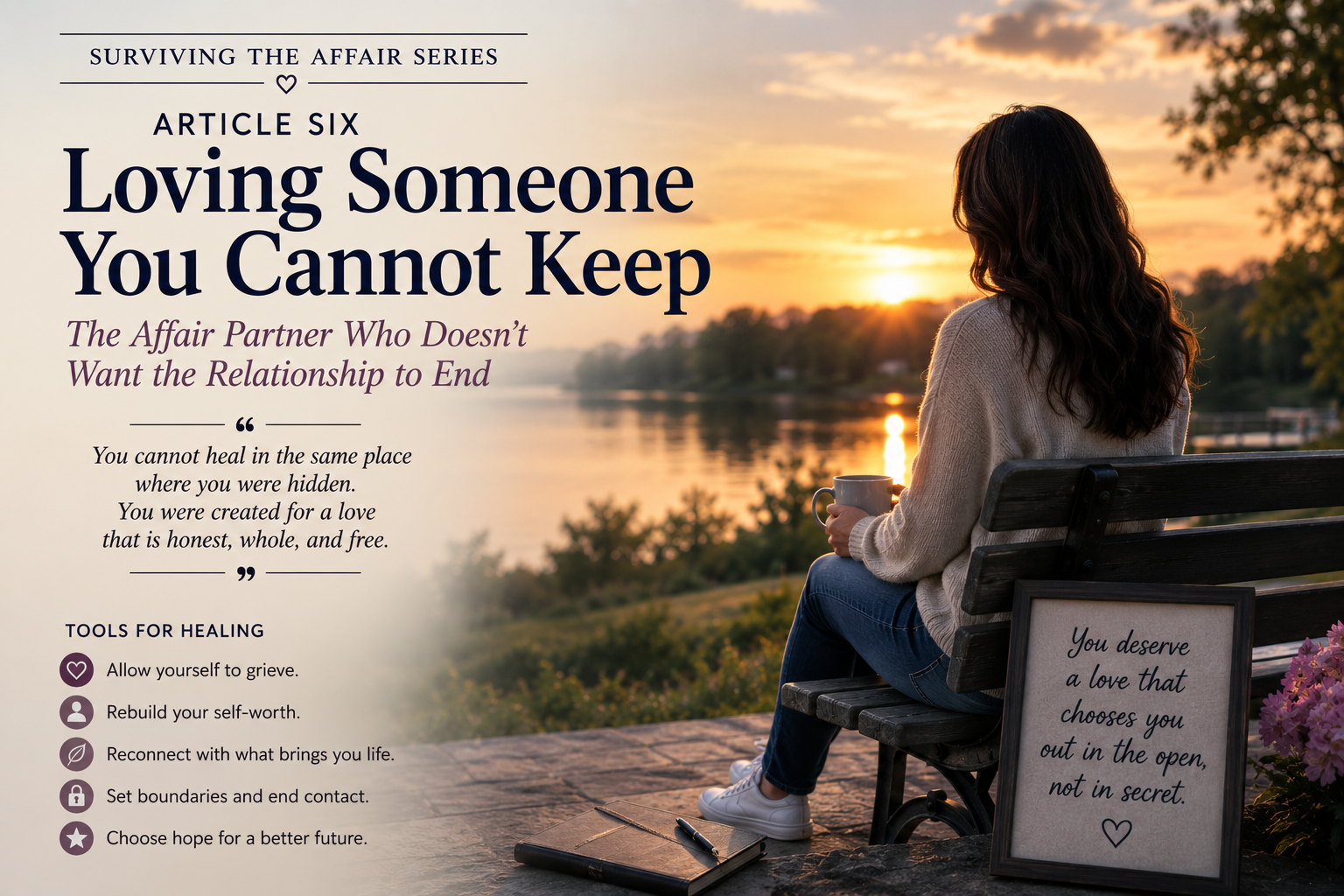
Part Six: The Affair Partner Who Doesn’t Want the Relationship to End
There is one person in nearly every affair who is rarely invited into the conversation. The affair partner. To many people, this individual is simply “the other woman” or “the other man.” They are viewed only through the pain they helped create. While they bear responsibility for their choices, reducing them to a stereotype rarely tells the whole story.
Some knowingly entered a relationship with a married person. Some were told the marriage was already over. Some believed divorce was only a matter of time. Some desperately tried to end the relationship but returned repeatedly. Others eventually fell deeply in love with someone they could never fully have.
None of these circumstances erase accountability. An affair causes real harm. Yet understanding the emotional world of the affair partner is not the same as excusing it. Healing begins with honesty—not caricatures.
This article is written for those who remain emotionally attached to someone who has chosen—or has been forced—to return to their marriage. You are grieving a relationship that may have felt deeply real, yet one that was built in secrecy and could never fully exist in the light. That grief deserves to be understood, even while acknowledging that the relationship itself was unhealthy.
When Fantasy Becomes Reality
Many affairs begin inside carefully controlled environments. There are no unpaid bills. No parenting disagreements. No household responsibilities. No extended family conflicts. There is only conversation, excitement, emotional intensity, and stolen moments. Psychologists sometimes describe this as a relationship protected from ordinary life.
Without everyday pressures, emotional intimacy often grows unusually fast. The relationship begins to feel extraordinary. Soulmate. Destiny. The one person who truly understands. These feelings are often sincere. But sincerity does not necessarily make them sustainable. Real relationships eventually require ordinary life. Most affairs never experience ordinary life.
Waiting for Tomorrow
Many affair partners live in a state of emotional suspension.
- “After the holidays…”
- “After the children graduate…”
- “After the divorce…”
- “Soon.”
Tomorrow becomes a promise that never quite arrives. Months become years. Life quietly passes. Many affair partners eventually realize they have built their future around someone else’s decisions. That realization is often devastating.
Loving Someone Who Chooses Someone Else
One of the deepest emotional wounds occurs when the married partner decides to end the affair and remain with their spouse. The affair partner often experiences intense emotions:
- Grief.
- Rejection.
- Loneliness.
- Confusion.
- Shame.
- Embarrassment.
Many wonder:
“Was any of it real?”
The answer is often yes. Feelings may have been genuine. But genuine feelings do not always produce healthy relationships. Love alone cannot overcome secrecy, divided loyalties, and broken trust.
The Hidden Cost of Being a Secret
Human beings were created for authentic connection. Healthy love thrives in openness. Affairs require concealment. Secret phone calls. Hidden messages. Excuses. Deleted conversations. Canceled holidays. Missed birthdays. Invisible grief. Over time, many affair partners begin realizing they are living a life that cannot be acknowledged publicly. They are important privately. Invisible publicly. That imbalance slowly erodes self-worth. Everyone deserves a relationship where they do not have to hide.
Hope Can Become a Prison
Hope is usually healthy. But misplaced hope can become emotionally imprisoning. Many affair partners continue waiting long after the relationship has effectively ended. They continue believing:
- “Maybe they’ll come back.”
- “Maybe they’re only staying because of the children.”
- “Maybe next month everything will change.”
Hope becomes less about possibility and more about avoidance. Sometimes healing begins when hope changes direction. Instead of hoping someone returns… Begin hoping you become emotionally free.
You Are More Than This Relationship
One of the greatest dangers in any unhealthy relationship is identity fusion. Your entire sense of worth becomes connected to one person. When that relationship ends, it feels as though you disappear too. Healing requires rediscovering yourself outside the relationship.
Ask yourself:
- Who was I before this affair?
- What dreams have I postponed?
- What values have I compromised?
- What kind of relationship do I truly deserve?
These questions often become the beginning of genuine recovery.
Choosing Self-Respect
Walking away from someone you love may become one of the hardest decisions you ever make. It may also become one of the healthiest. Self-respect sometimes requires accepting painful reality rather than continuing to chase unlikely possibilities. Healthy love does not require constant secrecy. Healthy love does not leave one person waiting indefinitely. Healthy love does not require sacrificing your identity to remain emotionally connected.
Tools for Healing
If you are struggling to let go, consider these practical steps:
- End all contact if the relationship has truly ended.
- Allow yourself to grieve without romanticizing the relationship.
- Work with a therapist to understand attachment patterns.
- Reconnect with trusted friends and family.
- Develop interests and goals that are independent of the relationship.
- Journal honestly about both the joys and the costs of the affair.
- Avoid monitoring your former partner’s social media.
- Practice self-compassion while accepting responsibility for your choices.
- Establish healthy relationship standards for the future.
- Focus on becoming the person you hope to share your life with someday.
A Christian Perspective
Throughout Scripture, God continually calls people away from hiddenness and toward truth. The invitation is never merely to stop doing wrong. It is to step into a different way of living. John 8:32 reminds us:
“Then you will know the truth, and the truth will set you free.”
Sometimes the greatest freedom comes not from getting what we wanted…But from releasing what was never ours to keep. God’s grace is available to everyone. To the faithful spouse. To the unfaithful spouse. To the affair partner. Grace does not ignore responsibility. It offers transformation beyond it.
A Therapist’s Reflection
Over the years, I have counseled affair partners whose grief surprised even them. Many assumed they had no right to mourn. Others believed their pain would be dismissed because they helped create the situation. Yet grief does not disappear because others disapprove of it. It simply becomes lonely.
The healthiest healing begins when two truths are held together. You may have genuinely loved this person. And…The relationship may still have been unhealthy. Those truths can exist together. Do not allow one relationship—especially one built in secrecy—to determine your worth. Your future is not limited by this chapter. Healthy love does not ask you to remain hidden. It invites you to be fully known. And that kind of love is worth waiting for.
About the Author

John S. Collier, MSW, LCSW-S is a licensed clinical social worker, psychotherapist, author, educator, and speaker with decades of experience helping individuals, couples, and families navigate life’s most difficult emotional challenges. Throughout his career, he has worked extensively with people struggling with relationship conflict, betrayal, anxiety, depression, trauma, grief, addiction, and life transitions. His counseling approach combines evidence-based psychological practices with practical wisdom, compassion, and a deep respect for each person’s unique journey.
John has devoted much of his professional life to understanding the complexities of human relationships. He has counseled couples working to rebuild trust after infidelity, individuals recovering from betrayal, and families seeking healing after painful life events. His clinical experience has reinforced one enduring truth: while relationships can be profoundly wounded, people possess an extraordinary capacity for growth, resilience, forgiveness, and transformation when they are equipped with the right tools and support.
As an author, John seeks to bridge the gap between professional mental health knowledge and everyday life. His writing translates complex psychological concepts into practical guidance that readers can understand and apply immediately. Whether addressing marriage, parenting, emotional wellness, trauma recovery, or spiritual growth, his goal is to provide resources that are both clinically sound and personally encouraging.
Surviving the Affair reflects John’s commitment to approaching infidelity with both honesty and compassion. Rather than reducing people to labels or stereotypes, he explores the emotional realities experienced by everyone affected—the betrayed spouse, the unfaithful partner, the affair partner, and the families whose lives are forever changed. Drawing upon years of therapeutic experience, he emphasizes accountability without condemnation, healing without minimizing pain, and hope without offering unrealistic promises.
John believes that healing begins when people are willing to face the truth with courage. While not every relationship can or should be restored, every individual has the capacity to grow beyond betrayal, rediscover integrity, and build a healthier future. His passion is helping readers move from surviving life’s greatest wounds to living with renewed purpose, emotional strength, and hope.
Through his books, speaking engagements, and counseling work, John continues to encourage others to pursue emotional health, healthy relationships, personal responsibility, and lasting transformation—one step at a time.toward healing, personal responsibility, and lasting transformation.
References
American Association for Marriage and Family Therapy. (2015). Infidelity. https://www.aamft.org
Brown, B. (2012). Daring Greatly. Gotham Books.
Glass, S. P. (2003). Not “Just Friends”: Rebuilding Trust and Recovering Your Sanity After Infidelity. Free Press.
Johnson, S. M. (2019). Attachment Theory in Practice: Emotionally Focused Therapy (EFT) with Individuals, Couples, and Families. Guilford Press.
Levine, A., & Heller, R. (2010). Attached: The New Science of Adult Attachment and How It Can Help You Find—and Keep—Love. TarcherPerigee.
Mikulincer, M., & Shaver, P. R. (2016). Attachment in Adulthood: Structure, Dynamics, and Change (2nd ed.). Guilford Press.
Perel, E. (2017). The State of Affairs: Rethinking Infidelity. Harper.
The Holy Bible, New International Version. (2011). Zondervan.
- Part One: The Wounds No One Sees
An overview of betrayal, trauma, grief, and the emotional complexity of affairs. - Part Two: When Forgiveness Feels Impossible
Understanding intrusive memories, resentment, trauma, and why forgiveness cannot be forced. - Part Three: Choosing Hope
Learning how trust is rebuilt, boundaries are established, and reconciliation becomes possible. - Part Four: When You No Longer Want to Stay
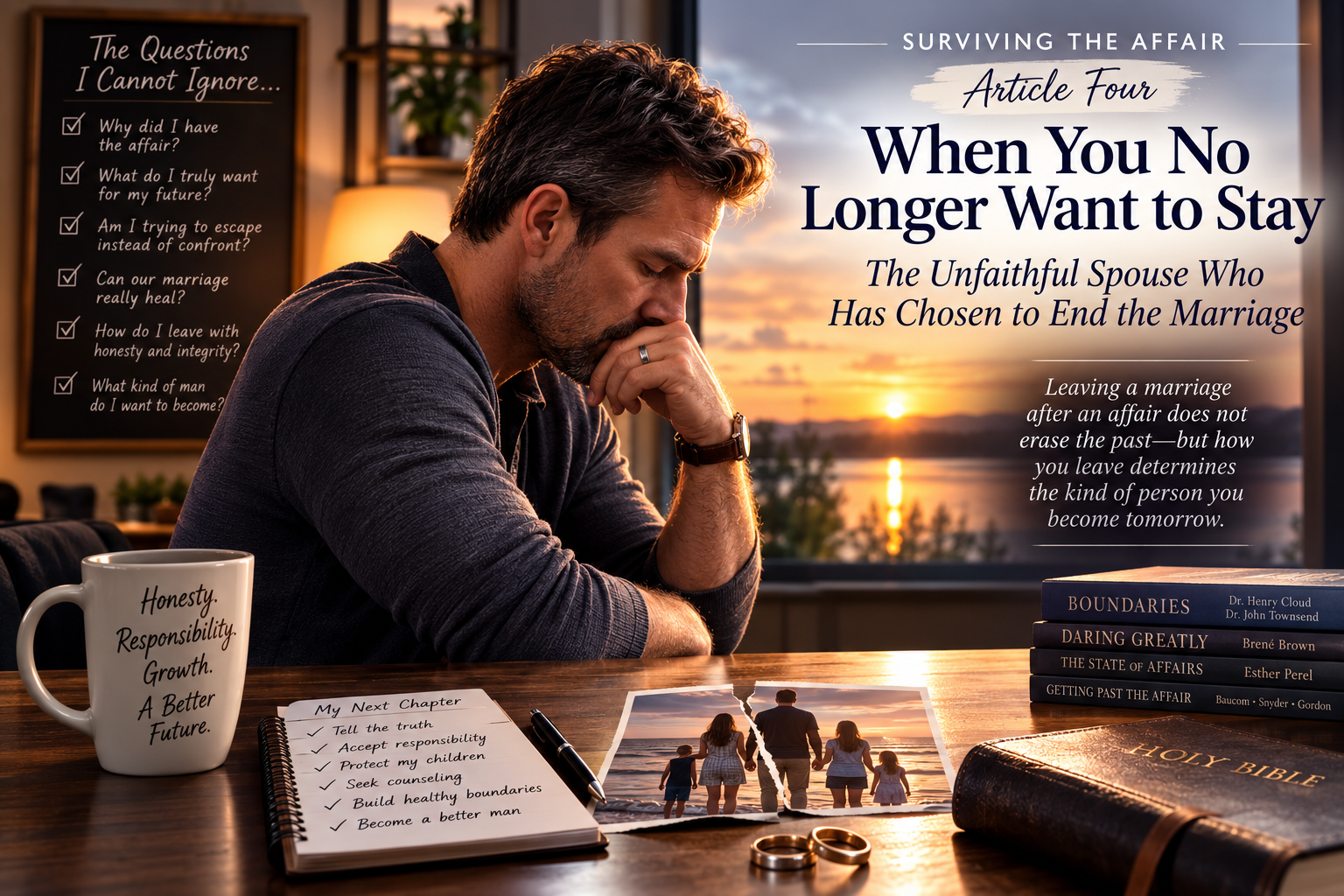
Navigating honesty, responsibility, guilt, and ending a marriage with integrity rather than continued deception. - Part Five: The Long Road Home
Understanding genuine remorse, rebuilding trust, transparency, and becoming trustworthy again. - Part Six: Loving Somone You Cannot Keep
Exploring attachment, hope, grief, and accepting that loving someone does not always justify continuing the relationship. - Part Seven: Choosing Integrity Over Desire
Examining grief, guilt, loneliness, moral conflict, and healing after choosing integrity over desire. - Part Eight: The Ripple Affect
Understanding the wider ripple effects of infidelity and protecting those who never chose to be part of the story. - Article Nine: Forgiveness, Reconciliation, and Letting Go
Separating forgiveness from reconciliation and understanding what emotional freedom truly means. - Part Ten: Beyond Survival
Whether the marriage survives or ends, discovering how people rebuild identity, hope, purpose, and healthy relationships again.