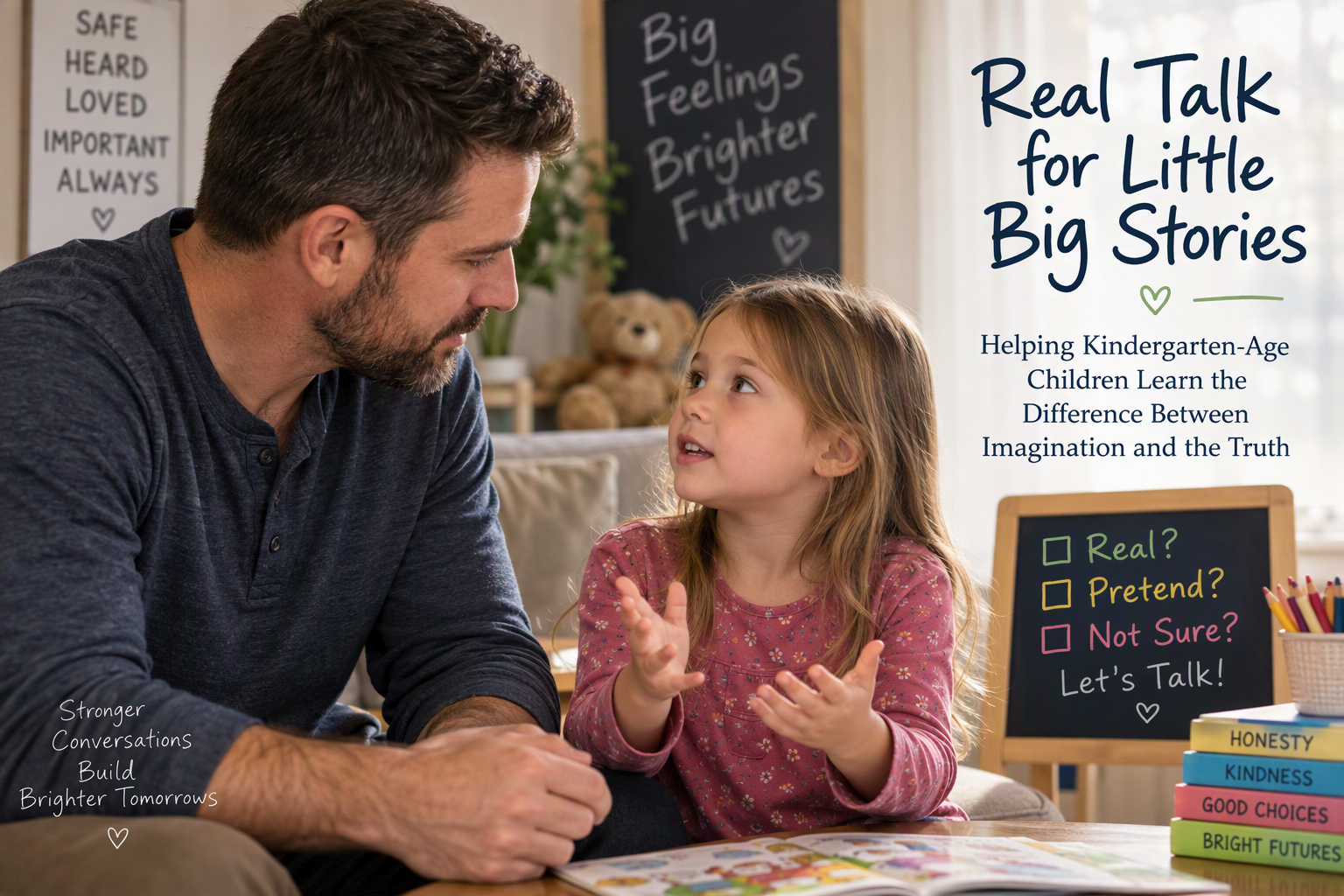
When Little Stories Become Big Concerns:
Helping Young Children Learn the Difference Between Imagination and the Truth
Parents expect young children to have wonderful imaginations. A cardboard box becomes a rocket. A stuffed animal talks. A child can turn the backyard into an entire kingdom before lunchtime.
That imagination is a healthy part of childhood. But imagination can become much more complicated when a kindergarten-age child begins telling stories about real people and real events.
A child might tell a teacher: “My daddy is mean to me.”
Another might say: “Mommy hit me.”
Or:
“My uncle got mad and broke my Xbox.”
Perhaps the parent knows that nothing resembling the child’s version of events happened. That can leave parents embarrassed, frightened, angry, or wondering, Why would my child lie about something like that?
Before assuming that a 5-year-old is intentionally trying to deceive someone, parents need to understand what is happening developmentally.
According to the American Academy of Pediatrics’ HealthyChildren.org, children younger than 6 can still have difficulty distinguishing reality from fantasy. The boundary between something imagined and something that actually happened may not be as clear to a young child as it is to an adult. [healthychildren.org]
Similarly, the American Academy of Child and Adolescent Psychiatry explains that children around ages 4 and 5 commonly make up stories and “tall tales.” This can be a normal developmental behavior because children enjoy storytelling while still learning to separate fantasy from reality. [aacap.org]
So the goal should not simply be“Stop lying.”
The better goal is: Teach the child how to recognize, describe, and communicate what really happened.
Why Would a Young Child Make Up a Story?
There isn’t one answer.
Two children can tell almost identical untrue stories for completely different reasons. Understanding the reason behind the behavior is often more helpful than focusing only on the inaccurate statement.
1. Imagination and reality are still developing
A kindergartener’s imagination can be incredibly vivid.
Suppose Dad turns off the television because it is bedtime. The child becomes angry and later tells the teacher: “My dad was really mean. He screamed at me all night.”
Perhaps Dad did not scream at all. The child’s statement may be less of a calculated accusation and more of an emotional version of events: “I was really mad at Dad.”
The American Psychological Association describes lying as a normal part of childhood development and notes that children’s ability to deceive is connected with developing self-control and understanding another person’s perspective. [apa.org]
Parents therefore have to teach an important distinction: Feelings are always real. Stories about what happened are not always accurate.
A child can truthfully say: “I was really mad at Daddy.”
That is different from saying: “Daddy hit me,” if no hitting occurred.
2. The child may be trying to explain an emotion
Young children do not always have the vocabulary to communicate complicated emotions.
“Mom is mean” might actually mean:
- “Mom wouldn’t let me stay up.”
- “Mom made me clean my room.”
- “Mom took my tablet away.”
- “Mom said no.”
- “I was angry with Mom.”
Instead of immediately correcting:
“Your mother is NOT mean!”
try: “It sounds like you were angry with Mom. Tell me what happened.”
Then help the child replace the broad statement with accurate language: “Mom told me I couldn’t play Xbox because it was bedtime, and that made me mad.”
Now the child is learning something much more valuable than simply being told not to lie. The child is learning how to communicate accurately.
3. The story may get attention
Children quickly learn which stories produce reactions. Consider these two statements:
“I played with blocks yesterday.”
and
“My uncle got mad and smashed my Xbox!”
Which statement gets more attention? The second one probably produces questions, surprise, concern, and conversations between adults. Child Mind Institute notes that children can lie for several reasons, including getting attention, testing a new behavior, improving how others see them, avoiding consequences, dealing with anxiety, or responding impulsively. [childmind.org]
If dramatic stories repeatedly create large amounts of adult attention, the child’s storytelling can accidentally be reinforced. That doesn’t mean adults should ignore concerning statements. It means they should respond calmly rather than dramatically.
Always Take Safety Statements Seriously
There is an extremely important distinction parents, teachers, and caregivers must make.
If a child says: “Mommy hit me.”
do not simply answer: “You’re lying.”
Statements involving abuse, inappropriate touching, threats, violence, fear, neglect, or someone hurting the child should be taken seriously and handled using appropriate school, clinical, or child-safety procedures. At the same time, adults should avoid interrogating or repeatedly questioning a young child. A better initial response may be: “Thank you for telling me. Tell me what happened.”
Allow the child to describe the event rather than supplying possibilities. This distinction matters because teaching honesty must never teach children that adults won’t believe them when something genuinely happens.
Other Reasons Children May Tell Untrue Stories
Avoiding consequences
A child knocks over a lamp.
“Who did this?”
“The dog knocked it over.”
Fear of punishment can make denial attractive. The American Academy of Pediatrics specifically identifies fear of disappointing parents or being punished as reasons children may lie. It also warns that extreme parental reactions can make children more likely to use lying as protection. [healthychildren.org]
Wishful thinking
Sometimes children tell the world the way they wish it were.
“We’re getting a puppy tomorrow!”
Nobody is getting a puppy.
The child may simply desperately want one.
Making a boring story exciting
“My uncle accidentally moved my Xbox.”
may become:
“My uncle got mad and threw my Xbox across the room!”
The child’s storytelling ability has developed faster than their understanding of when creative embellishment is appropriate.
Avoiding embarrassment
A child falls at recess and tells classmates:
“Someone pushed me.”
The real problem may be embarrassment rather than dishonesty for personal gain.
Testing cause and effect
Children experiment.
“What happens if I say this?”
Child Mind Institute specifically identifies testing out a new behavior as one reason children lie. [childmind.org]
Don’t Give a Kindergarten Child a Permanent Label
One of the most important things parents can do is separate the child from the behavior.
Avoid: “You’re a liar.”
Instead say: “That story wasn’t what really happened.”
There is an enormous psychological difference. One defines the child’s identity. The other identifies a behavior that can be corrected.
Parents want the child thinking: “I told something that wasn’t true, and I can fix it.”
Not: “I’m a bad kid.”
Child Mind Institute similarly recommends avoiding labels such as “liar” and instead helping children practice truth-telling and giving them opportunities to correct what they said. [childmind.org]
Teach Three Categories: Real, Pretend and Mistake
One simple activity can work particularly well with kindergarten-age children.
Create three categories:
REAL
Something that actually happened. “We went to Grandma’s house Saturday.”
PRETEND
Something imagined for fun. “A dinosaur lives in Grandma’s basement.”
MISTAKE
Something you thought happened but later discovered wasn’t right. “I thought Dad took my toy, but it was under my bed.”
This third category is important. Children need to know that being wrong doesn’t automatically make them dishonest.
Activity: The Truth Detective
Turn learning into a game.
Tell the child several statements:
- “We ate breakfast this morning.”
- “An elephant drove me to work.”
- “You have three hundred brothers.”
- “We went to the store yesterday.”
- “A dragon sleeps in our garage.”
Ask:
“Truth, pretend, or mistake?”
Then reverse roles. Let the child create statements and make the adult figure them out. The important rule is: Pretending is wonderful when everybody knows we’re pretending. This allows parents to encourage imagination without confusing imagination with factual communication.
Activity: Let’s Try That Story Again
When a child gives an obviously inaccurate account, avoid immediately launching into a lecture. Give the child an opportunity to correct it.
Child:
“Uncle broke my Xbox.”
Parent:
“Let’s stop and think. Did Uncle really break the Xbox, or are we making up a story?”
If the child admits making it up: “Good job fixing your story. Now tell me what really happened.”
When the child tells the truth: “Thank you. Telling the truth helps me trust what you tell me.”
The correction itself becomes practice.
Give Children Better Words for Their Feelings
Some “lying” problems are really communication problems. Teach replacement phrases.
Instead of: “Daddy is mean!” teach: “I’m mad at Daddy.”
Instead of: “Mommy hates me!” teach: “I’m sad because Mommy told me no.”
Instead of: “My teacher is horrible!” teach: “I didn’t like what my teacher told me to do.”
Instead of: “My brother always beats me up!” teach: “My brother pushed me when we were playing.”
The goal isn’t to tell children what they are allowed to feel. It is teaching them: Say what you feel, and describe what happened accurately.
Create a Family Rule About Honesty
Keep the rule simple enough that a 5-year-old can remember it:
“In our family, it is always safe to tell the truth. We may still have to fix what happened, but telling the truth helps us solve the problem.”
That final part is important. If admitting the truth guarantees an explosive reaction, children have another reason to hide it. The American Academy of Pediatrics recommends making clear that truthfulness matters while avoiding harsh punishment. Parents’ own honesty is also an important model for their children. [healthychildren.org]
Praise Truth-Telling, Especially When It Is Difficult
Imagine the child spills juice on the carpet. The child says: “I did it.” The parent might immediately want to talk about the carpet. First recognize honesty: “Thank you for telling me the truth.”
Then address responsibility: “Now let’s clean it up.”
This teaches two different lessons:
- Honesty earns recognition.
- Honesty doesn’t erase responsibility.
The child still cleans the mess.
Try a “Truth Reset”
Give a child a brief opportunity to reconsider. “I’m going to give you one minute to think about what really happened. Then we’ll start again.”
Afterward: “Okay. Let’s start over. Tell me what actually happened.”
A reset removes some of the pressure associated with being caught. It also provides practice using self-control before speaking.
Use Books and Stories
Children understand abstract concepts better through concrete examples.
Read a story involving honesty and pause occasionally:
“Was that something that really happened?”
“Why do you think the character said that?”
“How could the character fix it?”
“What could the character say instead?”
You can even make your child the hero of a homemade story:
Once there was a little boy who sometimes had stories pop into his head so quickly that they came out of his mouth before he stopped to decide whether they were real or pretend…
Let the child decide what the character should do next. That turns an uncomfortable behavioral issue into a skill-building exercise.
Parents and Teachers Need the Same Strategy
A kindergarten child spends much of the day away from parents. Consistency among the important adults in the child’s life can therefore make a major difference. Parents can talk privately with the teacher and say:
“We’re working on helping him distinguish between something that really happened, something he imagined, and something he wishes happened. If he tells an unusual story, please take any safety concern seriously, but when appropriate, you can also ask him whether he is telling you something real or telling an imagination story.”
Parents and teachers can use common phrases:
“Is this real, pretend, or something you’re not sure about?”
“Let’s slow down and tell what happened from the beginning.”
“How were you feeling when that happened?”
“Thank you for fixing the story.”
Consistency makes the lesson much easier for the child to learn.
Bring Grandparents, Babysitters and Family into the Plan
Children can become confused when different adults respond dramatically differently.
- A grandmother may laugh at an exaggerated story.
- A parent may become angry.
- A teacher may ask repeated questions.
- An uncle may say: “Don’t tell lies!”
Everyone has good intentions, but the child receives several different lessons. Instead, create a simple support plan.
The family’s response can be:
1. Stay calm.
2. Listen.
3. Take safety statements seriously.
4. Ask the child to distinguish real from pretend when appropriate.
5. Help the child restate what actually happened.
6. Praise the correction and honesty.
7. Avoid calling the child a liar.
Repeatedly hearing the same message helps the child learn the skill across settings.
Keep a Simple Parent-Teacher Pattern Log
If the behavior happens frequently, parents and teachers can collect information for two or three weeks.
Record:
- What the child said
- Where it happened
- Who was present
- What happened immediately before it
- How adults responded
- What the child appeared to gain or avoid
- Whether the child corrected the story afterward
Patterns may emerge. For example:
Mostly after correction?
The child may be escaping consequences.
Mostly around peers?
Attention or social approval may be important.
Mostly fantastic stories?
Imagination may be playing a large role.
Mostly during difficult tasks?
Frustration, anxiety, attention or learning concerns could be contributing.
This turns the question from“Why is my child lying?” into the more useful question:
“What problem is this behavior helping my child solve?”
When the Story Is Serious, Don’t Conduct Your Own Investigation
Stories such as:
“Mom hit me.”
“Someone touched me.”
“Daddy said he would hurt me.”
are different from:
“We have twelve puppies at home.”
When potential abuse or safety issues are involved, adults should take the statement seriously and follow appropriate safeguarding procedures. Parents understandably want to determine immediately what happened. But repeated, leading questions can create additional confusion.
A teacher or caregiver can remain calm and listen without suggesting answers. That protects two important principles simultaneously:
Children must know adults will listen when they report something unsafe.
And:
Adults should not turn every unusual kindergarten story into an interrogation.
When Should Parents Seek Professional Help?
Occasional invented stories at kindergarten age are usually very different from a persistent behavioral pattern. The American Academy of Child and Adolescent Psychiatry notes that frequent or elaborate lying can sometimes accompany other emotional or behavioral difficulties and may warrant professional evaluation. [aacap.org]
Child Mind Institute similarly explains that habitual lying becomes more concerning when it causes significant distress or problems in the child’s functioning. [childmind.org]
Consider discussing the behavior with the child’s pediatrician or a licensed child mental-health professional when:
- false stories become extremely frequent;
- the behavior is damaging friendships or school functioning;
- stories consistently involve serious allegations;
- the child seems unable to distinguish fantasy from reality well beyond what is developmentally expected;
- lying appears connected with significant anxiety, impulsivity, aggression or learning difficulties;
- the behavior suddenly changes dramatically;
- the child experiences significant distress; or
- parents and teachers are unable to improve the pattern despite consistent intervention.
Professional assessment is not about giving the child the label of “liar.” It is about determining what need the behavior may be communicating.
A Two-Week Honesty Challenge
Families can turn this into a positive exercise. For 14 days, create one daily opportunity to practice honesty.
Day-to-day goals can include:
Days 1-3: Practice “real or pretend?”
Days 4-5: Practice naming feelings accurately.
Days 6-7: Practice telling what happened in the correct order.
Days 8-9: Read stories about honesty.
Days 10-11: Role-play mistakes and telling the truth.
Day 12: Practice a “truth reset.”
Day 13: Have the child teach someone else what honesty means.
Day 14: Celebrate the child’s progress.
Celebrate the skill, not perfection.
“I’m proud that you’re learning how to tell people exactly what happened.”
What Parents Should Remember Most
Kindergarten-age children are still learning something adults take for granted: our words tell other people what happened in the world.
A 5-year-old saying something untrue does not automatically mean that the child is manipulative, dishonest, or developing poor character.
The American Psychological Association describes lying as a normal developmental phenomenon and emphasizes teaching children honesty rather than viewing childhood lying only as misconduct. [apa.org]
Children need adults to teach the difference among:
what happened,
what they felt,
what they imagined,
and
what they wished had happened.
Those are remarkably complicated distinctions for a young mind.
Conclusion
When parents hear that their kindergarten-age child told a teacher, “Dad is mean,” “Mom hit me,” or “Uncle broke my Xbox,” the first reaction may be embarrassment, fear or anger.
Slow down.
Listen.
Take potentially serious disclosures seriously.
Then start teaching.
Don’t merely tell a child,“Don’t lie.”
Teach them how to tell the truth.
Teach the child to describe events accurately. Give them words for difficult feelings. Help them separate imagination from reality. Allow them to correct inaccurate statements. Praise honesty while still requiring accountability. Ask teachers and family members to reinforce the same skills.
Most importantly, create a home in which telling the truth is expected but also emotionally safe. A child’s imagination is something parents should protect. The lesson isn’t to stop children from telling stories.
It is to teach them when a story belongs in the world of imagination and when their words need to describe what actually happened.
About the Author

John S. Collier, MSW, LCSW-S is a Licensed Clinical Social Worker Supervisor and the Executive Director of Southeast Kentucky Behavioral Health, LLC. His career in social work and behavioral health has given him the opportunity to work with individuals and families facing trauma, mental health challenges, relationship difficulties, major life transitions, and the everyday struggles that shape human growth.
John writes The Mind’s Trestle Board as a place to explore the intersection of mental health, relationships, personal responsibility, faith, morality, fatherhood, emotional development, and the lifelong work of becoming a better human being.
His writing is grounded in the belief that growth does not require perfection. It requires honesty, humility, reflection, responsibility, and a willingness to keep working on ourselves. Through both his professional experience and personal reflections, he encourages readers to look beneath their immediate emotions and consider the values, choices, commitments, and relationships upon which a meaningful life is built.
References
American Academy of Child and Adolescent Psychiatry. (2017). Lying and children: Facts for families, No. 44. [aacap.org]
American Academy of Pediatrics. (2025). When children lie: What parents can do. HealthyChildren.org. The guidance notes that children younger than approximately age 6 can have difficulty separating reality and fantasy and recommends calm responses and modeling honesty rather than harsh punishment. [healthychildren.org]
Arky, B. Child Mind Institute. Why kids lie and what parents can do about it. Clinical expert Matthew H. Rouse, PhD. [childmind.org]
Koplewicz, H. S., MD. Child Mind Institute. (2025). When should you get help for a child who’s a pathological liar? [childmind.org]
Talwar, V., PhD. American Psychological Association. The truth about why kids lie. Speaking of Psychology, Episode 200. [apa.org]
Talwar, V. The Truth About Lying: Teaching Honesty to Children at Every Age and Stage. American Psychological Association. The book emphasizes staying calm, addressing motivation, using positive discipline, recognizing honesty, modeling truthfulness and encouraging open communication. [apa.org]