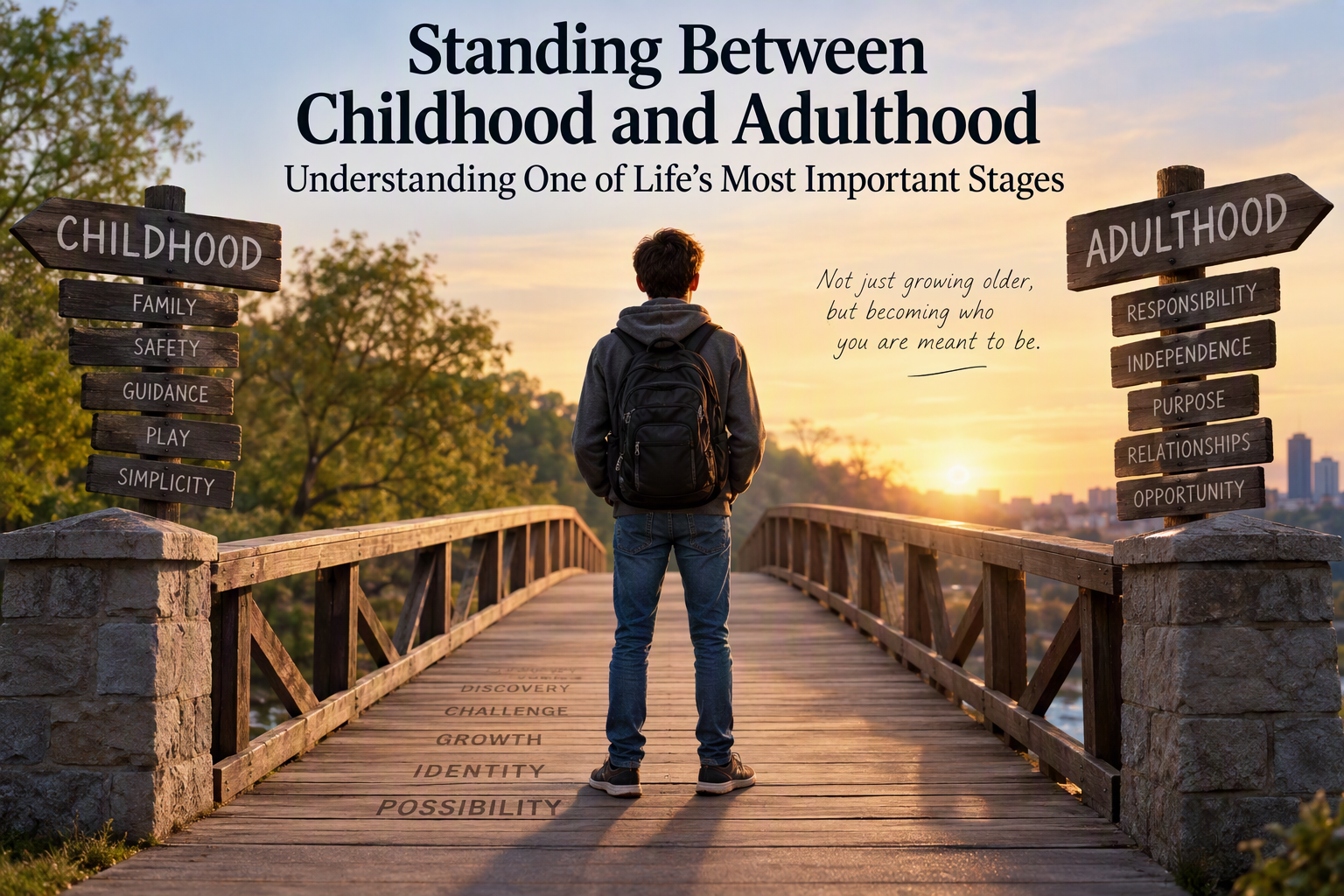
Standing Between Childhood and Adulthood: Understanding One of Life’s Most Important Life Stages
There comes a time in life when a young person is no longer a child but not yet an adult. It is a season filled with change, growth, questions, and self-discovery. This stage, known as adolescence, is one of the most important periods of human development.
During this time, young people begin to ask questions that will help shape the rest of their lives:
- Who am I?
- Where do I belong?
- What do I believe?
- What kind of person do I want to become?
Psychologists and developmental researchers have spent decades studying this stage of life. Although they approach it from different perspectives, most agree that adolescence is a critical period for developing identity, values, relationships, and independence.
A Bridge Between Two Worlds
Adolescence can be compared to standing on a bridge.
On one side is childhood, where parents make most decisions and provide protection and guidance. On the other side is adulthood, where people are expected to take responsibility for their choices and actions.
Young people spend years crossing that bridge.
As they do, they experience major changes in their bodies, emotions, relationships, and thinking. These changes can feel exciting one moment and overwhelming the next. Many adolescents want more freedom while still needing support and guidance from trusted adults.
This tension is normal. In fact, it is part of healthy development.
Erikson: The Search for Identity
Psychologist Erik Erikson believed the most important task during adolescence is developing a clear sense of identity. He called this stage Identity vs. Role Confusion. According to Erikson, young people begin exploring who they are and who they want to become. They may try new activities, develop different interests, form new friendships, or question beliefs they have always accepted.
This process is not rebellion for the sake of rebellion. It is often a search for identity.
When adolescents successfully develop a sense of who they are, they gain confidence and direction. When they struggle to find that identity, they may experience confusion about their place in the world.
Piaget: Learning to Think in New Ways
Developmental psychologist Jean Piaget focused on how thinking changes throughout life.
According to Piaget, adolescence marks the beginning of the Formal Operational Stage, where individuals become capable of abstract thought. This means they begin thinking about ideas rather than just facts. They can consider:
- Justice and fairness
- Morality
- Politics
- Faith and spirituality
- Future careers
- Life goals
A child may ask, “What happened?”
An adolescent is more likely to ask, “Why did it happen?” or “What should have happened instead?”
This new ability to think deeply helps adolescents understand the world, but it can also create stress as they become more aware of life’s challenges and uncertainties.
Kohlberg: Developing a Moral Compass
Psychologist Lawrence Kohlberg studied how people develop moral reasoning.
As children grow into adolescence, they often begin moving beyond simple ideas of right and wrong based on rewards and punishments. Instead, they begin considering values, fairness, and ethical principles.
For example, rather than asking, “Will I get in trouble?” an adolescent may ask:
- Is this fair?
- Is this the right thing to do?
- How will this affect others?
This growing moral awareness helps young people form personal values that can guide them throughout adulthood.
Marcia: Exploring Different Identities
Psychologist James Marcia expanded on Erikson’s work by studying how people develop identity.
Marcia found that adolescents often move through different stages of exploration before settling on a stable identity.
Some follow beliefs and goals chosen by others. Some explore many possibilities before making decisions. Others struggle to decide who they want to be.
These periods of exploration are often necessary because identity is not something that appears overnight. It develops through experience, reflection, and personal growth.
Bronfenbrenner: The Power of Environment
Psychologist Urie Bronfenbrenner believed development cannot be understood without looking at the environment around a person.
According to his ecological systems theory, adolescents are influenced by many different systems, including:
- Family
- Friends
- School
- Community
- Culture
- Society
Each of these environments shapes development in important ways.
A supportive family can provide stability during difficult times. Positive friendships can strengthen confidence and self-esteem. Good schools and mentors can help adolescents discover talents and future goals.
Bronfenbrenner’s theory reminds us that young people do not grow alone. They grow within relationships and communities.
Attachment Theory: The Need for Secure Relationships
Psychologists John Bowlby and Mary Ainsworth developed Attachment Theory, which emphasizes the importance of secure relationships.
Many people assume adolescents stop needing their parents as they get older. In reality, research shows that strong, supportive relationships continue to play a vital role in healthy development.
Even when adolescents seek independence, they still benefit from trusted adults who provide:
- Encouragement
- Stability
- Guidance
- Emotional support
Healthy attachment helps young people develop confidence, resilience, and healthy relationships later in life.
The Adolescent Brain
Modern neuroscience has added another important piece to our understanding of adolescence.
Research shows that the brain continues developing well beyond the teenage years. The areas of the brain responsible for judgment, planning, and impulse control mature more slowly than areas responsible for emotions and rewards.
This helps explain why adolescents can sometimes make decisions that seem irrational to adults.
It is not because they lack intelligence.
It is because their brains are still developing.
Understanding this can help parents, teachers, and mentors respond with patience rather than frustration.
Preparing for Adulthood
Developmental psychologist Jeffrey Arnett proposed that the process of becoming an adult often continues into the twenties. He called this stage Emerging Adulthood.
According to Arnett, many young people continue exploring:
- Careers
- Education
- Relationships
- Personal values
- Life goals
The identity questions that begin during adolescence often continue well into early adulthood as individuals work toward becoming the people they hope to be.
More Than Growing Older
All of these developmental theories point to the same conclusion:
Adolescence is far more than a stage of physical growth.
It is a time when identity is formed, values are developed, beliefs are tested, and character begins to take shape.
Young people are learning how to think for themselves, make decisions, build relationships, and understand their place in the world.
They are not simply getting older.
They are becoming the adults they will one day be.
For parents, teachers, mentors, and communities, this stage provides a unique opportunity to offer guidance, encouragement, and positive examples. The lessons learned during these years often remain with people for the rest of their lives.
The bridge between childhood and adulthood can sometimes feel uncertain, but it is also filled with possibility. Every question explored, every challenge faced, and every lesson learned helps build the foundation for the future.
About the Author
John S. Collier, MSW, LCSW-S is a Licensed Clinical Social Worker Supervisor, behavioral health executive, writer, and advocate for individuals, families, and communities facing life’s challenges. He serves as the Executive Director of Southeast Kentucky Behavioral Health, LLC, where he oversees behavioral health, substance use, developmental disability, and community support services throughout Kentucky.

John began his career in human services with a bachelor’s degree while serving in multiple roles within Kentucky’s public and community-based systems. In 2004, he became a Certified Social Worker and continued expanding his clinical expertise, eventually earning his Licensed Clinical Social Worker credential and Supervisor designation. Throughout more than two decades of service, he has worked with children, adolescents, adults, and families affected by trauma, mental illness, addiction, disability, grief, poverty, and systemic barriers to care.
His professional experience includes outpatient behavioral health, case management, crisis intervention, child welfare, developmental disabilities, substance use treatment, and organizational leadership. These experiences have provided him with a unique perspective on human growth and development across the lifespan.
As a clinician and leader, John has developed a special interest in understanding how people grow, adapt, and overcome adversity. Much of his writing explores the intersection of psychology, personal growth, faith, character development, relationships, and resilience. Through both clinical practice and leadership, he has witnessed how childhood experiences, family relationships, community influences, and life transitions shape the adults people eventually become.
John is also the author of The Mind’s Trestle Board, a collection of articles and reflections that examine life’s challenges through the lenses of psychology, personal experience, and timeless principles of growth and wisdom. His writing seeks to make complex psychological concepts understandable and relevant to everyday life while encouraging readers to pursue self-awareness, purpose, and healthy relationships.
When writing about adolescence and human development, John draws upon both established developmental theories and his extensive experience working with young people and families. He believes that understanding the challenges of each life stage helps individuals, parents, educators, and communities better support one another during times of change and growth.
Through his clinical work, leadership, and writing, John remains committed to helping others build stronger foundations for mental health, meaningful relationships, and personal fulfillment.
References
American Psychological Association. Identity versus identity confusion. APA Dictionary of Psychology.
American Psychological Association. Erikson’s Eight Stages of Psychosocial Development. APA Dictionary of Psychology.
Arnett, J. J. (2015). Emerging Adulthood: The Winding Road from the Late Teens Through the Twenties.
Bowlby, J. (1988). A Secure Base: Parent-Child Attachment and Healthy Human Development.
Bronfenbrenner, U. (1979). The Ecology of Human Development.
Erikson, E. H. (1968). Identity: Youth and Crisis.
Kohlberg, L. (1981). The Philosophy of Moral Development.
Marcia, J. E. (1966). Development and validation of ego-identity status. Journal of Personality and Social Psychology, 3(5), 551-558.
Piaget, J. (1972). The Psychology of the Child.
Ragelienė, T. (2016). Links of adolescents’ identity development and relationship with peers: A systematic literature review. Journal of the Canadian Academy of Child and Adolescent Psychiatry, 25(2), 97-105.
Core Competency #9, Developmental Perspectives Across the Life Span.
“The journey from childhood to adulthood is not merely a passage of time. It is the formation of identity, character, values, and purpose. The adults we become are often shaped by the questions we ask, the challenges we face, and the guidance we receive during these formative years.” – John S. Collier, MSW, LCSW-S