
Welcome to SOUTHEAST KENTUCKY BEHAVIORAL HEALTH
More Than “Thank You”: Honoring Veterans Through Gratitude, Understanding, and Support

By John S. Collier, MSW, LCSW-S
Executive Director, Southeast Kentucky Behavioral Health, LLC

“Your courage. Your sacrifice. Our gratitude. Always.”

Veterans Day gives us an opportunity not only to say those words, but also to think about what they should mean after November 11 is over.

Veterans Day Is About Those Who Served

Veterans Day traces its roots to the end of World War I. Fighting ceased on November 11, 1918, at the eleventh hour of the eleventh day of the eleventh month. What began as Armistice Day was later changed to Veterans Day so the nation could honor veterans from all periods of military service. The U.S. Department of Veterans Affairs describes the purpose of Veterans Day as honoring America’s veterans for their patriotism, love of country, and willingness to serve and sacrifice for the common good. That distinction matters.

Memorial Day provides a special time to remember those who died in service to the nation. Veterans Day gives us an opportunity to recognize all who served in the United States Armed Forces. The national Veterans Day ceremony is held each November 11 at Arlington National Cemetery and is specifically intended to honor and thank those who served. So when we meet a veteran at work, at church, in our neighborhoods, in our families, or in a behavioral health office, we are meeting someone whose life includes an experience many civilians will never fully share.

The Uniform May Come Off, but Some Experiences Come Home

Military service does not automatically mean that someone has a mental health condition. We should never assume that every veteran has PTSD, depression, substance-use problems, or difficulty adjusting to civilian life.

At the same time, we should understand that military service can expose people to experiences that carry lasting consequences.

The VA National Center for PTSD reports that about 7% of U.S. veterans experience PTSD at some point during their lives. The numbers vary considerably according to service era, deployment experiences, trauma exposure and other factors. Those statistics remind us of an important principle in behavioral health:

Veterans are not diagnoses. They are people.

Some may need treatment. Some may never need formal mental health services. Some may struggle years after leaving service. Others may demonstrate extraordinary resilience. Often, several of these things can be true at different points in the same person’s life.

Our responsibility is to make sure that when help is needed, asking for that help is treated as an act of strength rather than weakness.

When “Thank You for Your Service” Must Become More

The phrase “Thank you for your service” matters.

But gratitude becomes more meaningful when it produces action.

The most recent 2026 National Veteran Suicide Prevention Annual Report, summarized by the Department of Veterans Affairs, reports 6,488 veteran suicide deaths in 2024, averaging 17.7 deaths per day. Perhaps one of the most important findings is that 62% of veterans who died by suicide in 2024 had not received VA health care during the year of death or the year before. That should concern every behavioral health professional, health-care organization, family and community.

It also tells us that veteran mental health cannot be viewed solely as the responsibility of the VA.

Veterans live in our communities.

They walk through the doors of community mental health centers. They visit primary-care offices. They attend churches. They work beside us. They coach youth sports. They raise families. They own businesses. They become teachers, first responders, counselors and community leaders.

Sometimes the person who needs someone to ask, “Are you really doing okay?” is already standing beside us.

Behavioral Health Organizations Have a Role

Community behavioral health providers can be an important part of that safety net.

In 2026, the Substance Abuse and Mental Health Services Administration released a specific toolkit for community behavioral health organizations serving service members, veterans and their families. The guidance emphasizes identifying veterans in care, understanding military and veteran experiences, and incorporating that knowledge into mental health and substance-use services. That does not require treating every veteran differently.

It means learning enough to ask better questions.

Instead of simply asking:

“Have you experienced trauma?”

we may also need to ask:

“Have you ever served in the military?”

And when the answer is yes, clinicians should understand that military culture, deployments, combat exposure, injuries, loss, transitions from military to civilian life and other service-related experiences may be important parts of the person’s story.

Good behavioral health care begins by understanding the whole person.

Supporting the Family Matters Too

Military service affects more than the person who wears the uniform.

Spouses, partners, parents, children and caregivers may experience deployments, separations, uncertainty, reintegration and changes that come with military life and the transition afterward.

That is why veteran-informed behavioral health care should recognize families as part of the larger picture.

SAMHSA maintains resources specifically designed to help communities strengthen behavioral health systems for service members, veterans and their families through cooperation among federal, state and local organizations. This is an especially important lesson for community-based behavioral health organizations.

Sometimes helping a veteran means helping the family surrounding that veteran.

Honor Without Stigma

Perhaps one of the greatest ways behavioral health professionals can honor veterans is by helping remove the idea that seeking treatment represents weakness.

The opposite is true.

There is strength in recognizing when something is wrong.

There is courage in discussing trauma.

There is courage in admitting that sleep has become difficult, that anger has become hard to control, that alcohol or another substance has become a coping mechanism, or that memories from years ago still interfere with everyday life.

And there is tremendous courage in saying:

“I need help.”

Evidence-based treatment exists for conditions such as PTSD. VA research, for example, has supported trauma-focused approaches including Prolonged Exposure and Cognitive Processing Therapy, including delivery of some treatment through telehealth. No veteran should believe that treatment diminishes what that person accomplished in uniform.

Our Veterans Are Also Our Coworkers

The image that inspired this article recognizes Brandon, one of our own, along with every veteran within the Southeast Kentucky Behavioral Health family and throughout our communities.

That is important.

Veterans are not an abstract population represented only by statistics.

They are people we know.

They sit across from us at meetings.

They work beside us.

They are members of our families and communities.

Today, Southeast Kentucky Behavioral Health says thank you to Brandon and to every veteran who has served our nation.

But our gratitude should extend beyond a graphic posted on Veterans Day.

It should appear in how we treat people.

It should appear in the services we provide.

It should appear in how carefully we listen.

It should appear in our willingness to recognize when somebody may be struggling.

And it should appear in our willingness to stand beside that person when help is needed.

“Your courage. Your sacrifice. Our gratitude. Always.”

The final word may actually be the most important.

Always.

Not only November 11.

Not only when the flag is displayed.

Not only when ceremonies are held.

Not only when someone is wearing a uniform.

Always.

A Message to Our Veterans

To every veteran in Southeast Kentucky and beyond:

Thank you for answering a call that many others never had to answer.

Thank you for the time away from families.

Thank you for the missed birthdays, holidays and ordinary days that cannot be replaced.

Thank you for carrying responsibilities most Americans will never completely understand.

And if military service left wounds that cannot be seen, please understand something equally important:

Those wounds do not make you weak.

Asking for help does not erase courage.

Receiving counseling does not erase service.

Taking medication when clinically appropriate does not erase strength.

Talking about what happened does not diminish sacrifice.

A strong person can still hurt.

A brave person can still need help.

A veteran can be proud of service and still need someone to walk beside them.

Those truths can exist together.

Conclusion: Honoring the Past, Supporting a Brighter Tomorrow

The Veterans Day image includes another fitting statement:

“Honoring the past. Supporting brighter tomorrows. Together.”

That captures what Veterans Day should ask of us.

We remember.

We recognize sacrifice.

We express gratitude.

But then we move forward together.

For those of us working in behavioral health, that means making sure veterans and their families know that compassionate, respectful and evidence-based care is available.

For everyone else, it may mean something much simpler:

Check on the veteran in your life.

Listen.

Include.

Respect.

Remember.

And sometimes simply sit beside someone long enough for that person to know they do not have to carry everything alone.

To Brandon, to the veterans within the Southeast Kentucky Behavioral Health family, and to all who have served: thank you.

Your service matters.

Your sacrifice matters.

And you still matter today.


Need Help?

Veterans experiencing a crisis do not have to face it alone. The Veterans Crisis Line is available 24 hours a day, 7 days a week. Call 988 and press 1, or use 988’s text/chat options. Veterans do not have to be enrolled in VA health care to use the Veterans Crisis Line.

About the Author

John S. Collier, MSW, LCSW-S is a Licensed Clinical Social Worker Supervisor and Executive Director of Southeast Kentucky Behavioral Health, LLC. His professional work focuses on behavioral health, clinical social work, leadership, community-based services and strengthening access to mental health care. He is also the author of The Mind’s Trestle Board, where he writes about mental health, relationships, faith, personal responsibility, resilience and the experiences that shape people’s lives.

References

U.S. Department of Veterans Affairs. (2026). 2026 National Veteran Suicide Prevention Annual Report and Veteran Suicide Data and Reporting. U.S.

Department of Veterans Affairs. History of Veterans Day. U.S. Department of Veterans Affairs. (2026). Veterans Day. National Center for PTSD, U.S. Department of Veterans Affairs. (2026). Epidemiology and Impact of PTSD. National Center for PTSD, U.S.

Department of Veterans Affairs. (2026). How Common Is PTSD in Veterans? Substance Abuse and Mental Health Services Administration. (2026). Engaging Service Members, Veterans, and Families: A Toolkit for Certified Community Behavioral Health Clinics. Substance Abuse and Mental Health Services Administration. Service Members, Veterans, and Their Families Technical Assistance Center. U.S. Department of Veterans Affairs, Office of Research & Development. Posttraumatic Stress Disorder (PTSD).
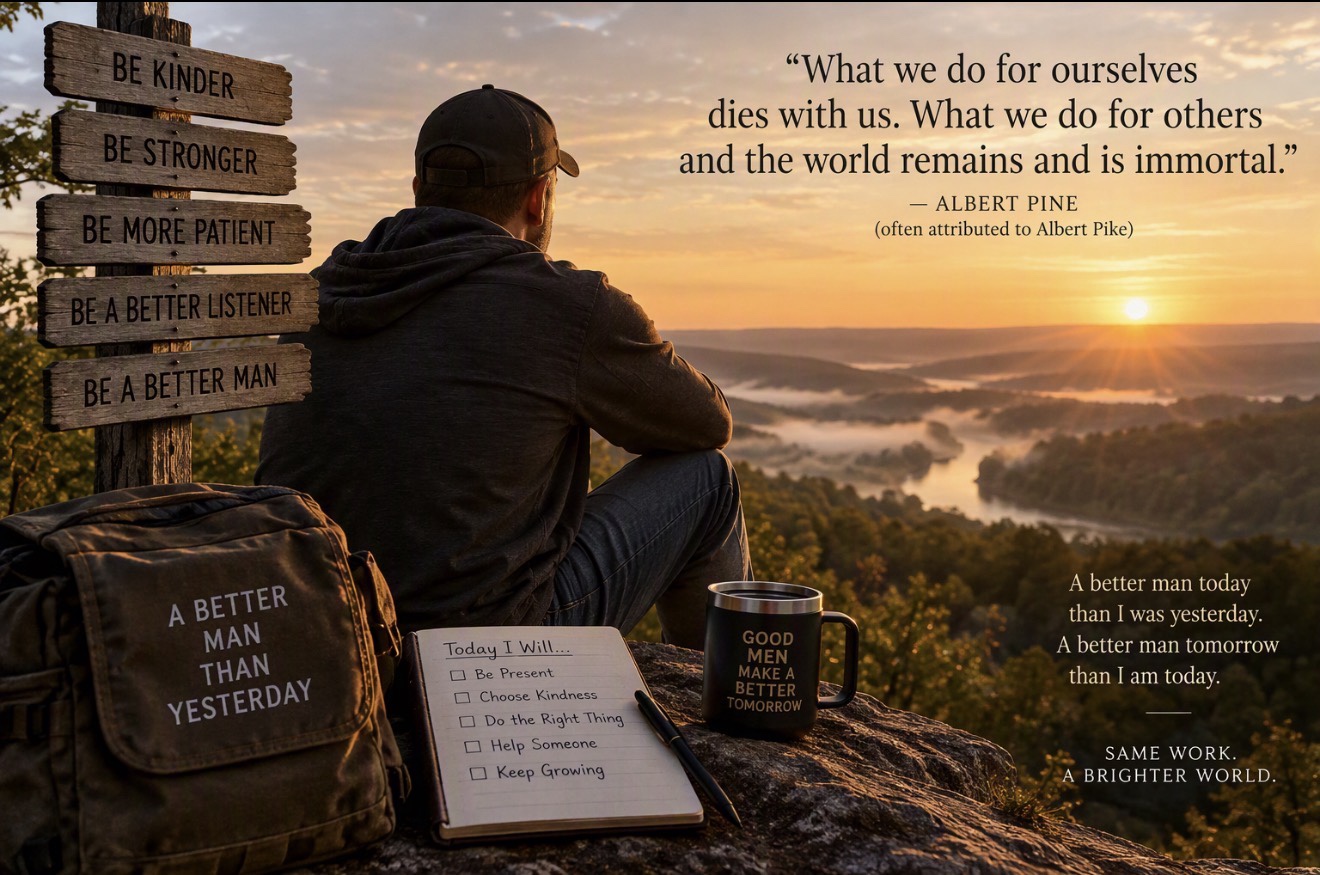
Becoming Better: The Daily Work of a Good Man

“What we do for ourselves dies with us. What we do for others and the world remains and is immortal.”
— Albert Pine (often attributed to Albert Pike)

As I’ve gotten older, I have found myself thinking more about what kind of man I am and what kind of man I want to become.

Not because I think I have everything figured out.

Actually, it is the opposite.

The more I learn, the more I realize how much I still need to grow.

Every day, I try to be a better man than I was yesterday. And if I’m honest, that can be hard. Some days I do well. Other days I fall short. I lose my patience. I become frustrated. I make mistakes. I say things I wish I could take back.

But then I wake up the next morning and try again.

For me, that is what being a moral man looks like.

It is not being perfect.

It is being committed to growing.

The Man in the Mirror

Every morning, the first person I have to answer to is the man in the mirror.

I can fool other people. I can make excuses. I can blame circumstances.

But deep down, I know when I could have done better.

I know when I should have listened more.

I know when I should have shown more patience.

I know when I should have chosen courage instead of comfort.

The struggle is not with other people nearly as much as it is with myself.

The person I am competing with today is the person I was yesterday.

What Really Matters

As the Executive Director of a growing behavioral health organization, I spend much of my life helping people. I work with individuals who are struggling, families who are hurting, children who need support, and staff members who are trying to make a difference.

The longer I do this work, the more I realize something important.

People will not remember most of our titles.

They will not remember how many meetings we attended.

They will not remember how much money we made.

But they will remember how we treated them.

They will remember whether we showed up when they needed us.

They will remember whether we cared.

That is why Albert Pine’s quote speaks so deeply to me.

Everything I do for myself will eventually be gone.

But the people I help, the encouragement I give, the kindness I show, and the lives I touch may continue long after I am gone.

A Good Man Is Never Finished

One lesson life has taught me is that becoming a good man is never a completed project.

There is always room to improve.

I can become a better father.

A better leader.

A better friend.

A better partner.

A better listener.

A better example.

There is always another lesson to learn and another weakness to overcome.

For many men, that can feel discouraging.

I see it differently.

I believe it is a gift.

If I still have room to grow, then I still have purpose.

The Quiet Things Matter Most

Many people think a legacy is built by doing something famous.

I do not believe that.

I believe most legacies are built in ordinary moments.

A father staying up late to help his child.

A husband keeping his promises.

A friend answering the phone when someone is hurting.

A man doing the right thing when nobody is watching.

These moments may never make headlines.

But they shape lives.

In my work, I have met many people who can clearly remember a teacher, coach, parent, counselor, or mentor who changed their life with a few simple words or actions.

That is the power of doing good for others.

Small acts often leave the biggest footprints.

Why We Keep Trying

The world can be difficult.

There are days when being kind feels harder than being angry.

There are days when honesty costs us something.

There are days when doing the right thing seems unnoticed.

Yet good men keep trying.

We keep trying because character matters.

We keep trying because our children are watching.

We keep trying because the people around us deserve our best.

We keep trying because we know the world becomes a little better every time someone chooses integrity over selfishness.

A moral man does not always succeed.

But he refuses to quit trying.

The Immortal Part of a Man

One day, every one of us will leave this world.

Our jobs will be filled by someone else.

Our belongings will belong to someone else.

Our accomplishments will slowly fade into history.

But something remains.

The love we gave.

The lives we helped.

The wisdom we shared.

The people we encouraged.

The sacrifices we made for others.

That is the immortal part of a man.

Not the things he owned.

The lives he touched.

Conclusion

When I think about Albert Pine’s quote, I am reminded that the goal is not simply to have a successful life.

The goal is to have a meaningful one.

I do not want to be remembered for what I accumulated.

I want to be remembered for what I contributed.

Like many men, I am still a work in progress. I still stumble. I still learn. I still have days when I am not the man I want to be.

But every morning, I get another chance.

Another chance to be a little wiser.

A little kinder.

A little stronger.

A little better than I was yesterday.

And if I can help someone else along the way, then perhaps a small part of my life will continue living in the lives of others.

That is the kind of immortality worth striving for.


“The goal is not to become a perfect man. The goal is to become a better man today than you were yesterday and a better man tomorrow than you are today.”


About the Author

John S. Collier, MSW, LCSW-S is a Licensed Clinical Social Worker Supervisor, Executive Director of Southeast Kentucky Behavioral Health, LLC, and author of The Mind’s Trestle Board. Through his work in behavioral health, leadership, and writing, he explores personal growth, resilience, character development, and the daily pursuit of becoming the person we were created to be.


References

Frankl, V. E. (2006). Man’s Search for Meaning. Beacon Press.

Covey, S. R. (2004). The 7 Habits of Highly Effective People. Free Press.

Aristotle. Nicomachean Ethics.

Pine, A. (attributed). “What we do for ourselves dies with us. What we do for others and the world remains and is immortal.”


September 11: A Day of Remembrance, Gratitude, and Reflection

By John S. Collier, MSW, LCSW-S

Every generation has moments that become permanently etched into memory. For many Americans, September 11, 2001, is one of those moments. It is a day marked by sorrow, sacrifice, courage, and unity. Twenty-five years later, we still remember where we were, how we felt, and the profound impact that day had on our nation and the world.

On the morning of September 11, 2001, nineteen terrorists hijacked four commercial aircraft. Two planes were flown into the Twin Towers of the World Trade Center in New York City, one struck the Pentagon, and a fourth crashed in Pennsylvania after passengers courageously fought back against the hijackers. Nearly 3,000 people lost their lives in what remains the deadliest foreign attack on American soil. Yet while the events of that day revealed unimaginable evil, they also revealed something else: the remarkable strength of the human spirit.

We remember the firefighters who climbed stairwells while others were descending to safety. We remember the police officers who rushed toward danger. We remember emergency medical personnel, military members, volunteers, and ordinary citizens who placed the lives of strangers above their own. More than 2,000 police officers and nearly 1,000 firefighters responded to the World Trade Center attacks, joining countless others in rescue and recovery efforts. Their actions remind us that heroism is not always found in grand speeches or celebrated victories. Often, it is found in quiet acts of service, in selfless sacrifice, and in the willingness to help another human being despite personal risk.

For me, September 11 carries an additional significance. It is the day my son was born.

Over the years, people have often asked what it was like to welcome a child into the world on a day overshadowed by national tragedy. The answer is difficult to put into words. While television screens showed devastation, uncertainty, and heartbreak, I was also witnessing one of the most meaningful moments of my life. The contrast was profound. A day of collective grief became, for me, a day forever intertwined with the gift of new life.

As my son grew older, each birthday became more than a celebration. It became an opportunity to pause and remember. Before the cake is cut, before gifts are opened, before the laughter begins, there is reflection. Reflection on those who never came home. Reflection on the families whose lives changed forever. Reflection on the heroes whose bravery continues to inspire generations.

The passage of time does not diminish the significance of September 11. If anything, it increases our responsibility to remember. A growing number of Americans were born after the attacks and have no personal memory of the events. The National September 11 Memorial & Museum has emphasized the importance of preserving the stories of loss, courage, compassion, and service for future generations so that the promise to “never forget” remains meaningful. Remembering is not about reliving tragedy. It is about honoring the humanity that emerged in its wake.

It is about remembering the office worker who helped a colleague down dozens of flights of stairs. It is about the passenger who made one final phone call to loved ones before confronting unimaginable danger. It is about the first responder who continued searching for survivors long after hope had faded. It is about the families who found the strength to carry on despite overwhelming loss.

Their stories teach us that courage is contagious. Compassion matters. Service matters. Community matters.

In a world that often feels divided, September 11 reminds us of a time when Americans stood together. Differences that normally separated people seemed insignificant in the face of shared grief and shared purpose. Neighbors helped neighbors. Communities rallied together. Strangers became family.

Those lessons remain relevant today.

As we observe another anniversary of September 11, may we remember the victims with dignity. May we honor the survivors with respect. May we thank the first responders, military personnel, medical professionals, volunteers, and countless others whose sacrifices demonstrated the very best of humanity.

And may we never lose sight of what they showed us: that even in our darkest hours, courage endures, compassion survives, and the human spirit remains stronger than fear.

Today, I remember those who were lost.

Today, I thank those who served.

And today, as I celebrate another year of my son’s life, I am reminded that remembrance and gratitude can exist side by side, honoring the past while appreciating the precious gift of the present.

About the Author

John S. Collier, MSW, LCSW-S is the Executive Director of Southeast Kentucky Behavioral Health (SEKYBH) and a Licensed Clinical Social Worker Supervisor with extensive experience in behavioral health, community services, clinical leadership, and organizational development. Throughout his career, he has been dedicated to strengthening individuals, families, and communities through compassionate care, advocacy, and service.

As a behavioral health professional, John believes that some of life’s most difficult moments often reveal the resilience, courage, and humanity that connect us all. His writing frequently explores themes of hope, remembrance, personal reflection, and the enduring strength of the human spirit.

In this article, John’s reflections on September 11 are both historical and deeply personal. September 11, 2001, is not only a day of national remembrance, but also the day his son was born. This unique intersection of public tragedy and personal joy has shaped his perspective on gratitude, service, sacrifice, and the importance of honoring those whose lives and actions continue to inspire future generations.

When not leading organizational initiatives or advocating for improved behavioral health services across Kentucky, John enjoys writing articles, poetry, and community-focused content that encourages reflection, understanding, and meaningful human connection.


Author Contact

John S. Collier, MSW, LCSW-S
Executive Director
Southeast Kentucky Behavioral Health (SEKYBH)
London, Kentucky

“We honor the past not by dwelling in tragedy, but by remembering the lives, sacrifices, and lessons that continue to guide us forward.” – John S. Collier


References

National Commission on Terrorist Attacks Upon the United States. (2004). The 9/11 Commission Report: Final Report of the National Commission on Terrorist Attacks Upon the United States. U.S. Government Printing Office. National September 11 Memorial & Museum. (2026). September 11, 2001 Historical Exhibition. Retrieved from the National September 11 Memorial & Museum. National September 11 Memorial & Museum. (2026). Marking the 25th Anniversary. Retrieved from the National September 11 Memorial & Museum. National September 11 Memorial & Museum. (2026). Homepage and Educational Resources. Retrieved from the National September 11 Memorial & Museum.

Be Content With What You Have, But Never With Who You Are Becoming

By John S. Collier, MSW, LCSW-S

There comes a point in life when we should be able to look around and say, “I have enough.”

Enough clothes.

Enough things.

A good enough vehicle.

A comfortable enough home.

Enough possessions to live our lives without constantly chasing the next purchase.

That does not mean we stop working, dreaming, planning, or enjoying nice things. There is nothing inherently wrong with financial success or material comfort. The problem begins when we believe the next possession, promotion, house, vehicle, or dollar will somehow complete us.

Research has repeatedly found an important difference between pursuing material goals and pursuing goals involving personal growth, relationships, and contribution to others. Psychologist Tim Kasser describes materialistic values as those centered on wealth, possessions, image, and status. When these become a person’s highest priorities, they tend to conflict with goals involving relationships and personal or spiritual growth. (Annual Reviews⁠)

There is, however, another kind of contentment that can become dangerous.

We can become too content with ourselves.

We can decide that because we have reached a certain age, earned a certain degree, achieved professional success, raised children, accumulated possessions, or survived difficult seasons of life, we no longer need to change.

That is where contentment becomes complacency.

We should learn to say:

“I have enough.”

But we should be very cautious about ever saying:

“I am good enough that I no longer need to grow.”

Contentment and Complacency Are Not the Same Thing

Contentment is gratitude.

Complacency is stagnation.

Contentment says, “I appreciate what I have.”

Complacency says, “I don’t need to become better.”

Those are very different statements.

You can appreciate your home without needing a larger one and still recognize that you need to become more patient.

You can be satisfied with your income while recognizing that you need to become more generous.

You can enjoy your accomplishments while realizing that you need to become more humble.

You can be grateful for your relationships while recognizing that you need to become a better listener.

You can appreciate who you are without pretending there is nothing left to change.

Research on human motivation supports the value of this distinction. Self-Determination Theory distinguishes extrinsic aspirations—such as money, fame, appearance, and recognition—from intrinsic aspirations such as personal growth, meaningful relationships, community involvement, and health. Intrinsic goals are more closely connected to basic psychological needs and well-being. (Self Determination Theory⁠)

In studies by Kasser and Ryan, people who placed greater relative importance on intrinsic aspirations such as self-acceptance, relationships, and community reported better indicators of well-being than people whose priorities centered more heavily on financial success, appearance, and recognition. (Sage Journals⁠)

Perhaps one of the healthiest things we can learn is this:

Stop trying to constantly upgrade everything you own and begin intentionally upgrading the person who owns it.

There Is Nothing Wrong With Having Nice Things

Material possessions themselves are not the enemy. Money can feed a family. A house can provide safety. A dependable vehicle can get us to work. Savings can provide security.

A successful business can employ people and support a community. Money can be given generously to someone in need. Material resources can accomplish tremendous good. The question is not simply what we possess. The deeper question is what possesses us.

Research does not suggest that merely owning things makes someone unhappy. Rather, concerns arise when wealth, image, possessions, and status become central measures of identity and success. Kasser’s review of the literature found that giving materialistic values relatively high priority is associated with lower personal well-being and poorer interpersonal outcomes. (Annual Reviews⁠)

There is freedom in reaching the place where we can look at what someone else owns without suddenly becoming dissatisfied with what we have.

Their new vehicle does not make ours less dependable.

Their larger house does not make ours less of a home.

Their salary does not determine our worth.

Their success does not make us unsuccessful.

Someone else’s abundance does not automatically mean we are lacking.

That is contentment.

But Never Become Content With Your Character

There is a completely different standard when we turn our attention inward.

Our possessions can reach enough.

Our character should always remain under construction.

We should never reach a point where we decide:

I am patient enough.

I am compassionate enough.

I am disciplined enough.

I am forgiving enough.

I am wise enough.

I am humble enough.

I am honest enough.

I am loving enough.

I am spiritually mature enough.

There is always another lesson.There is always another rough edge that can be polished. There is always another weakness that can become stronger. There is always another opportunity to become better.

That does not mean living with constant self-criticism. Healthy personal development is not about waking every morning and deciding something is wrong with you. It is about recognizing that being a worthwhile human being today does not prevent you from becoming a better human being tomorrow.

Self-acceptance and self-improvement can exist at the same time.

The House May Be Finished, But You Are Not

Think about building a house.

Eventually the foundation is complete. The walls are finished. The roof is installed. The rooms are painted. Furniture is moved inside.

At some point, we can reasonably say:

“It is finished.”

Human character does not work that way.There is no final nail. There is no last coat of paint. There is no day when we should hang a sign on our hearts reading:

CONSTRUCTION COMPLETE.

Life keeps remodeling us.

Marriage reveals things about us.

Parenthood reveals things about us.

Divorce can reveal things about us.

Friendship reveals things about us.

Leadership reveals things about us.

Failure reveals things about us.

Success reveals things about us.

Grief reveals things about us.

Conflict reveals things about us.

Getting older reveals things about us.

Even the people who irritate us sometimes reveal something about us.

Every season gives us another opportunity to examine the structure.

Sometimes we discover a crack.

Sometimes we discover something that needs reinforcing.

Sometimes we discover something that needs torn out and rebuilt.

The wise person does not become ashamed because something needs work.

The wise person does the work.

Ask Hard Questions About Yourself

Growth requires self-examination.

It is easy to identify what everybody else needs to change.

It is much harder to ask:

What do I need to change?

Where am I difficult to live with?

Do I listen, or am I simply waiting for my opportunity to speak?

Can I accept correction without becoming defensive?

Do I apologize without adding an excuse?

Do I treat people differently depending upon what they can do for me?

Do I carry grudges?

Do I speak respectfully when I am angry?

Am I dependable?

Do the people closest to me experience the same person that strangers see?

Do I practice privately what I claim to value publicly?

Those questions can be uncomfortable.

They are supposed to be.

Growth usually begins somewhere beyond our comfort.

Character Is Wealth Too

We spend enormous amounts of energy building financial wealth while sometimes overlooking another form of wealth.

Patience is wealth.

Integrity is wealth.

Wisdom is wealth.

A peaceful conscience is wealth.

Self-control is wealth.

A trustworthy reputation is wealth.

A strong marriage is wealth.

Children who know they are loved are wealth.

Friendships built over decades are wealth.

The ability to admit you were wrong is wealth.

Forgiveness is wealth.

Compassion is wealth.

Faith is wealth.

A life that made someone else’s life better is wealth.

None of those appear on a bank statement.

Yet they may ultimately become the most valuable things we possess.

Research following young adults after college found something especially interesting: achieving intrinsic aspirations involving growth, relationships, community, and health was associated with better psychological health. Achieving extrinsic aspirations, however, did not produce the same benefit and was associated in that study with indicators of ill-being. (ScienceDirect⁠)

In other words, getting what we want is not always the same thing as getting what we need.

Success Is Also a Character Test

We often think adversity tests character.

It does. But success tests character too. What happens when you have money? What happens when people know your name?What happens when you become the person making decisions?What happens when people begin calling you sir, ma’am, doctor, boss, director, president, or leader?What happens when you finally occupy the room you once dreamed of entering?

Do you remember the people who helped you get there?Do you still treat the person cleaning the room with the same dignity as the person leading the meeting?

Success can improve our circumstances without necessarily improving our character.That improvement remains our responsibility.The goal should be to climb higher without believing the climb makes us higher than other people.

Compare Yourself Differently

Materialism encourages horizontal comparison.

We look sideways.

What does he drive?

Where does she live?

How much do they earn?

Where did they vacation?

What are they wearing?

What position do they hold?

Growth asks us to make a different comparison.

Look backward.

Compare yourself with yourself.

Who were you five years ago?

Who were you last year?

Who were you yesterday?

Are you more patient?

Are you more forgiving?

Do you handle disappointment better?

Are you more dependable?

Are you less judgmental?

Can you admit when you are wrong?

Do you communicate better?

Do you love people better?

Have you learned anything from your failures?

Are you becoming wiser rather than merely older?

That is a much more meaningful measurement of success.

Never Become Too Old to Grow

One of the saddest sentences a person can say is:

“That’s just the way I am.”

Sometimes those words are presented as self-acceptance.

Often they are simply permission not to change.

Perhaps you have always had a temper.

Work on it.

Perhaps you have always struggled to communicate.

Learn.

Perhaps apologizing is difficult.

Practice.

Perhaps you interrupt people.

Listen.

Perhaps you hold grudges.

Learn forgiveness.

Perhaps you have spent years blaming everyone else.

Examine yourself.

Your past may explain something about your character.

It does not necessarily have to determine your future character.

As long as we are living, there is an opportunity to learn.

The Biblical Balance: Contentment and Growth

Scripture provides a remarkable balance between contentment and continued growth.

Paul wrote:

“But godliness with contentment is great gain.”
— 1 Timothy 6:6

Biblical contentment is not a command to abandon growth. Paul himself rejected the idea that he had spiritually arrived. In Philippians 3:12–14, he explained that he had not already reached perfection but continued pressing forward toward what lay ahead.

That gives us two important biblical ideas that belong together:

Be content with what God has provided.

Keep growing into who God is calling you to become.

We can be grateful without becoming stagnant.

We can appreciate today without believing yesterday’s growth is sufficient for tomorrow.

Conclusion: Have Enough, But Keep Becoming

There may eventually come a time when you look around your home and realize you really do not need much more.

That is a blessing.

Enjoy it.

Sit on the porch.

Drink the coffee.

Drive the vehicle you already own.

Wear the clothes already hanging in your closet.

Enjoy the people sitting around your table.

Stop believing happiness is waiting inside the next box delivered to your front door.

Say:

“Thank You, God. I have enough.”

But when you look into the mirror, maintain enough humility to say something different.

“There is still work to do.”

Not because you are worthless.

Because you are unfinished.

Become kinder.

Become wiser.

Become more patient.

Become more disciplined.

Become more forgiving.

Become more dependable.

Become more compassionate.

Become more courageous.

Become more generous.

Become more humble.

Become more loving.

Become more like Christ.

One day, you may have enough possessions.

But you should never have enough character.

Be content with what is in your hands. Be grateful for what is under your roof. But never become complacent about what is being built within your heart.


Devotion: Lord, Keep Working on Me

Scripture

“Not that I have already obtained all this, or have already arrived at my goal, but I press on…”
— Philippians 3:12

There is something deeply humbling about Paul’s words.

This was a man who had devoted his life to Christ, endured tremendous suffering for his faith, taught others, established churches, and wrote letters that would become part of the New Testament.

Yet Paul did not say:

“I have arrived.”

He said, in essence:

“I am still pressing forward.”

That should tell us something.

Christian maturity is not reaching a place where God no longer needs to work on us.

Christian maturity may actually be becoming increasingly willing to let Him work.

We can thank God for what He has already changed without pretending there is nothing left to change.

Perhaps God has helped you become more patient.

There may still be more patience to learn.

Perhaps you have learned forgiveness.

There may still be someone difficult to forgive.

Perhaps you have grown in wisdom.

There are still things you do not understand.

Perhaps your faith is stronger than it was ten years ago.

It can become stronger still.

We are simultaneously grateful for the work God has completed and available for the work He has not.

Reflection

Today, instead of asking God for another possession, another opportunity, another achievement, or another blessing, consider asking Him something different:

“Lord, what needs to change in me?”

That prayer requires courage.

The answer may involve pride.

It may involve anger.

It may involve forgiveness.

It may involve how we speak to someone.

It may involve admitting we were wrong.

It may involve becoming more generous.

It may involve surrendering something we desperately want.

But perhaps one of God’s greatest blessings is not always changing what is around us.

Sometimes His greatest work is changing what is within us.

Prayer

Heavenly Father,

Thank You for everything You have provided. Teach me to recognize when I have enough. Protect my heart from comparison, envy, greed, and the endless desire for more.

Help me enjoy the blessings already sitting around my table.

But Father, while teaching me contentment with material things, never allow me to become complacent about my character.

Show me where I need to grow.

Correct me when I am wrong.

Humble me when pride gets in the way.

Teach me patience when I become frustrated.

Teach me forgiveness when I have been hurt.

Teach me compassion when I am tempted to judge.

Teach me courage when doing what is right is difficult.

Teach me to listen more carefully, speak more wisely, love more deeply, and serve more willingly.

I do not ask You simply to give me more.

I ask You to make more of me.

Thank You for how far You have brought me.

And thank You that You are not finished with me yet.

In Jesus’ name,

Amen.


About the Author

John S. Collier, MSW, LCSW-S

John S. Collier, MSW, LCSW-S, is a licensed clinical social worker, behavioral health professional, author, and community leader whose career has centered on helping individuals and families navigate life’s difficult seasons. His writing draws from social work, human behavior, relationships, faith, personal reflection, and the lessons that can be discovered through both success and adversity.

Collier’s articles and poetry frequently explore personal responsibility, emotional wellness, relationships, faith, healing, resilience, leadership, and the continuing process of becoming a better person. Rather than presenting growth as the pursuit of perfection, his work emphasizes self-examination, accountability, grace, compassion, and the willingness to continue learning.

At the heart of his writing is a simple belief: our experiences may shape us, but we still have a responsibility to decide what kind of people those experiences will help us become.


References

Kasser, T. (2016). Materialistic values and goals. Annual Review of Psychology, 67, 489–514. https://doi.org/10.1146/annurev-psych-122414-033344. (Annual Reviews⁠)

Kasser, T., & Ryan, R. M. (1996). Further examining the American dream: Differential correlates of intrinsic and extrinsic goals. Personality and Social Psychology Bulletin, 22(3), 280–287. https://doi.org/10.1177/0146167296223006. (Sage Journals⁠)

Niemiec, C. P., Ryan, R. M., & Deci, E. L. (2009). The path taken: Consequences of attaining intrinsic and extrinsic aspirations in post-college life. Journal of Research in Personality, 43(3), 291–306. https://doi.org/10.1016/j.jrp.2008.09.001. (ScienceDirect⁠)

Schmuck, P., Kasser, T., & Ryan, R. M. (2000). Intrinsic and extrinsic goals: Their structure and relationship to well-being in German and U.S. college students. Social Indicators Research, 50, 225–241. https://doi.org/10.1023/A:1007084005278. (DOI⁠)

Self-Determination Theory. (n.d.). Goals, values and aspirations. Center for Self-Determination Theory. (Self Determination Theory⁠)

The Holy Bible. 1 Timothy 6:6–8; Philippians 3:12–14; Romans 12:2; 2 Peter 1:5–8.