Welcome to SOUTHEAST KENTUCKY BEHAVIORAL HEALTH
From Victim to Survivor: Reclaiming the Life That Was Never Theirs to Take

By John S. Collier, MSW, LCSW-S

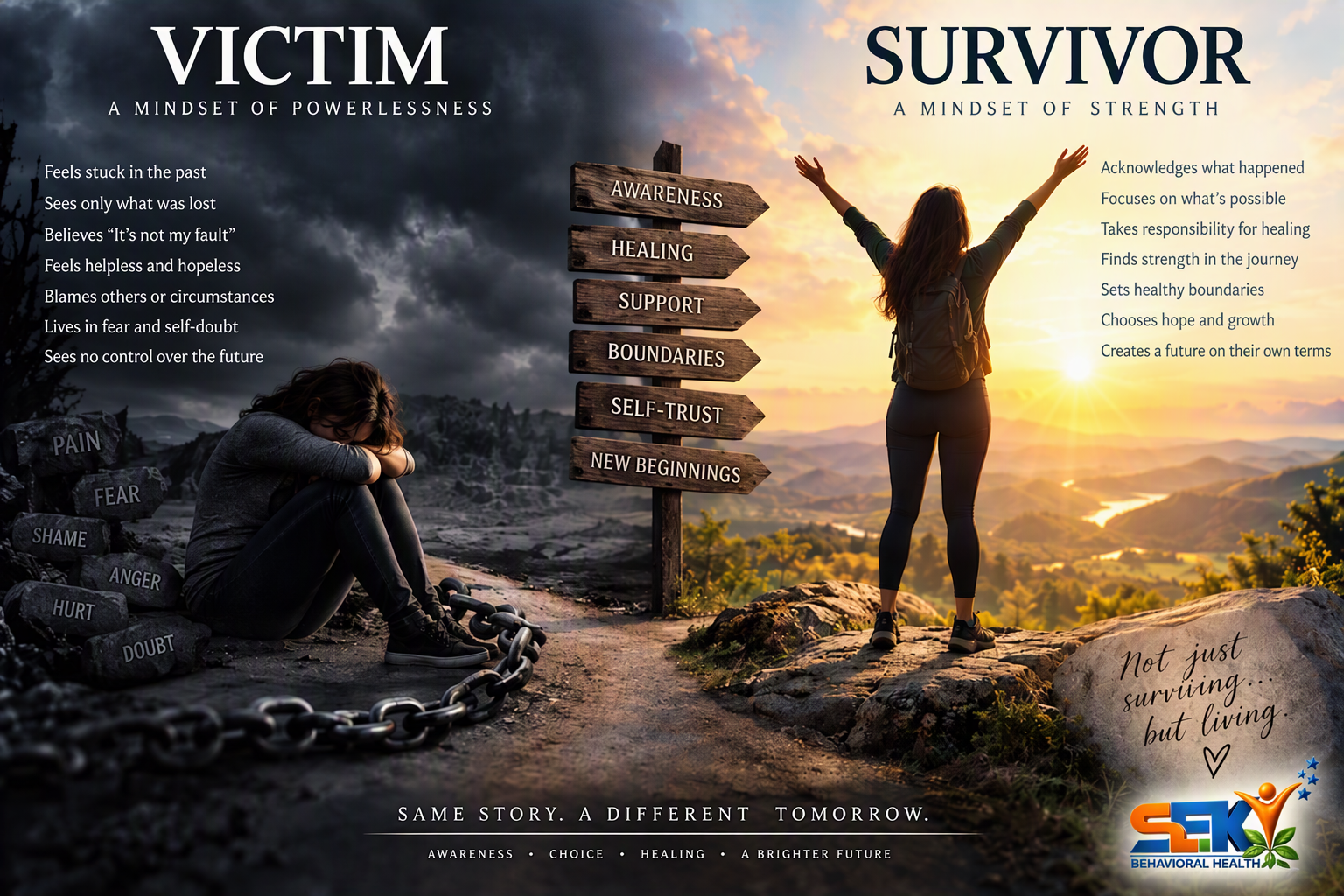
There is a difference between being a victim and living permanently from the frame of mind of a victim.

If someone abused you, betrayed you, abandoned you, assaulted you, neglected you, manipulated you, or harmed you, you may have truly been a victim.

That is a fact.

Calling yourself a survivor does not change the facts. It does not make what happened smaller. It does not excuse the person who hurt you.

It changes something else.

It changes who gets to write the next chapter.

A victim asks:

“Look what they did to me.”

A survivor eventually learns to ask:

“What am I going to do with my life now?”

That may sound like a small difference.

It isn’t.

It may be one of the most important changes that happens during healing.


First, There Is No Shame in Being a Victim

Before talking about a “victim mindset,” we need to be extraordinarily careful with our words.

A person who has experienced trauma may feel afraid, angry, powerless, suspicious, overwhelmed, or emotionally numb. These responses should not automatically be interpreted as weakness or a character problem.

SAMHSA describes trauma as experiences that can have lasting effects on a person’s mental, physical, social, emotional, or spiritual well-being. It also emphasizes that people respond to traumatic experiences differently. Strong support and resilient qualities can influence how someone responds. Likewise, the American Psychological Association recognizes that trauma can have long-lasting psychological and physical consequences, including PTSD, depression, anxiety, sleep problems, dissociation, and other difficulties. So when someone has been badly hurt, telling them to “stop acting like a victim” can be cruel and clinically misguided.

There are times when surviving is enough.

Getting through the day is enough.

Staying safe is enough.

Getting out of bed is enough.

But there may eventually come a point when survival asks something more of us.

The question changes from:

“What happened to me?”

to:

“What happens next?”


The Victim Frame of Mind

The victim frame of mind is not simply sadness about something painful.

It occurs when the injury becomes the lens through which a person begins interpreting much of life.

Something terrible happened to me.

Therefore:

  • I am powerless.
  • People cannot be trusted.
  • My life will always be this way.
  • There is nothing I can do.
  • Someone else must change before I can heal.
  • My past determines my future.
  • What was taken from me can never be rebuilt.
  • Because I was hurt, I will always be broken.

These beliefs are understandable after trauma.

But understandable does not necessarily mean helpful forever.

One particularly important example is avoidance. VA National Center for PTSD explains that wanting to avoid reminders of trauma is common, but relying heavily on avoidance can worsen PTSD symptoms and make moving forward more difficult. A coping strategy that once helped you survive can eventually become the wall preventing you from living.

That is one of trauma’s cruel contradictions.


The Survivor Frame of Mind

The survivor does not pretend the wound never happened.

The survivor learns to carry the scar without allowing the scar to become an identity.

The survivor can say:

Yes, that happened.

Yes, it hurt me.

Yes, I have wounds from it.

No, it was not fair.

No, I did not deserve it.

And yes, I still have a life to live.

Research on resilience after trauma examines precisely this question: how people adapt following profoundly difficult experiences and how resilience can be fostered after trauma. Survival is therefore not denial.

It is not saying:

“It didn’t hurt.”

It is saying:

“It hurt, and I am still here.”


Victim Thinking Says, “They Have the Power.”

Survivor thinking says:

“I have choices.”

Perhaps you could not choose what happened.

You can choose what you do today.

You can choose whether to ask for help.

You can choose your boundaries.

You can choose whom you allow close to you.

You can choose whether to continue treatment.

You can choose whether the people who wounded your past are permitted to control your future.

Trauma-informed care itself recognizes the importance of safety, trust, collaboration, empowerment, voice, and choice in recovery. SAMHSA identifies these ideas among the central principles of trauma-informed approaches. That word matters:

Choice.

Trauma frequently involves losing control.

Recovery often involves discovering where control still exists.


“Why Did This Happen to Me?”

Nearly everyone who has suffered deeply has asked some version of this question.

Why me?

Why did they do it?

Why didn’t someone protect me?

Why didn’t I see it?

Why didn’t I leave sooner?

Why didn’t anyone believe me?

Those questions deserve compassion.

But there is another question that can eventually become more useful:

“Given that this happened, who do I want to become now?”

That question cannot rewrite yesterday.

It can begin changing tomorrow.


Survivors Learn the Difference Between Responsibility and Blame

This may be the hardest concept in the entire journey.

You are not necessarily responsible for what happened to you.

But you eventually become responsible for what you do with what happened to you.

Those are completely different statements.

If someone injured you, responsibility for that action belongs to that person.

Healing belongs to you.

That may feel terribly unfair.

It often is.

Sometimes another person creates the wound while you are left doing the work of repairing it.

But refusing to heal until the person who hurt you makes everything right can leave your future tied to the very person who harmed your past.

Your healing does not need their permission.

Your recovery does not require their understanding.

Your future does not require their apology.

Accountability matters. Justice matters. Acknowledgment matters. In fact, the American Psychological Association recognizes the potential importance of acknowledgment, apology, redress, and restitution in trauma recovery. But your life cannot always remain suspended while waiting for those things.


How Do You Become the Survivor?

There is no switch that suddenly changes someone from victim to survivor.

Healing tends to be a process.

Some days you may feel strong.

The next day, something may trigger an old wound and make you feel as though you have gone backward.

You haven’t necessarily failed.

Here are several places to begin.


1. Tell the Truth About What Happened

Survivorship doesn’t begin by minimizing the past.

It begins with truth.

It happened.

It hurt.

It affected me.

You do not have to defend the person who hurt you.

You do not have to rewrite history to make other people comfortable.

Healing requires honesty.

And sometimes that honesty needs to happen with a qualified mental health professional rather than alone.


2. Stop Making the Wound Your Identity

Notice the enormous difference between these statements:

“I experienced abuse.”

and

“I am damaged.”

Or:

“Someone betrayed me.”

and

“I am unlovable.”

An event is not an identity.

Trauma can influence identity development, and researchers continue to study the relationship between trauma exposure and identity. What happened may always be part of your story.

It does not have to become your entire definition.

You are more than the worst thing someone ever did to you.


3. Identify What You Still Control

Take a sheet of paper and make two columns.

I Cannot Control

  • What happened yesterday
  • What another person thinks
  • Whether someone admits wrongdoing
  • Whether someone apologizes
  • Whether everyone understands my story
  • Another person’s choices

I Can Influence or Control

  • What I do today
  • Whether I ask for help
  • My boundaries
  • Many of my daily choices
  • Whose advice I seek
  • Whether I participate in treatment
  • How I respond when old patterns appear
  • What kind of person I am trying to become

Spend less energy fighting the first list.

Invest more energy in the second.

That is where your power lives.


4. Recognize Avoidance

Avoidance can feel like safety.

Sometimes it is appropriate to avoid genuine danger. But avoiding every thought, emotion, place, relationship, or reminder associated with what happened is different.

The VA National Center for PTSD notes that emotional and behavioral avoidance can interfere with recovery and that effective PTSD treatments can help people learn to cope with trauma-related thoughts and feelings. The U.S. Department of Veterans Affairs has similarly developed recovery materials specifically focused on identifying problematic avoidance behaviors and gradually changing behaviors that keep people stuck in trauma recovery. Courage does not mean never being afraid.

Sometimes courage is simply deciding:

“Fear is present, but fear is no longer making every decision.”


5. Build Boundaries Instead of Walls

Trauma may teach:

Never trust anybody again.

Healing teaches something more sophisticated:

Learn who has earned your trust.

A wall keeps everyone outside.

A boundary has a gate.

A survivor learns when to open it, when to close it, and who receives a key.


6. Allow Yourself to Receive Help

Being a survivor does not mean doing everything alone.

Actually, refusing every form of help can sometimes keep people isolated.

SAMHSA emphasizes safety, peer support, trust, collaboration, and empowerment as important elements within trauma-informed approaches. Help may include professional counseling, trusted friends and family, support groups, medical care, community resources, or spiritual support according to your beliefs and circumstances.

Strength isn’t proving that you need nobody.

Sometimes strength is finally admitting:

“I don’t have to carry all of this by myself.”


7. Give Yourself Permission to Have a Future

Trauma keeps pulling the mind backward.

Healing gradually teaches it to look forward again.

Make plans.

Set a goal.

Learn something.

Build something.

Reconnect carefully.

Create new routines.

Find something meaningful enough that tomorrow becomes more than another day spent thinking about yesterday.

This does not dishonor what happened.

It demonstrates that what happened did not win.


Forgiveness Is Not the Price of Admission

People are sometimes told that they cannot heal unless they forgive the person who hurt them.

I would be careful with that message.

Forgiveness may be deeply meaningful for some people, especially within their spiritual beliefs. But forgiveness should not be confused with denying harm, restoring an unsafe relationship, abandoning boundaries, or removing accountability.

You can heal while still saying:

“What you did was wrong.”

You can move forward without pretending it never happened.

You can have compassion and boundaries at the same time.


Survival Is Not Becoming Who You Were Before

Perhaps this is where we sometimes misunderstand recovery.

After something profound happens, you may never become exactly the person you were before.

That doesn’t automatically mean something has been lost forever.

Perhaps the goal isn’t to go backward.

Perhaps it is to move forward.

Wiser.

More discerning.

More compassionate.

Better acquainted with your boundaries.

More aware of your strength.

More intentional about the life you build.

Resilience research has increasingly examined not merely whether people endure trauma, but how resilience may be fostered following it. The goal isn’t to become untouched.

It is to become unowned by what touched you.


The Day You Become a Survivor

There may never be a ceremony.

Nobody hands you a certificate.

You probably won’t wake up one morning completely free from every painful memory.

Instead, the transformation may happen quietly.

One day you realize you haven’t thought about it for several hours.

Then perhaps an entire day.

You recognize a trigger and choose a different response.

You establish a boundary you once believed you couldn’t establish.

You stop explaining yourself to somebody committed to misunderstanding you.

You ask for help.

You laugh again without feeling guilty.

You make plans.

You love again.

You hope again.

And somewhere along the way, your vocabulary changes.

You stop saying:

“This is who I am because of what they did.”

And begin saying:

“This is who I am becoming despite what happened.”

That is the difference.

The victim’s story is centered around what was done.

The survivor’s story acknowledges what was done but slowly turns toward what comes next.


Conclusion: Take Back the Pen

You cannot erase pages that have already been written.

Some pages may contain things you wish had never happened.

Some contain loss.

Others contain betrayal, fear, grief, humiliation, abandonment, or pain.

There is no wisdom in pretending those pages aren’t there.

Read them when you need to.

Grieve them.

Talk about them.

Learn from them.

Get professional help working through them when necessary.

But eventually, remember something extraordinarily important:

There are blank pages after them.

And those pages still belong to you.

Being a survivor does not mean saying, “It didn’t hurt me.”

It means being able to say:

“It hurt me. It changed me. There were days when I didn’t know whether I could carry it anymore. But I am still here, and what happened to me will not be given the authority to decide everything that happens next.”

You didn’t choose every chapter.

But you can still take back the pen.


About the Author

John S. Collier, MSW, LCSW-S

John S. Collier is a Licensed Clinical Social Worker Supervisor and the Executive Director of Southeast Kentucky Behavioral Health, LLC. His career in social work and behavioral health has included years of work with individuals and families experiencing mental health concerns, trauma, behavioral challenges, relationship difficulties, developmental disabilities, and complicated life transitions.

He earned his bachelor’s degree and became a Certified Social Worker in 2004 before continuing his education and professional development in clinical social work. He became a Licensed Clinical Social Worker in 2010 and later earned the credential of Licensed Clinical Social Worker Supervisor.

As Executive Director of Southeast Kentucky Behavioral Health, Collier works in behavioral health leadership, clinical services, organizational development, community-based behavioral supports, and advocacy for individuals and families throughout southeastern Kentucky.

He is also the author of The Mind’s Trestle Board, where he writes about mental health, relationships, masculinity, family, morality, personal responsibility, faith, emotional growth, and the difficult process of becoming a better version of ourselves. His writing often draws from the intersection of clinical experience, human behavior, personal reflection, and the belief that people should never be reduced to the worst moment of their lives.


References

American Psychological Association. (2024). Individual, collective, and intergenerational trauma recovery: Considering the restorative roles of restitution and reparations.

American Psychological Association. Nugent, N. R., Sumner, J. A., & Amstadter, A. B. (2014). Resilience after trauma: From surviving to thriving. European Journal of Psychotraumatology, 5.

PubMed Central. Substance Abuse and Mental Health Services Administration. (2026). Trauma and violence: What is trauma and its effects? SAMHSA.

Substance Abuse and Mental Health Services Administration. (2023). Practical guide for implementing a trauma-informed approach. SAMHSA.

Truskauskaite-Kuneviciene, I., Brailovskaia, J., Kamite, Y., Petrauskaite, G., Margraf, J., & Kazlauskas, E. (2020). Does trauma shape identity? Exploring the links between lifetime trauma exposure and identity status in emerging adulthood. Frontiers in Psychology, 11, 570644.

PubMed Central. U.S. Department of Veterans Affairs, National Center for PTSD. (2026). Avoidance. National Center for PTSD. U.S. Department of Veterans Affairs, South Central MIRECC. (2022). An active approach to recovering from trauma: Breaking the cycle of safety aids and avoidance. U.S. Department of Veterans Affairs.

Getting Triggered: Taking Responsibility for Your Reactions

Your Trigger Is Your Responsibility

The phrase“I got triggered” has become increasingly common in modern conversations. People use it to describe intense emotional reactions to something another person said, did, or failed to do. While emotional triggers are real and deserve attention, there is an important truth that is often overlooked: your emotional trigger is your responsibility, not someone else’s.

This does not mean other people are always right, kind, or considerate. It does not mean hurtful behavior should be excused. Rather, it means that while external events may activate an emotional response, you remain responsible for how you interpret, manage, and respond to that reaction.

Emotional triggers are often connected to unresolved experiences, personal beliefs, fears, insecurities, past trauma, or deeply held expectations. According to the Cleveland Clinic, emotional triggers are situations, events, thoughts, or interactions that provoke intense emotional reactions that may be disproportionate to the present event because they are connected to past experiences. [health.cle…clinic.org]

A trigger is not proof that someone else caused your emotions. Instead, it is often evidence that something within you requires examination, healing, or growth.


Understanding the Difference Between Cause and Responsibility

A useful distinction exists between cause and responsibility.

Someone may say something rude. That statement may act as a catalyst for anger. However, the emotional reaction that follows belongs to the individual experiencing it.

Many people spend years blaming family members, coworkers, former partners, friends, or society for their emotional pain. While others may influence our experiences, remaining trapped in blame often prevents healing.

When responsibility is surrendered, personal power is surrendered as well.

Consider these examples:

  • Someone criticizes your work, and you become enraged.
  • A friend does not text back quickly, and you become anxious.
  • A spouse disagrees with you, and you immediately become defensive.
  • A coworker receives recognition, and you become resentful.

The external event occurred. However, the intensity of the emotional response often reflects an internal issue that deserves attention.

As psychologist Susan Albers notes, emotional triggers often function as “knee-jerk reactions” connected to prior emotional wounds, pain, or stressful experiences rather than the present situation alone. [health.cle…clinic.org]


Why Blaming Others Keeps You Stuck

Blame can feel empowering in the moment because it removes responsibility from ourselves. Unfortunately, it also removes our ability to create lasting change.

When your happiness depends on other people changing, you remain powerless. When your peace depends on others behaving perfectly, you remain trapped. When your emotional well-being depends upon controlling the behavior of everyone around you, you are fighting a battle you cannot win. Personal accountability allows you to move from:

  • Victimhood to ownership
  • Reactivity to intentionality
  • Resentment to growth
  • Helplessness to empowerment

Self-awareness is a foundational component of emotional intelligence. Research and psychological theory indicate that self-awareness helps individuals recognize emotions, understand behavioral patterns, and make more intentional choices. [positiveps…hology.com], [dictionary.apa.org]


Signs That You May Be Operating From a Trigger

You may be reacting from a trigger when:

  • Your emotional response feels much larger than the event itself.
  • You repeatedly experience the same conflicts.
  • You immediately become defensive.
  • You struggle to calm yourself after an interaction.
  • You replay conversations repeatedly in your mind.
  • You frequently blame others for how you feel.
  • You find yourself saying things you later regret.

Recognizing these signs is not a reason for shame. It is an opportunity for growth.


Eight Steps to Take Ownership of Your Triggers

1. Pause Before Reacting

Strong emotions create urgency. Triggers often convince us that immediate action is necessary.

Instead:

  • Stop.
  • Take several deep breaths.
  • Create distance between feeling and action.

Even a brief pause allows the thinking parts of the brain to engage before impulsive behavior occurs. Naming and observing emotions can strengthen emotional regulation and reduce reactivity. [apa.org], [scienceinsights.org]


2. Identify What You Are Feeling

Many people only recognize anger.

However, underneath anger may be:

  • Fear
  • Shame
  • Rejection
  • Insecurity
  • Embarrassment
  • Loneliness
  • Disappointment

Ask yourself:

“What am I actually feeling right now?”

Awareness creates choice.


3. Ask, “Why Does This Affect Me So Strongly?”

Instead of focusing on the other person’s behavior, focus inward.

Questions to consider:

  • What belief was activated?
  • What fear was touched?
  • What memory does this remind me of?
  • Why does this matter so much to me?

This shift transforms the experience from blame to self-discovery.


4. Separate Facts From Stories

The event and the story you tell yourself about the event are not the same thing.

Example:

Fact: Someone interrupted you.

Story: They do not respect me.

The emotional reaction usually attaches itself to the story, not merely the event. Challenge assumptions and consider alternative explanations before reacting.


5. Own Your Emotional Experience

Practice saying:

  • “I feel hurt.”
  • “I feel anxious.”
  • “I feel angry.”
  • “I am responsible for how I respond.”

Avoid statements such as:

  • “You made me angry.”
  • “You ruined my day.”
  • “You caused my anxiety.”

Others influence us, but they do not control our responses.


6. Develop Healthy Coping Skills

The National Institutes of Health recommends evidence-based wellness practices that help individuals manage emotional stress and build resilience, including mindfulness, physical activity, social support, adequate sleep, gratitude practices, and healthy self-care routines. [nih.gov], [nimh.nih.gov]

Helpful coping strategies include:

MindfulnessLearn to observe emotions without immediately reacting.
Deep BreathingSlow breathing helps calm the body’s stress response.
JournalingWriting allows emotions to be processed instead of suppressed.
ExercisePhysical activity helps regulate mood and reduce stress.
MeditationMeditation increases emotional awareness and self-control.
TherapyProfessional support can help uncover deeper emotional patterns.
Social SupportHealthy relationships provide perspective and encouragement. [apa.org], [nih.gov]

7. Reframe the Trigger as a Teacher

Instead of asking: “Why did they do this to me?”

Ask: “What is this reaction teaching me about myself?”

Every trigger contains information. It may point toward:

  • An insecurity
  • An unmet need
  • A fear
  • A limiting belief
  • An unresolved wound

Growth begins when curiosity replaces blame.


8. Practice Accountability Daily

Accountability is a skill. Each day ask yourself:

  • What triggered me today?
  • How did I respond?
  • What could I have done differently?
  • What lesson did I learn?

Over time these reflections strengthen emotional resilience and self-awareness.


Conclusion

Being triggered is part of the human experience. Everyone encounters situations that evoke strong emotions. The presence of a trigger is not a character flaw, nor is it proof that someone else is responsible for your emotional state. Healing begins when we stop viewing triggers as evidence of other people’s failures and start viewing them as opportunities for self-examination and growth.

You may not be responsible for every experience that shaped you, but you are responsible for how you manage your reactions today. The moment you stop blaming others for your triggers is the moment you begin reclaiming your power. You are not responsible for what happened to you in the past. You are responsible for what you do with it now. Growth occurs when accountability becomes stronger than blame, and self-awareness becomes stronger than reactivity.


About the Author


References

American Psychological Association. (n.d.). Emotion-Focused Coping. APA Dictionary of Psychology. Retrieved from APA Dictionary of Psychology. [dictionary.apa.org]

American Psychological Association. (n.d.). Emotions. Retrieved from the American Psychological Association. [apa.org]

American Psychological Association. (2018). Emotional Intelligence. APA Dictionary of Psychology. [dictionary.apa.org]

American Psychological Association. (2024). Healthy Ways to Handle Life’s Stressors. American Psychological Association. [apa.org]

Cleveland Clinic. (2024). Can You Identify Your Emotional Triggers? Cleveland Clinic Health Essentials. [health.cle…clinic.org]

Centers for Disease Control and Prevention. (2024). Managing Difficult Emotions. U.S. Department of Health and Human Services. [cdc.gov]

National Institute of Mental Health. (2025). Caring for Your Mental Health. National Institutes of Health. [nimh.nih.gov]

National Institutes of Health. (2026). Emotional Wellness Toolkit. National Institutes of Health. [nih.gov]

Positive Psychology. (2025). Using Self-Awareness Theory and Skills in Psychology. PositivePsychology.com. [positiveps…hology.com]


The Quiet Control: How a Partner Can Manipulate You into Feeling Guilty Without You Realizing It

Not all controlling relationships involve shouting, threats, or obvious abuse. Some of the most damaging forms of manipulation happen quietly—so subtly that the person experiencing them may not recognize what is happening until years later. Instead of demanding obedience through intimidation, a manipulative partner often gains control through guilt, obligation, emotional pressure, and carefully crafted narratives that make you question your own judgment.

This form of manipulation is particularly difficult to identify because it often masquerades as love, concern, disappointment, or vulnerability. The controlling partner rarely says, “You must do what I want.” Instead, they create emotional conditions where saying “no” feels selfish, cruel, or even abusive.

Over time, guilt becomes the invisible leash.


Understanding Guilt as a Tool of Control

Healthy guilt serves a purpose. It reminds us when we have genuinely hurt someone and motivates us to repair relationships. Toxic guilt, however, is manufactured. It convinces you that you are responsible for another person’s emotions, happiness, or problems—even when you are not.

Manipulative partners understand, consciously or unconsciously, that caring people are easier to control through guilt than through force.

Rather than respecting your freedom, they reshape your emotional landscape until you begin policing yourself.

Eventually, they no longer need to pressure you.

You pressure yourself.


Common Signs of Quiet Emotional Manipulation

1. They Make You Responsible for Their Feelings

Healthy partners express emotions without assigning blame.

Manipulative partners make their emotional state your responsibility.

You may hear statements like:

  • “If you really loved me, you wouldn’t do that.”
  • “You always make me feel alone.”
  • “I’m only upset because of what you did.”

Soon you begin changing your behavior—not because you agree—but because you fear upsetting them.


2. They Constantly Play the Victim

Whenever conflict arises, they become the injured party.

Even when they caused the problem, the conversation somehow ends with you apologizing.

Over time, you stop bringing up concerns because you know you’ll leave feeling guilty instead.


3. They Rewrite Reality

Psychologists refer to this as gaslighting.

Examples include:

  • “That never happened.”
  • “You’re remembering it wrong.”
  • “You’re too sensitive.”
  • “You’re imagining things.”

After hearing these responses repeatedly, many people begin doubting their own memory and perceptions.


4. They Use Silent Punishment

Instead of discussing problems openly, they withdraw emotionally.

They stop texting.

They avoid affection.

They become cold.

The message is clear:

“You hurt me, and you’ll have to figure out how to make it right.”

The silence becomes emotional punishment.


5. They Turn Every Boundary into an Insult

Healthy boundaries are viewed as acts of self-respect.

Manipulative partners treat boundaries as personal rejection.

When you say:

“I need some time to myself.”

They hear:

“You don’t love me.”

Eventually, setting boundaries becomes emotionally exhausting.


6. They Keep Score

Every favor becomes emotional currency.

“I did this for you.”

“I sacrificed everything.”

“After all I’ve done…”

Love slowly transforms into debt.

Instead of giving freely, everything becomes part of an invisible ledger.


7. They Create Obligation Instead of Connection

Healthy love invites.

Manipulation obligates.

Instead of asking,

“Would you like to come?”

They imply,

“A loving partner would come.”

Notice the difference.

One offers freedom.

The other removes it.


8. They Isolate You Slowly

Few controlling partners immediately forbid friendships.

Instead, they subtly criticize people close to you.

“They don’t really care about you.”

“I don’t trust them.”

“They’re a bad influence.”

Eventually, spending time with friends feels like choosing them over your partner.

Isolation often happens one relationship at a time.


9. They Make You Explain Yourself Constantly

Simple decisions require long justifications.

Why were you late?

Why did you spend money?

Why did you call your sister?

Why didn’t you answer immediately?

Eventually, you begin overexplaining everything—even when you’ve done nothing wrong.


10. You Feel Guilty for Taking Care of Yourself

One of the clearest signs of emotional manipulation is this:

You feel guilty for resting.

Guilty for saying no.

Guilty for seeing friends.

Guilty for having hobbies.

Guilty for succeeding.

Guilty for being happy without them.

Healthy relationships celebrate individuality.

Manipulative relationships punish it.


Why This Works

Manipulation succeeds because it targets empathy.

People who are compassionate naturally want harmony.

They want others to feel loved.

They dislike conflict.

Manipulative individuals exploit these qualities.

The more caring you are, the easier it becomes to convince you that every disagreement is your fault.

Over time, you become emotionally conditioned.

Like Pavlov’s famous experiments, your brain begins associating independence with guilt.

Eventually, merely thinking about asserting yourself creates anxiety.


The Psychological Cycle

The pattern often follows a predictable sequence:

  1. You express a need.
  2. Your partner reacts emotionally.
  3. You feel guilty.
  4. You apologize.
  5. You abandon your need.
  6. Temporary peace returns.

The cycle repeats.

Each repetition strengthens the control.


Questions to Ask Yourself

If you’re unsure whether you’re experiencing manipulation, ask yourself:

  • Do I apologize more than my partner?
  • Am I afraid to disappoint them?
  • Do I feel responsible for fixing their emotions?
  • Have I stopped seeing people I care about?
  • Do I second-guess my own memory?
  • Do I avoid bringing up problems because I know I’ll feel guilty?
  • Have I become less like myself since the relationship began?
  • Do I feel relief when they aren’t around?
  • Am I constantly trying to prove I’m a good partner?
  • Do I feel emotionally drained more often than emotionally safe?

One “yes” does not necessarily indicate manipulation. However, a consistent pattern of these experiences deserves careful attention.


Reclaiming Your Emotional Freedom

Breaking free from guilt-based manipulation begins with recognizing a simple but powerful truth:

You are responsible for your behavior—not for another adult’s emotions.

You can be compassionate without becoming responsible for someone else’s emotional regulation.

Healthy relationships allow room for:

  • Different opinions
  • Personal boundaries
  • Individual friendships
  • Independent interests
  • Honest disagreement
  • Mutual accountability

Love should expand your life—not shrink it.


When Professional Help Is Needed

If guilt, fear, confusion, or emotional exhaustion have become constant features of your relationship, speaking with a licensed mental health professional can provide valuable perspective. A therapist can help you distinguish between healthy compromise and unhealthy emotional control, strengthen your boundaries, and rebuild confidence in your own perceptions and decisions.

If the relationship includes threats, intimidation, physical violence, coercive control, or fear for your safety, it is important to seek support from trusted friends, family, a licensed professional, or a domestic violence resource. Emotional manipulation can exist on its own, but it can also occur alongside other forms of abuse.


Final Thoughts

Healthy love does not require you to abandon yourself.

It does not ask you to silence your needs, doubt your reality, or carry the weight of another person’s emotional life. Genuine intimacy is built on mutual respect, honest communication, and shared responsibility—not on guilt, fear, or obligation.

One of the most important questions you can ask yourself is not, “How do I make my partner happy?” but rather, “Can I be fully myself in this relationship without fearing guilt, punishment, or rejection?”

A relationship that encourages authenticity, respects boundaries, and welcomes open dialogue is far more likely to foster lasting trust than one sustained by emotional pressure. Recognizing subtle manipulation is not about assigning blame; it is about understanding the difference between love that nurtures and control that confines. Awareness is often the first step toward healthier relationships and a renewed sense of emotional freedom.

Here’s an original “About the Author” in a style that is warm, credible, and reader-focused, similar in tone to the type of biography often found in relationship and self-help books, while avoiding copying or closely imitating any specific copyrighted text.

About the Author

John S. Collier, MSW, LCSW is a licensed clinical social worker, therapist, author, and educator with more than three decades of experience helping individuals, couples, and families navigate life’s most difficult challenges. Throughout his career, he has worked extensively with people struggling with relationship conflict, emotional trauma, anxiety, depression, grief, addiction, and the lasting effects of unhealthy relationship patterns.

John’s passion for writing grew out of thousands of conversations with people who simply wanted to understand why relationships become painful and how they can heal. His work combines practical clinical knowledge with compassion, helping readers recognize destructive patterns, build emotional resilience, and create healthier, more meaningful connections.

Drawing from evidence-based psychological principles, years of clinical practice, and a deep appreciation for the resilience of the human spirit, John writes in a style that is both informative and approachable. His goal is not simply to explain human behavior, but to provide readers with practical tools they can apply in everyday life.

In addition to his work in mental health, John has authored numerous books on relationships, emotional wellness, Christian devotionals, Freemasonry, leadership, parenting, trauma recovery, and personal growth. His diverse body of work reflects a lifelong commitment to education, service, and helping others live with greater wisdom, purpose, and hope.

John believes that healthy relationships begin with self-awareness. Whether addressing emotional manipulation, communication, forgiveness, or personal growth, he encourages readers to replace fear with understanding, guilt with healthy boundaries, and confusion with confidence.

When he is not counseling, teaching, or writing, John enjoys continuing his research in psychology, leadership, and human behavior while developing educational resources designed to make professional knowledge accessible to everyday readers.

His mission is simple: to help people understand themselves, strengthen their relationships, and discover that lasting change is possible through knowledge, courage, and intentional action.

References

American Psychiatric Association. (2022). Diagnostic and Statistical Manual of Mental Disorders (5th ed., text rev.).

Forward, S., & Frazier, D. (1997). Emotional Blackmail. HarperCollins.

Gottman, J. M., & Silver, N. (2015). The Seven Principles for Making Marriage Work. Harmony Books.

Linehan, M. M. (2015). DBT Skills Training Manual (2nd ed.). Guilford Press.

Simon, G. K. (2010). In Sheep’s Clothing: Understanding and Dealing with Manipulative People (2nd ed.). Parkhurst Brothers.

Stark, E. (2007). Coercive Control: How Men Entrap Women in Personal Life. Oxford University Press.