Surviving the Affair: The Ripple Effect
Part Eight: When Children, Family, and Friends Are Caught in the Middle
One of the greatest misconceptions about an affair is that it affects only the people directly involved. It does not.
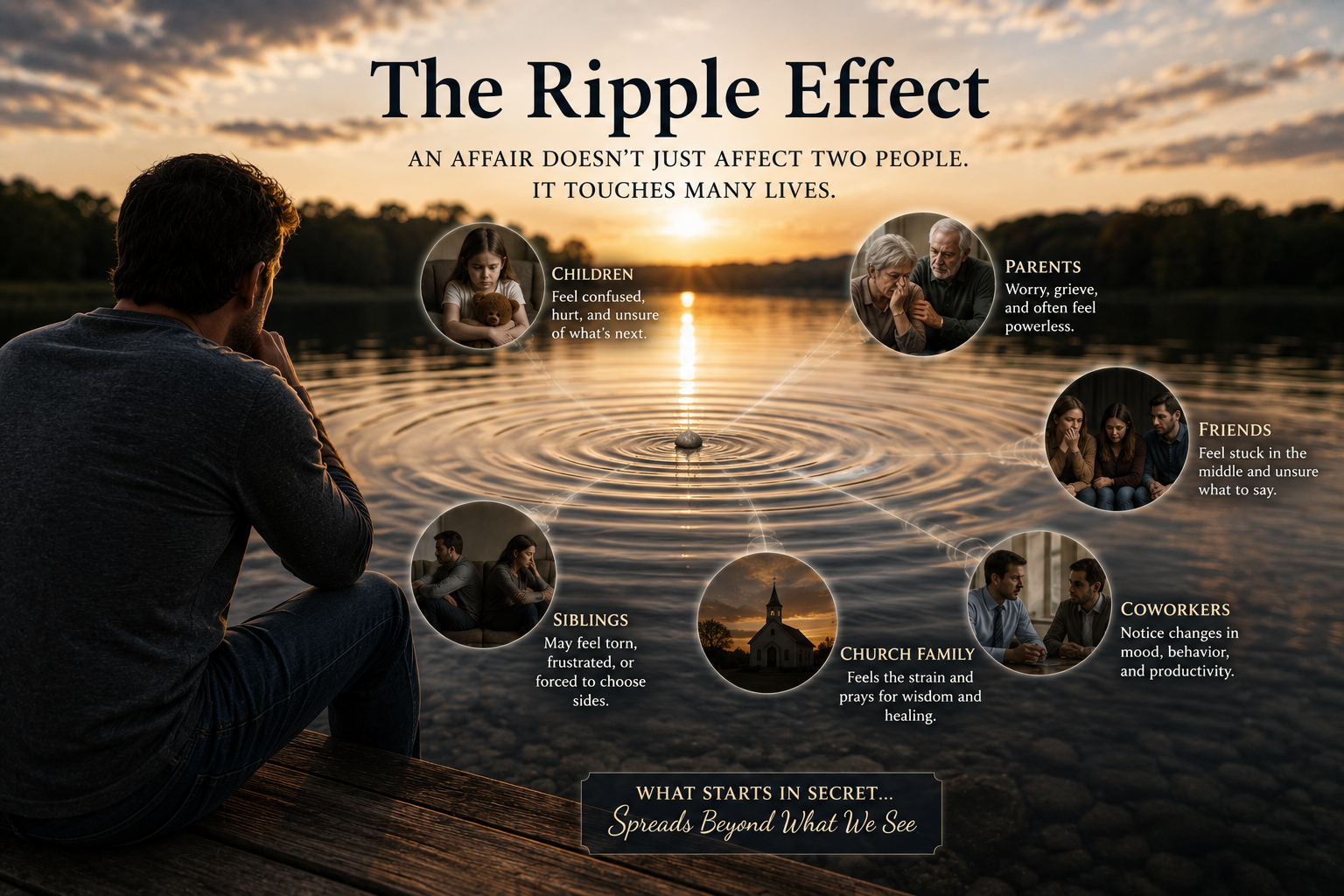
An affair begins between a few people, but its consequences often spread far beyond them. Children lose their sense of security. Parents struggle to watch their adult children suffer. Brothers and sisters are forced to choose sides. Close friends become uncomfortable. Church families become divided. Coworkers notice changes in mood and productivity. Even grandparents often find themselves grieving a family they no longer recognize.
Like a stone thrown into still water, the affair creates ripples that continue long after the initial impact. Most people focus on whether the marriage survives. Few stop to consider everyone else who must learn how to survive it as well. Whether reconciliation occurs or divorce becomes inevitable, the choices made during this season will shape many lives for years to come. The encouraging news is that while an affair creates widespread pain, wise decisions afterward can also create widespread healing.
Children Feel More Than Parents Realize
Many parents believe they have successfully hidden the affair from their children. Sometimes they have. More often, they have hidden only the details. Children notice changes long before they understand them. They notice silence replacing laughter. They notice separate bedrooms.
They notice tension at the dinner table. They notice tears behind closed doors. They notice parents becoming emotionally unavailable. Children may not know what happened. They almost always know something has happened.
When parents avoid honest, age-appropriate conversations, children often create their own explanations. Many blame themselves.
- “Maybe Mom and Dad fight because I misbehave.”
- “Maybe if I were better, things would go back to normal.”
Children were never responsible for the affair. They should never carry its emotional burden.
Protecting Children from Adult Problems
One of the greatest gifts parents can give their children during marital crisis is emotional protection. Children need parents. They do not need detectives. They do not need therapists. They do not need messengers. They do not need judges. Avoid placing children in situations where they feel responsible for managing adult emotions. That includes:
- Asking children to keep secrets.
- Criticizing the other parent in front of them.
- Using children to gather information.
- Expecting children to comfort an emotionally overwhelmed parent.
- Asking children to choose sides.
Children deserve permission to love both parents. Even when one parent has made serious mistakes.
Family Members Often Grieve Too
Parents often feel helpless. They watch their son or daughter suffer. They wonder what they should say. How much should they become involved? Should they encourage reconciliation? Should they support divorce? Should they remain neutral? Family members frequently experience what psychologists call secondary trauma.
Although they were not directly betrayed, they suffer because someone they deeply love is hurting. Their instinct is to protect. Unfortunately, protection sometimes becomes pressure. Healthy support sounds like:
- “I’m here for you.”
- “Whatever decision you make, I want it to be a healthy one.”
- Unhealthy support often sounds like:
- “If you stay, I’ll never respect you again.” or “You have to forgive them.”
Neither statement allows healing.
Friends Often Don’t Know What to Do
Affairs place friendships in awkward positions. Mutual friends wonder whether they should remain connected to both spouses. Some withdraw completely because they fear saying the wrong thing. Others unintentionally make things worse by offering simplistic advice.
- “Just move on.”
- “Once a cheater, always a cheater.”
- “Everything happens for a reason.”
People in deep emotional pain rarely need quick answers. They need compassionate listeners. Sometimes the greatest gift a friend can offer is quiet presence.
The Church Can Become Either a Hospital or a Courtroom
For people of faith, an affair often creates a second crisis. The spiritual crisis. Some individuals fear judgment. Others fear rejection. Some stop attending church entirely because they feel embarrassed. Healthy faith communities understand an important truth. Grace never eliminates accountability. Accountability should never eliminate grace.
Churches become places of healing when they speak truth with compassion, encourage repentance where needed, support healthy boundaries, and refuse to reduce people to the worst decision they have ever made. Every person involved needs wisdom. Every person involved needs hope.
Holidays, Birthdays, and Family Traditions Change
Families rarely anticipate how many ordinary moments become emotionally complicated after an affair.
- Birthdays.
- Christmas.
- Thanksgiving.
- Graduations.
- Weddings.
- Vacations.
- Children’s sporting events.
Questions suddenly emerge. Who will attend? Who will sit where? Who should be invited? The healthiest families focus less on old expectations and more on creating emotionally safe experiences for everyone involved. Flexibility often becomes an expression of maturity.
Forgiveness Does Not Mean Ignoring Healthy Boundaries
Extended family members sometimes misunderstand forgiveness. Forgiveness does not require pretending everything is normal. Trust often returns gradually. Relationships sometimes need time before old traditions resume. Healthy boundaries communicate safety—not punishment. Families heal best when grace and wisdom work together.
Tools for Helping Families Heal
Whether the marriage survives or not, these practices help reduce long-term emotional harm:
- Keep children out of adult conflicts.
- Speak respectfully about one another in front of family members.
- Encourage counseling for both adults and children when needed.
- Create predictable routines to restore emotional stability.
- Allow children to ask questions appropriate to their age.
- Build healthy co-parenting communication if separation occurs.
- Seek support from trusted friends, pastors, or counselors.
- Be patient with extended family members as they process their own grief.
- Protect family gatherings from unnecessary conflict.
- Focus on long-term healing rather than short-term emotional victories.
A Christian Perspective
Throughout Scripture, God continually works through broken families. Abraham’s family struggled. Jacob’s family struggled. David’s family struggled. Yet God’s redemptive work continued.
An affair may change a family’s story. It does not remove God from the story. Colossians 3:13 reminds believers:
“Bear with each other and forgive one another if any of you has a grievance against someone. Forgive as the Lord forgave you.”
Forgiveness, patience, and grace do not erase painful consequences. They create the possibility of healing despite them. Families that practice truth, humility, and love often discover that while life may never return to what it once was, it can still become healthy again.
A Therapist’s Reflection
One of the most heartbreaking moments in counseling occurs when a child quietly asks, “Is this my fault?” The answer is always the same. “No.” Children did not create the affair. They cannot fix it. They should never be expected to carry it. Adults have the responsibility to protect children—not only physically, but emotionally. When parents choose maturity over revenge… When grandparents choose support over criticism…When friends choose listening over judgment…When churches choose restoration over condemnation…Healing spreads through the family just as surely as pain once did.
Affairs create ripples. So does grace. So does wisdom. So does love. The choices made after betrayal will become part of the legacy your family remembers. Choose the kind of legacy that leads toward healing.
About the Author

John S. Collier, MSW, LCSW-S is a licensed clinical social worker, psychotherapist, author, educator, and speaker with decades of experience helping individuals, couples, and families navigate life’s most difficult emotional challenges. Throughout his career, he has worked extensively with people struggling with relationship conflict, betrayal, anxiety, depression, trauma, grief, addiction, and life transitions. His counseling approach combines evidence-based psychological practices with practical wisdom, compassion, and a deep respect for each person’s unique journey.
John has devoted much of his professional life to understanding the complexities of human relationships. He has counseled couples working to rebuild trust after infidelity, individuals recovering from betrayal, and families seeking healing after painful life events. His clinical experience has reinforced one enduring truth: while relationships can be profoundly wounded, people possess an extraordinary capacity for growth, resilience, forgiveness, and transformation when they are equipped with the right tools and support.
As an author, John seeks to bridge the gap between professional mental health knowledge and everyday life. His writing translates complex psychological concepts into practical guidance that readers can understand and apply immediately. Whether addressing marriage, parenting, emotional wellness, trauma recovery, or spiritual growth, his goal is to provide resources that are both clinically sound and personally encouraging.
Surviving the Affair reflects John’s commitment to approaching infidelity with both honesty and compassion. Rather than reducing people to labels or stereotypes, he explores the emotional realities experienced by everyone affected—the betrayed spouse, the unfaithful partner, the affair partner, and the families whose lives are forever changed. Drawing upon years of therapeutic experience, he emphasizes accountability without condemnation, healing without minimizing pain, and hope without offering unrealistic promises.
John believes that healing begins when people are willing to face the truth with courage. While not every relationship can or should be restored, every individual has the capacity to grow beyond betrayal, rediscover integrity, and build a healthier future. His passion is helping readers move from surviving life’s greatest wounds to living with renewed purpose, emotional strength, and hope.
Through his books, speaking engagements, and counseling work, John continues to encourage others to pursue emotional health, healthy relationships, personal responsibility, and lasting transformation—one step at a time.h his counseling, writing, and educational work, John equips individuals and families with practical tools to strengthen relationships, heal emotional wounds, and build resilient futures.
References
American Academy of Pediatrics. (2016). Helping Children Cope with Divorce and Family Stress.
American Association for Marriage and Family Therapy. (2015). Infidelity. https://www.aamft.org
Bowen, M. (1978). Family Therapy in Clinical Practice. Jason Aronson.
Gottman, J. M., & Gottman, J. S. (2015). 10 Principles for Doing Effective Couples Therapy. W. W. Norton & Company.
Nichols, M. P., & Davis, S. D. (2020). Family Therapy: Concepts and Methods (12th ed.). Pearson.
Snyder, D. K., Baucom, D. H., & Gordon, K. C. (2007). Getting Past the Affair. Guilford Press.
The Holy Bible, New International Version. (2011). Zondervan.
- Part One: The Wounds No One Sees
An overview of betrayal, trauma, grief, and the emotional complexity of affairs. - Part Two: When Forgiveness Feels Impossible
Understanding intrusive memories, resentment, trauma, and why forgiveness cannot be forced. - Part Three: Choosing Hope
Learning how trust is rebuilt, boundaries are established, and reconciliation becomes possible. - Part Four: When You No Longer Want to Stay
Navigating honesty, responsibility, guilt, and ending a marriage with integrity rather than continued deception. - Part Five: The Long Road Home
Understanding genuine remorse, rebuilding trust, transparency, and becoming trustworthy again. - Part Six: Loving Somone You Cannot Keep
Exploring attachment, hope, grief, and accepting that loving someone does not always justify continuing the relationship. - Part Seven: Choosing Integrity Over Desire
Examining grief, guilt, loneliness, moral conflict, and healing after choosing integrity over desire. - Part Eight: The Ripple Affect
Understanding the wider ripple effects of infidelity and protecting those who never chose to be part of the story. - Article Nine: Forgiveness, Reconciliation, and Letting Go
Separating forgiveness from reconciliation and understanding what emotional freedom truly means. - Part Ten: Beyond Survival
Whether the marriage survives or ends, discovering how people rebuild identity, hope, purpose, and healthy relationships again.