
Welcome to SOUTHEAST KENTUCKY BEHAVIORAL HEALTH
When Helping Becomes Enabling

If You Don’t Let People Suffer the Consequences of Their Actions, You Will Always Be a Safe Space for Their Worst Behavior

“Sometimes the most loving thing you can do is stop protecting someone from the consequences of the choices they keep making.”

There is a hard lesson that many good-hearted people eventually have to learn:

Helping someone and protecting someone from accountability are not the same thing.

We want to believe love means staying. Forgiving. Helping. Giving another chance. Paying the bill. Making the excuse. Cleaning up the mess. Answering the late-night call. Fixing the problem one more time.

Sometimes that is love.

But sometimes what we call love slowly turns into enabling.

Psychology Today describes enabling as behavior that shields someone from the natural negative consequences of their actions. Cleveland Clinic similarly explains that repeatedly rescuing someone can keep that person from learning to make better choices and becoming more independent.

Eventually, we have to ask ourselves a difficult question:

Am I helping this person become better, or have I simply become a comfortable place for their worst behavior to land?

—

When Grace Loses Accountability

Grace is important.

People make mistakes. People struggle. People relapse. People fail. People sometimes hurt those they love.

Everyone deserves opportunities to learn and change.

But grace without accountability can become permission.

There is an enormous difference between saying:

“You made a mistake, but I believe you can do better.”

and saying:

“You can keep making the same choice, and I will keep protecting you from what happens afterward.”

The second message may never be spoken aloud.

But behavior communicates it.

If someone repeatedly creates financial problems and another person always pays the bill, what incentive exists to change?

If someone repeatedly speaks disrespectfully but knows everyone will eventually pretend nothing happened, what has that person learned?

If someone continually fails to meet responsibilities and someone else quietly picks them up, the consequences never reach the person responsible.

What began as compassion can slowly become participation in the problem.

—

Consequences Are Not the Same as Punishment

This distinction matters.

A consequence does not necessarily mean punishment.

A natural consequence is simply what happens because of a choice.

If I spend money irresponsibly, I may not have enough money later.

If I continually break promises, people may stop trusting me.

If I repeatedly disrespect someone, that person may decide to limit contact with me.

If I fail to fulfill a responsibility, I may lose an opportunity.

Cause and effect are among life’s greatest teachers.

Research and clinical guidance on natural and logical consequences emphasize that predictable responses to behavior help people understand the relationship between choices and outcomes.

When we constantly interrupt that process, we may also interrupt the lesson.

—

The Rescue Cycle

Enabling rarely begins with someone saying, “I want this person to continue behaving badly.”

It usually starts with love.

Something happens.

We rescue them.

They promise it will not happen again.

Things improve temporarily.

Then it happens again.

We rescue them again.

Eventually, something important changes.

The rescue becomes expected.

Cleveland Clinic notes that enabling often comes from love and a desire to help, yet repeatedly assuming the role of problem solver can prevent a loved one from learning to make healthier choices.

The person stops wondering:

“What will happen if I make this choice?”

and begins assuming:

“Who will fix this when it goes wrong?”

That is when helping becomes dangerous.

—

You Can Become a Safe Place for Bad Behavior

There is something beautiful about being someone’s safe place.

A healthy safe place says:

“You can tell me the truth.”

“You can admit you failed.”

“You can cry here.”

“You can ask for help.”

“You don’t have to pretend to be perfect.”

But an unhealthy safe place says something entirely different:

“You can mistreat me and I will remain available.”

“You can ignore your responsibilities and I will handle them.”

“You can break my trust repeatedly and I will keep resetting the clock.”

“You don’t have to change because I will absorb the consequences.”

That isn’t emotional safety.

It is insulation from accountability.

And there’s a difference.

—

Boundaries Change the Message

The APA Dictionary of Psychology defines a boundary as a psychological demarcation that protects a person’s integrity or helps establish realistic limits in a relationship or activity.

A boundary therefore isn’t primarily about controlling another person.

It is about deciding what you will participate in.

That’s an important distinction.

Instead of:

“You aren’t allowed to yell anymore.”

A boundary might be:

“If you begin yelling at me, I will end the conversation until we can speak respectfully.”

Instead of:

“You have to become responsible with money.”

It might become:

“I love you, but I will no longer pay debts created by choices I didn’t make.”

Instead of:

“You have to stop lying.”

It might be:

“I cannot maintain the same level of trust when I continue discovering dishonesty.”

APA guidance on professional boundaries makes a similar point in another context: limits can protect both people and support healthier relationships rather than serving as rejection.

A boundary doesn’t require the other person’s cooperation.

That’s what makes it a boundary.

—

“But What If They Suffer?”

Perhaps they will.

Watching someone you love experience consequences can be painful.

But discomfort is not always damage.

Sometimes discomfort is information.

It says:

Something isn’t working.

Something needs to change.

This choice costs more than I thought it would.

When we immediately remove every uncomfortable consequence, we may unintentionally remove the motivation to do something differently.

Psychology Today specifically identifies cleaning up or shielding someone from the natural negative consequences of problematic behavior as a form of enabling.

This doesn’t mean we abandon people in danger.

It doesn’t mean refusing medical care.

It doesn’t mean allowing a child or vulnerable adult to experience preventable harm.

And it certainly does not mean retaliating against somebody.

It means understanding an important truth:

There is a difference between protecting someone from danger and protecting someone from responsibility.

—

Stop Carrying What Belongs to Someone Else

Many people become exhausted because they are carrying responsibilities that were never theirs.

Another adult’s finances.

Another adult’s honesty.

Another adult’s employment.

Another adult’s temper.

Another adult’s relationships.

Another adult’s choices.

Another adult’s responsibilities.

We convince ourselves:

“If I don’t do it, nobody will.”

That may be true.

But occasionally, nobody doing it is exactly what allows reality to finally become visible.

If you always catch someone before they fall, that person may never realize how close to the edge they have been living.

—

Love Them Enough to Let Them Own It

Accountability does not require cruelty.

You don’t have to humiliate someone.

You don’t need to say, “I told you so.”

You don’t have to enjoy seeing another person struggle.

You can remain compassionate while refusing to rescue.

You can say:

“I love you, but I can’t fix this for you.”

“I believe you can handle this.”

“I’ll support you while you work through it, but I won’t take responsibility for something that belongs to you.”

“I forgive you, but forgiveness doesn’t erase the need for change.”

“I am here when you’re ready to do something different.”

That isn’t abandonment.

Sometimes it is the most honest kind of support we can give.

Cleveland Clinic makes this distinction directly: healthy help supports improvement, while enabling prevents someone from learning better choices and becoming more capable of standing independently.

—

Boundaries Will Reveal Relationships

There is another uncomfortable reality about setting boundaries.

Some people will not like them.

A person who benefited from your lack of boundaries may experience your new boundary as unfair.

Someone accustomed to unlimited access to your time may call you selfish when you begin saying no.

Someone accustomed to having you fix every problem may tell you that you’ve changed.

They may be right.

You have changed.

You stopped confusing love with unlimited tolerance.

You stopped confusing forgiveness with permission.

You stopped confusing compassion with rescuing.

And you stopped measuring the health of the relationship by how much mistreatment you could endure.

—

The Goal Isn’t to Make Them Suffer

This deserves emphasis.

The purpose of consequences is not suffering for suffering’s sake.

Healthy accountability shouldn’t be revenge.

The goal isn’t:

“I’m going to teach you a lesson.”

The healthier position is:

“I’m no longer going to prevent life from teaching the lesson.”

That is an enormous difference.

One is punishment.

The other is stepping out of the cycle.

—

Conclusion: Stop Being a Safe Place for the Worst Version of Someone

We should all strive to be safe people.

Safe enough that someone can be honest.

Safe enough that someone can acknowledge a mistake.

Safe enough that someone can ask for help.

Safe enough that someone can admit failure and try again.

But being emotionally safe does not mean becoming a consequence-free environment.

Sometimes love comforts.

Sometimes love forgives.

Sometimes love gives another chance.

And sometimes love quietly steps aside and says:

“This belongs to you.”

Because if you repeatedly protect someone from the consequences created by their own choices, eventually you may stop being a safe place for their healing and become a safe place for their worst behavior.

Perhaps one of the greatest expressions of respect is believing another adult is capable of facing reality, taking responsibility and changing.

You can love someone without rescuing them.

You can forgive someone without trusting them immediately.

You can care without carrying.

You can support without enabling.

And you can say no without becoming cruel.

Sometimes the boundary isn’t where love ends. The boundary is where unhealthy love ends and healthy love finally begins.

—

About the Author

John S. Collier, MSW, LCSW-S is a Licensed Clinical Social Worker Supervisor and Executive Director of Southeast Kentucky Behavioral Health, LLC. His professional work focuses on behavioral health, counseling, leadership, personal growth, relationships and helping individuals build healthier and more meaningful lives.

Collier is also the author of The Mind’s Trestle Board, where he explores the intersection of psychology, relationships, responsibility, faith, morality, leadership and personal development. His writing often challenges readers to examine not only the behavior of others, but also their own choices, boundaries and responsibilities.

Through his clinical experience and reflective writing, Collier encourages a simple principle: meaningful change requires honesty, personal responsibility and the willingness to do the difficult work of becoming better.

—

References

American Psychological Association. (2018). Boundary. APA Dictionary of Psychology. APA Dictionary of Psychology.

Stringer, H. (2025). The benefits of better boundaries in clinical practice. American Psychological Association.

Wu, J. (2020). How to recognize (and correct) enabling behavior. Psychology Today.

Cleveland Clinic. (2023). 4 signs of enabling and how to stop. The article discusses the distinction between helping and repeatedly rescuing someone from the consequences of problematic choices.

Johnson, L. (2023). Helping children learn: The importance of natural and logical consequences when working with children who have experienced trauma. Outcomes First Group. The resource explains natural and logical consequences and their role in learning cause and effect.
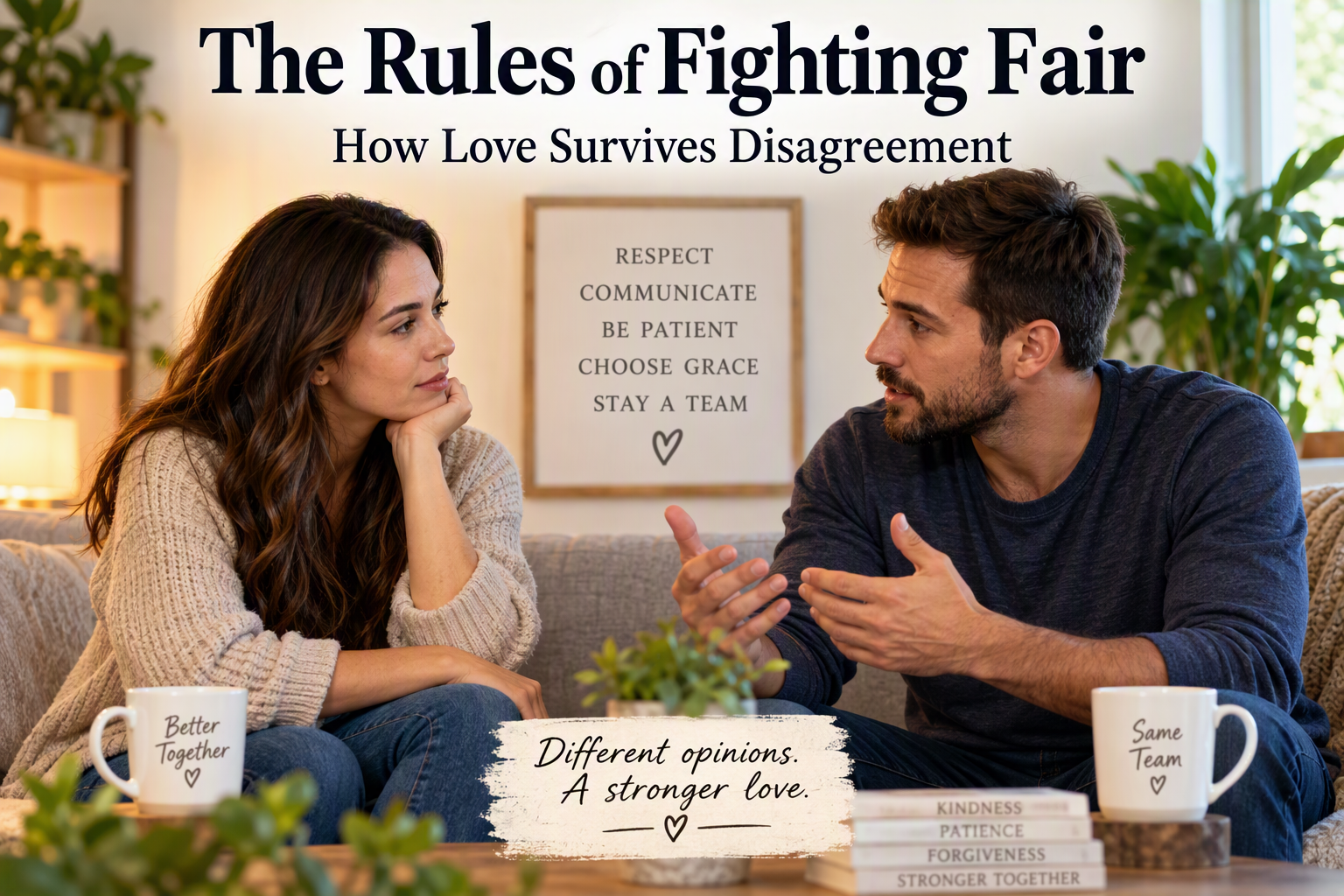
The Rules of Fighting Fair: How Love Survives Disagreement

Every relationship has arguments. No matter how deeply two people love each other, there will be moments of frustration, misunderstanding, disappointment, and hurt. The difference between healthy relationships and unhealthy ones is not whether conflict exists. The difference is how conflict is handled.

The image above presents five simple but powerful rules for couples during arguments. At first glance, they seem obvious. Yet these principles address some of the most common mistakes that damage trust and intimacy. They remind us that being angry with someone is not a license to stop loving them.

Research consistently shows that conflict itself is not the greatest threat to a relationship. Rather, it is destructive communication patterns, contempt, criticism, stonewalling, and defensiveness that place relationships at risk (Gottman & Silver, 2015).

Rule #1: Be Mad at Me, But Don’t Insult Me

“Anger is not a ticket to speak carelessly.”

When emotions run high, words often become weapons. People say things they never truly mean because they want the other person to feel the same pain they are feeling.

The problem is that arguments eventually end, but hurtful words often remain.

You may forget what the disagreement was about, but you rarely forget being called worthless, stupid, selfish, or unlovable. According to relationship researcher John Gottman, contempt and personal attacks are among the strongest predictors of relationship dissatisfaction and eventual separation (Gottman & Silver, 2015).

Healthy couples understand an important truth: attack the problem, not the person.

You can say:

  • “That hurt me.”
  • “I am disappointed.”
  • “I feel ignored.”

Without saying:

  • “You’re pathetic.”
  • “You never do anything right.”
  • “You’re just like your mother.”

Respect should not disappear simply because peace has.

Anger can be temporary. The damage caused by contempt can be permanent.

Rule #2: Be Mad at Me, But Tell Me Why

“Don’t assume I know.”

One of the greatest relationship myths is that people should automatically know what is wrong.

The truth is that nobody can read minds.

Many arguments grow larger because one partner believes the other should already understand the issue. Meanwhile, the other person is confused and becomes frustrated trying to guess.

Clear communication is one of the strongest predictors of relationship success. Research by Markman, Stanley, and Blumberg (2010) found that couples who communicate concerns directly and clearly are better able to resolve conflict and maintain emotional intimacy.

Instead of saying:

  • “You know exactly what you did.”

Try saying:

  • “When this happened, it made me feel unimportant.”

People cannot fix problems they do not understand.

Love requires communication, not telepathy.

As marriage and family therapist Virginia Satir observed, communication is to relationships what breathing is to life. Without it, connection slowly deteriorates (Satir, 1988).

Rule #3: Be Mad at Me, But Don’t Broadcast It

Conflict belongs between the people involved.

Too often people rush to social media, group texts, friends, family members, or coworkers to discuss relationship problems before discussing them with their partner.

While outside support can sometimes be helpful, publicly shaming a partner almost never improves the relationship.

Once private details become public, they cannot easily be taken back.

Strong relationships protect each other’s dignity, even during difficult moments. Maintaining emotional safety and mutual respect helps partners feel secure enough to resolve disagreements constructively (Tatkin, 2012).

This does not mean remaining silent about abuse, manipulation, or situations involving safety concerns. Those circumstances require outside support and intervention. However, ordinary relationship disagreements generally benefit from privacy, maturity, and direct communication.

A couple should be teammates solving a problem together, not opponents recruiting spectators.

Rule #4: Be Mad at Me, But Don’t Forget My Good Qualities

Conflict has a way of shrinking our perspective.

When we are hurt, our minds naturally focus on the thing causing the pain. Suddenly one mistake feels larger than a thousand acts of kindness.

Psychologists often describe this tendency as negative filtering, where attention becomes focused on a person’s flaws while overlooking their strengths.

A healthy relationship requires balance.

Remember:

  • The person who forgot an anniversary may also be the person who supported you through difficult times.
  • The person who made a mistake may also be the person who loves you deeply.
  • The person frustrating you today may be the person who has stood beside you for years.

Research from the Gottman Institute has found that successful couples maintain a strong ratio of positive interactions to negative interactions, even during periods of conflict (The Gottman Institute, 2024).

A moment of failure should not erase a history of goodness.

Rule #5: Be Mad at Me, But Remember Grace

“Remember all the times I’ve forgiven you.”

This final point may be the most powerful.

Every person who has been in a long-term relationship has needed forgiveness. No one is perfect. No one gets everything right.

Healthy couples recognize that relationships are not scoreboards.

Love is strengthened when both people remember that they have received grace as often as they have given it.

Research from the Greater Good Science Center at the University of California, Berkeley indicates that forgiveness is associated with stronger relationships, better emotional health, reduced stress, and greater overall well-being (Greater Good Science Center, 2023).

Forgiveness does not excuse harmful behavior or remove accountability. Instead, it acknowledges that human beings are flawed and that lasting relationships require compassion.

The question is not whether your partner will eventually disappoint you.

They will.

The question is whether there is enough humility, understanding, and forgiveness to move forward together.

The Real Secret Behind Healthy Arguments

Many people believe successful couples avoid conflict. The truth is quite the opposite.

Successful couples argue.

They disagree.

They become frustrated.

They occasionally hurt one another.

What separates them from struggling couples is that they continue fighting for the relationship while addressing the problem.

They remember that the person sitting across from them is not the enemy.

The problem is the enemy.

Relationship experts consistently emphasize that couples who approach conflict as a shared challenge rather than a battle to be won are more likely to experience long-term satisfaction and stability (Markman et al., 2010; Gottman & Silver, 2015).

The argument should never become a contest about who wins. It should become a conversation about how both people can heal, learn, and grow.

Because at the end of the day, the healthiest relationships are not those free from anger.

They are the relationships where love remains present even when anger arrives.


“Being angry with someone is not the opposite of loving them. Treating them without respect is.”


About the Author

John S. Collier, MSW, LCSW-S is the Executive Director of Southeast Kentucky Behavioral Health, LLC and author of The Mind’s Trestle Board. Through his writing, he explores relationships, personal growth, emotional wellness, morality, and the challenges people face as they seek meaningful connections with others. His work blends professional behavioral health experience with practical life lessons intended to encourage reflection, healing, and personal development.


References

Chapman, G. (2015). The 5 Love Languages: The Secret to Love That Lasts. Northfield Publishing.

Gottman, J. M., & Silver, N. (2015). The Seven Principles for Making Marriage Work (Revised ed.). Harmony Books.

Greater Good Science Center. (2023). The Science of Forgiveness. University of California, Berkeley.

Harvard Health Publishing. (2022). Communication and Conflict Resolution in Relationships. Harvard Medical School.

Markman, H. J., Stanley, S. M., & Blumberg, S. L. (2010). Fighting for Your Marriage (3rd ed.). Jossey-Bass.

Mayo Clinic Staff. (2023). Healthy Communication and Relationship Wellness. Mayo Clinic.

Satir, V. (1988). The New Peoplemaking. Science and Behavior Books.

Tatkin, S. (2012). Wired for Love: How Understanding Your Partner’s Brain and Attachment Style Can Help You Defuse Conflict and Build a Secure Relationship. New Harbinger Publications.

The Gottman Institute. (2024). Managing Conflict in Relationships.


Do Not Break Their Spirit: A Parent’s Call to Lead with Love

There are few responsibilities in life more important than raising a child. Parents are entrusted with more than providing food, shelter, and safety. They are shaping hearts, building confidence, and helping young people discover who they are. The words we speak, the standards we set, and the way we respond to mistakes all leave lasting impressions.

Many parents begin with good intentions. They want their children to succeed, make good decisions, and develop strong character. Yet sometimes, in the pursuit of these goals, parents unintentionally wound the very people they are trying to help. Constant criticism, unreasonable expectations, harsh discipline, and emotional distance can discourage a child and leave lasting scars.

Children need guidance, but they also need grace. They need correction, but they also need compassion. They need structure, but they also need understanding.

When Correction Becomes Discouragement

Every child will make mistakes. Learning, growing, and maturing all involve failure. A healthy parent understands that mistakes are opportunities for teaching rather than occasions for humiliation.

Unfortunately, some parents unknowingly create an environment where children feel they can never measure up. Nothing is good enough. Every success is overshadowed by a failure. Every effort is met with criticism. Instead of feeling encouraged to grow, children begin to feel defeated.

When children repeatedly hear messages such as:

  • “Why can’t you do anything right?”
  • “Your brother never has this problem.”
  • “If you would just try harder.”
  • “You’re always messing things up.”

They may begin to believe these statements about themselves.

Discouragement does not always come from yelling. Sometimes it comes from unrealistic expectations. A child who constantly feels like they are failing an impossible standard eventually stops trying. They lose confidence, motivation, and hope.

Children need to know they are loved even when they struggle.

Common Ways Parents Provoke Their Children

Most parents would never intentionally harm their children emotionally. Yet certain behaviors can slowly damage trust and self-esteem.

Being Unreasonable

Children need rules, but rules should be fair, understandable, and age-appropriate.

When expectations are impossible to meet, children become frustrated and discouraged. A parent who expects perfection sets their child up for failure.

Healthy discipline asks:

  • Is this reasonable?
  • Is this expectation appropriate for their age?
  • Am I teaching or simply demanding?

Rules should help children develop responsibility, not create constant fear of failure.

Showing Favoritism

Few things hurt a child more deeply than feeling less valued than a sibling.

Favoritism sends the message that love must be earned. Whether intentional or not, repeatedly praising one child while criticizing another creates resentment and insecurity.

Every child is unique. One may excel academically while another shines socially or creatively. Parents should celebrate each child’s strengths rather than comparing them to one another.

Comparison steals confidence.

Acceptance builds it.

Belittling and Mocking

Children are learning how to view themselves. Parents often become the mirror through which a child develops their identity.

When a parent mocks a child’s fears, appearance, efforts, or emotions, the child learns to doubt their worth.

Statements such as:

  • “That’s a stupid idea.”
  • “You’re too sensitive.”
  • “Stop crying.”
  • “You’ll never be good at that.”

may seem small in the moment, but they can echo for years.

A child’s feelings may not always be logical, but they are always real.

Listening with empathy teaches children that their emotions matter and that they can trust their parents with their struggles.

Over-Correcting Out of Frustration

Discipline should be about teaching, not venting.

Parents are human. Stress accumulates. Work becomes overwhelming. Financial pressures mount. Relationships strain under life’s demands.

However, children should never become the target of a parent’s frustration.

Correction motivated by anger often focuses on punishment rather than growth. The goal shifts from teaching a lesson to expressing irritation.

Before responding to a child’s mistake, it can be helpful to ask:

“Am I correcting my child, or am I releasing my frustration?”

The answer can make all the difference.

The Power of Active Listening

Children desperately want to feel heard.

Many conflicts between parents and children are not caused by disobedience alone. They stem from feeling misunderstood.

Active listening means giving children your attention without immediately judging, correcting, or dismissing their perspective.

Listening does not mean agreeing with everything they say. It means communicating that their thoughts and feelings matter.

When children feel heard, they become more open to guidance.

When they feel ignored, they often become defensive or withdrawn.

A child who trusts their parent will seek advice. A child who feels constantly criticized may hide their struggles.

Choosing Calm Communication

Words have extraordinary power.

A raised voice may gain temporary compliance, but calm communication builds lasting respect.

Children are always learning from what they see. Parents who respond with patience teach emotional regulation. Parents who communicate respectfully model healthy relationships.

When emotions run high, consider:

  • Taking a brief pause.
  • Lowering your voice instead of raising it.
  • Asking questions before making assumptions.
  • Focusing on the behavior rather than attacking character.

Instead of saying:

“You’re lazy.”

Try saying:

“I know you’re capable of more effort.”

One attacks identity.

The other encourages growth.

Balancing Discipline with Love

Discipline is necessary. Children need boundaries. They need guidance and accountability.

But effective discipline is rooted in love rather than control.

Healthy discipline:

  • Explains the reason behind rules.
  • Focuses on learning rather than shame.
  • Remains consistent and fair.
  • Gives children opportunities to improve.
  • Reinforces that mistakes do not diminish their worth.

Children should leave a correction feeling guided, not crushed.

They should understand that their behavior may need to change, but their value never does.

The Legacy Parents Leave

Long after childhood ends, many adults still hear the voices of their parents in their minds.

Some hear encouragement:

  • “I believe in you.”
  • “You can do hard things.”
  • “I’m proud of your effort.”
  • “You are loved.”

Others hear criticism, comparison, and disappointment.

Every parent leaves a legacy through their words.

Children do not need perfect parents. They need parents who are willing to learn, apologize when necessary, and lead with love.

The goal of parenting is not creating perfect children. The goal is helping children become healthy, confident, compassionate adults who know they are valued.

When correction is balanced with kindness, expectations are balanced with understanding, and discipline is balanced with love, children flourish.

And perhaps the greatest gift a parent can give is not a life free from mistakes, but a home where mistakes become opportunities for growth rather than reasons for shame.


Pull Quote

“Children should leave a correction feeling guided, not crushed. Their behavior may need to change, but their value never does.”


About the Author

John S. Collier, MSW, LCSW-S is a Licensed Clinical Social Worker Supervisor and Executive Director of Southeast Kentucky Behavioral Health, LLC. Through his writing and clinical work, he explores relationships, emotional health, personal growth, resilience, and the challenges individuals and families face in everyday life. He is also the author of The Mind’s Trestle Board, where he examines the connections between thoughts, emotions, behavior, and human flourishing.

Southeast Kentucky Behavioral Health proudly supports Breast Cancer Awareness Month.