Welcome to SOUTHEAST KENTUCKY BEHAVIORAL HEALTH
Becoming Better: The Daily Work of a Good Man

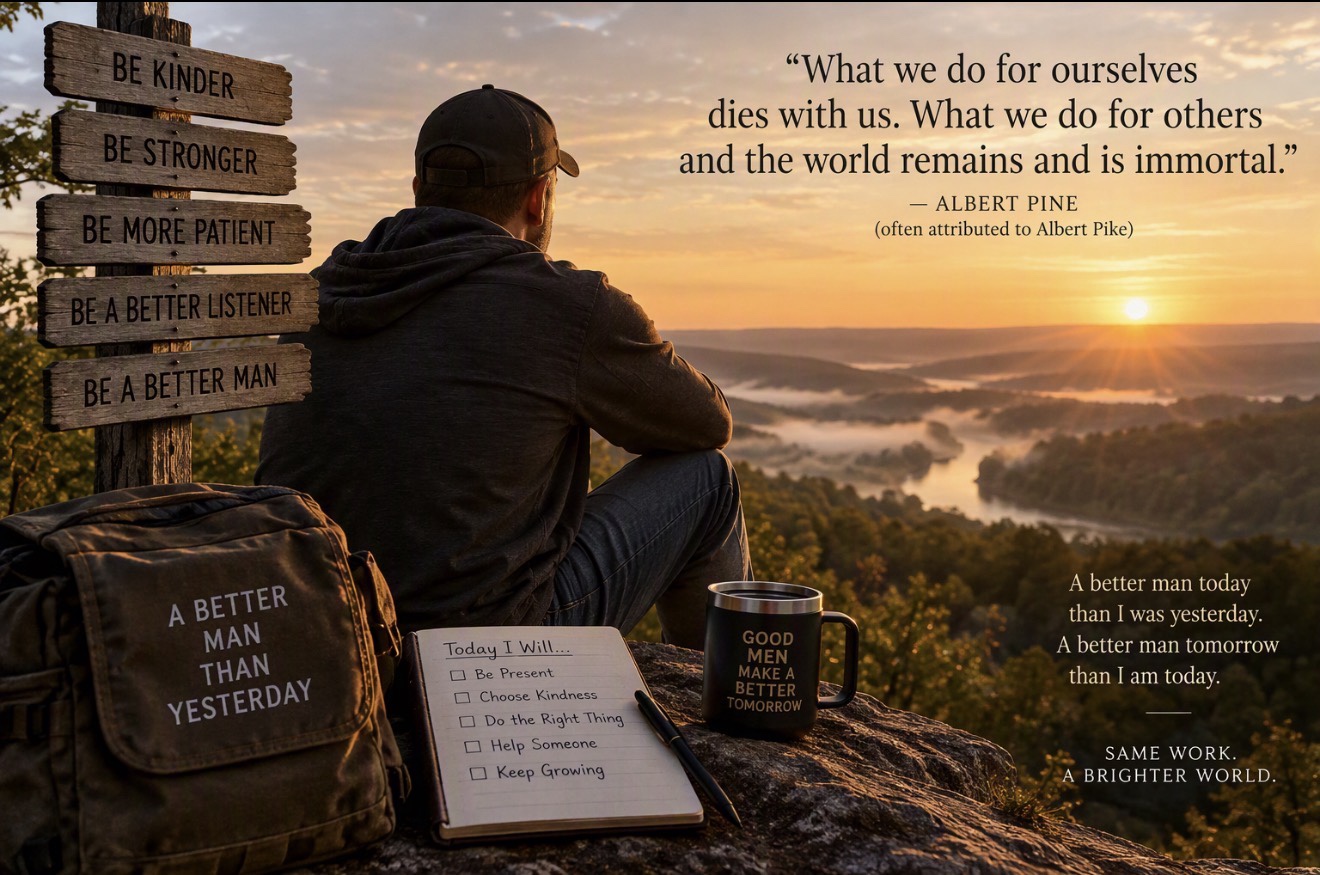
“What we do for ourselves dies with us. What we do for others and the world remains and is immortal.”
— Albert Pine (often attributed to Albert Pike)

As I’ve gotten older, I have found myself thinking more about what kind of man I am and what kind of man I want to become.

Not because I think I have everything figured out.

Actually, it is the opposite.

The more I learn, the more I realize how much I still need to grow.

Every day, I try to be a better man than I was yesterday. And if I’m honest, that can be hard. Some days I do well. Other days I fall short. I lose my patience. I become frustrated. I make mistakes. I say things I wish I could take back.

But then I wake up the next morning and try again.

For me, that is what being a moral man looks like.

It is not being perfect.

It is being committed to growing.

The Man in the Mirror

Every morning, the first person I have to answer to is the man in the mirror.

I can fool other people. I can make excuses. I can blame circumstances.

But deep down, I know when I could have done better.

I know when I should have listened more.

I know when I should have shown more patience.

I know when I should have chosen courage instead of comfort.

The struggle is not with other people nearly as much as it is with myself.

The person I am competing with today is the person I was yesterday.

What Really Matters

As the Executive Director of a growing behavioral health organization, I spend much of my life helping people. I work with individuals who are struggling, families who are hurting, children who need support, and staff members who are trying to make a difference.

The longer I do this work, the more I realize something important.

People will not remember most of our titles.

They will not remember how many meetings we attended.

They will not remember how much money we made.

But they will remember how we treated them.

They will remember whether we showed up when they needed us.

They will remember whether we cared.

That is why Albert Pine’s quote speaks so deeply to me.

Everything I do for myself will eventually be gone.

But the people I help, the encouragement I give, the kindness I show, and the lives I touch may continue long after I am gone.

A Good Man Is Never Finished

One lesson life has taught me is that becoming a good man is never a completed project.

There is always room to improve.

I can become a better father.

A better leader.

A better friend.

A better partner.

A better listener.

A better example.

There is always another lesson to learn and another weakness to overcome.

For many men, that can feel discouraging.

I see it differently.

I believe it is a gift.

If I still have room to grow, then I still have purpose.

The Quiet Things Matter Most

Many people think a legacy is built by doing something famous.

I do not believe that.

I believe most legacies are built in ordinary moments.

A father staying up late to help his child.

A husband keeping his promises.

A friend answering the phone when someone is hurting.

A man doing the right thing when nobody is watching.

These moments may never make headlines.

But they shape lives.

In my work, I have met many people who can clearly remember a teacher, coach, parent, counselor, or mentor who changed their life with a few simple words or actions.

That is the power of doing good for others.

Small acts often leave the biggest footprints.

Why We Keep Trying

The world can be difficult.

There are days when being kind feels harder than being angry.

There are days when honesty costs us something.

There are days when doing the right thing seems unnoticed.

Yet good men keep trying.

We keep trying because character matters.

We keep trying because our children are watching.

We keep trying because the people around us deserve our best.

We keep trying because we know the world becomes a little better every time someone chooses integrity over selfishness.

A moral man does not always succeed.

But he refuses to quit trying.

The Immortal Part of a Man

One day, every one of us will leave this world.

Our jobs will be filled by someone else.

Our belongings will belong to someone else.

Our accomplishments will slowly fade into history.

But something remains.

The love we gave.

The lives we helped.

The wisdom we shared.

The people we encouraged.

The sacrifices we made for others.

That is the immortal part of a man.

Not the things he owned.

The lives he touched.

Conclusion

When I think about Albert Pine’s quote, I am reminded that the goal is not simply to have a successful life.

The goal is to have a meaningful one.

I do not want to be remembered for what I accumulated.

I want to be remembered for what I contributed.

Like many men, I am still a work in progress. I still stumble. I still learn. I still have days when I am not the man I want to be.

But every morning, I get another chance.

Another chance to be a little wiser.

A little kinder.

A little stronger.

A little better than I was yesterday.

And if I can help someone else along the way, then perhaps a small part of my life will continue living in the lives of others.

That is the kind of immortality worth striving for.


“The goal is not to become a perfect man. The goal is to become a better man today than you were yesterday and a better man tomorrow than you are today.”


About the Author

John S. Collier, MSW, LCSW-S is a Licensed Clinical Social Worker Supervisor, Executive Director of Southeast Kentucky Behavioral Health, LLC, and author of The Mind’s Trestle Board. Through his work in behavioral health, leadership, and writing, he explores personal growth, resilience, character development, and the daily pursuit of becoming the person we were created to be.


References

Frankl, V. E. (2006). Man’s Search for Meaning. Beacon Press.

Covey, S. R. (2004). The 7 Habits of Highly Effective People. Free Press.

Aristotle. Nicomachean Ethics.

Pine, A. (attributed). “What we do for ourselves dies with us. What we do for others and the world remains and is immortal.”
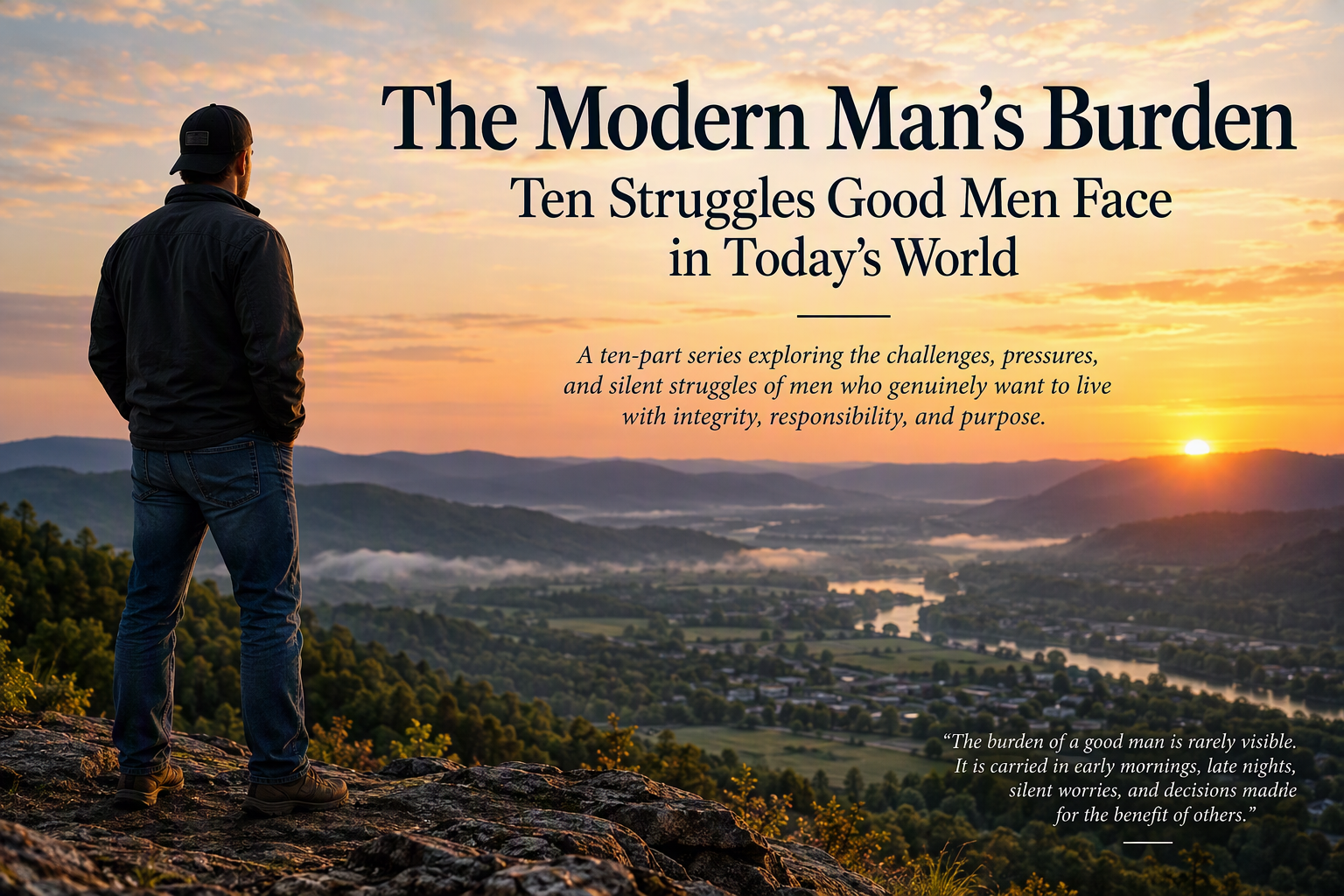

The Modern Man’s Burden

Ten Struggles Good Men Face in Today’s World


“The burden of a good man is rarely visible. It is carried in early mornings, late nights, silent worries, and decisions made for the benefit of others.”

Introduction

Despite what social media, movies, and modern culture often portray, most men are not trying to become rich, famous, powerful, or admired. Most men are simply trying to do right by the people they love.

They are showing up for work. They are paying bills. They are trying to be faithful husbands, present fathers, dependable friends, ethical leaders, and responsible citizens. They are doing their best to keep promises, carry responsibility, and maintain their integrity in a world that often feels increasingly complicated.

Yet many good men find themselves silently struggling.

Not because they lack character.

Not because they lack motivation.

But because the challenges facing men today are often invisible.

The good man frequently carries burdens that others rarely see.

This article serves as the introduction to a ten-part series exploring some of the most common struggles morally grounded men face in today’s society. While every man’s experience is unique, these challenges often appear repeatedly in counseling offices, conversations among friends, and quiet moments of self-reflection.


The Changing Landscape of Manhood

For thousands of years, cultures generally provided men with a clear understanding of what was expected of them. While these expectations were not always healthy or fair, they were often straightforward.

Today, many men find themselves navigating conflicting messages.

They are told to be strong but vulnerable.

Confident but humble.

Providers but fully available.

Leaders but never authoritative.

Emotionally expressive but never overwhelming.

Ambitious but never too ambitious.

The result is often confusion.

Many men genuinely want to do the right thing but struggle to understand what “the right thing” looks like in a rapidly changing world.

Research consistently suggests that men experience significant challenges related to loneliness, mental health, social connection, and identity (American Psychological Association, 2018; U.S. Surgeon General, 2023).

The reality is that many good men are carrying far more than they reveal.


The Ten Struggles We Will Explore

1. The Lonely Burden of Being Strong

Many men feel responsible for carrying the emotional and financial weight of their families. They become everyone’s source of support while often lacking support themselves.


2. The Crisis of Male Friendship

As men age, meaningful friendships often become increasingly difficult to maintain. Many discover that they have people around them but very few people they can truly talk to.


3. Providing in a World Where Enough Is Never Enough

The pressure to earn more, achieve more, and provide more can leave even successful men feeling inadequate.


4. The Good Man’s Struggle With Anger

Anger is often one of the few emotions society permits men to express openly. Beneath that anger are frequently fear, grief, disappointment, shame, and exhaustion.


5. The Temptation of Escapism

When stress becomes overwhelming, many men retreat into work, technology, sports, entertainment, alcohol, or other distractions rather than confronting the pain they carry.


6. Leading a Family Without Losing Yourself

The responsibilities of husbandhood, fatherhood, and leadership can sometimes cause men to lose touch with their own needs, dreams, and identities.


7. The Fear of Failure

Many capable and accomplished men secretly believe they are one mistake away from disappointing those who depend on them.


8. What Society Tells Men Versus What Men Actually Need

Modern culture often gives conflicting messages about masculinity, leaving many men unsure of how to define themselves.


9. Why Good Men Stay in Toxic Situations

Loyalty is an admirable trait, but some men remain in unhealthy relationships, jobs, or circumstances long after they should have established boundaries.


10. The Quiet Search for Purpose

Even after achieving career success, financial stability, or family goals, many men continue searching for deeper meaning and significance.


What This Series Is Not

This series is not about blaming women.

It is not about politics.

It is not about culture wars.

It is not about claiming that men have it harder than anyone else.

Every group faces unique struggles.

Instead, this series seeks to acknowledge an often-overlooked reality: good men face challenges too.

Their struggles deserve compassion, understanding, and attention.

Recognizing those struggles does not diminish anyone else’s suffering. It simply creates room for honest conversations about what many men experience every day.


The Importance of Talking About Men’s Struggles

Many men are taught from an early age that expressing struggle is weakness.

As a result, problems often remain hidden until they become crises.

Depression is ignored.

Burnout is normalized.

Loneliness is dismissed.

Relationships deteriorate.

Purpose fades.

The burden grows heavier.

The strongest men are not necessarily those who carry everything alone. The strongest men are often those who possess the courage to acknowledge their struggles and seek support when necessary.

Authentic strength is not silence.

Authentic strength is honesty.


Conclusion

Behind many good men is a story few people fully understand.

A story of sacrifices made quietly. Responsibilities carried faithfully. Fears hidden carefully. And hopes held tightly despite uncertainty. The modern man’s burden is not weakness.

It is often evidence of love, duty, responsibility, and commitment.

But burdens become lighter when they are understood.

Over the coming weeks, we will take a closer look at each of these ten struggles, exploring not only the challenges themselves but practical paths toward resilience, connection, purpose, and emotional well-being.

Because good men should not have to carry life’s heaviest burdens alone.


About the Author

John S. Collier, MSW, LCSW-S is the Executive Director of Southeast Kentucky Behavioral Health, LLC and author of The Mind’s Trestle Board. As a Licensed Clinical Social Worker Supervisor, he has spent years helping individuals and families navigate mental health challenges, relationships, personal growth, resilience, and the search for meaning. His writing combines psychological insight, practical wisdom, and compassion to help readers better understand themselves and the people around them.

References

American Psychological Association. (2018). Guidelines for Psychological Practice with Boys and Men. American Psychologist, 73(9), 1193-1207.

Murthy, V. H. (2023). Our Epidemic of Loneliness and Isolation. U.S. Surgeon General Advisory. U.S. Department of Health and Human Services.

Pleck, J. H. (1995). The Gender Role Strain Paradigm: An Update. In R. F. Levant & W. S. Pollack (Eds.), A New Psychology of Men. Basic Books.

Real, T. (2022). Us: Getting Past You and Me to Build a More Loving Relationship. Random House.

Seidler, Z. E., Dawes, A. J., Rice, S. M., Oliffe, J. L., & Dhillon, H. M. (2016). The Role of Masculinity in Men’s Help-Seeking for Depression. Clinical Psychology Review, 49, 106-118.


September 11: A Day of Remembrance, Gratitude, and Reflection

By John S. Collier, MSW, LCSW-S

Every generation has moments that become permanently etched into memory. For many Americans, September 11, 2001, is one of those moments. It is a day marked by sorrow, sacrifice, courage, and unity. Twenty-five years later, we still remember where we were, how we felt, and the profound impact that day had on our nation and the world.

On the morning of September 11, 2001, nineteen terrorists hijacked four commercial aircraft. Two planes were flown into the Twin Towers of the World Trade Center in New York City, one struck the Pentagon, and a fourth crashed in Pennsylvania after passengers courageously fought back against the hijackers. Nearly 3,000 people lost their lives in what remains the deadliest foreign attack on American soil. Yet while the events of that day revealed unimaginable evil, they also revealed something else: the remarkable strength of the human spirit.

We remember the firefighters who climbed stairwells while others were descending to safety. We remember the police officers who rushed toward danger. We remember emergency medical personnel, military members, volunteers, and ordinary citizens who placed the lives of strangers above their own. More than 2,000 police officers and nearly 1,000 firefighters responded to the World Trade Center attacks, joining countless others in rescue and recovery efforts. Their actions remind us that heroism is not always found in grand speeches or celebrated victories. Often, it is found in quiet acts of service, in selfless sacrifice, and in the willingness to help another human being despite personal risk.

For me, September 11 carries an additional significance. It is the day my son was born.

Over the years, people have often asked what it was like to welcome a child into the world on a day overshadowed by national tragedy. The answer is difficult to put into words. While television screens showed devastation, uncertainty, and heartbreak, I was also witnessing one of the most meaningful moments of my life. The contrast was profound. A day of collective grief became, for me, a day forever intertwined with the gift of new life.

As my son grew older, each birthday became more than a celebration. It became an opportunity to pause and remember. Before the cake is cut, before gifts are opened, before the laughter begins, there is reflection. Reflection on those who never came home. Reflection on the families whose lives changed forever. Reflection on the heroes whose bravery continues to inspire generations.

The passage of time does not diminish the significance of September 11. If anything, it increases our responsibility to remember. A growing number of Americans were born after the attacks and have no personal memory of the events. The National September 11 Memorial & Museum has emphasized the importance of preserving the stories of loss, courage, compassion, and service for future generations so that the promise to “never forget” remains meaningful. Remembering is not about reliving tragedy. It is about honoring the humanity that emerged in its wake.

It is about remembering the office worker who helped a colleague down dozens of flights of stairs. It is about the passenger who made one final phone call to loved ones before confronting unimaginable danger. It is about the first responder who continued searching for survivors long after hope had faded. It is about the families who found the strength to carry on despite overwhelming loss.

Their stories teach us that courage is contagious. Compassion matters. Service matters. Community matters.

In a world that often feels divided, September 11 reminds us of a time when Americans stood together. Differences that normally separated people seemed insignificant in the face of shared grief and shared purpose. Neighbors helped neighbors. Communities rallied together. Strangers became family.

Those lessons remain relevant today.

As we observe another anniversary of September 11, may we remember the victims with dignity. May we honor the survivors with respect. May we thank the first responders, military personnel, medical professionals, volunteers, and countless others whose sacrifices demonstrated the very best of humanity.

And may we never lose sight of what they showed us: that even in our darkest hours, courage endures, compassion survives, and the human spirit remains stronger than fear.

Today, I remember those who were lost.

Today, I thank those who served.

And today, as I celebrate another year of my son’s life, I am reminded that remembrance and gratitude can exist side by side, honoring the past while appreciating the precious gift of the present.

About the Author

John S. Collier, MSW, LCSW-S is the Executive Director of Southeast Kentucky Behavioral Health (SEKYBH) and a Licensed Clinical Social Worker Supervisor with extensive experience in behavioral health, community services, clinical leadership, and organizational development. Throughout his career, he has been dedicated to strengthening individuals, families, and communities through compassionate care, advocacy, and service.

As a behavioral health professional, John believes that some of life’s most difficult moments often reveal the resilience, courage, and humanity that connect us all. His writing frequently explores themes of hope, remembrance, personal reflection, and the enduring strength of the human spirit.

In this article, John’s reflections on September 11 are both historical and deeply personal. September 11, 2001, is not only a day of national remembrance, but also the day his son was born. This unique intersection of public tragedy and personal joy has shaped his perspective on gratitude, service, sacrifice, and the importance of honoring those whose lives and actions continue to inspire future generations.

When not leading organizational initiatives or advocating for improved behavioral health services across Kentucky, John enjoys writing articles, poetry, and community-focused content that encourages reflection, understanding, and meaningful human connection.


Author Contact

John S. Collier, MSW, LCSW-S
Executive Director
Southeast Kentucky Behavioral Health (SEKYBH)
London, Kentucky

“We honor the past not by dwelling in tragedy, but by remembering the lives, sacrifices, and lessons that continue to guide us forward.” – John S. Collier


References

National Commission on Terrorist Attacks Upon the United States. (2004). The 9/11 Commission Report: Final Report of the National Commission on Terrorist Attacks Upon the United States. U.S. Government Printing Office. National September 11 Memorial & Museum. (2026). September 11, 2001 Historical Exhibition. Retrieved from the National September 11 Memorial & Museum. National September 11 Memorial & Museum. (2026). Marking the 25th Anniversary. Retrieved from the National September 11 Memorial & Museum. National September 11 Memorial & Museum. (2026). Homepage and Educational Resources. Retrieved from the National September 11 Memorial & Museum.