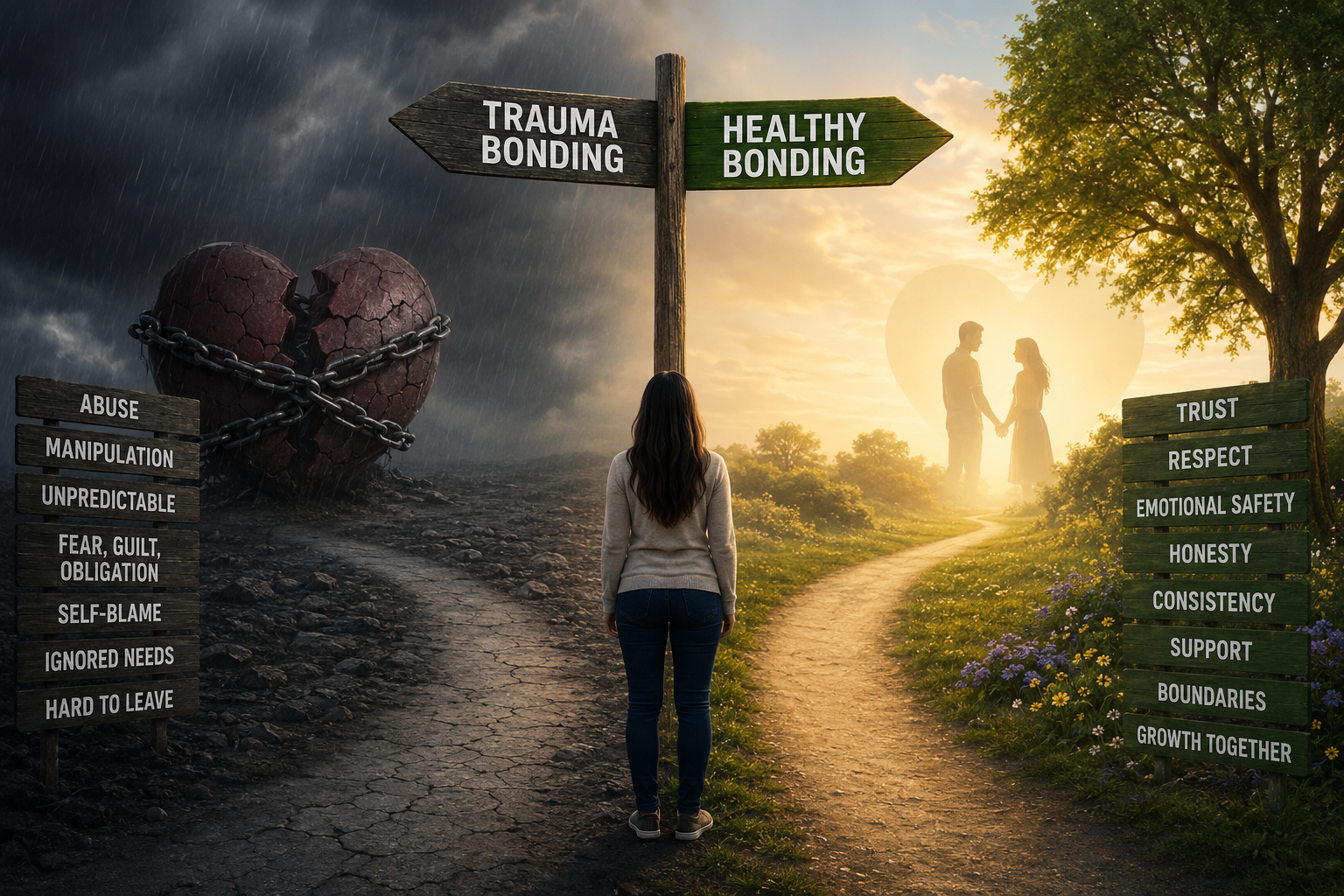
Trauma Bonding vs. Healthy Bonding: Knowing the Difference Can Change Your Life
Understanding the Difference Between Emotional Attachment and Emotional Safety
Human beings are created for connection. Healthy relationships provide safety, encouragement, and belonging. Unfortunately, not every powerful emotional connection is healthy. Some relationships become rooted in cycles of pain, manipulation, and intermittent affection, creating what mental health professionals refer to as a trauma bond. Because these relationships often contain moments of genuine affection mixed with emotional abuse, they can be difficult to recognize and even more difficult to leave.
Understanding the difference between trauma bonding and healthy bonding is not simply an academic exercise—it can be the first step toward emotional freedom, healing, and healthier relationships.
What Is Trauma Bonding?
Trauma bonding is a psychological attachment that develops between a victim and an abusive or controlling individual through repeated cycles of mistreatment followed by periods of kindness, affection, or reconciliation. These unpredictable cycles strengthen emotional dependence, making the relationship increasingly difficult to leave despite the ongoing harm.
Psychologists Dutton and Painter (1981) first described trauma bonding while studying abusive relationships. They found that intermittent reinforcement—alternating fear with affection—creates unusually powerful emotional attachments, much like unpredictable rewards strengthen addictive behaviors.
Trauma bonding is not evidence of deep love. Rather, it is often the result of survival instincts becoming intertwined with emotional attachment.
Characteristics of Trauma Bonding
A Cycle of Abuse and Relief
The relationship repeatedly moves through periods of conflict, emotional pain, apologies, temporary closeness, and then another episode of abuse. The moments of kindness create hope that “things will be different this time,” keeping the cycle alive.
Emotional Highs and Lows
Trauma bonds often feel incredibly intense. The emotional roller coaster can produce excitement, anxiety, relief, and fear in rapid succession. Over time, these emotional extremes become confused with passion or love.
Self-Blame
Individuals trapped in trauma bonds frequently assume responsibility for the problems within the relationship. They may believe:
- “If I were more patient…”
- “If I tried harder…”
- “If I changed…”
Rather than recognizing abusive behavior, they internalize responsibility for another person’s choices.
Fear, Obligation, and Guilt
Many remain in unhealthy relationships because they feel responsible for the other person’s emotions or believe leaving would make them selfish or disloyal.
Fear may include:
- Fear of abandonment
- Fear of retaliation
- Fear of being alone
- Fear that no one else will love them
These emotions become powerful psychological chains.
Needs Become Secondary
In trauma bonds, one person’s emotional needs dominate the relationship while the other’s needs are ignored, minimized, or criticized.
Over time, individuals may lose touch with:
- Their own identity
- Personal goals
- Self-esteem
- Emotional boundaries
Leaving Feels Impossible
One of the defining characteristics of trauma bonding is that leaving often feels emotionally unbearable—even when remaining in the relationship is clearly harmful.
This is not weakness.
It reflects the powerful neurological and psychological effects of chronic stress, attachment, and intermittent reinforcement.

What Is Healthy Bonding?
Healthy bonding develops through consistent experiences of trust, respect, honesty, and emotional safety. Unlike trauma bonding, healthy relationships do not depend upon fear or emotional instability to maintain closeness.
Instead, healthy love provides a secure foundation where both individuals are free to grow.
Healthy bonding encourages emotional security rather than emotional dependency.
Characteristics of Healthy Bonding
Trust
Healthy relationships are built upon reliability and honesty. Each individual feels confident that the other will act with integrity.
Trust grows slowly through consistent actions—not grand promises.
Emotional Stability
Healthy relationships experience disagreements, but they do not rely upon chaos to create closeness.
Partners experience:
- Calm communication
- Predictability
- Emotional consistency
- Psychological safety
Conflict becomes an opportunity for understanding rather than intimidation.
Mutual Respect
Healthy partners recognize one another as equals.
Both individuals:
- Listen respectfully
- Value differing opinions
- Protect one another’s dignity
- Encourage healthy independence
Respect is present even during disagreement.
Open Communication
Healthy bonding allows difficult conversations without fear of punishment.
Individuals feel emotionally safe expressing:
- Needs
- Concerns
- Feelings
- Disappointments
- Boundaries
Communication becomes a bridge rather than a battlefield.
Healthy Boundaries
Healthy love recognizes that two individuals can remain emotionally connected while maintaining separate identities.
Healthy boundaries include:
- Respecting personal time
- Supporting friendships
- Encouraging hobbies
- Protecting emotional well-being
- Accepting the word “no”
Boundaries strengthen relationships rather than weaken them.
Growth and Healing
Healthy relationships inspire people to become better versions of themselves.
Partners celebrate one another’s:
- Successes
- Personal development
- Healing
- Independence
- Spiritual growth
Love becomes a place of restoration instead of exhaustion.
Why Trauma Bonds Feel Like Love
One of the greatest challenges is that trauma bonds often feel incredibly powerful.
The brain releases dopamine during moments of reconciliation after emotional pain, reinforcing attachment despite ongoing harm. Chronic stress also activates survival systems involving cortisol and adrenaline, making emotional separation feel threatening even when it is necessary.
This explains why individuals frequently say:
“I know this relationship isn’t healthy, but I can’t seem to leave.”
The attachment is real.
The relationship, however, may not be healthy.
Breaking Free from Trauma Bonding
Recovery begins with awareness.
Healing often includes:
- Learning to recognize unhealthy relationship patterns.
- Rebuilding healthy personal boundaries.
- Seeking support from trusted friends, family, or mental health professionals.
- Challenging distorted beliefs about self-worth.
- Practicing self-compassion.
- Developing emotionally safe relationships.
Healing rarely happens overnight.
It occurs one healthy decision at a time.
Choosing Healthy Bonding
Healthy relationships are not perfect.
They still involve disagreements, disappointments, and moments of frustration.
The difference is that healthy relationships remain grounded in:
- Trust
- Respect
- Emotional safety
- Accountability
- Honesty
- Compassion
- Consistency
These qualities foster resilience instead of fear.
Conclusion
Trauma bonding and healthy bonding can appear similar on the surface because both involve strong emotional attachment. The difference lies in the foundation upon which that attachment is built.
Trauma bonds are sustained through fear, unpredictability, manipulation, and emotional dependency. Healthy bonds are sustained through trust, respect, consistency, and emotional safety.
Recognizing the difference empowers individuals to make choices that protect their emotional health and foster lasting well-being. While breaking a trauma bond may be one of the most difficult journeys a person undertakes, it is also one of the most courageous. Healing is possible, and healthy relationships are attainable.
You deserve a love that helps you grow—not one that requires you to lose yourself.
About the Author
John S. Collier, MSW, LCSW-S, is a licensed clinical social worker and Executive Director of Southeast Kentucky Behavioral Health, LLC. With over two decades of experience in behavioral health, he writes at the intersection of evidence-based practice, lived experience, and Christian hope. Throughout his career, John has helped individuals and families navigate trauma, anxiety, depression, grief, relationship challenges, and life transitions. His passion is translating complex psychological concepts into practical, compassionate guidance that empowers readers to pursue emotional healing, personal growth, and lasting resilience. Whether writing for clinicians, faith communities, or the general public, John seeks to provide resources that are both scientifically grounded and deeply encouraging.
References
Dutton, D. G., & Painter, S. L. (1981). Traumatic bonding: The development of emotional attachments in battered women and other relationships of intermittent abuse. Victimology, 6(1–4), 139–155.
Freyd, J. J. (1996). Betrayal Trauma: The Logic of Forgetting Childhood Abuse. Harvard University Press.
Gottman, J. M., & Silver, N. (2015). The Seven Principles for Making Marriage Work (Revised ed.). Harmony Books.
Herman, J. L. (2022). Trauma and Recovery: The Aftermath of Violence—From Domestic Abuse to Political Terror (3rd ed.). Basic Books.
Johnson, S. M. (2019). Attachment Theory in Practice: Emotionally Focused Therapy (EFT) with Individuals, Couples, and Families. Guilford Press.
van der Kolk, B. A. (2015). The Body Keeps the Score: Brain, Mind, and Body in the Healing of Trauma. Penguin Books.