
Southeast Kentucky Behavioral Health proudly supports Breast Cancer Awareness Month.



The phrase“I got triggered” has become increasingly common in modern conversations. People use it to describe intense emotional reactions to something another person said, did, or failed to do. While emotional triggers are real and deserve attention, there is an important truth that is often overlooked: your emotional trigger is your responsibility, not someone else’s.

This does not mean other people are always right, kind, or considerate. It does not mean hurtful behavior should be excused. Rather, it means that while external events may activate an emotional response, you remain responsible for how you interpret, manage, and respond to that reaction.
Emotional triggers are often connected to unresolved experiences, personal beliefs, fears, insecurities, past trauma, or deeply held expectations. According to the Cleveland Clinic, emotional triggers are situations, events, thoughts, or interactions that provoke intense emotional reactions that may be disproportionate to the present event because they are connected to past experiences. [health.cle…clinic.org]
A trigger is not proof that someone else caused your emotions. Instead, it is often evidence that something within you requires examination, healing, or growth.
A useful distinction exists between cause and responsibility.
Someone may say something rude. That statement may act as a catalyst for anger. However, the emotional reaction that follows belongs to the individual experiencing it.
Many people spend years blaming family members, coworkers, former partners, friends, or society for their emotional pain. While others may influence our experiences, remaining trapped in blame often prevents healing.
When responsibility is surrendered, personal power is surrendered as well.
Consider these examples:
The external event occurred. However, the intensity of the emotional response often reflects an internal issue that deserves attention.
As psychologist Susan Albers notes, emotional triggers often function as “knee-jerk reactions” connected to prior emotional wounds, pain, or stressful experiences rather than the present situation alone. [health.cle…clinic.org]
Blame can feel empowering in the moment because it removes responsibility from ourselves. Unfortunately, it also removes our ability to create lasting change.
When your happiness depends on other people changing, you remain powerless. When your peace depends on others behaving perfectly, you remain trapped. When your emotional well-being depends upon controlling the behavior of everyone around you, you are fighting a battle you cannot win. Personal accountability allows you to move from:
Self-awareness is a foundational component of emotional intelligence. Research and psychological theory indicate that self-awareness helps individuals recognize emotions, understand behavioral patterns, and make more intentional choices. [positiveps…hology.com], [dictionary.apa.org]
You may be reacting from a trigger when:
Recognizing these signs is not a reason for shame. It is an opportunity for growth.
Strong emotions create urgency. Triggers often convince us that immediate action is necessary.
Instead:
Even a brief pause allows the thinking parts of the brain to engage before impulsive behavior occurs. Naming and observing emotions can strengthen emotional regulation and reduce reactivity. [apa.org], [scienceinsights.org]
Many people only recognize anger.
However, underneath anger may be:
Ask yourself:
“What am I actually feeling right now?”
Awareness creates choice.
Instead of focusing on the other person’s behavior, focus inward.
Questions to consider:
This shift transforms the experience from blame to self-discovery.
The event and the story you tell yourself about the event are not the same thing.
Fact: Someone interrupted you.
Story: They do not respect me.
The emotional reaction usually attaches itself to the story, not merely the event. Challenge assumptions and consider alternative explanations before reacting.
Practice saying:
Avoid statements such as:
Others influence us, but they do not control our responses.
The National Institutes of Health recommends evidence-based wellness practices that help individuals manage emotional stress and build resilience, including mindfulness, physical activity, social support, adequate sleep, gratitude practices, and healthy self-care routines. [nih.gov], [nimh.nih.gov]
Helpful coping strategies include:
| Mindfulness | Learn to observe emotions without immediately reacting. |
| Deep Breathing | Slow breathing helps calm the body’s stress response. |
| Journaling | Writing allows emotions to be processed instead of suppressed. |
| Exercise | Physical activity helps regulate mood and reduce stress. |
| Meditation | Meditation increases emotional awareness and self-control. |
| Therapy | Professional support can help uncover deeper emotional patterns. |
| Social Support | Healthy relationships provide perspective and encouragement. [apa.org], [nih.gov] |
Instead of asking: “Why did they do this to me?”
Ask: “What is this reaction teaching me about myself?”
Every trigger contains information. It may point toward:
Growth begins when curiosity replaces blame.
Accountability is a skill. Each day ask yourself:
Over time these reflections strengthen emotional resilience and self-awareness.
Being triggered is part of the human experience. Everyone encounters situations that evoke strong emotions. The presence of a trigger is not a character flaw, nor is it proof that someone else is responsible for your emotional state. Healing begins when we stop viewing triggers as evidence of other people’s failures and start viewing them as opportunities for self-examination and growth.
You may not be responsible for every experience that shaped you, but you are responsible for how you manage your reactions today. The moment you stop blaming others for your triggers is the moment you begin reclaiming your power. You are not responsible for what happened to you in the past. You are responsible for what you do with it now. Growth occurs when accountability becomes stronger than blame, and self-awareness becomes stronger than reactivity.

American Psychological Association. (n.d.). Emotion-Focused Coping. APA Dictionary of Psychology. Retrieved from APA Dictionary of Psychology. [dictionary.apa.org]
American Psychological Association. (n.d.). Emotions. Retrieved from the American Psychological Association. [apa.org]
American Psychological Association. (2018). Emotional Intelligence. APA Dictionary of Psychology. [dictionary.apa.org]
American Psychological Association. (2024). Healthy Ways to Handle Life’s Stressors. American Psychological Association. [apa.org]
Cleveland Clinic. (2024). Can You Identify Your Emotional Triggers? Cleveland Clinic Health Essentials. [health.cle…clinic.org]
Centers for Disease Control and Prevention. (2024). Managing Difficult Emotions. U.S. Department of Health and Human Services. [cdc.gov]
National Institute of Mental Health. (2025). Caring for Your Mental Health. National Institutes of Health. [nimh.nih.gov]
National Institutes of Health. (2026). Emotional Wellness Toolkit. National Institutes of Health. [nih.gov]
Positive Psychology. (2025). Using Self-Awareness Theory and Skills in Psychology. PositivePsychology.com. [positiveps…hology.com]
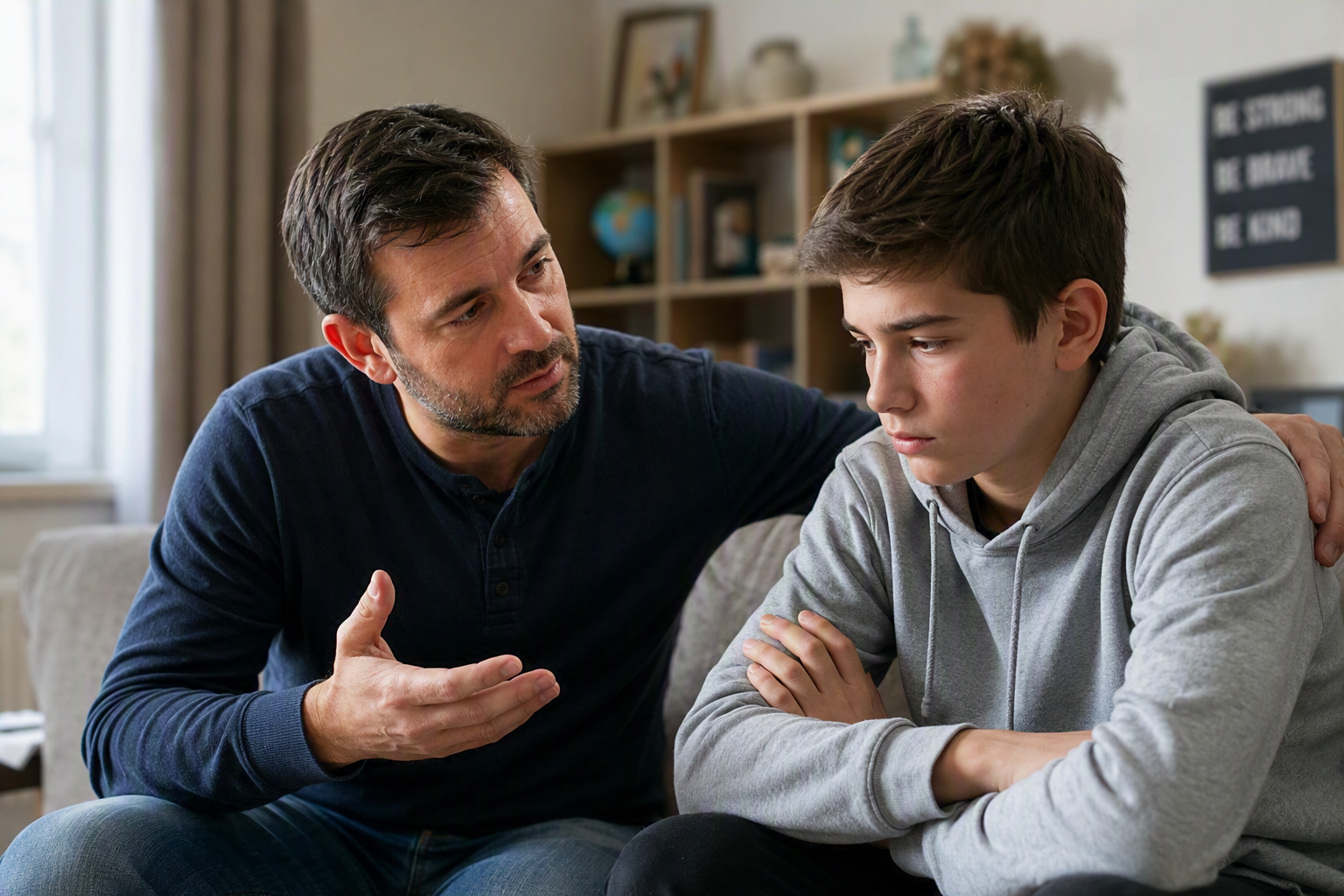
One of the most challenging periods for many families occurs when a boy enters puberty. Parents often describe feeling as though their once cheerful, affectionate child has become easily frustrated, argumentative, explosive, or emotionally distant seemingly overnight. While anger is not an inevitable part of adolescence, increased irritability and emotional intensity are common during the transition from childhood to adolescence. Understanding why this happens can help parents respond effectively and preserve a healthy relationship with their son.
Around age 11 to 13, boys experience significant biological, emotional, and social changes. Testosterone levels increase, physical changes begin to emerge, and the brain undergoes substantial restructuring. During this period, the emotional centers of the brain develop more rapidly than the areas responsible for judgment, impulse control, and emotional regulation (Steinberg, 2014; National Institute of Mental Health, 2023).
As a result, a 12-year-old boy may experience emotions much more intensely than he did as a child while simultaneously lacking the skills needed to manage those emotions effectively. What appears to be defiance or disrespect may actually be emotional overwhelm.
Puberty can also create feelings of confusion and insecurity. Boys may worry about their appearance, athletic abilities, academic performance, friendships, or fitting in socially. Many boys have difficulty expressing vulnerable emotions such as embarrassment, fear, disappointment, sadness, or anxiety. Instead, these emotions are often expressed through irritability or anger (American Academy of Pediatrics, 2024).
Anger is frequently referred to as a “secondary emotion.” This means it often covers more vulnerable feelings underneath.
For example:
Many boys grow up receiving social messages that it is acceptable to show anger but not acceptable to show sadness, fear, or emotional pain. Consequently, anger becomes the emotion they know how to display most readily (Siegel & Bryson, 2014).
When parents focus only on stopping the angry behavior without exploring the feelings underneath, opportunities for connection and growth may be missed.
Normal developmental anger may include:
However, parents should seek professional support if anger is accompanied by:
These signs may indicate underlying mental health concerns requiring assessment and intervention (American Academy of Child & Adolescent Psychiatry, 2024).
One of the most powerful tools a parent possesses is emotional regulation. When parents become angry in response to a child’s anger, the situation often escalates.
Instead of saying:
“Calm down right now!”
Try saying:
“I can see you’re really upset. Let’s talk when you’re ready.”
A calm response helps the adolescent nervous system begin to settle. Children often borrow emotional regulation from the adults around them before they develop it themselves (Siegel & Bryson, 2014).
When a child becomes angry, ask yourself:
Understanding the underlying emotion does not excuse inappropriate behavior, but it does help address the true problem.
Many boys simply lack the language to describe their emotional experiences.
Help them identify feelings such as:
Research demonstrates that helping children name emotions improves emotional regulation and self-awareness (Siegel & Bryson, 2014).
Empathy and accountability should exist together.
Parents can communicate:
“It’s okay to be angry. It’s not okay to yell at people.”
Or:
“It’s okay to feel frustrated. It’s not okay to punch a wall.”
Children need to know that emotions are always acceptable, but certain behaviors are not.
Physical activity has consistently been shown to reduce stress, improve mood regulation, and decrease emotional reactivity among adolescents (Centers for Disease Control and Prevention, 2024).
Encourage activities such as:
Many boys process stress more effectively through movement than through conversation alone.
Sleep deprivation can significantly worsen irritability, impulsivity, and emotional regulation difficulties.
The American Academy of Sleep Medicine recommends that children aged 6 to 12 receive 9 to 12 hours of sleep per night (Paruthi et al., 2016).
Parents can help by:
Many parents become discouraged when their son gives one-word answers.
Don’t give up.
Instead of asking:
“How was school?”
Try:
“What was the best part of your day?”
Or:
“What was the most annoying thing that happened today?”
Questions that invite discussion often receive better responses.
Children learn more from what parents do than from what parents say.
Demonstrate healthy coping strategies:
Your child is constantly learning how to handle big emotions by watching you.
One of the biggest mistakes parents make is assuming that angry behavior means their child no longer needs them. In reality, adolescence is a time of increased independence and increased need for parental support.
A 12-year-old boy may push a parent away verbally while desperately needing reassurance, structure, understanding, and connection.
The goal is not to eliminate anger. Anger is a normal human emotion. The goal is to help children develop the skills necessary to express anger safely, understand its causes, and respond constructively.
With patience, consistency, and support, most boys learn to navigate these difficult years successfully. Parents who remain calm, connected, and emotionally available provide one of the strongest protective factors against future behavioral and emotional difficulties.
If your son is struggling with anger during puberty, remember this: his behavior is communication. Behind the slammed door, the argumentative tone, or the emotional outburst is often a young person trying to make sense of a rapidly changing body, brain, and world.
Meet the emotion before correcting the behavior. Listen before lecturing. Stay connected even when it feels difficult.
The relationship you build during these years can become the foundation that guides your son safely into adulthood.
John S. Collier, MSW, LCSW-S is a Licensed Clinical Social Worker Supervisor and the Executive Director of Southeast Kentucky Behavioral Health, LLC. With extensive experience in behavioral health, trauma-informed care, child and adolescent mental health, family systems, and organizational leadership, Mr. Collier has dedicated his career to helping children, adolescents, adults, and families navigate life’s challenges while building healthier and more resilient communities.
Throughout his clinical career, Mr. Collier has worked with children and adolescents experiencing emotional and behavioral difficulties, including anxiety, depression, trauma-related disorders, attention-deficit/hyperactivity disorder (ADHD), oppositional behaviors, anger management concerns, and family relationship challenges. His approach emphasizes understanding the underlying causes of behavior rather than focusing solely on symptoms, helping families develop practical strategies that strengthen communication, emotional regulation, and healthy relationships.
As a clinical supervisor, educator, and advocate for quality behavioral healthcare, Mr. Collier is committed to translating complex psychological and developmental concepts into practical guidance that parents and caregivers can readily understand and implement. His work reflects a belief that informed, supported, and empowered families play a critical role in promoting positive outcomes for children and adolescents.
In addition to his clinical practice and leadership responsibilities, Mr. Collier is the author of The Mind’s Trestle Board, where he regularly writes about mental health, personal growth, resilience, grief, family relationships, child development, and behavioral health topics. His writing combines evidence-based research with real-world clinical experience to provide readers with meaningful insights and actionable strategies.
Through his work, Mr. Collier continues to advocate for compassionate, person-centered care while helping individuals and families build the skills necessary to thrive through life’s challenges and transitions.
“Every behavior tells a story. When we seek to understand the story behind the behavior, we create opportunities for healing, growth, and connection.”
— John S. Collier, MSW, LCSW-S
American Academy of Child and Adolescent Psychiatry. (2024). Anger and children. Retrieved from https://www.aacap.org
American Academy of Pediatrics. (2024). HealthyChildren.org: Understanding puberty and adolescent development. Retrieved from https://www.healthychildren.org
Centers for Disease Control and Prevention. (2024). Physical activity guidelines for children and adolescents. Retrieved from https://www.cdc.gov
National Institute of Mental Health. (2023). The teen brain: Still under construction. Retrieved from https://www.nimh.nih.gov
Paruthi, S., Brooks, L. J., D’Ambrosio, C., Hall, W. A., Kotagal, S., Lloyd, R. M., … Wise, M. S. (2016). Recommended amount of sleep for pediatric populations: A consensus statement of the American Academy of Sleep Medicine. Journal of Clinical Sleep Medicine, 12(6), 785-786.
Siegel, D. J., & Bryson, T. P. (2014). No-drama discipline: The whole-brain way to calm the chaos and nurture your child’s developing mind. New York, NY: Bantam Books.
Steinberg, L. (2014). Age of opportunity: Lessons from the new science of adolescence. Boston, MA: Houghton Mifflin Harcourt.
Few experiences are as emotionally painful as wanting someone who does not return your feelings. Whether it is the end of a long-term relationship, an unrequited crush, or someone who gradually pulls away, the desire to continue pursuing a person who has clearly communicated disinterest is surprisingly common. Many people find themselves asking, “If I love them enough, why won’t they love me back?” or “Maybe if I just try a little harder, they’ll change their mind.”
The truth is that continuing to chase someone who has chosen not to pursue a relationship often prolongs emotional suffering rather than healing it. Modern psychology suggests that this behavior is rarely about love alone. Instead, it frequently reflects attachment patterns, unmet emotional needs, cognitive biases, and challenges with self-esteem.
Understanding why people chase unavailable partners can help individuals recognize unhealthy patterns, heal from rejection, and develop healthier relationships built on mutual respect and reciprocal affection.
Human beings are wired for connection. According to Baumeister and Leary’s Belongingness Theory, people possess a fundamental motivation to establish and maintain meaningful interpersonal relationships. Social acceptance contributes significantly to emotional well-being, while rejection activates many of the same neurological pathways involved in physical pain.
Research using functional magnetic resonance imaging (fMRI) has demonstrated that social rejection activates the anterior cingulate cortex—the same brain region involved in processing physical pain (Eisenberger, Lieberman, & Williams, 2003). This explains why rejection can literally “hurt.”
Because rejection feels painful, many individuals instinctively attempt to restore the relationship, believing that regaining the person’s affection will relieve the emotional discomfort.
One of the greatest psychological traps is believing that persistence eventually leads to love.
Popular movies, romance novels, and cultural myths often portray relentless pursuit as romantic. The hero refuses to give up, fights for the relationship, and ultimately wins the person’s heart.
Real life rarely follows this script.
Healthy relationships require mutual desire, not persuasion.
When one individual repeatedly communicates disinterest—either verbally or through consistent behavior—continued pursuit usually creates increasing emotional distance rather than intimacy.
Healthy love cannot be negotiated.
John Bowlby’s Attachment Theory provides one of the strongest explanations for why some individuals struggle to let go.
People with anxious attachment styles often fear abandonment and become highly sensitive to signs of rejection. Rather than accepting distance, they frequently intensify efforts to restore closeness.
These behaviors may include:
Ironically, these behaviors often overwhelm the other person, reinforcing withdrawal and creating what psychologists call the anxious-avoidant cycle.
Meanwhile, individuals with secure attachment generally recognize rejection as painful but temporary. They mourn the loss while maintaining confidence that healthier relationships remain possible.
Sometimes the person being pursued is not actually the central issue.
Instead, rejection becomes interpreted as evidence of personal inadequacy.
Common internal beliefs include:
This transforms the pursuit into an attempt to repair damaged self-esteem rather than build a genuine relationship.
Research consistently demonstrates that individuals with lower self-esteem experience greater emotional distress following romantic rejection and may engage in more persistent attempts to restore the relationship (Murray, Holmes, & Collins, 2006).
One surprising reason people continue chasing unavailable partners involves dopamine.
Contrary to popular belief, dopamine is not merely the brain’s “pleasure chemical.”
Instead, dopamine is heavily involved in anticipation, motivation, and reward prediction.
Intermittent reinforcement—occasional texts, mixed signals, brief moments of affection—creates one of the strongest behavioral conditioning schedules known in psychology.
This principle was originally demonstrated by B. F. Skinner’s work on variable-ratio reinforcement.
Just as gambling becomes addictive because rewards are unpredictable, uncertain romantic attention can become psychologically compelling.
The occasional positive interaction creates hope that “this time things will be different.”
Economists describe the sunk cost fallacy as continuing to invest in something simply because significant resources have already been invested.
Relationships are no exception.
Individuals often think:
Past investment does not increase future probability of success.
Healthy decisions should be based upon present reality rather than previous emotional investments.
People frequently confuse obsession with love.
Love seeks the good of both people.
Obsession seeks relief from one’s own emotional discomfort.
Love respects boundaries.
Obsession ignores boundaries.
Love accepts another person’s freedom.
Obsession attempts to overcome resistance.
One of the clearest indicators of mature love is the willingness to respect another person’s autonomous decision—even when that decision causes pain.
When someone becomes emotionally unavailable, many individuals unconsciously idealize them.
Their strengths become exaggerated.
Their flaws become minimized.
Their absence increases perceived value.
Psychologists refer to this as scarcity bias.
The less available something becomes, the more desirable it appears.
Ironically, people often chase an imagined version of the person rather than the individual who actually exists.
Accepting rejection does not mean accepting personal worthlessness.
It simply means recognizing that compatibility requires two willing participants.
Healthy love cannot exist without:
When only one individual is carrying the relationship, the relationship no longer exists—it has become unilateral pursuit.
Self-respect means recognizing when to stop investing emotional energy where it is no longer welcomed.
Walking away is often misunderstood as weakness or surrender.
In reality, it frequently reflects emotional maturity.
Letting go acknowledges several important truths:
Healing begins when energy shifts away from changing another person and toward growing oneself.
Research consistently identifies several characteristics associated with satisfying long-term relationships:
Healthy love is rarely characterized by relentless pursuit.
Instead, it develops through mutual willingness to know, value, and support one another.
The question is not simply, “Why would you chase someone who doesn’t want you?”
A more meaningful question is:
“What inside of me believes I must earn the love that should be freely given?”
Often, chasing reflects unresolved fears of abandonment, low self-esteem, anxious attachment, or hope that persistence will overcome rejection. Yet genuine love is never created through pressure or persuasion.
The healthiest relationships arise when two individuals freely choose one another each day. While rejection is painful, it is also clarifying. It reveals where emotional energy should no longer be invested and creates space for relationships founded on mutual respect, authentic affection, and shared commitment.
Ultimately, self-worth should never depend upon another person’s willingness to stay. The moment you stop chasing someone who has chosen to walk away, you begin walking toward a healthier version of yourself.
Here is the revised About the Author section with your preferred credentials included.
John S. Collier, MSW, LCSW-S, is a licensed clinical social worker, behavioral health leader, educator, and author with more than two decades of experience helping individuals, couples, families, and communities navigate life’s emotional, relational, and spiritual challenges. Throughout his career, he has worked extensively with individuals experiencing anxiety, depression, obsessive-compulsive disorder (OCD), trauma, grief, relationship difficulties, and behavioral concerns across the lifespan.
Drawing upon years of clinical practice, leadership in community behavioral health, and a deep commitment to lifelong learning, John is passionate about translating evidence-based knowledge into practical guidance that readers can apply to everyday life. His writing blends sound research, clinical insight, compassionate understanding, and practical application, making complex topics accessible to professionals, students, and readers seeking meaningful personal growth.
In addition to his clinical work, John has served in executive and leadership roles within community behavioral health, helping develop programs that expand access to quality behavioral health services, strengthen families, and promote resilience throughout underserved communities. His commitment to education extends beyond clinical practice through the development of books and resources that encourage emotional wellness, healthy relationships, effective parenting, leadership, Christian living, Freemasonry, and lifelong personal growth.
John is a prolific author whose works span behavioral health, Christian devotionals, Freemasonry, leadership, parenting, relationships, personal development, and poetry. Whether writing scholarly works, practical guides, devotional literature, or reflective poetry, he strives to combine professional knowledge with compassion, wisdom, and hope. His writing is grounded in the belief that knowledge should not merely inform—it should inspire transformation and equip readers with practical tools for everyday life.
John believes that lasting change begins with self-awareness, is strengthened through intentional choices, and flourishes in relationships characterized by integrity, respect, grace, and genuine human connection. Through every book he writes, his mission is to encourage readers to discover hope in adversity, strength in struggle, and purpose in every season of life, empowering them to build healthier relationships, stronger communities, and more meaningful lives.
Baumeister, R. F., & Leary, M. R. (1995). The need to belong: Desire for interpersonal attachments as a fundamental human motivation. Psychological Bulletin, 117(3), 497–529. https://doi.org/10.1037/0033-2909.117.3.497
Bowlby, J. (1988). A Secure Base: Parent-Child Attachment and Healthy Human Development. Basic Books.
Eisenberger, N. I., Lieberman, M. D., & Williams, K. D. (2003). Does rejection hurt? An fMRI study of social exclusion. Science, 302(5643), 290–292. https://doi.org/10.1126/science.1089134
Murray, S. L., Holmes, J. G., & Collins, N. L. (2006). Optimizing assurance: The risk regulation system in relationships. Psychological Bulletin, 132(5), 641–666. https://doi.org/10.1037/0033-2909.132.5.641
Skinner, B. F. (1953). Science and Human Behavior. Macmillan.
Aron, A., Fisher, H., Mashek, D. J., Strong, G., Li, H., & Brown, L. L. (2005). Reward, motivation, and emotion systems associated with early-stage intense romantic love. Journal of Neurophysiology, 94(1), 327–337. https://doi.org/10.1152/jn.00838.2004
American Psychological Association. (2023). APA Dictionary of Psychology. https://dictionary.apa.org
Leary, M. R. (2015). Emotional Responses to Interpersonal Rejection. Oxford University Press.